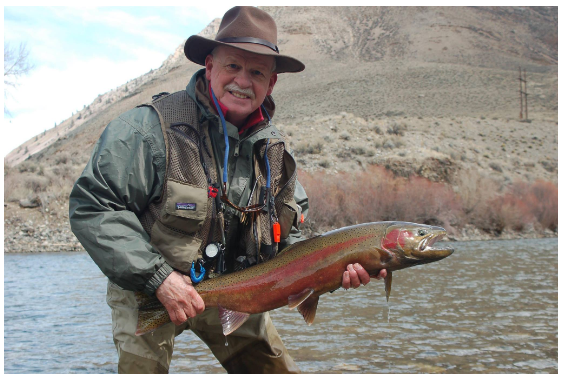
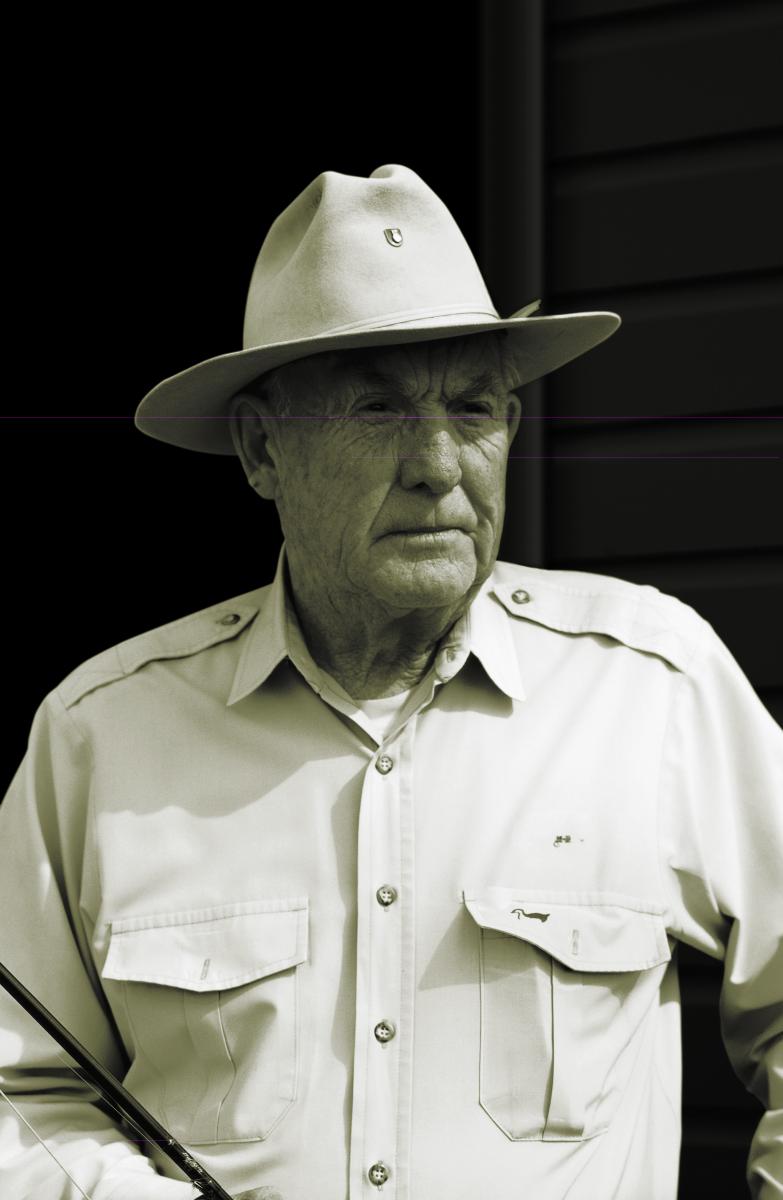
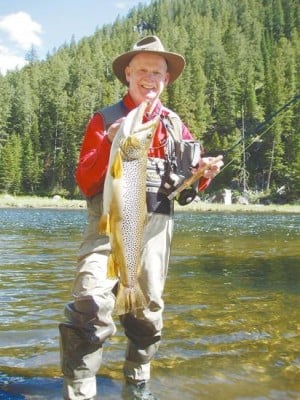
The great Bob Jacklyn is here to take us into West Yellowstone and his classic experiences in the area.
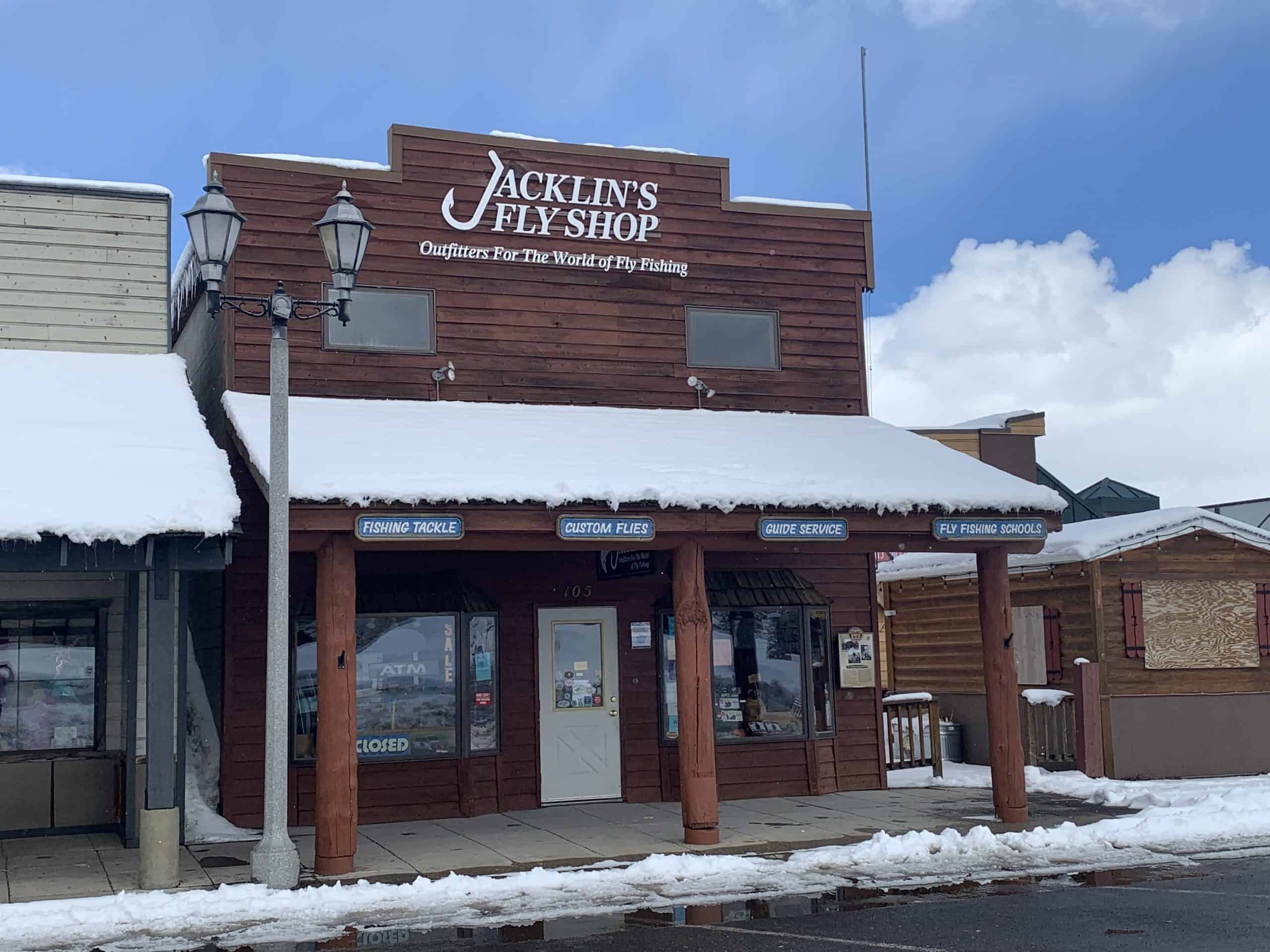
03:10 – Bob opened his fly shop in April 1974.
03:55 – The Firehole River is Bob’s go-to river and the Madison in the park.
04:45 – Bob just retired from guiding last year after 53 years of guiding and outfitting.
06:50 – Bob started guiding in 1969 and Bud Lilly offered him a job. They eventually became competitors but remained very good friends.
13:00 – He noted Jim Danskin who was a great angler and also feature in their book.
15:25 – Bob tells us about the fly fishing school they taught.
23:00 – Bob has kept only 6 fish in his whole life.
31:30 – Tip for new guides: Use a long leader and a long tippet.
33:10 – The best time to fish the Firehole River on the first couple weeks of June up until the first couple weeks of July.
41:10 – Sage Rods used to be called Winslow Rods. Bob also tells us about the history of Fenwick Rods, which was one of his first rods, and how it’s related to Sage Rods.
44:20 – We hear about the story of how Jim Green patented the Feralite ferrule.
54:00 – Bob was a musician and was raised in a musically inclined family. He used to be a drummer when he was in the army. He also had dyslexia but did not find out until later.
Episode Transcript
Dave (2s):
Today on Yellowstone Tetons Travel podcast,
Bob (6s):
They got several rafts. One raft got turned upside down and they lost all the rods. Everything broke. So as Jim told me the story himself, so what he did is he started sitting on the bank, he was an engineer, and he was started putting rods together without a feral, putting one rod over the other rod. And he designed the feral life feral. He went back to work the following week and they designed the first rod with a feral life feral. And it stopped. Changed the whole section, the whole course of Rod building forever.
Dave (40s):
Bob Jacklin on the creation of the modern Day Fly Rod Ferrell. We are traveling to West Yellowstone and one of the classic fly shops in the country today on Traveled. Welcome to Traveled where it’s all about the journey we are all on in fly fishing and in life. This is our chance to take a deep dive into a specific area around the country so you have a better feel for the people, the resources and community that make this part of the country so unique. Before we jump into it with Bob Jacqueline today, I wanted to share a little love with our travel sponsor. This podcast is powered by Swing Outdoors and the Wetly Swing podcast. You can head over to wetly swing.com/teton, T E T O N. And if you get a chance, you can check in with any of the hotels, lodges, fly shops, any of the businesses and brands that are at that website.
Dave (1m 27s):
And you support this podcast by checking out Yellowstone Teton. This week, Bob Jacqueline is here to share the stories from many years of fishing and guiding and teaching in the West Yellowstone area. We hear about how his wall of hats came to be. We discover the Firehouse River and we hear this story about this Madison River epic 10 pound fish that was caught on video and this thing went viral. It’s a pretty good story, tons of good stuff from Bob. He’s a guy we’ve been trying to get on for a long time, so it’s time to experience the road less travel. Let’s jump into this one with one of the most classic fly shops and the man behind it. Here we go.
Dave (2m 7s):
Bob. Jacqueline, How you doing, Bob?
Bob (2m 11s):
We’re doing well. It’s good morning.
Dave (2m 13s):
Yeah, thanks for, thanks for making some time this morning to come on the show and chat about your history. You have a long, long history. You’re very well-known. I’ve heard a lot about you. I’ve actually had a, a number of people that you’ve mentored over the years that have either been through your shop, worked for you, and, and now they’re out doing their whole thing. How does that feel for you when you see all these people, these kids that, you know, they literally were little kids when they first started and now they’re running their own fly fishing businesses. What, how’s that feel for you?
Bob (2m 41s):
I feel real good. I hired ’em as young boys and several, quite a few of them, not just one or two and worked with ’em. And in some cases I had a place for ’em to stay, which is tough to find in West Yellowstone. But the newer shop, I had a, a place for about three of them, them upstairs in a apartment. So it worked out real good for a lot of years.
Dave (3m 4s):
Yeah. How was that now? It’s been, I think it was the early seventies, right? Was it 74 when you opened the shop?
Bob (3m 11s):
I opened in in April, 1974. Yes.
Dave (3m 14s):
Yeah, April, 1974. This is always probably the, the the obvious question, but since then, I mean, has there been a lot of changes in West Yellowstone?
Bob (3m 22s):
Oh yeah. Especially the last 10 years. We’re getting a lot more people. And the problem is with fishing a lot of the times is finding a place to park.
Dave (3m 31s):
Right.
Bob (3m 31s):
It used to be finding a good spot to fish. You could get there, but nowadays, the last, the last three years has been so crowded. It’s tough to, you still get some good fishing, but you gotta find a place to park all, in other words, all the good fishing areas and tourist areas are pretty well filled up.
Dave (3m 50s):
That’s right. That’s right. And what are your, what are the main rivers that you fish? If you had to say, what’s the first river, if you’re going out on your own to fish that you’re hitting
Bob (3m 57s):
The first river we, I usually fish is the fire hole river and the Madison in the park. But the fire hole is the top river in the park. As far as early it’s Clearwater, no, normally clear, I don’t know about this year, but Clearwater right up until mid-June. It starts about the 10th of June fishing. Well,
Dave (4m 17s):
Okay. And so the fire hole That’s right. And that’s the one that’s really interesting because it literally has hot springs. Right. And, and throughout the stream
Bob (4m 25s):
You can catch a fish right next to a hot spring, wherever water’s hot, 10 feet away, it’s cold.
Dave (4m 31s):
Right, right. Yeah. That is cool. So you spent most of your time, I mean obviously you’re at the gates, you’re in West Yellowstone right there, but you’re, you fish mostly in the park. Is that kind of where you’ve done your guiding and teaching?
Bob (4m 44s):
No, we got on the Madison River for many years and float the river. We’ve got right now, I have to be honest with you though, I retired from guiding, I have 53 years of guiding, 53 years of outfitting and guiding. And I just decided this year would be my last, this was last year was my last year of guiding. I’m forgetting to be up in age. I’m 78 years old and I’m wearing out a little bit.
Dave (5m 10s):
I hear you. I hear you. My dad was a guy for many years and, and I remember when he told me, I asked him one day about going fishing and he said, you know what? I, I, you know, basically, I mean we all, we all get older, right. And he was basically saying, Hey, I don’t get out as much, so I’m not doing the jumping in and outta the boats. Right. All that stuff.
Bob (5m 27s):
I gave up the boat. We have guys that work for us right up till last year and do a good job floating the river. But, and the last few years I’m doing pretty much wade trips and teaching people flight, flight cast in theory and, and how to handle a river by waiting.
Dave (5m 43s):
Right, right, right. Yeah. And I wanna talk about fly casting, cause I know that’s something you’ve been an expert on for many years. But before we get into that, talk about like the shop itself. So you have, you’re still, you have, you still have a program, you have guides at your shop. There are still, if somebody wanted to a trip, they can go to you.
Bob (5m 59s):
Not this year. I’m, I’m retired from guiding, I’m not doing any outfitting this year, but Mark Johnson has been with me and I think he’s working with Big Sky Anglers Okay. This year. And Rob Orsini is working with Blue Ribbon Flies this year, I think. So both of my guys are found some other good folks to work
Dave (6m 21s):
With. That’s amazing. Yeah. Now we know the guys like Big Sky. We’ve definitely had them on the podcast and it seems like all the names around that area, you know, your shop, you know, like Bud Lilly, right. That was you, you, that was one of your mentors, all these big names. Why is it that there’s so many shops that seem like they’re all, everybody knows ’em around the country. Why do you think that is in that area?
Bob (6m 41s):
Well, this is probably the finest general, generally the finest fly fishing for trout, any place in the country, right here in West Yellowstone. That’s why I settled here. When I got outta the Army in 19, I started guiding in 1969, but Lilly offered me a job and I started guiding for Bud. We became, we were competitors for a while, but we became very, very close friends. I was with him and wrote him a letter of thank you for getting me started in this or helping me get started. And he was like one of my big competitors, but a good friend. And I was with him the night before he died. Oh,
Dave (7m 17s):
Wow. So Bud Lil Yeah. And he was, and that’s obviously another huge name out there who I think is in the spot where the big Sky anglers. Right. They they kind of
Bob (7m 26s):
Same spot.
Dave (7m 27s):
Yeah. Yeah. Same spot. So, so talk about that a little bit. I I wanna dig more into obviously what you have going in your history, but like Bud Lil what, what, because I, you know, obviously we haven’t had him on the show. Talk about him a little bit. How was, you know, what made him so important or unique in that area?
Bob (7m 43s):
What made him so good as well as Bud Lilly and Pat Barnes goes back even before Bud, but Bud started his business around 1951 and he just entered it without being involved right out of the Navy. He was after the Second World War and he got into the fishing business. There was a shop for sale in West Yellowstone, which is, they didn’t want a lot of money. And Bud was newly married and just took a chance on it. And he was able to, to rent a location at Eagles store, Eagles tackle store and all. Bud worked the fishing department at that store and changed the name to Bud Lilly’s Trout shop.
Bob (8m 27s):
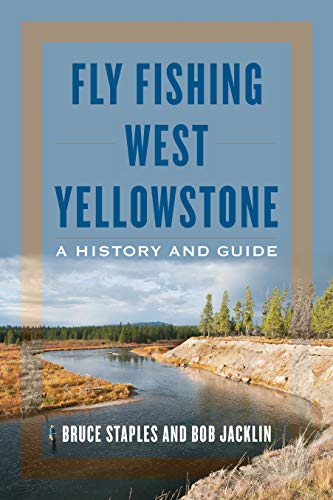
It used to be called Trout Shop. And I wrote about that. I finished a book with Bruce Staples. We just, it was published last spring. It’s called The Fly Fishing History of West Yellowstone. The whole, the thing is there I, everything about it where it started from a lot about Bud Lilly, who he knew real well. He helped us a lot. So it was good putting all this stuff together.
Dave (8m 52s):
That’s amazing. So there’s a book that, is that book out there now or is it coming out soon?
Bob (8m 57s):
No, it’s out right now.
Dave (8m 58s):
Oh, good, good. We’ll put a link in the show notes so people can pick that up. And that is, that’s a great, so anything we leave out here today, we’ll, we’ll make sure to pick up that book as well.
Bob (9m 7s):
Yeah. Fly pitching West Yellowstone is called Fly Fishing West Yellowstone, A History and Guide.
Dave (9m 14s):
Amazing Fly Fishing West Yellowstone. Yeah. We’ll also put a link to that episode we had with Bruce Staples. We’ve actually had him on twice now. He did a primer recently of the, of the expo out there. But, so this is awesome. So tell me about this, Bob. I want to go back a little bit to, you know, your background. Let, let’s take it back to the, the start a little bit. Talk about how you first got into fly fishing. When did that come to be?
Bob (9m 36s):
I grew up in Elizabeth, New Jersey and I could take a bus to, up to, to Springfield, New Jersey, another bus over had I took buses as a kid or I hitchhiked a lot too later on. But I fished all through New Jersey and I’ve been interested in trail fishing since I was really about 13 years old. I fished a little bit earlier than that, but I was really interested in trout fishing and with that was with made and salmon, eggs and all that. But I also graduated right away to fly fishing. There was so much involved in it to learn. And I did. I just spent a whole lifetime learning.
Dave (10m 15s):
Yeah, you did. And how did you make it out? So New Jersey as a kid, and then when do you, so I guess, yeah, you go into the army, like you said, that got you outta New Jersey. And then how did you, how’d you end up, why West Yellowstone?
Bob (10m 27s):
I went to West Yellowstone cause I didn’t know anything about West Yellowstone in those days. I didn’t get involved in, in, there were, there wasn’t a lot of information you could get on one town like West Yellowstone, but Yellowstone Park, I did know people who fished there years ago, like Herb Howard who invented the flight tie thread. Herb Howard, Ray Bergman, some of the old, old timers talked about it and I was able to catch on. So I made a promise to myself. I went in the army and I, my promise was I would save my money when I get outta the Army. I would buy a car and drive to Yellowstone. Yellowstone was the key. That’s where I came. I fished Yellowstone for about four days before Someone told me, a guy I met was fishing with, he said, there’s a town just 14 miles away, cold beer, dancing girls.
Bob (11m 17s):
I said, when do we leave?
Dave (11m 19s):
There
Bob (11m 20s):
You go. So that’s how I found West Yellowstone and Bud Lilly. I did have a Jimmy, Darren, one of the well-known fly fishermen in the forties and fifties. He told me I was still in my army uniform. I went into his shop in New York City and he said, if you go out west, look up a name of Pat Barnes. So I wrote on a piece of paper, pat Barnes, big Brown Trout. I carried that all the way across the country and lo and behold, and I got to West Yellowstone a couple days after fishing in the park, went into West Yellowstone. There was a sign, pat Barnes. And that’s how I got familiar with Pat. And then I eventually bought him out.
Bob (12m 0s):
So that’s how I my own for about nine years. And then I saved my money and I bought Pat Barnes out. He wanted to retire. It was in his mid seventies.
Dave (12m 12s):
Right, right, right. So yeah, pat Bar. So how were Pat Barnes and Bud Lilly? Were they more similar or more different in their styles?
Bob (12m 19s):
They were, well it’s hard just to, just to come up with something real quick. But Bud was more of a businessman. Pat Barnes was more of a guide. They both were guides and good guides than fishermen, but goes way back into the thirties. He taught school in West Yellowstone as a young man in the thirties and guided for Dan Bailey and some of the old Don Martinez. Pat Barnes knew real well. So he knew a lot of these people way before Buddy Van knew them.
Dave (12m 49s):
Right, right, right, right. So, okay, so you got Pat Barnes and then who are we, who are we missing here from the history? Just some of the other names. Have we talked about most of the names, the big names people would be thinking about here?
Bob (12m 59s):
Well, Jim Danskin ran a shop Danskins tackle store and I wrote about him in my book. We got pictures of all these people and stories about him in this book, fly Fishing West Yellowstone, A history and guide.
Dave (13m 13s):
Perfect.
Bob (13m 14s):
And so I’m Real world Bruce Staples and I, Bruce did all the main writing there. I put a lot of information in the book with Bruce and all. But he did, he was quite writer and he did all the hard writing.
Dave (13m 26s):
How’d that look? So Bruce is a, a little bit younger than you. Did you, did he kind of interview you or did you guys just sit down and talk? How did that book come to be?
Bob (13m 35s):
We talked together several times. I worked with him with this East Idaho fly fishing fair. And Bruce and I became good friends. He’s about five years older than I am.
Dave (13m 46s):
Oh, is he’s older. Okay.
Bob (13m 48s):
Yeah. And he did that for a living. He worked at the I N E L L out there in the desert, in the nuclear test and stuff. And his job was to go out there and write. And I said, how did you get to be a good writer? He says, they hired me to write and, and I wrote whatever they told me.
Dave (14m 4s):
Oh wow. Yeah. So he, he’s experienced. That’s awesome. He’s
Bob (14m 9s):
Just that easy. He told him what to write and he wrote it.
Dave (14m 11s):
Right, right, right. Gotcha. Okay.
Bob (14m 13s):
So he became a good writer. A real good,
Dave (14m 16s):
Yeah. Yeah. No, I know that book is well known, that book. And he’s wrote, written some other stuff I think as well,
Bob (14m 21s):
He’s written several other books on flies. Yes.
Dave (14m 24s):
Yeah. Yeah. Cool. Well let’s hear about the shop a little more. Cause we had a number of guests that have been on that have talked about the shop. One of ’em was one of those kids that was there. What, what was that shop like? Take us back. Has the shop changed much between back when you opened in 74 and today?
Bob (14m 40s):
A little. Yeah. And today is, is different. But back in 74 was selling some flies and a few rods. I also was employed. I taught Bud Lilly’s fly fly fishing school along with Bud and Bud’s son, Greg Lilly and Charlie Brooks. So we worked together in there and after several years with Bud Lilly, I got offered a job with the Fenwick Corporation in West Yellowstone. And they opened this, built the schoolhouse in West Yellowstone about eight miles out out of town. And I worked for them for 10 years teaching fly casting.
Dave (15m 16s):
Oh wow.
Bob (15m 16s):
But I ran my store, ran my store at the same time.
Dave (15m 20s):
Gotcha. So what would that look, so fly, so the Fenwick, so people would come in and it, it was essentially just a fly casting school? Or was it like everything?
Bob (15m 28s):
It was a fly fishing school. Not just casting, but we put a lot of effort into casting. We had people, it was pretty much a five day program. Three days we’re in the classroom on the casting ponds, teaching casting. And then two days we’re usually spent on the river with lunch and all that. We were bringing as many as 21 people a week would be about an average for us, the Fenwick School. And I worked for 10 years with them teaching casting, once Yellowstone Park opened the Yellowstone River on the 15th of July, every year it used to open, we would bring the whole class there on Wednesday. So they had three days or Thursday rather.
Bob (16m 8s):
They had three days of, of instruction and then two days fishing on the river with guides. Most of the guides were casting instructors like myself.
Dave (16m 19s):
Gotcha. So people were getting their, their casting dow in. And then what were the techniques you guys would be in that school? Would you cover kind of everything? Dries, nmp streamers, like all, everything
Bob (16m 29s):
We, I covered a myself or you shared things. I covered reading the water and pretty much the Wetly. And Charlie Brooks sometimes helped us out with some of the nim fishing stuff like that. We had a few different people show up. Frank and Gladys Gray ran the school and they were tournament casters from California, from the Los Angeles area. They belonged to the casting clubs back there. And on a Sunday they’d go to church and have a breakfast out and spend all afternoon fly casting or tournament casting, other kind of casting, spinning and fake casting. And it was a big clubs back there.
Bob (17m 9s):
We’d compete on casting and just fun. And we, I learned a lot of my technique from the California casters itself. There’s a bunch of really good casters down there in the Long Beach area.
Dave (17m 23s):
Oh right, okay. So that’s where you learned. And then you eventually, like the federation, the fly fishing or what is it called now? Federation of Fly Fishers. Right. Was the group, you, you were there early on.
Bob (17m 34s):
International Federation of Fly Fishers. They changed it to international. Cause we have a lot of our members now who live all over the world.
Dave (17m 44s):
Yeah. So that was something you were certified early on, right. With fff,
Bob (17m 48s):
I was certified. I was one of the first, I was the first six people to pass the test that took the certification test for, for the fly casting structures.
Dave (17m 60s):
Wow. And what year was that?
Bob (18m 2s):
That was around, boy, I’m trying to think now. Let’s say 1982.
Dave (18m 7s):
Okay. Yeah, 82. Perfect. Wow. So that’s it. So you’re there early on whenever that exact year was not important, but, and then who were some of the early other people that were getting their certification? Early on with F fff?
Bob (18m 20s):
John Galewski, who’s one of my guides for years and a close friend, he got certified the same time. There was about eight of us took the test and six of us passed. It was about eight hour tests and seven of the other people from Ranon, from Barbara and Alan Roar from the fly casting club in California. One of the main instructors. They helped certify Doug Swer, helped certify some of us. Purchased a whole list of names. People that were good about that. Bruce, the name Bruce Richards from Bozeman area is retired now. But he worked for Scientific Anglers all his life once he got outta college.
Bob (19m 2s):
And he’s one of the finest casting instructors going Bruce Richards. So he was involved in that. So a lot of us, like me were involved right from the beginning with this casting.
Dave (19m 14s):
Yeah. That’s amazing. Well, tell me about this. I wanna hear this story because I’ve, I was online and I actually saw the Drake magazine had a post, a blog post about this. But you had this, this 10 pound Madison River fish caught on an indicator. I watched the video and it was pretty amazing cuz I was expecting, you know, like just some fish and you pull out this like over 10 pound brown trout. Talk about that. What, what was, why was the camera rolling there and then how, how did you find a fish like, and have you ever found anything that big before?
Bob (19m 42s):
I was doing a little casting program on the correct way to Nim Fish and for an outfit out of Colorado. And right now I can’t put the name on it, but Terry Wickstrom is the name I think. Anyway, we did that and I, it went down between the lakes. The wind was blowing so hard. We went to the Madison in the morning, no wind and nobody was there just above, just thank you. Just just above, just below he and dam. So we went there, went there and that was really good area. So I put an indicator on and we had two cameras, one on the hill and one right next to me in the water.
Bob (20m 25s):
I didn’t know that big fish was there. I had no idea. But after a half hour of fishing, I caught nothing. And it seemed to me I needed to catch something to bend the rod for this movie we’re making, we were making a movie on the correct way to nim Fish for trout. And I haven’t caught a damn thing. Most guys would move, but it was, the wind was so bad it was in a prime spot. So we stated, so I put another fly on, I put a little green ca rock worm calyon plus I had a march Brown nim, which I really expected maybe to catch a fish on. And I, I was casting on camera as you saw.
Bob (21m 6s):
And all of a sudden that indicator stopped and I struck, I was into something really big. I knew it was really big. I’ve caught big fish before. But this, this seemed to be really big and I just stuck with ’em. I thought it took about 15 minutes to land them. That’s what I tell you, according to the camera people. It took eight minutes and the fish was actually 30 inches long and weighed 10 plus pounds a little bit over 10. And I kept the fish. I did take some ridicule and some history and people fit never to use my store again cuz I kept the fish. But I’ve been a taxidermist and studied it for 40 years.
Dave (21m 45s):
Oh wow.
Bob (21m 46s):
And I do all my amounts myself and I refurbished several amounts for Yellowstone Park, stuff like that. So I wanted to mount on myself. Kelly Gallop do had a new way. He was a taxidermist too or his, and he, he had a new way of doing the head, the head of fish you can’t preserve very well. And usually they go bad or dry out. Add a way of doing it in plastic, making a plastic mold to the fish. The way you gotta do is attach the plastic head to the body of the fish when you mount it, and then you can paint it and do all the work. And he, Kelly came in the store and looked at that and he says, there’s one thing I knew I was gonna catch you on.
Bob (22m 28s):
He said, me, I didn’t catch you. He said, where are you attached the head to? The main body of the fish. I can always tell where somebody did it with you. I can’t tell.
Dave (22m 38s):
Oh wow. There you go.
Bob (22m 39s):
So like, he was, so I got his approval. He helped me do the head in plastic, the mouth inside outside. He did the whole head in liquid plastic and let it put it in there, here on top, down the bottom and made a plastic head with the jaw and everything.
Dave (22m 57s):
Oh wow. Yeah. That’s
Bob (22m 58s):
Cool. So it’s all done. I’ve got the fish hanging in my store and I did take some ridicule, but I’ve kept about six fish in my whole life. So I, I felt I, I deserved to be an A taxi. I wasn’t gonna waste it. I used everything. I even took the head when I cut it off and sent it to fish and game in Bozeman and they said the best they could figure out the fish was 11 years old.
Dave (23m 22s):
Oh, 11 years old. Wow. Damn.
Bob (23m 24s):
So we even used the head for a little information there. So everything went well. And the people that were mad at me, I guess they’re still mad or not, whatever.
Dave (23m 33s):
Well I think anybody that would be still mad at you now would be probably a crazy person. It seems like. You know what I mean? Like, you’re, you’re, you’re over however many years you’ve met Phish in, you know, six fish doesn’t sound like that’s too many fish to take
Bob (23m 46s):
In my report to them. That said something like that is that a good biologist would’ve taken that fish outta circulation anyway.
Dave (23m 54s):
Right, right, right, right. How many fish like that, you know? So that fish is over 10 pounds. How many fish like that in the, you know, ma Madison and Roy? Anywhere in West Yellowstone? Would you, have you seen over the years?
Bob (24m 4s):
Over the years, I’ve seen a fair amount of five and seven pounds. And I heard about one close to 10 pounds years ago in he lake near West Yellowstone. We’ve got several reports of fish that are about 15 pounds. One of ’em I mounted for Fish and Game and it’s hanging in the office in Bozeman, Montana with my name under it. I was mounting it, I didn’t catch it, but it was a 15 pound fish that was Gil netted and harvested by fishing game in Hebgen Lake.
Dave (24m 34s):
Amazing, amazing. Well, I’m gonna swing by, we’ll send some people that way to take a look at that fish, the 15 pounder as well. So your fish, if they come into your shop, they can see that 10 pounder on the wall.
Bob (24m 44s):
Oh yeah. It’s there.
Dave (24m 45s):
Yeah. What else is on the wall when you look around? I, my dad had a shop, a little tiny shop back in the, I remember he had all sorts of cool old stuff like Creoles and just old hats and stuff. I mean, what, when you look around your shop, describe a little bit like what it looks like for somebody who hasn’t been there.
Bob (24m 59s):
Well, we have every species of trout mounted that I mounted them all and hung ’em up there. Different sizes. So Brooke Brown, rainbow, even, even a couple of cutthroats or hybrid fish from Yellowstone Lake areas. Those, there’s, I got those. And then I have a wall of fame of hats. I have a book to go with it. So all the famous fishermen that I knew once they passed on or they were just ready leaving town, oh, I would get their hat. And I have a book to go along with. It’s a book of hats and you can write a history. A lot of it’s oh bits, but the history of different people and the picture of their hat.
Bob (25m 41s):
And I have the hat. It’s, that’s amazing. In my store. The problem is I got, now I’m getting older and putting a, getting ready to put my place up for sale. I don’t know what to do with all the hats and everything else I have.
Dave (25m 55s):
Right, right, right. Well I think they should go in some sort of a fly fishing, you know, somewhere museum. Right. They, we can’t lose these hats.
Bob (26m 2s):
They have a good museum right across the streets from my store, Yellowstone Museum. And I have a fly fishing section in there, but we’d like to expand that, make it even more. But we have some rods and reels and Oh, perfect. Fines and different things that people had.
Dave (26m 18s):
Yeah, yeah, yeah. Well I think we can get that taken care. We’ll get some, maybe get some people to, to pony up some money and expand that thing. We’ll, we’ll get those hats in there and well talk about that with your, your shop. So, and, and again, I know this because it’s like, you know, it’s hard to leave anything, right? You’ve done something your whole life. Do you look at that where you’re kind of thinking, if you were to say, Hey, I’m, I’m just gonna retire, I’m gonna sell this thing, would you be okay with that? Is that something you’re thinking about or are you kind of thinking, no, I’m gonna stay here till, you know, till the end?
Bob (26m 44s):
I’ve been thinking about it for a while, but we’re getting closer to maybe doing something. You never know. But I we’re, my wife and I are saying, how we gonna get rid of all this stuff? Somebody doesn’t wanna buy everything. I even got a bunch of deer heads. I was a deer hunter for a lot of years and I mounted all my own deer heads, so I got some of them to give away or sell or something. So I got a lot of stuff to get rid of once I, once we decide to maybe sell a store or the, or the area, you know, the actual building and property itself, it’s a small, small building, but it’s, it is done a good job for me over the years.
Dave (27m 24s):
Sure, sure. Yeah, yeah. Well I can’t wait to get in there and check this out. It sounds like you got some pretty well in the history, like the hat. So do you have one like, like Bud Lilly, does he have a hat up there?
Bob (27m 33s):
Yes, I got two of buds, you know, one of ’em, he actually took off his head and handed it to me.
Dave (27m 38s):
Oh wow. What, what kind of hat did Bud Lily wear?
Bob (27m 41s):
He had a couple of ’em, A straw had cowboy hat and he had a more expensive hat, you know, like a Stetson or something with a, with a pet federation pin on it. He always wore, he wore the hat every day in the store. Once I got going in my store, most of the guys in myself started wearing baseball caps. So we started, stopped using the fly fishermen. But on the river I still wear a fly fishing hat or Stetson style. But normally for teaching and stuff we wear a baseball cap with a logo on it.
Dave (28m 19s):
Today’s episode is sponsored by Eastern Idaho’s Yellowstone Teton territory. Idaho’s most renowned zone for fly fishing. From the Henry’s Fork to the South fork of the snake and all the high alpine lakes and streams in between Yellowstone Teton territory provides anglers and other outdoor enthusiasts with all the information they need to plan their next big trip. You can visit wetly swing.com/teton right now to get the full list of outfitters lodges, fly shops and all kinds of inspiration to get you started on your next trip to Eastern Idaho. That’s Teton, T e t o n Wetly swing.com/teton.
Dave (28m 60s):
So back to that fish, that 10 pound fish grew to 10 pounds and these bigger fish. Is that, how is that happening? Is that because they’re heading to the lake and growing or they like, do you know kind of the history of that fish? You caught that 10 pounder.
Bob (29m 12s):
I know pretty much we know it. We’re pretty sure it came from, from Quake Lake and Quake Lake has a fair amount of eight and 10 pound fish. Nobody catches many of ’em, but they’re there. They’ll come up and spawn and like all, all fisheries that are spawning, some of those fish will hold over. This big brown I got was in June. That fish should been back in Quake Lake, but he wasn’t, he was right up into Madison because he was 10 pounds. There’s lots of small fish in the Madison, there’s planet E. He came up the following year before to spawn or maybe several times and just found a nice spot. He was the only fish in that area.
Bob (29m 52s):
That’s why I didn’t catch anything. I took fish in the same spot and neither was no fish there. He was the only one. Finally he took my fly.
Dave (30m 1s):
Yeah. And the fly was a green ro. Rock worm. You had a, had an indicator, right? So you’re nipt fishing?
Bob (30m 6s):
I was nt fishing, I was trying to demonstrate the correct method of nip fishing and I think I pulled it off with a 10 pound fish.
Dave (30m 14s):
Wow. So you’re fishing so nipping, so have over the years, did you and your classes in your shop, do you kind of teach everything or do you guys tend to like try to, when the dry flies are out, that’s the focus?
Bob (30m 24s):
Well there’s a heavy focus on the dry flies. People wanna see the fish take the fly. But we we’re very happy to fish NIMS down on Madison. Now on the flow trips, a lot of guys are using indicators and NIMS and where we get a lot of whitefish in his share trout too. So that’s one way to get a beginner, fairly easy way to cast out menu line and follow the indicator down. That indicator does two things, tells you when you get a strike naturally. But more than that it tells you whether you’re floating the fly correctly or not. If you’re dragging the indicator you’re driving the fly. But if you can keep the indicator going exactly the speed of the water, the fly’s gonna be down near the bottom and then it’s gonna be moving exactly the way the trout want it.
Dave (31m 13s):
Exactly, exactly. What would be another, that’s a great tip on the indicator stuff. What, what would be, you know, if somebody was like for a guide, you know there’s a lot of guides and folks that listen to this as well. What would be a tip for them? Like a new guide that’s coming in, he’s maybe not super experienced. What, what do you tell your new guides?
Bob (31m 30s):
Long leader and long tip it, I like a nine foot liter and I put about an 18 inch butt section on the liter and then about a 24 inch tipt. The tip is usually starts out around four x, something like that. But five x is the most common, especially fire hole river and Madison in the park. Five x for sure. We don’t have to go to six X very often, but once in a while in mid-summer, Trian Trico we may want to go to six x, but we pretty much, I stay with five X as best I can. And that way key casting is everything. Joan Wolf made a great comment about casting one time.
Bob (32m 10s):
She says, if you don’t know what you’re doing in the fly fishing world on the river, she said, at least if you can cast, you’re in the game. If you can’t cast, you’re never in the game. That’s
Dave (32m 20s):
A great point. And
Bob (32m 21s):
I guided and fish with Joan and Lee Wolf quite a bit many years ago and they were, he’s still a good friend of mine. John Wolf and Lee passed on many years ago now.
Dave (32m 31s):
That’s right, that’s right. So you knew Lee as well.
Bob (32m 34s):
I would fish with ’em Lee and John. Oh yeah, Lee and I were good friends.
Dave (32m 37s):
Right. What, what was Lee’s? He, he probably wore a bunch of different hats. Does he have a cap up in your shop?
Bob (32m 42s):
He has a cap in my shop, but Lee didn’t wear a lot of hats most of the time he had that white hair and he just fished with no cap at all.
Dave (32m 50s):
Oh he did, right.
Bob (32m 51s):
Yeah, I, he did fish with a hat today. I fished one of the days I fished with him and we do have that hat hanging up.
Dave (32m 58s):
Oh you do? Oh wow. This is cool. Good deal. All right, so, so that’s it. So you, and you mentioned the fire hole at the start. So that’s a river I haven’t fished. I would love to hit. Sounds like there’s more pressure now, like everything, right? You have more people but when is a good time to hit the fire hole? Like throughout the year?
Bob (33m 13s):
The fire hole is gonna be the first couple weeks in June or maybe first right up to the first couple weeks in July.
Dave (33m 21s):
Okay. And that’s it. And then what happens after July?
Bob (33m 24s):
It’s after July. Things get a little too warm on the fire hole and it’s not fishing as well. The, the good news about the fire hole, it’s loaded with fish. Most of ’em are small so there’s not much as far as a big fish. I did hear of a couple 18 inch fish this year. Guys I know fished a fire hole and got a couple 18 inches but not much bigger than that. Years ago they caught a few bigger fish. I don’t know what happened to them, but the biomass of fish went in the numbers on the fire hole and slowly brown trout but some rainbows. But it’s absolutely of, of fish. So if you wanna have a good day or evening fishing, you go up to the fire hole, put a little dry fly on little pale morning done as a good all around fire.
Bob (34m 9s):
Small, like size 16 ca and fish that ripple water. And you do really well. The reason you don’t do well in mid-July. In August on the fire hole, as those fish move out of the river, move up to some tributaries to get some colder water, the water gets too warm for trout and they move now about some, sometime around the 10th of September those fish move back in the river. So most of the guides fish the fire hole in the month of June and then again in late September, October.
Dave (34m 40s):
October. And then does it fish throughout the, what happens when the, the weather starts getting cold there? Does it, can you still fish it?
Bob (34m 46s):
The worst the weather gets, the better it fishes. Some of the best fishing I ever had on the fire hole is in the middle of a snowstorm. Snow coming down, the fish rising all over the place.
Dave (34m 57s):
Right, right. You said the 16 number size 16 ca What was your go-to Catalyst dry to use?
Bob (35m 5s):
Just a regular he care catalyst. We all tie a little different one, but just standard. Yep.
Dave (35m 10s):
With a, with a, did you have a all different body colors or did you have a specific one you loved?
Bob (35m 15s):
I liked the tan, I liked the he l care wing tan l care wing and tan body.
Dave (35m 21s):
Wow, this is cool. So the fire hole, that’s definitely one we’re gonna have to hit. Did you guys cut? You must have just fished everything were there. What were some of the other big rivers you really enjoyed? You know, when you were guiding?
Bob (35m 31s):
I fished the Henry’s Fork and I had a guide license for that river in the early days of my store. But then I got to the point where it was worth worth some dollars and I was in tight with, with money and stuff. So I sold my Henry Fork license and stopped guiding down there. But I fished down there quite a bit, quite a few years. Early on when I was a young guy, I could guide down there, I had a license and then later on I could just fish myself. But it was Henry for one of the top rivers of my area dad. The Upper Madison, the Gallatin gets fished really hard and it floated with fish. The upper reaches have some brown, but most of us cutthroat and some rainbow.
Bob (36m 15s):
But the Gallatins good all the way. It gets fished almost every day of the year. Even Christmas, if you drive to Boon, you can find at least one person fishing to Gallatin.
Dave (36m 28s):
That’s right. So you got the Gallatin YaaS. Yeah. You goes and you, how far from your shop to drive over to the Henry’s fork, say up to Trout Hunter? How far would that be? How
Bob (36m 36s):
Long? 20 minutes.
Dave (36m 38s):
Oh that’s it. It’s only 20 minutes away.
Bob (36m 40s):
Yeah.
Dave (36m 40s):
Okay. Yeah, I always forget about that. You’re you’re right there. Yeah. So that’s, these are all, all these huge streams are right next door.
Bob (36m 46s):
Yeah, we’re all right together. And a lot of good years ago things were a little tougher with, with competitors and stuff, but right now it seems like everybody’s getting along real well.
Dave (36m 56s):
Yeah, that’s right. Tell me about this. So I wanted to hear a little bit about, just a little bit on West Yellowstone. We’re gonna dig a little bit back into the fishing here if we have time, but especially the casting. But what’s the West Yellowstone? So you have, you know, that town, I’ve been through it, it’s been a little while, but what makes it unique? I mean obviously it’s a, the tourist thing going on, but what is, is there something special about West Yellowstone itself?
Bob (37m 18s):
One of the things that made it unique years ago we had dirt streets. Oh wow. And holes all over the place. And when it rained you could cast the fly line out in the middle of the street. It was wet.
Dave (37m 30s):
Wow.
Bob (37m 30s):
But the other thing about West is a great thing is we’re in the best area for trout fishing, no matter what direction you can go. Oh. He had to go about from one mile to about 10 miles you in every river we want and 20 miles including the Henry’s Fork. So it’s all right here in West Yellowstone. And we have, like we say, fork about four the best shops going around.
Dave (37m 54s):
Right. That’s what it is. It, it literally, it comes down, you got all the tourists coming through for the park and everything, but at the end of the day you guys have some of the best fishing in the country. Like some of the biggest names, biggest shops, biggest rivers, that’s it.
Bob (38m 7s):
Sure. The Madison is just less than a mile away. You could walk there from here across country or take your car downstream and down about three miles out of town, the river crosses the highway and every fish coming outta he lake in Nepal come right up that area right across the highway. So there’s gets fished heavy, but people do catch them. A lot of nice fish. I’d say not a lot of real big ones, but let’s say an 18 inch fish, you guys can get good fish. We can get an 18 inch for the day for sure. Wow. And some smaller fish.
Dave (38m 41s):
And some smaller fish. And, and Kelly Gallup, we mentioned him earlier. Do you know him pretty well?
Bob (38m 46s):
I, I got to know him once he opened his store. We got to be friendly. Yes.
Dave (38m 50s):
Yeah. Yeah. What’s the, we’ve had him on a couple times. He’s always at entertaining, you know, guest to have on what’s, what do you, you know, what, what do you think about when you hear Kelly go, what, what’s, describe him, look for somebody who doesn’t know him.
Bob (39m 3s):
He runs a nice shop down there, right down below the dam. He lake. He’s got some good guides work for him. And he’s built a shop tour where he is got some good fly time material, some good flies. And he is got a good place that you can stop and get a fishing license and get something to drink and you know, soda pop and ice cream and stuff. And he’s got all that. So he’s got that sliding in area. And that’s been around for a long time.
Dave (39m 28s):
That’s right. That’s right. And he does his own, I think he does his own schools right out there as well. Does does he have, I wanna say he has kind of as they’re lodging and all that too at his place,
Bob (39m 37s):
He has some lodging. Just what he has, I’m not sure, but I know I saw have been to a couple of his cabins. So he does have some rooms in cabins like, like two rooms or three to a cabin. Yeah,
Dave (39m 49s):
That’s right. That’s right. Well I wanna hear on some of the casting cuz you’re a casting expert, you’ve been doing this your whole life. What are some, you know, when somebody comes to you and maybe they’re, you know, maybe it’s windy out they struggle or just they struggle with casting in general. What, where do you start with somebody to give ’em some tips?
Bob (40m 5s):
Well, I have something I wrote on casting, which is pretty simple, but I always start with the roll cast. So I teach the roll cast that gives them the fundamental that the line always follows a tip of the rod and you bring the rod forward and increase in speed and then make a sudden dead stop and the stop the rod stops, but the line continues to roll and it’ll unroll in front of you. So the roll cast is the most important. And then we teach the pick up and lay down and then we teach the false cast pass that we teach fishing casts and your right turn, left turn and a lot of reach cast you reach to the right, reach to the left.
Bob (40m 44s):
There’s a lot to it to learn for a second. But to start out, the Fenwick school is where I learned much most of my teaching ability over the years, many years. And we go with pretty much the roll cast pick up and lay down. And the false cast.
Dave (41m 1s):
And the false cast. And, and as far as Rods, the Fenwick, I remember, I mean back in the day, right, they were a large company. I mean has, as far as the rods you guys sell in your shop now, what, what sort of rods are you carrying in there
Bob (41m 15s):
Lately? Lately I’ve been carrying the St. Croix rods and some lower price Shakespeare and stuff. There’s a lot of people wanna fly fish but don’t really wanna spend too much money. So I provide that with a, a decent casting rod and something at around a hundred, $150 rather than four or five or $600. But they’re all good nowadays. It’s hard to find a bad rod. Even coming from China, there’s good rods. There’s some good casting rods out there. So that’s good. I sell Sage. I was the first person ever. I was first shop whoever had a sage rod in the store. I was the one.
Bob (41m 55s):
But then at the Fenwick school and Sage came outta Fenwick. So when they were gonna build their own rod, they talked to me and I was gave them an order and I got the first one myself and one guy from Seattle, we both claimed we’re the first ones ever have a sage rod in the store. They weren’t even called Sage then. They were called Winslow.
Dave (42m 16s):
Oh they were Winslow, that’s what it was. Sage. Okay.
Bob (42m 19s):
Winston but Winslow. Yeah,
Dave (42m 21s):
Winslow.
Bob (42m 22s):
The reason they had to stop the name is they were in the town of Winslow. Sage was made in an old, in old Fenwick. The man who Don Green, who actually started Sage, he actually, his father actually built the building where all the fen rods were made on Bainbridge Island off Seattle. And then when, when Sage got so big, they bought that factory back from Don Green’s father or Don Green evidently. And they, they’ve used it for Fenwick per sage. Now the Fenwick rods is still sold, but they’re sold through a import corporation.
Bob (43m 3s):
So they’re not sold by Fenwick anymore, but they’re still available that, that was the finest rod you could buy in 1967 or so. Fenwick rod and, and the price of the rod was $37 and 50 cents.
Dave (43m 18s):
And was that a glass rod or a graphite?
Bob (43m 20s):
That was a glass rod, brown glass. I always catered Bud Lilly right up till he died about selling me my first fendler rod. He sold us to me for $37 and 50 cents. Didn’t even gimme a discount. So he used to laugh. We used to laugh about that quite a bit.
Dave (43m 37s):
Right. So you bought $37 at 50 cents for your first glass Fenwick.
Bob (43m 42s):
That was my finest, that was my best rod today. It had a serial number on it. It was a seven and a half foot Fenwick glass rod, two piece rod. It was And and Jim. And Jim Green helped design the feral, the design of the whole rod. He built that rod with a design for the rod. What he did is he went on a fishing trip in the fifties on the south fork of the Salmon River in Idaho. And they got several rafts. One raft got in the turned upside down and they lost all the rods. Everything broke. So as Jim told me this story himself, so what he did is he started sitting on the bank, he was an engineer and he was started putting rods together without a feral putting one rod over the other rod.
Bob (44m 29s):
And he designed the feral life feral. He went back to work the following week and they designed the first rod with a feral light feral. And it stopped, changed the whole sections, the whole course of rod building forever.
Dave (44m 43s):
Wow. Wow. So that was the original, that’s how the Ferrell, well not the Ferrell, they had ferrells before but this was a special type of Ferrell.
Bob (44m 50s):
It’s a glass feral, one piece fits over the other.
Dave (44m 53s):
Oh right. Yeah. Before then it was metal. Like the bamboo? Yeah, it was just metal.
Bob (44m 57s):
It was metal. So with one piece fitting over the other, that becomes the, that becomes the strongest part of the rod and not the weakest part.
Dave (45m 6s):
Dang, that’s so cool. So that’s how literally the, the present day
Bob (45m 10s):
Ferrell just done, he was actually taking the number of rods. Probably some of ’em were spinning, some were fly. I know, but he probably stuck one bottom section to a different rod over the top. Maybe he had a cutter a little bit off the broken rod and he fitted in one piece over the other and that became a alite feral designed by Don Green and Jim Green, excuse me. And for the Fenwick Corporation. Yeah, Don Green. Jim Green, they’re not related but they had the same last name and both, both involved with Rod Company Sage and you know they, and that’s how they come up with, they had to change the name from Windsor to Sage.
Bob (45m 53s):
I dunno where they got sage from, but it’s a good name.
Dave (45m 55s):
Yeah.
Bob (45m 57s):
So I had several original rods in my store that said Winslow on them. They didn’t say Sage. That was before they used the name Sage.
Dave (46m 6s):
Right, right, right,
Bob (46m 8s):
Right. Somehow they couldn’t use the name Winslow. Cause that’s the town of Winslow is where, where they
Dave (46m 13s):
Were at Winslow, Washington. Was that Winslow Washington?
Bob (46m 16s):
Yeah, Winslow Washington on Bainbridge Island.
Dave (46m 19s):
Oh, on Bainbridge. Yeah. Which is where they still are I think. Wow. And Jim, you knew Jim Green pretty well.
Bob (46m 24s):
Oh yes.
Dave (46m 25s):
Is Jim still alive?
Bob (46m 27s):
No, Jim’s gone now 1930s casting a distance tournament. Nobody could believe that he did that and he, I forget what the distance was but with the rod he made and he won the tournament. He was the tournament castor one of the top guys,
Dave (46m 43s):
He was one of the guys. So, wow, this is great. And and so Jim gr and that that rod, that 37 and 50 rod, the Fenwick, do you still have that rod? Did you, do you have a lot of your older rods still?
Bob (46m 54s):
I have everything. I’ve never given anything away except the rods that I give away. My original rods, I still have it. I got it marked in the case. $37 and 50 cents.
Dave (47m 6s):
There you go. So you still got it. So you still got the rod. Why was it, why was it a seven and a half foot rod and not say a eight or nine foot rod?
Bob (47m 13s):
I could’ve picked an eight or eight and a half. Eight and a half was the most popular back in those days. But I still lived in New Jersey and that seven and a half foot seem to do just what I want for out here. It was okay. And in New Jersey I used it where I used it more before I moved out here as a young fisherman. So I used it there. But my preference on fishing rods is eight and a half foot. Even today with the nice sage rods we have on St. Croix, all the rods out there, I prefer eight and a half for a 5, 5, 6 line. And I said I use all my own fishing for personally that eight and half foot, but seven and a half still a nice rod for small streams and stuff.
Dave (47m 57s):
Yep. So the eight and a half gives you over the nine, it’s just a, what gives you a little more in the tighter quarters? Is that kinda mainly why it’s a little better?
Bob (48m 4s):
The thing I, the reason I like the eight and a half in over the nine, there’s not much difference. So you could argue on it a little bit, but there’s not much difference. But the eight and a half is faster line speed than the nine because eight and a half, six inches shorter, you can go from stop to stop quicker than you can with the nine foot. Cause it takes that much longer. So you increase your speed and I like a fast fly line cause it goes where I want it, it goes where I’m looking, wherever I wanna put it, the line goes there and that’s the speed. And I like that it’s just a little extra speed. Is it better than all lines? No, it’s not better than all eight and a halfs. It’s just a good one.
Bob (48m 44s):
So it’s my preference on that one just because of the line speed. The line moves faster through the air.
Dave (48m 51s):
That’s it. That’s an awesome tip. That’s so cool to hear. So you got all the rods going and what, what has been, I’m sure you’ve had tons of different reels. Do you have a real old reel you like that’s in the shop still?
Bob (49m 2s):
Well the Fenwick or years ago the medalist was number one we sold, I must have sold I’d say a couple of dozen Fenwick, $37 and 50 cent rods in a week for those people taking to school at Fenwick. We lent them rods at all too, but they wanted to buy one and we’ve put a medalist reel with ’em and a medalist reel sold for $14 back in those days. Nowadays you can’t get ’em. But Fenwick come out with some of the newer reels on the market today, so they are quite nice.
Dave (49m 36s):
Right, right, right. That’s awesome. So tell me this, Bob. So on your in your shop, what’s your daily, so now obviously things will probably change, but when you come in, are you still going in the shop and are you still there a good part of the day?
Bob (49m 48s):
I’m there all the time in the summer except when I go fishing or guide. But I’m not guiding this year. So I may still fish with fish with some people, but I’m not doing any guiding and no money transferred.
Dave (50m 1s):
That’s right. But we can, if somebody was gonna stop by this summer, say in June July or something like that, you, you’d probably be around there.
Bob (50m 7s):
I may not be in the afternoon all the time. I get tired or go fishing, but I’ll be there in the morning.
Dave (50m 13s):
In the morning. Okay. So if somebody wants to catch you, they can come in, say before noon or something like that?
Bob (50m 18s):
Yes.
Dave (50m 19s):
Oh good. That’s awesome. So and then who, and then when you’re not there, who’s taking care of the shop?
Bob (50m 23s):
We’ll have several people. My wife Sharon was in the store a little bit in the back. She keeps everything going the way it’s supposed to. And I’ll have several employees that are really good fishermen and tournament castors.
Dave (50m 36s):
There you go. So there’s plenty of knowledgeable people in your shop and Oh yeah. I think probably a lot of people are gonna wanna swing by just to see that. The wall of hats, is it a wall, is it like a wall? The, just the whole wall of
Bob (50m 46s):
Hats. It’s a whole wall of hats in a book. You can look up a hat, see somebody’s hat. I hand ’em a book. Read about that person, Jim Green, we got his hat up there. We got less likeor. We got people you can’t believe that are up there. And they’re, and Charlie Brooks, we got his hat cuz I’ve actually fished with Charlie wearing that hat.
Dave (51m 8s):
Wow. How many hats do you think are up there?
Bob (51m 11s):
I’d like to say a hundred, but I don’t think there’s a hundred up. That’s 70, maybe
Dave (51m 15s):
Seven in that range. That’s a lot of hats. Okay. This is awesome. So basically, yeah, I mean, you’re kind of in that period, just kinda like I said, my, my dad who is just, I mean, he’s kind of out there just, you know, enjoying life, right? You put all your, your effort in. How’s it look when you look back on it? Is there anything, when you say, Hey, wow, I built this, this name, this fly shop in one of the most, you know, amazing places in the country. How does it feel for you when you look back on everything?
Bob (51m 39s):
It looks really good. I, I have something a little different. I didn’t know it as a kid, but I was born with dyslexia and I didn’t speed read very well and I couldn’t, couldn’t read, couldn’t spell, couldn’t do anything. And I reversed numbers. And as I grew up a little bit, I had no idea I had dyslexic. My ex-wife mentioned that in the store. She said one time, this is yours in the eighties, she said, do you know that you’re dyslexic? And I had no idea what dyslexic was. So I, after my divorce, I started reading all I could on Dyslexic and went to a couple of seminars and actually did several books have been published several times.
Bob (52m 21s):
So I’m not, not as proud of what I did. I’m proud of how far I came from where I started.
Dave (52m 28s):
Right.
Bob (52m 29s):
That’s how I look at my life. How far I came from where I actually started.
Dave (52m 34s):
That’s right. And, and is dyslexia for those who don’t know, is that something that you just always have your, your life? Or do you now don’t really have any dyslexia?
Bob (52m 42s):
I didn’t know, I didn’t know what the name was, so I didn’t know I had anything, even through the army. I could read music, believe it or not. But I, I was in the Army band, so I was proud of that. But other than that, I just came a long ways from where I started. I came here with $12,000 in a dream and I ended real well. So I am proud of that, but I’m not proud, so proud of how what I did. A lot of guys have done more than I’ve done. But I, I, I had a good, good run in here and everything is paid for and I’ve got a hundred a one credit rating. I haven’t screwed anybody with payment on anything.
Dave (53m 20s):
Amazing. That’s awesome, Bob. That’s, that’s so cool to hear.
Bob (53m 24s):
And that’s what I’m proud of, of not what I did, but how far I came from where I started.
Dave (53m 29s):
Yeah. Well I think you’ve definitely, I think you’re probably selling yourself a little short, you know, because I know a lot, I’ve heard and talked to a lot of people, you know, and your name has come up a lot. Right? I I think a lot of people attribute a lot to you. So I think you probably influence and think of the, you know, I, I can’t even imagine right. The hundreds, thousands of people who have come through the town in your shop. Right. And probably you’ve touched on and got into fly fishing because of that, that that must feel pretty good as well.
Bob (53m 54s):
I met a lot of people.
Dave (53m 55s):
That’s good. Well, let’s start to, let’s take it outta here, right? Pretty quick here with the, you mentioned music. I, I always love touching on the music. Did you, were you a musician? Did you play music? Did you listen to music? What, what was music for you?
Bob (54m 7s):
I was a musician in, in the high school band, but my whole family were drummers all the way back to 1868. My grand grandfather, my great-grandfather, gave me my first drumming lesson. So I was a drummer and I did as best I could. I tried out for the US Army Band and I made the tryout, went through the US Military Conservatory of Music, which is with hosts the Navy, army and Marines. Went through that school and it got stationed, believe it or not, right near home, 50 miles from home in Fort Monmouth, New Jersey. So I was in the Army band, I was proud of that.
Bob (54m 47s):
I did a good job. I worked hard in there. And all the time I still had that dyslexia and not able to spell right or read well or anything. And that, that did bother me growing up. I, I’m not ashamed to say that it’s just the way it was, but I’m proud of how far I came. I’m sitting here today with everything paid with a really nice swipe. Everything’s going well.
Dave (55m 11s):
Yeah, I think that’s a great reminder for everybody. You know, like, it’s like you have struggles and sometimes you kind of gotta battle above those struggles, you know? I mean that’s, that’s something that, you know, I’ve had to do for certain things. That life throws stuff at you, right? And the the key is to stick with. Stick with it. It seems like you stuck with it even though dyslexia was not easy,
Bob (55m 30s):
It was not easy, but at least I always like fly fishing. And the other thing that made I fly fishing great is it’s a learning experience. You’re learning every time you go out, even as a guy, you suppose that people think you know it all. You don’t know it all. You’re learning all the time. That’s what makes it really fun.
Dave (55m 48s):
Love that, love that Bobo. I think we can leave it there. This has been an amazing conversation today. We’ll send everybody out to Jacqueline’s Fly Shop and definitely I’m gonna pop in there when I’m in. Hopefully we can get up there soon when the season gets started. And yeah, I just wanna give a heads up for you. This year is 2023. Now as you look out, are you just kinda enjoying, it seems like semi-retirement, is that how it feels for you just kicking back and enjoying life?
Bob (56m 15s):
You’re getting closer to it. That’s right.
Dave (56m 17s):
Thanks Bob. Hey, I just wanted, again say thanks for taking the time today. This has been amazing and appreciate, you know, everything you’ve done for fly fishing and excited to keep in touch with you.
Bob (56m 26s):
Thank you. Take care.
Dave (56m 29s):
Bob Jacqueline on Traveled part of the Wetly Swing podcast and Swing Outdoors. This podcast was supported by Eastern Idaho’s Yellowstone Teton territory. You can support this podcast and Yellowstone Teton by heading over to wetly swing.com/teton, T E T O n. And let any of the companies know that you heard them through this podcast and now give us some support. Don’t forget to check back with me if you have a local area or a spot around the country you wanna learn more about. This is our chance to take a deep dive into these areas and I would love to get some feedback from you. Sent me a message, Dave wetly swing.com for all the information. Thanks again for your support today.
Dave (57m 10s):
And let’s take a quick look before we get outta here. Let’s take a look. We haven’t done this in a while. I always love doing this cuz I am gonna see if anything’s been updated. I’m gonna go to wetly swing.com/teton. Gonna remember to do this because it’s always exciting right away. I’m gonna pop in here where Wilderness meets happiness in Idaho. Okay, so we got the regions and we’ve been covering a few of these regions so far. Idaho Falls Island Park, St. Anthony, Swan Valley, Teton Valley. We’ve covered quite a bit of this so far, which has been awesome. Combination things to do. Spring events, calendar guides, outfitters. Let’s just go to Guides Outfitters, let’s see who we’re missing here.
Dave (57m 52s):
Guides outfitter. So here we go. There’s a list. We got fishing guides, we got guides and outfitters, honey guides. So here we go. So we’ve got the Henry’s Fork Lodge, which we’ve had on. We have heard about Three Rivers Ranch. I’ve heard about the, we’ve had the Henry’s Work Foundation, the Lodge of Palisades. We heard about Moss Avery Lodge, that’s the one we haven’t, I don’t think I’ve heard about. And, and also Drift Lodge and Fly shops. So we got some good stuff here. We’re gonna be working through. That’s a couple of the shops. And I’m just gonna click through the Palisades cause I know there was a show done on that. Here we go. Palisades has got a map, it’s got directions, a little summary located on the banks of the famous South Fork of the Snake River.
Dave (58m 34s):
The lodge at Palisades Creek offers all inclusive fly fishing trips year round and waterfowl hunting in the fall. There are Orbis and Doors Lodge and Fly Shopper Open May through October. There we go. So there’s a shout out to the Logic Palisades. I’ve been wanting to connect more. We have, we’re obviously hitting the South Fork for the Euro school, which is, which is already, we’ve closed that one up that’s gonna be coming up this fall and, but if you ever wanna check on that, we’re gonna be doing likely another one of those trips next year. And, and I’m gonna leave it that for now. I think this is good. Check it out. That’s suite.com/teton and you can see some of the other guides, events and things like that going on over there.
Dave (59m 17s):
All right, I’m gonna get outta here. I hope you have a chance to get out sometime. We’re moving into spring, kind of spring, summer, and, and it’s gonna be happening spring, summer, fall. If you get a chance to head out to this part of the woods, you know who to find. You know where to look up and you know where to find out what to do. All right, I’m gonna get outta there. Hope you have a good day. Talk to you soon.
That was one of the biggest names in the Teton area. Listen again if you want to take it further.