If you’ve listened to Phil’s two-part series on making sense of Stillwater fly lines, you probably get why this topic is so important. For anyone new to stillwater fly fishing, understanding fly lines, leaders, and tippets can be confusing. But when you’re fishing lakes, knowing your gear options, especially the right fly line, leader, and tippet, is key to success.
Today, Chris Walker from Rio Products joins our Stillwater guru to dive deep into fly lines, leaders, and tippets tailored for stillwater fishing. This episode is packed with solid info to help you get your setup dialed and catch more fish on the lake.
If you haven’t already, be sure to check out Phil’s two-part series on Stillwater fly lines:
Chris Walker has run the product development team at Rio Products for over seven years, working on everything from picking materials to designing fly lines, leaders, and tippets. Before this, he was a manufacturing engineer at a semiconductor factory.
Chris has a degree in material science and engineering and has been fishing his whole life. He grew up in upstate New York chasing smallmouth bass and carp, spent some time striper fishing in New England, and fished the Great Lakes tributaries for a while. After a few years in North Carolina chasing false albacore and trout in the mountains, he now lives in Idaho, where he fishes for trout a lot.
Chris says stillwater fly fishing is one of the most interesting parts of fly fishing because there are so many ways to do it. You’ve got everything from big heavy rigs with indicators and long leaders, to super light setups with tiny midges fishing shallow water. He’s designed lines for all kinds of situations, from shallow to deep.
Chris says he loves working with experts and then designing fly lines that really fit what anglers need for these different styles and places.
Every fly line has two main parts: the core and the coating. The core is inside and gives the line its strength and stiffness. It’s what keeps the line from breaking when you’re pulling a fish. The coating makes the line float or sink and helps shape the taper for better casting. Rio uses two basic core types:
Chris says that with monofilament cores, they look at a few things beyond just strength. Diameter affects stiffness. A thicker core is stiffer and stronger. But a big part is how the core is made. They can tune the core to be either the strongest for its size or more supple and easier to straighten.
For tropical lines, they pick the stiffest and strongest cores. But for stillwater lines in cold water, they go for the most supple core that’s easy to pull off the reel and lies nice and straight. It doesn’t have to be the highest break strength. The goal is a line that works well in cold, low temperatures without memory issues.
Line memory and line twist are two different problems anglers often face. Memory happens when the line sits coiled on the reel and wants to stay that way. It usually gets better the more you cast and straighten it out.
A line twist, on the other hand, happens when the line actually spins around itself, often caused by certain casting styles like the Belgian cast or by a spinning fly or indicator.
The key to casting heavy stillwater rigs, like indicators, long leaders, and weighted flies, is turnover. Turnover means the line straightens in the air and delivers the rig on a straight path.
The challenge is that these rigs are heavy, so the line needs enough power to turn them over. You can get more power in the taper by putting more weight closer to the fly, which means a shorter front taper or “front-loading” the taper.
For example, Rio’s Stillwater Floater has a short, about three-foot front taper, designed to give that extra power without forcing anglers to use heavier rods. It’s all about matching the taper to what the rig needs.
Chris explains that the back taper is really important for roll casting. It controls how much weight is in the D loop, which powers the cast. A longer back taper means a smoother transition from thick head to thin running line. That helps you pick up more line off the water and carry it farther before shooting the line to your target.
If your heavy section is too short, you can’t lift enough line when there’s a lot of thin running line between you and the head. More mass in the back taper loads the rod better, helping with accurate and precise casts.
Chris says it’s totally different when you’re fishing delicate dry flies. Instead of a big, heavy indicator and weighted fly, you’ve got a long, tapered leader and a really light, fine fly. Now it’s not about power, but finesse. You want a long front taper and a relatively light head so you don’t kick the fly over hard.
For maximum accuracy, you’ll have a long head and a long rear taper so you can carry line and don’t have to shoot to reach your target. It’s all about turning the fly over delicately so it lands lightly and doesn’t spook the fish.
Chris says the main thing with sinking lines is how deep and how fast they sink. The tricky part is that sinking depends on how long you wait and how fast you retrieve. Any sinking line, whether it’s a slow type 3 or a fast type 7, will eventually get to the bottom if you wait long enough.
To control sink rate, Rio changes the density of the coating (not the total weight) so faster sink rates have a thinner but denser coating. Rio’s Fathom series offers type 3 to type 7 sinking lines with the same weight but different sink rates.
Grain weight is just how heavy the line is. It’s a unit of weight, similar to pounds or ounces. In the past, lines were sold by grain weight, and people thought heavier grain meant faster sinking. However, sink rate now depends on the coating density, not just its weight.
For example, Rio can create a floating line and a sinking line with the same grain weight; however, the sinking line features a denser coating with tungsten, allowing it to sink faster.
Chris says sweep lines are different from regular sinking lines. Usually, the tip sinks fastest to keep the line straight and reduce slack. But sweep lines have a slow sinking tip, a faster sinking middle, and a slower running line again. This makes the belly the deepest part, with the fly trailing higher.
The tip of a sinking line is the thinnest part and has the least coating, so it sinks slower than the rest of the line. To fix this, Rio uses density compensation — adding a denser coating on the thin tip section. This keeps the tip’s overall density the same as the thicker parts of the line, so the whole line sinks evenly in a straight line.
Hang markers are small bumps on the line that indicate when to start the hang. Rio’s hang markers are made by sliding a thin plastic sleeve onto the line and welding it in place, creating a smooth, easy-to-feel bump.
This bump doesn’t mess with casting or shooting through the guides, but you can clearly feel it when stripping in line. Plus, it’s a different color, so you can see it coming too. Chris says it’s like a little “wake-up call” telling you you’re near the end and it’s time to initiate the hang.
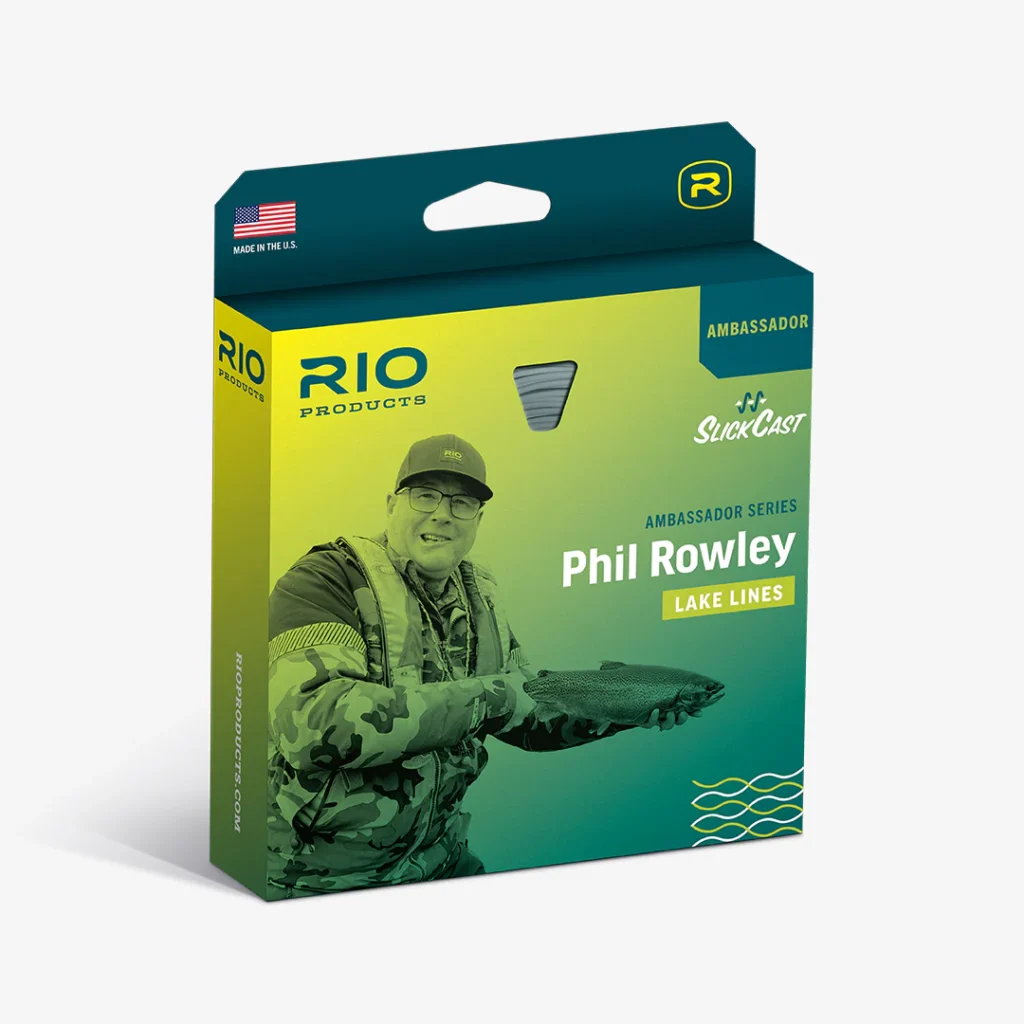
Rio collaborates with local fishing experts to design lines specifically tailored for their unique fisheries. An example of this is Phil’s lake lines, where they added a tippet ring at the end to eliminate worries about welded loops hanging up in the guides.
The series also includes switch lines made with Pyramid Fly Company for Pyramid Lake’s big cutthroats, and saltwater lines developed with Sarah and Brian for false albacore fishing in North Carolina.
This series combines RIO’s line-making expertise with ambassadors’ deep local knowledge to make fishing easier and more enjoyable.
Leaders and tippets are mostly made from two materials: nylon and fluorocarbon. Both materials are thermoplastic polymers, meaning they can be melted and reformed. The process starts by melting raw nylon or fluorocarbon and extruding it into the shape and diameter needed.
When choosing between nylon and fluorocarbon, the biggest difference is price. Fluorocarbon is much more expensive.
But fluorocarbon’s main advantage is its density, which helps sink flies faster, making it great for nymphing or indicator fishing when you want your fly to hang at the right depth longer.
Fluorocarbon also has different optical properties because of its refractive index, which changes how light bends and affects how fish see your fly underwater.
Episode Transcript
Phil (2s):
Welcome to the Littoral Zone podcast. I’m your host, Phil Rolli. The Littoral zone, or shoal area of the lake is a place where the majority of the action takes place. My podcast is intended to do the same, put you where the action is to help you improve your Stillwater fly fishing On each broadcast. I, along with guests from all over the world, will be providing you with information, tips, and tricks, flies, presentation techniques, along with different lakes or regions to explore. I hope you enjoy today’s podcast. Please feel free to email me with your Stillwater-related fly fishing questions and comments.
Phil (42s):
I do my best to answer as many as we can prior to each episode just before the main content. Thanks for listening. I hope you enjoy today’s show. If you’ve listened to my two part series on making sense of Stillwater Fly Lines, you’ll perhaps understand my interest in this subject for fly Fishers First venturing into the world of Stillwater fly fishing. Understanding Stillwater fly lines leaders and tippets can be daunting and confusing when fly fishing lakes. I believe having a good understanding of the fly line leader and Tipt options available to you is key to your success. It’s important that you choose the right tool for the job, If you will.
Phil (1m 26s):
I’m looking forward to this episode as Chris Walker from Rio Products joins me to discuss flylines leaders and tipits in detail. We’ll be focusing on the requirements that Stillwaters often demand. It is an interesting episode full of valuable information to help you better understand the specific line leader and tipper requirements for fly fishing lakes. I hope you enjoy this topic as much as I do. Well, good morning Chris. Thanks for joining me. Morning
Chris (1m 55s):
Phil. Thanks for having me on.
Phil (1m 57s):
We’re gonna talk about one of my favorite things, probably something you’re probably sick of hearing me talk about in this or ask questions of our fly lines. But first, why don’t you tell everybody, my listeners, a little bit about yourself, your role with Rio, how long you’ve been there, and any other cool fascinating facts you can provide.
Chris (2m 14s):
Sure thing. Yeah, so my name’s Chris Walker and I manage the product development group here at Rio Products. So that’s everything from material selection to taper design and product positioning for various applications of fly lines leaders and tip tippet. I’ve been here a little over seven years now. Before this, I was a manufacturing engineer at a semiconductor factory, which was much less interesting for fishy people like you and I. So it’s been a great change that way. My background is in engineering. I’ve got a degree in material science and engineering and I’ve been a fisherman my whole life. So it’s really a, it’s a great job. Really enjoy what I do here and never get tired of talking about fly lines.
Phil (2m 56s):
No, and as you know, you and I have had discussions before. You’re from North Carolina, is it? Or South? Is that where you grew up on the East Coast?
Chris (3m 4s):
I grew up on the East Coast. Yeah, I grew up in upstate New York actually. Oh, okay. And that semiconductor job was in North Carolina. So I was there for about four years. But yeah, grew up fishing for a smallmouth, bass and carp in my local river. Spent some time in New England, so I did a little striper fishing there. Of course, I did the Great Lakes Lake run tributary fishing circuit for a while. I was all over those tributaries for a couple years in North Carolina. It was false albacore trout in the mountains and now that I live in Idaho, tons and tons of tr fishing.
Phil (3m 38s):
Yeah. But a lot of sort of Stillwater stuff, oceans Lakes, so, Hmm, interesting.
Chris (3m 45s):
Yeah, exactly. There’s certainly, there’s plenty of Stillwater opportunity out here. I would say I’m mostly oriented as a, a river and stream angler here. But you and I have been out on our local stillwaters a couple times now. Yeah. So yeah, we have that opportunity as well.
Phil (3m 60s):
No, you have some beautiful river and stream fishing and I, one thing you’re not, you’re being too modest about, you’re one of the nicest casters I’ve ever seen.
Chris (4m 8s):
Oh, well thank you. It’s
Phil (4m 9s):
A little bit of envy in that, although I did I still remember that day on the Henrys Fork. Do you remember it? That what I remember it well. Yeah. Yeah. What stretch were we fishing? We were fishing
Chris (4m 20s):
Between, that was the lower Henry Fork. So aura to Chester that day.
Phil (4m 24s):
Yeah. It was a short little stretch And we were sitting there having lunch. It was a pretty slow day and then a fish row right against the bank and not in a place we expected to see a fish. And you were up and the amount of stealth and you change your fly before you cast and everything and then you made a perfect cast. It was poetry in motion, set the hook and you forgot to check your tip and broke it off. Yeah.
Chris (4m 46s):
Beautiful cast. Not such a beautiful hook set. Ah,
Phil (4m 49s):
I never saw a fly run reel throw that high in the air. That was so funny. You know, if we all had a good laugh about that. ’cause we’ve all done it, right? We’ve all done it. Oh yeah,
Chris (4m 58s):
It happens.
Phil (4m 59s):
It was the take after that. It just would’ve been fighting it and having to land it and let it go and all that stuff. So anyway. Okay. That’s
Chris (5m 5s):
Right. We got the best out of them. Yeah,
Phil (5m 6s):
That, that was good fun. That was good fun. And you’ve joined me once before on my YouTube channel. I did a live event. I checked the time of the, the date of that. That was April, 2021. It was you and Simon And we talked still water lines and fly lines at that time and we’re sort of, I guess we’re probably at risk doing it again, but we’re, things have changed a lot since 2021 on a variety of fronts and particularly fly lines. So why don’t we just jump in and talk about fly lines for still waters primarily welcome to obviously pull in other line types as well because I think they all have applicability to, to everything, at least from what you’ve taught me.
Phil (5m 47s):
But typically in lakes, as you know, we’re throwing indicators, some dry fly fishing, fishing subsurface with floating lines, long leaders, midge tips, and a lot of sinking line work from hovers lines that sink at one inch per second down to lines that sink at seven inch per second. And now the sweep lines, we’ll talk about those ’cause I get a lot of questions about that. And just I guess as a bunch real like still water fly fishers ’cause we are line addicted to say the least.
Chris (6m 18s):
That’s absolutely true. Yeah. I think Stillwater fishing is one of the more interesting applications in fly fishing because there is such a wide variety of technique. It’s, as you said, everything from, you know, big heavy rigs with a, a big indicator and a long leader and a heavy fly underneath to some of the longest lightest leaders out there. Like level leader setups with single kiid flies probably more like two or three kiid flies. But really light setups that are designed to fish shallow all the way up to heavy setups that are designed to fish deep. So it is a rich, a rich application for a fly line designer. Certainly.
Phil (6m 55s):
Yeah. Of lots of weird, ’cause we all do things a little different. And of course, not only are you, I think it’s important that not only is Rio, you know, handling the needs of, of fly fish Stillwater fly fishers in North America, but all over the world, particularly in Europe and the uk, we’re still, water fishing is very big. Isn’t it
Chris (7m 12s):
Big? Yeah, absolutely. And that’s, that’s actually one of the first times I was exposed to Stillwater fly fishing. I was pretty new at Rio still and I got the opportunity to travel to the UK and fish with a couple Rio Pros on their stillwaters. And it was totally foreign to me, a completely different technique and application from anything I’d seen before. We spent the whole day throwing mid tips and doing hand twist retrieves with multiple fly rigs and catching big grown on rainbows as they call ’em over their stocked rainbows that have had a chance to, to get big and fat on Carus
Phil (7m 45s):
Survived a carnage of their planting. Like, like most stillwaters, they get the heck kicked out of ’em in the first two weeks of being inserted into the lake stocky bashing, I think they call it over there.
Chris (7m 57s):
Yep, you got it. Yeah. But it’s great. That’s, that’s one of the cool things about my job is I get to, I get to fish with people who know exactly what they’re doing in a specific fishery and then we get to turn around and try to design a product that’s well suited to that application.
Phil (8m 10s):
That’s cool. Well you wanna start talking about how fly lines are made and cores, strengths, weaknesses, you know, I know for example, monofilament mono cores, if that’s the right term nowadays. Is it common with your clear intermediate lines and memory issues and some of the critiques people may have of the, about those? So maybe walk through maybe what the Cores Rio uses without giving away, you know, too much proprietary stuff but you know, what they’re best suited for, why they’re done, those kind of things. And just a general understanding of how fly lines are made.
Chris (8m 44s):
Sure. Yeah. So every fly line we make has two basic components. The first is the core and the second is the coating. So the core, as the name suggests, it’s inside the coating, it’s the in the center of the line. And that’s actually the material that gives the line all of its strength as well as a lot of the stiffness properties. So it’s the part of the line that bears the load if you’re pulling on a fish, the core is the thing keeping your line from breaking. And the coating is really there just to either make the line float or sink and also help us distribute weight in a specific way to make the line cast well. So that’s how we create a taper and a fly line is by adjusting the coating. Now within those two categories cores, we’ve got sort of two basic types of core and that’s a braided core or a monofilament core as you said.
Chris (9m 32s):
So the major differences between those two, A monofilament core tends to be a little bit stiffer. Sometimes that makes it better for tropical applications where you want your line to be a little stiffer, but it’s also clear. So that’s why we use it for those clear intermediates, like you said. And of course there’s different, different versions of a monofilament core. Some are stiffer, some are more supple for cold water, still water applications. We usually choose a more supple mono core if we’re gonna go that route.
Phil (10m 2s):
And it has pretty low memory too, like low stretch I wanna say as well. ’cause it sounds like you’re not using your traditional multifilament dacron cores much anymore. Is that true?
Chris (10m 12s):
Well, we still use a multifilament core and it’s actually the, so we, we call that a braided core. That’s the nomenclature we use here at Rio. Okay. And it’s actually a common misconception that that’s Dacron. There might be fly line brines that that use a dacron core, A braided core is based on nylon. Okay. So a little bit different chemically. Those differences aren’t, aren’t especially important. But one of the reasons we would choose that braided core is it is a little bit more supple that makes it a little bit less prone to memory than a monofilament core.
Phil (10m 47s):
Okay. Is nylon stronger than Dacron? Is that one of the reasons too, or,
Chris (10m 52s):
You know, that’s an interesting question.
Phil (10m 55s):
Sorry.
Chris (10m 55s):
It it’s gonna depend on the, the construction. So you could, obviously you could make a Dacron braid that’s really strong, like your braided backing 30 pound Dacron breaks a 30 pounds. You can have a a 20 pound version that’s a little bit thinner and less strong same’s true for nylon course. So we have braided nylon as light as 12 pound braking strength and as heavy as 30 pound. So just depending on the application we would, we would pick different brake strengths
Phil (11m 22s):
And maybe not so much in stillwaters, but that always sticks in my mind because you get, sometimes people will, you know, set up a leader system that has a breaking strain in excess of the core strength and their fly line breaks. ’cause now it’s become the weakest link in, in simple terms. And then critiques are, oh those lines break all the time and, and well you had a hundred pound test on there. Yeah, that’s not going to break. The weakest link is now your fly line core and ping off it goes. So yeah.
Chris (11m 51s):
Yep. That does happen from time to time. And hopefully we’re not getting too far a field here, but the, the most common situation for that is somebody who’s fishing like 15 pound maxima. Yeah. Everybody knows maxima as super strong tip at 15 pound is crazy strong. And that’s ’cause it doesn’t actually break at 15 pounds. It breaks at like 23 pounds. So if you’re tying 15 pound tip it Yeah. With, you know, maximum of 15 pound on the end of a 20 pound break strength fly line, just like you said, all of a sudden the fly line might be the weak link in that system now. So,
Phil (12m 24s):
But some guys, I know some guys for their still water leaders will build a butt section not as thick as a maybe a, you know, a, a factory tapered leader and and are using 15 and 20 pound maxima because it’s a little thinner diameter. But they’re still getting some pretty strong core strength in excess of the posted limits on the spools. So that, that’s interesting ’cause what’s your typical in your, you know, your 5, 6, 7 weight that still water fly fishes use most often. What’s the typical brake strain of those cores? I know I should know this.
Chris (12m 56s):
No, you’re fine. 20 pound is pretty typical in those applications. So a, a braided core that goes in a a 5, 6, 7 weight still water line would be 20 pound brake strength. The same sizes if we make ’em on a mono core like the mid dip series, those are probably more like 25 pound.
Phil (13m 13s):
Okay. Alright. That’s interesting. All right, so that’s cores. You mentioned the, I guess the mono core would be the critique. Some fly fishers have is the memory concerns. ’cause my first experience is with a, a mono core line. Were not really fly fishing lakes. It was the fall months. We used to chase coho when I lived on the west coast of Canada. They like to hold up in what we would affectionately call frog water. They like to slower pools or even back waters. They’d stack up in there and they’d become very spooky. It’s low, it’s clear. And you know, a traditional line with a, they could see that going through the water. I don’t think they knew what it was, but they didn’t like it, so they would just move aside from it. Right. It was moving and, and then the mono cores came in.
Phil (13m 55s):
But they were all originally done for a salt water application. So they weren’t great as far as being, you know, less visible to fish. But oh, it was like cas in a slinky. Those things were horrible because we were using a tropical line in a, you know, a temperate almost cold water environment. It didn’t work well. So what are you, you know, the different monos you are using for the cores? You mentioned looking for more supple. Is that what you’re doing with the still water lines? Because we’re using it, you know, in water temperatures. My last trip of the season, everything froze up. The water temperature was 37 Fahrenheit. So definitely a no swimming day. But yeah, it’s a little cold. So that’s probably a challenge, isn’t it, for a line that’s got a cover.
Phil (14m 36s):
Conceivably, if you’re trout fishing won’t even get into car and bass, another things that live in more warmer water. But you could be, you know, if you’re fishing responsibly that you know low, you know, mid to low thirties all the way up to 65 Fahrenheit, how do you manage that temperature range?
Chris (14m 52s):
Yeah, that’s a good question. So within mono cores, we look for a couple different properties. Strength is obviously a big one. We just kind of covered that outside of strength, the things that affect stiffness are diameter of course. So, you know, higher diameter core is gonna be a little stiffer than a lower diameter core. It’s also gonna be stronger. And then beyond that, it’s actually a property of how the core is manufactured. So for all monofilament, you can sort of choose between the highest brake strength to diameter ratio or a more supple, an easier to straighten material. So based on how the the core is actually manufactured, you can kind of tune that property.
Chris (15m 36s):
Yeah. So to, to give you an example, a tropical core, we’re probably looking for the strongest core we can get for a given diameter. And we’re also looking for it to be pretty stiff. Yeah. So that would be one end of the spectrum. Like you’re talking about a Stillwater monofilament core, it’s gonna be used in really cold conditions. We’re looking for sort of the most supple and the easiest to, to straighten. So there is a material property we can tune that way And we work closely with our suppliers to make sure we’re getting that right. But in the case of a a cold water monofilament core, we’re looking for one that isn’t necessarily leaning heavily on the highest brake strength. Like we just said, 25 pounds is plenty for a Stillwater application, but we want to be able to pull it off the reel and give it a stretch between our hands and make sure it lies nice and straight.
2 (16m 25s):
Since 19 72, 4 wheel campers has been building rugged, lightweight campers designed to fit almost any truck in every kind of adventure. Whether you’re keeping it simple like me with the Project M or gearing up for full-time off the grid travel, there’s a four wheel camper built to match your lifestyle. You can head over to four wheel campers.com right now to use the builder tool to find your perfect topper slide in or flatbed camper for your next journey. Patagonia just launched the next evolution in waiters and they’re built for anglers just like you. The swift current line includes ultralight, packable options for the hiking crew and expedition ready waiters. If you’re hard on your gear like me, they’re designed for comfort, built from recycled materials and backed by Patagonia’s ironclad warranty.
2 (17m 11s):
You can check them out right now at wetly swing.com/swift current, that’s wet fly swing.com/s W-I-F-T-C-U-R-R-E-N-T Swift current waiters. Check ’em out now.
Phil (17m 27s):
Yeah, and I think that’s important. I think people sometimes have this expectation it’s gonna fall off, you know, like a, you know, a regular braided core line and be supple and that’s just, you know, I, I think I’ve had this discussion when people like to compare different brands of line and they all fall victim, it’s physics, they all follow, they have to follow the same rules, they’re bound by the same constrictions and it’s all the same. ’cause you mentioned the tropical application, that’s obviously big fish, warmer temperatures. We’re obviously with a few exceptions, not catching fish that big and not that warmer a temperature. We probably shouldn’t be trout fishing in those situations anyway because they’re not gonna be liking it much. So I think that’s important because that leads to another question I have is you, you get, I ran into an angler that was struggling with a line and he just, it’s brand new and it’s coiling up and it’s horrible and it’s ugly.
Phil (18m 17s):
So I went out to the, it was a destination trip at a lodge And we went out to the dock and, well, let’s see how you could cast, he was good caster, his issue wasn’t line memory, you know, he was trying, it was line twist. So maybe we can, you know, when you’re talking about memory, just the difference between the two and, and the causes of twist and, and how you fix both. ’cause I think memory you just said just, you know, the first thing you do I do with my, when I gonna use a clear intermediate line before I make the first cast is, you know, give it that as you’re pulling the line off the reel and, and sort of getting ready to cast is to give it a good stretch, you know, three to four foot pulls and, and put a little tension on it and it just, the memory falls out of it. But line twist is a little different right. It’s a different cause and a different fix.
Chris (18m 56s):
Absolutely. Yeah. Yeah. So the, the very easiest way to tell the difference between memory and twist is, what I like to do is I’ll pull an arm’s length of line off my reel. Let’s say I, I’m having issues with my line coiling up. I’m trying to determine is it memory or twist. I’ll pull, you know, five or six feet off the reel between my hands and then I’ll just bring my hands close together. And what I’m looking for is the loop of line as it goes slack between my hands. If it spins around itself, if it actually winds up on itself and spins itself into a loop, I know it’s memory and that’s because, or sorry I said that the wrong way. Yeah. Twist if I bring my hands together and it twists around like a
Phil (19m 38s):
Phone cord
Chris (19m 39s):
That’s twist
Phil (19m 40s):
Like an old for those who remember phones with cords on ’em, but yeah.
Chris (19m 43s):
Yeah, exactly. And what’s going on there is the one end of the line is actually twisted relative to the other end of the line. Yeah. There’s a bunch of things that can cause that, it could be a casting fault or it could even just be a casting strategy. If you’re doing a, like a Belgian cast or like an oval constant tension cast that can put a twist in your line. And as you cast more that way, it increases the twist. So that, that
Phil (20m 8s):
I, I ran into that very thing down in Argentina for Golden Dora, because you’re slinging, you know, forough, andino’s deceivers with big, you don’t want to hit yourself or anybody else. So using an oval cast, and guess what, I had line twist and we had to had to fix it. ’cause that’s ’cause the rod tips is, is not moving parallel, not in the same path. Is that true? You’ve got, you know, tip, I think I read the saw somewhere, you know, the, on the back, you know, obviously on the continuous motion build you’re sweeping around more horizontal to sling all that trouble away from you and come up to the vertical position and without pausing immediately power forward. So you’ve got your rod tip, part of the cast is moving in a, in an arc and then part of it is your traditional overhead straight path.
Chris (20m 55s):
Yep, that’s right. So a like a, a very typical overhead cast, which is just a mirror image front and back. You know, you’re, you’re making a forward cast and you’re doing exactly the opposite on the back cast.
Phil (21m 5s):
Well that’s the way it’s supposed to work. Okay. That’s good to know.
Chris (21m 8s):
Ideally, yeah, when the conditions are good, that’s what you’re striving for. So that obviously doesn’t induce any twist in your line. Just like you’re saying though, in a Belgian cast, you’re basically making your, your back cast under the rod tip your forecast over the rod tip. Yeah. In a constant sort of circular motion. And that does introduce twist. So that’s how you tell if it’s, if it’s memory or twist or that’s how I tell anyways, I, I bring those two pieces of line together. If it spins around itself, that’s twist. The other dead giveaway is the more you fish memory should, should go away. Even If you’re not stretching your line, you know, If you pull that clear intermediate line off your reel, make your first cast and it’s a little bit coily, your second cast should be a little better.
Chris (21m 48s):
Your third cast should be a little better still. It should get progressively better throughout the day. Twist on the other hand, if you’re doing that, that Belgian cast, it’ll get worse and worse. Yep. Another thing that can cause twist is a fly or an indicator that’s big and wind resistant enough that it spins on the cast. Yeah. Same thing. The more times you cast it, the worse that twist will get. So If you find the coils of your line getting worse throughout the day, that’s another indication that it’s probably line twist.
Phil (22m 17s):
So why does the memory get better with repeated casting as opposed to the twist which gets worse?
Chris (22m 25s):
Yeah, so the, the memory usually what people are talking about is memory from the reel. Yes. So
Phil (22m 32s):
That’s
Chris (22m 32s):
Good. Yeah. We start, when we make a fly line, we, we make it in a straight length. That’s the only way we can, we obviously can’t, you know, apply a coating to a 90 foot line that’s in a coil already. So it’s created on a straight axis. Then when we go to coil it, there’s some stiffness in that line. We, we bend it around that coil, put it in a box very similar to when you re it up on a reel, you’re taking a line that’s relatively straight, you’re bending it into a coil on that reel and the longer it sits on that reel, the more that bending stress relaxes. Yeah. So it basically starts to assume the shape of that reel. So then the converse of that is when you take it fishing, you strip it off your reel. Now you’re trying to get your line to assume a, a straight line again rather than that tight coil.
Chris (23m 15s):
And just the longer you spend with it off the reel straightened out while you’re casting, the more that memory tends to relax.
Phil (23m 22s):
Okay. That’s interesting. ’cause yeah, and that’s another good way to tell too, if they can’t figure out the twisting and the coiling is just, is it getting worse with every cast or is it getting better? Right. So I always say with memory two about a five pound rainbow of brown’s a good line stretcher a two. So yeah. Yeah.
Chris (23m 38s):
That’s the easiest way to stretch it. You can stretch the whole line at once.
Phil (23m 42s):
How do you cure line? You know, memory cure is, you know, put it under tension, give it a tug. How, what’s the recommended cure for line twist?
Chris (23m 49s):
Yeah. So the only way to get rid of that line twist is to, to undo it essentially. So there’s a couple ways, the easiest way If you do happen to be standing in a river is you can just let your entire line flow downstream of you
Phil (24m 1s):
Take the fly off. Of course. Right,
Chris (24m 3s):
Exactly. I cut my fly off first just to make sure the end can spin freely. Yeah. Works best If you’re standing in fast water, you can just strip off however much line you’re fish in. It’s probably 60 feet is usually enough to, to cure all the, the issues you’ve got. Yeah. And then you just stand there for a couple minutes and let it un twist when you reel it up and and fish again. It should behave much better If you happen to be in Stillwater you can tow it behind the boat. Yeah. Whether you’re kicking around in a float tube. That would be the hard way to do it.
Phil (24m 33s):
Take a little more times a slower unwinding. Yeah. At least the speed I go.
Chris (24m 39s):
Right? Yep. If you fire up the outboard, you’re moving between spots, you can drag it behind the boat that way too. The other really tricky way to do this, it’s cool when you get it right it actually makes it worse when you get it wrong, is you can, you can cast however much line you’re working with 50, 60 feet onto the water and then with your line laying on the water, you actually spin the rod and reel in your hand. So you’re essentially spinning the line from the end. You’re holding the rod end around the axis of the line. Now the trick there is you gotta spin it the right direction. Yeah. It’ll be a dead giveaway If you get it wrong ’cause it twists it more. Yeah. If you spun it the right direction it gets much better.
Chris (25m 19s):
It should be obvious ’cause your line’s un twisted.
Phil (25m 22s):
Yeah. When I was in Argentina we just took the big ’cause. It was a combination of the Belgian noval and a big wind resistant fly that, you know, sort of made it even worse. And we just, when we were moving from spot to spot, I just trailed it out the back of the boat and let get beat around in the current and that that in the chopped from the boat and the motor and that seemed to make it better. So, and I know on Rio’s YouTube channel there is a good video on memory and twist, isn’t there? I think back when Zach was with the, with the company he was, he had a good tip on that. So people should check that out. I’ll put links to that in the show notes as well. Okay. So we we’re jumping around a bit here ’cause you’ve talked to me before. You know, that’s the way I, I go tapers and I think really important with the, the floating line, the Stillwater floater for example, the, the demands on that line when you and I worked with that was trying to ca you know, the challenges of casting complex indicator rigs, level leaders, long leaders, weighted flies, and that whole taper discussion because you know, a floating line is, I’d argue is the most versatile line you can have still water fishing, you can fish drives with it.
Phil (26m 28s):
You can fish, you know, a team of flies with it. You can fish weighted nymphs, you can fish indicator systems and you can fish from the surface to, you know, 20, 25 feet down with the right setup. And, and that’s kind of, we’ll let’s step aside from the dryly presentations for a second. Let’s talk about that. What’s needed for a fly line to, you know, fish those rigs subsurface the indicator and the way it flies. Long leader stuff to get that to turn over.
Chris (26m 55s):
Sure. Yeah. So you, you said the key word there, which is turnover. Yeah. That’s very common fly fishing vernacular. The best definition of that is, is simply when you’re making your cast, you’ve formed your loop, your rig is flying out there, dragged by the line, does the line actually straighten and deliver the rig on a a relatively straight line? That’s what we mean by turnover. If it turns over the line straightens in the air and it delivers that rig effectively. So for the, the application you’re talking about like a Stillwater rig with an indicator long leader, heavy flies really the main challenge there is the rig itself is pretty heavy and it’s pretty cumbersome. Yeah. So you need a line that has enough power to turn that over.
Chris (27m 39s):
And that’s really sort of where we start with all our taper design is what rig am I trying to deliver and what does the line need to do to facilitate that? So in the case of that Stillwater floater, it’s really about the power to turn that rig over. And the way you get more power in a fly line taper is, well there’s a couple different ways you can add weight, which would be like going up in rod weights go from a five to a six or a six to a seven, obviously you don’t always want to do that. You want to take your six weight rod and you want it to be able to, to fish a range of different technique. So that doesn’t always work. The other way you can achieve more power in a taper is by putting more of the weight close to the fly. Yeah. So that could be a shorter front taper.
Chris (28m 20s):
That’s one of the things we added to that Stillwater floater is a pretty short front taper
Phil (28m 23s):
That’s three feet I think.
Chris (28m 25s):
Yep, exactly. And it could also be what we call front loading a taper. So putting more of the weight of the head nearer to the fly. Nearer to the rig. Again, giving it more power to turnover
Phil (28m 37s):
Because that’s important too. ’cause you see some lines that you know may have a higher grain weight and we’ll get into that in a second. But it’s where you put that. Right. Because my understanding is with the Stillwater floaters, the example here is not only we shorten the taper to put the, what I call the mass of the line closer to the, the front of the line to push that over. But also we upped the, the line weight literally from a six actually has a, an eight weight head on it again to do that as well because it also, that also gave the line a little more surface area for roll casting, which is an important component of an indicator rig. ’cause we love, I love to roll cast that thing because it is tangle prone and a roll cast is a great way to avoid that.
Phil (29m 22s):
Similar I guess to your trout spay and those kind of things where you’re using the roll cast for perhaps not the same reasons but similar.
Chris (29m 30s):
Yep. Yeah, definitely. So the another thing that contributes to a good roll cast is just getting enough weight in the D loop. Yes. So yeah, the difference between an overhead cast and a roll cast and an overhead cast, the entire line’s in the air, the entire line is contributing to the, the weight that loads your rod and ultimately delivers the fly. A roll cast differs in that you have an anchor, there’s a, you know, your, your fly, your leader, your indicator and probably the tip of your fly line are actually in the water creating the anchor to load the rod. So in that instance part of the line is, is static, it’s on the water and it’s not moving. And then it’s really the back of that fly line’s head that ends up in the D loop and that’s the weight that you’re using to load the rod.
Chris (30m 15s):
So a couple characteristics that make a line roll cast better. One is simply that it’s just a little bit heavier than a line that’s meant to overhead cast nicely because you have less of that line weight contributing to the rod load. And the other thing that helps is having more of that weight actually towards the back of the head. So that puts more of the weight in the D loop, less of the weight in the anchor. And that means the heavier D loop sectional line has a little bit more momentum and power to turn over that line that’s creating your anchor.
Phil (30m 45s):
Okay. So that’s why the important that’s right here that we’re talking about the back taper, the rear taper and its importance on helping form the roll cast. I know Simon was also talking about the line how it aids. You’re able to aer realize more line. So if a fish, If you are using that line just fish for fish moving on the surface, you can pick up more line and then you know, pick it up and deliver it to the target without having to strip it all the way back in, get that head in the guides, get a couple of false cast and then get it off to the target. Then in that situation your opportunities miss ’cause the fish is gone. It takes too long to get that line there. So is that correct? Am I understanding that right?
Chris (31m 25s):
Yeah, that’s right. I would, I would say for a, in a roll casting situation it’s, it’s the back of the head is really where all the action is. That’s where you’re tuning how much weight goes into the, into the D loop and how much power you can turn over your, your tip width as you said the back taper, the longer your back taper is that just gives you more control at distance. Yeah. So let’s say I’ve got, you know, most of my head weight is in the first 30 feet of a fly line. If it goes from a 30 foot head straight into running line, if I have 50 feet of line on the water, I can’t pick up that head. There’s a bunch of light running line between me and the more powerful section of fly line there that’s actually gonna contribute to my cast.
Chris (32m 6s):
Yeah.
Phil (32m 6s):
It just can’t physically lift that you’re asking something that’s just can’t ’cause the running line’s designed to do is its name, it’s run right on when you shoot line it, you know, low resistance and off it goes and you get that nice long distance cast you’re hoping for. Right,
Chris (32m 20s):
Exactly. So the, the converse example would be, let’s say I’ve got my 30 foot heavy section on the water, but now I have a long 20 foot back taper. Now there’s a much smoother transition between my thin running line and my thick head section and that allows me to pick up line at a little greater distance. It allows me to carry a little bit more line before I decide to shoot to my target. Yeah. So that’s better in those applications where being really precise and really accurate helps
Phil (32m 46s):
And helps with the roll cast too because you’re getting that obviously that thicker, you know that as that line tapers down the running line is more mass back there, which is gonna help load your rod if I understand that correctly. Yep,
Chris (32m 56s):
That’s correct.
Phil (32m 57s):
Okay. All right. Now obviously the difference when we’re fishing And we do fish dry flies and lakes, that’s not what you want because you’ve got a line with a, a lot of mass, you know, short front taper, oversized head section, longer back taper a lot of material out there and you try to target a surface feeding fish on a relatively calm or light wind day, there’s a pretty good chance that line’s gonna come down a little on the heavy side and scatter things. Right. So now you’re looking for different properties for surface feeding fish much I think much the same way. You know that day we tease you about on the Henry’s fork but you did not want to use a still water floater for that situation unless you’re trying to knock the fish unconscious.
Phil (33m 40s):
Right? Yeah. The same basic principles, whether it’s moving water or still water, you want that delicate presentation. So what’s the difference between those? We talked about the first line design for turning over indicators, long leaders, all that stuff where the mass oversized head, what are we looking for in a floating line for those delicate situations?
Chris (33m 57s):
Yeah, so it’s totally different. You know, your, your rig that you’re trying to deliver is completely different instead of a a big heavy indicator and a weighted fly and a lot of, you know, leader in between the two. Yeah. Now we’re talking about a long tapered leader. It probably goes down to a fine tipt that fly I broke off and that Henry Sport fish was like a size 18 CDC compare iton,
Phil (34m 19s):
I think I tied it on so it was probably my fault.
Chris (34m 22s):
Yeah. But in any case, really, really light fine fly. So, so now it’s less about power and more about finesse. You don’t need any of that power to turn over powerfully and you know, really kick the fly over and deliver it to the target. Now it’s all about accuracy and being able to turn the fly over delicately so it lands lights and doesn’t spook the fish. So in that case, we’ll go back to that same rule more, more weight close to the fly means more power. If I move weight farther away from the fly, I get more finesse. Yeah. So that means a long front taper a relatively light head. I’m not gonna use a a line that’s two sizes heavy to deliver a small drop fly.
Chris (35m 2s):
Yeah. And like we were talking about with rear tapers, you’re looking for maximum accuracy. So you’re probably gonna have a long head and a relatively long rear taper so you can just carry line and you don’t have to shoot to reach your target. Yeah.
Phil (35m 16s):
More almost like a conventional double taper approach, right. Where you just have to continue to cast. Yeah. ’cause that I, and the difference between I think the Stillwater floater has a three foot head and I know the, the one I, you know, I use for my technical still water casting dry small nymphs and shallow situations where I can see fish and I don’t want, you know, I want that delicate presentation. It’s, that’s technical trout is 10 foot of, of front taper. So quite a difference and, and If you ask that technical trout to chuck an indicator rig it can do it, but you’re asking a lot of it and then you’d have to start overpowering things more horsepower, you’re tired and overpowering cast usually causes all kinds of casting problems.
Phil (35m 59s):
Tailing loops and all tangles. It’s good for leader sales. We’ll get to that in a bit. Okay. Yeah, exactly. Now one of the things you talked about there was the whole, you know, oh it’s, you know the, If you got a six weight floater that’s got an eight weight head basically on it, you know, what am I doing to my fly rod? It’s, I think some people worry they’ve just tied a truck onto the end of the rod and you know, sooner or later that rod’s gonna shatter and there’s gonna be graphite splinters everywhere. That’s just not the case. ’cause the grain weight in that five six range that most times we’re still water trail fishing for example is insignificant really isn’t it? The difference between the two
Chris (36m 40s):
It’s, it’s insignificant in, you know, keeping your rod in one piece. Yeah. You’re not gonna break anything and you’re not gonna overload your rod by going up a couple line sizes like we just alluded to. It’s very significant in terms of how the, the fly line delivers your rig. Yeah. But yeah, that’s a very common question I hear is, you know, why would I buy a six weight line that actually weighs as much as an eight weight line? Isn’t that gonna overload my rod? There’s a couple ways to approach that. The one I usually like to talk about is what is two sizes heavy actually mean. Yeah. So, so one size heavy, if I’m fishing a five weight rod, you know, the AFTA standard says that my line should weigh 140 grains in the first 30 feet for a six weight rod.
Chris (37m 22s):
That AFTA standard is 160 grains in the first 30 feet. Right? Yeah. Grains are a funny unit of measure. Nobody really has a good picture of what a grain is. So I’ll give you one. A standard business card weighs about 20 grains. Wow. Yeah. So If you think about that example going from a five weight to a six weight, I could take a five weight line, I could tie a business card to the end of my tipt and now it weighs as much as a six weight line. Yeah. So it’s not so much weight that it’s gonna, you know, ruin your casting or break your rod. It’s really just the way we tune a line to fit a certain application better.
Phil (37m 57s):
Yeah. And there’s, I’m sure rod design comes in, you know, fast action rods versus moderate action versus really soft action rods impacts that I, I was talking to a friend over in Australia and he often underlines for fishing from shore underlines his rod to get a, a different presentation so he could be fishing sevens and eights and have a five or a six line on it for that application. ’cause there’s a lot of personality I’ll call it, that gets put into these things that make, because years ago we used to certain rods deliberately overload ’cause it just seemed to load and cast better and just felt probably more masking our casting flaws than anything in the rod or line design.
Phil (38m 37s):
But it, it worked and I always get asked that If you should overline or underline and I generally just, if it’s a six weight rod, put a get the six weight line and geniuses such as you have done all the figuring out and I trust you so
Chris (38m 53s):
Well. I don’t know how much genius there is behind it, but it, that’s my approach too. Yeah. Is I fish, you know, a line that’s marketed for a six weight rod, I fish it on a six weight rod for the most part. Of course it’s important to choose a a line that’s suited for the application. We sort of covered that already, but you know, when I’m designing a line, if I write six weight on the line, I’m intending for it to be phished on a six weight rod for that given application. One more good example of, you mentioned there’s lots of personal preference. Some people like to underline, some people like to overline. If you’re one of those people that’s great. I would never tell anybody to, to stop casting away that they like to cast. Like I think that’s the ultimate proof of what works for you is If you like it, do it.
Chris (39m 35s):
Yeah. One example I’ll give you is something that Simon Goss worth actually showed me for the first time we were having a sales meeting. We had a bunch of our sales reps around And we were doing some casting competitions and Simon brought out what he calls the flip flop casting competition where he puts a 10 weight line on a three weight rod, hands it to the first guy and then he puts a three weight line on a 10 weight rod and hands it to the next guy. And both of ’em have to cast that as far as They can. Then they gotta trade and cast each other’s setup as far as They can. And what I’ll tell you, it doesn’t feel good. Nobody wants to cast a 10 weight line on a three weight rod. But a good caster like Simon who’s, you know, world class Yes. He can make it look easy on both.
Chris (40m 16s):
Yeah. So it’s not like, you know, it’s not like a 10 weight line’s gonna break your three weight rod. And it’s not impossible to cast a three weight line on a 10 weight rod. It truly is just down to, you know, what works for you and also what works for your application
Phil (40m 30s):
And the technique you’re using. I remember at a end of a fly fishing show one day everybody left and all the presenters were given this casting challenge, I think on a five weight, I think it was to cast some giant marlin or sailfish fly that was more wood than fly. Not fun. And we could cast it but you know, you, it was all technique, right? ’cause If you tried to get up there and just muscle it, you had to really let things load. And really it was just, it was horrible and it was embarrassing as hell. ’cause you’re in front of everybody. And I think I was happy that I got it, you know, middle of the pack and I was, I was done. I was, yeah,
Chris (41m 8s):
Yeah,
Phil (41m 9s):
Yeah. You usually, you’re like, probably like me. You see those contests and you disappear. Right. Just going to the bathroom. Yeah. So, okay, so we talk floating lines. Let’s talk sinking lines now. What are you looking for in sinking lines? The, the challenges there? What do, what, what are the design considerations you gotta think about for a sinking line?
Chris (41m 27s):
Oh yeah, that’s a good question. So in a sinking line, like obviously the, the first property you need to tune is how far is it gonna sink and how fast. Yeah. And that’s one that, that requires some unpacking, right? Yeah. So a lot of people say, well I want to fish 15 feet down. What sink rate line should I use?
Phil (41m 46s):
How long is, that’s a good que how long is a piece of string? Right?
Chris (41m 50s):
Exactly. Exactly. How long are you gonna wait? You know, how fast are you retrieving? So
Phil (41m 55s):
Are you anchored definition? Are you drifting? Are Yeah, yeah,
Chris (41m 57s):
Exactly. So, so by definition, any sinking line we make anything from a hover all the way to a type seven. If it’s a 90 foot line and I wait long enough, it’s gonna end up 90 feet deep, right? Yeah. It’s just a matter of how fast you want it to get down there. So to tune that property, we, we change the density of the coating. We don’t actually change the, the total weight of the fly line for a given series. So a good example would be the Fathom series where we have everything from a type three down to a type seven. If I choose any six weight line in that fathom series, it’s gonna weigh the same amount in the first 30 feet. The only difference is the density of coating we use to get that weight. Yeah. So obviously the faster syn rates, they’re gonna have a higher density coating.
Chris (42m 41s):
It’s gonna be a thinner line, but it’s gonna weigh the same and that’s gonna allow it to sink more quickly. So if you’re trying to get deep really fast, you would choose a faster sinking line. Of course.
Phil (42m 51s):
Yeah. ’cause I always look at it like you say, a lot of factors come in the depth you’re trying to achieve the retrieve speed of your fly closely linked to the activity level of the fish. So if the fish are not in the mood to chase, they’re not aggressive, you have to use slower retrieve. So typically you’re gonna use a slower syn rate line. ’cause you need to move that fly slower. And obviously you don’t want that to sink below the fish and be lying on the bottom for most applications. So there’s yeah, there’s no mag and are you anchored, are you drifting? Is there any kind of wind induced current? That’s why you have to have all those lines. That’s what I tell myself anyway. So one of the things there you touched about, we, I think a couple of times is grain weight.
Phil (43m 32s):
And I, I gave, I told you I’d asked this question when we were talking before we started recording, but a lot of confusion between syn rate and grain weight and people assuming that a high, a line that has 4, 5, 6, 700 grains is gonna sink like a rock. And that’s just not the case, is it? And, and then you’re gonna have to defend yourself a bit here. Why in some line types outside of still water, do you follow a grain standard which sort of more this to do with sync rate than grain weight? If I ex if I articulated that question properly, go. Yeah.
Chris (44m 8s):
All right. All right. I love this question. I love answering this question because it is confusing and I think, I think the confusion starts with some historic line designs. Like, like past tips were sold by grain weight exclusively. It was one density of sink tip. You could have it in 150 grain, 200, 2 50 and so on. And manufacturers of those styles of lines, Rio was one of ’em for many years. They assigned a syn rate to each of those grain weight lines. So automatically we sort of condition people to think more grain weight means faster syn rate. Right now in the the fly line world, that’s not really the case.
Chris (44m 50s):
And what it comes down to is the definition of a grain. So a grain is just a, a unit of weight. It’s the same as a pound. It’s obviously not the same as a pound. There’s
Phil (45m 0s):
Oh No,
Chris (45m 1s):
You know, way more weight in one pound than one grain. Boy, I’m trying to remember the, the conversion off the top of my head. Nobody cares.
Phil (45m 7s):
I’ve got it written down. I I should have had it written up, but I looked it up. Right. ’cause it’s grain weight is used to determine, for the most part the weight of the line. 6 0 8, 7 weight, eight weight, as you said, the AMA standard, so many grains over so much length of line determines whether it’s a five weight or six weight or seven weight. And then syn rate is about the coating, the tungsten powder on the coating of the line that makes it sink. ’cause you can have a 400 grain weight line that sinks like a rock and it can float like a feather on the surface too. Correct.
Chris (45m 37s):
Yep. That’s exactly right. So, so I think of grains, you know, there’s that, that old trick question which weighs more a pound of feathers or a pound of lead, right? Yeah. The answer spoiler is they weigh the same. Right. Oh,
Phil (45m 49s):
Well that’s good to know.
Chris (45m 51s):
Same could be said about grains, which weighs more, you know, a hundred grains of feathers or a hundred grains of lead, they weigh the same. Yeah. Grain is just a, a unit of weight. Yeah. So it says nothing about the density. So to, to go back to your example, I could have a 400 grain shooting head for a, a spay rot. Let’s say, let’s say I’ve got a 400 grain skagit shooting head. Yeah. That’s actually a floating head. I could equally have a 400 grain shooting head that’s set up to sink. It could be like a, like an outbound short shooting head with a type six coating. Weighs the same, but it’s got a denser coating. So now it sinks really quickly. So the number, the number the consumer should pay attention to when they’re buying a fly line is sink rate rather than grain weight.
Chris (46m 35s):
Okay. If they’re looking for how their line is gonna sink or float or, you know, hover as the case may be, they should be looking for sink rate rather than grain weight.
Phil (46m 43s):
Okay. And it’s, no, the tungsten powder doesn’t have any impact subtly or otherwise on grain weight.
Chris (46m 50s):
Oh, sure. Yeah, of course it does. So, so the tungsten powder, yeah. This is a component of the coating Yes.
Phil (46m 55s):
That makes it sink. Yeah, yeah,
Chris (46m 57s):
Exactly. So we have a whole range of coatings we can apply to a fly line here at Rio Floating coatings. They actually use a, a hollow glass sphere. So it’s a tiny little particle, it looks like just white powder in your hands. But we mix that into the coating and that makes your line buoyant. So it, it drives the density down. It means we have to put on more volume of that coating to get to a desired weight. The tungston powder, like you’re alluding to, does exactly the opposite. So that’s a, a very dense metal powder. We mix that into the coatings and it drives the density of the coating up. So we make coatings everywhere from, you know, call it 20% less dense than water up to like 350% more dense than water.
Chris (47m 47s):
So it runs the gamut from high floating to fast sinking. And that all comes down to the components of that, that coating. Did we mix in microbus or did we mix in Tungston powder?
2 (48m 0s):
Let’s take a break and check in with Jackson Hole Fly Company right now. The right gear can turn a good day on the water into an unforgettable one Jackson Hole. Fly company’s combo kits are built to match the rhythm of the river, giving you everything you need in one simple package. Each kit pairs a perfectly matched rod and reel with essential accessories rated to fish right outta the box. From the beginner friendly Crystal Creek to the high performance Flat Creek, there’s a setup for every angler. And don’t forget about their packs and slings. I’ve been loving my Jackson Hole sling pack for a number of years now. The perfect size to fit all your gear, but not too heavy and not too big to drag you down.
2 (48m 40s):
Check out their slings and rods and much more at Jackson hole fly company.com. And you can support this podcast by checking in with Jackson Hole Fly Company today.
Phil (48m 52s):
And I guess one thing we, we didn’t talk about is how lines are made. They’re typically, you’ve got the core, you’ve mixed the coding up, and there’s some good videos on your YouTube channel that show how this process is done. Then I’ll make sure to link those in the show notes as the the notes as well and just how they’re made. And then those, that line is extruded out and the coating’s applied. And it goes through, from what I’ve seen, a complex pulley system all over the place. And it comes off, you know, how many lines are you running in a production run? Like how many lines if you’re gonna make a Stillwater floater and it’s Stillwater floater day, how long is, is the total length of line you’re making? Of which, how many lines are within that length?
Chris (49m 32s):
Yeah, it’s a good question. And it, it all varies, you know, based on what our production needs are. So, you know, the, probably the best example of a big production run would be like a Rio Gold. Yeah. Something that’s kind of a, a general purpose, multi application trout line. Those are always our highest sellers. When we schedule a run of those that might be thousands of lines, we might just run ’em continuously for weeks. But in the actual manufacturing process, the way it’s done is fly lines are made end to end. So you’ve got one continuous chain of core that we’re running through our equipment. We’re applying coatings with all their, you know, specified densities and diameters and colors to make a fly line.
Chris (50m 18s):
And then basically those are manufactured in what we call a skain of about 15 to 20 lines. So every 15 or 20 lines we’re, we’re cutting a SCA off of our machinery. Those are taken to the next step, which is the coil ’em into individual fly lines. After that, we weld some loops. Many of our lines have printed information on ’em, so you can identify what line is on your reel, and then they go to packaging. But yeah, to answer your question, it’s probably 15 to 20 lines made end to end. And we like to run obviously longer production runs that’s more efficient. It takes less set up time, less change over time. Yep.
Phil (50m 55s):
So there’s obviously a, a bit of a complex schedules to line needs for current needs and anticipating the future, all based on past sales, anticipated growth, all that typical stuff any manufacturer goes through trying to figure out to make sure they have the, just the right amount of product for the needs at the time. Right.
Chris (51m 15s):
Yep. Absolutely.
Phil (51m 16s):
And you’re, and you guys are handling the world. That must be a fun equation.
Chris (51m 20s):
It’s more fun to be the guy who designs them than Yeah. To keep ’em in stock. That’s for sure.
Phil (51m 25s):
Production manager comes out. What have you been doing? Have you been talking to Phil again? Yeah, yeah, exactly. Yeah. Some of our, our crazy things we want to have, let’s talk a little bit about sweep lines, because I think more and more people are becoming aware of them, but not quite understanding, you know, what they are, how they’re made their applications. I can help with that, but just maybe you can give us a little from your perspective, the sweep lines that Rio manufactures.
Chris (51m 51s):
Yeah, I’ll, I’ll defer to you on application because you’re the, you’re the sweep line master in this conversation. But I can tell you technically what it is. I would say the, the typical way to make a sinking line is you want, under most circumstances, you want the end of the line furthest away from you closest to your fly. Ideally, you want that sinking the fastest or at least the same rate as the rest of the line. Yeah. And what that helps with is it just make sure that the line is in a relatively straight line between you and the fish. That’s an advantage because there’s less slack in your system If you have light biting fish, it’s a little bit easier to fuel a take. It’s a little bit easier to set the hook and you don’t have to pull slack out.
Chris (52m 32s):
And where the sweep line diverges from that is, it isn’t sinking at its fastest at the tip of the line. So our sweep lines are set up to have a relatively slow sinking tip and then a body section in the middle that sinks faster and then a running line that sinks slower again. Yeah. So you get, when it sinks, you get this interesting pattern where the belly of your line is actually the deepest point and your fly is sort of trailing behind it higher up in the water column.
Phil (52m 57s):
Yeah. And I like those lines ’cause you’re literally sweeping vertically through the water to find where the fish may be. I, you know, I tend to use those lines a lot off drop offs, over deeper water where fish could be stacked up 10 feet down, 15 feet down, 20 feet down, or scattered throughout and you’re trying to pull your flies through as opposed, If you look to an indicator method where we are, our fly is suspending at a set depth. And if those fish are at that depth, life is good. But if it’s not, that’s where the sweeps come in. And it often happens for me when you’re fishing deeper water. ’cause fish will, they don’t just go lie on the bottom. They will go stage out there and just do their thing. And a sweep line is a, is a great way to, to get through those. And you do those in two sync rates, right?
Phil (53m 38s):
You do a slow version where that midsections four inches per second, right. If my math is right and then the fast is the six, right?
Chris (53m 46s):
Yep, exactly.
Phil (53m 47s):
Okay. And you mentioned something about the tip thing, and I don’t think we’ve covered it yet, but you know, we’re, I don’t wanna take you all day here, but a little bit of talk on density compensation ’cause that is important for sinking lines and what is it? And you know, how did, why did it come to be?
Chris (54m 1s):
Absolutely. Yeah. So that gets, that gets even a little bit more complicated. But it’s important to understand with our, our density conversation. So on a typical fly line, a weight forward design, you have a front taper. So it’s, it’s thin at the tip, then it tapers up and gets thick in the belly, then it tapers down and gets thin in the running line on a sinking line. What that means is the tip section, if I were to use just one density the whole way Yeah. The tip section is the thinnest part of the fly line. It has the least coating. And because of that, it actually has the highest densities, or sorry, I said the bad words. It has the lowest density. So the, the core is less dense than the coating and a sinking line typically.
Chris (54m 43s):
And If you have less coating over that core, it drives the overall density of that section of line down so it sinks a little bit slower. So if we were to make our lines, our sinking lines with just one density of coating along the entire length, that thin tip section is not gonna sink as fast as the rest of the line. You know, in a sweep application, maybe you want that, but in a typical sinking line application, you probably don’t want the tip of your fly line trailing behind the rest of it and kind of pointing up in the water column. So the way we fix that is we use a technique called density compensation. So a bunch of our sinking lines at the, the very tip, the thinnest part of the fly line, we actually put a higher density coating on there.
Chris (55m 25s):
And what that does is it keeps the overall density of the tip the same as the overall density of the belly. So now the line sinks nice and level. So instead of getting that tailing effect where the tip floats a little higher or sinks a little less quickly than the rest of the line, it sinks in a nice straight line and you maintain that straight line connection to the fish.
Phil (55m 45s):
Okay. Yeah. And that’s sort of a feature, you know, ’cause I always tell people, sometimes they’ll see two sinking lines. Like I know you’ve got kind of an entry level lines and the elite lines And we, you know, that’s one of the reasons for the price difference is the elite series has that density compensation where as that entry level line does not, right? Yep, that’s exactly right. Obviously got a few other things as well. Hang markers. Do you wanna say anything about those? For those of you don’t know, a hang marker is a marking on the line that is a prompt to initiate the hang, which is a, a rod raise and pause at the end of your retrieve to induce any fish following your flies. They have the opportunity to take it.
Phil (56m 27s):
And with most of the lines, Rio’s got, they’re on there because from floating line to the fastest sinking you can initiate the hang. Now you, we use a, a focused, you know, other manufacturers use line color or texture changes. We use more the way I used to do it by wrapping thread on the line and, and making a short focused bump that didn’t affect the castability of the line and the ability to shoot through the guides or any of that stuff. It’s just, I always joke, it’s kind of a wake up call, Hey, you’re near the end, you better start to initiate the hang. And, and so that’s sort of the application. How are you, how is that install, you know, on the line? How is that manufactured?
Chris (57m 6s):
Oh yeah, that’s a good one. And it’s, it’s one that’s evolved a lot over the years. I think I’m really proud of where our hang markers ended because it took a lot of iterations to get there. And I think we’ve got a really, a really functional one that is, you know, not disruptive Yeah. When you’re casting. But it is obvious when you get to it, the way we make those is we actually add a thin sleeve of plastic to the surface of the line after we’ve manufactured it. So instead of taking our our coed up fly line and stick it in a box and shipping it, yeah. We actually uncoil about 20 feet of it And we slide a small plastic tube up the end of the line and then we weld it in place to give you that sort of tactile reference. You, when you’re stripping the line in, you can feel it hit your fingers, you know, you’re getting close to the end and you can start your hang.
Chris (57m 49s):
Yeah. I really like ours because they’re smooth. So we, we weld into the line in a way that there’s a nice tapered step up to that hang marker. They come through the guides really easily. They go back out through the guides really easily when you’re casting. So there’s no issues of the hang marker hanging up while you’re fishing. But they are easy to feel and they’re easy to see too. It’s a, obviously a different color than the rest of the line. So you can see it coming
Phil (58m 15s):
And they’re set at 20 feet, correct?
Chris (58m 17s):
Yeah, that’s
Phil (58m 18s):
Right. And I like that because most times we’re using nine and a half, most often 10 foot rods in still water fishing. So I have two, I always call it at least two hang opportunities. I could hang the line when that marker hits the tip. That may be a scenario where I’m using a shorter liter setup and I still want a bit of distance between myself and the fish so I don’t spook it. Or I could bring it down through the full length of that 10 foot rod to my real hand and feel it or see it there and longer leader setup. So I’m still, you know, I still have the opportunity to do the hang there, use ’em in different colors too. So that’s a, you can also use that to determine the sink rate If you happen to get your lines mixed up. I know some competitive anglers color them all, all the same color.
Phil (58m 58s):
So their competitors, their, their competition can’t tell, they know they’re using a sinking line but have no clue as to what sink rate it is. And the other thing is castability, right? You get that marker at the tip area of your rod, you have enough line outside the, the tip to effectively load or bend the rod for casting as well. Correct.
Chris (59m 17s):
Yeah. They’re just a really useful tool. It’s a, a great reference point so you know how far away the tip of your line is, how much more you have to go in the retrieve. And as you said, it’s helpful to know how much line’s at the tip when you’re casting.
Phil (59m 28s):
Okay. Alright. Running a, how long we been going here? Oh, coming on an hour. So I’m gonna keep you a little longer. Let’s jump out of the fly line bucket right now. ’cause I could certainly spend more time down there. I know we didn’t talk, well actually we should, before we, we close off. You’ve just released the ambassador series of lines that cover, you’ve got the line, you work with me on that. We put the Tippet ring at the end to remove the concerns people have around welded loop connections and running through the guides and hanging up on that. And that’s probably something we can talk about maybe in a future episode in more detail. You’ve also done them in a, a switch line. Correct. You worked with Pyramid Fly Company to develop a line to the needs of that specifically Pyramid Lake.
Phil (1h 0m 13s):
And then you worked with Sarah and Brian on Saltwater Line as well, correct?
Chris (1h 0m 19s):
Yep, that’s right. Yeah. Yeah. I love the ambassador series. It’s great. It’s just a, it’s a great way for us to really connect with specific fisheries. I think what it speaks to is, you know, Rio, we have lots of expertise in how to make a fly line, but our ambassadors have all the expertise in their specific fisheries. So whether that’s your Stillwater applications or Sarah and Brian fishing for false albacore in North Carolina, or the Pyramid Fly code guys fishing for big cutthroats in Pyramid Lake. They’re the true experts in their fisheries. So if we work with them on a set of specifications to make the ultimate line for that application, I think everybody wins. It’s a really cool series of lines that way.
Phil (1h 0m 59s):
Yeah, these line, what I like, you know, I, I guess there’s always some critics out there that, you know, oh, another, another fly line, but we’re trying to solve problems here and make life easier for people and, and give them a tool that, that makes their day on the water or time on the water just that much more enjoyable. So thanks for letting me do that. I appreciate it. Okay, let’s take a walk.
Chris (1h 1m 18s):
Thanks for feeding us ideas.
Phil (1h 1m 19s):
Yeah, yeah. You say that sometimes, sometimes you’re like, oh, Phil, what have you been drinking leaders? And tip it, boy, we could spend another hour on this. So maybe a quick, how are they made, how is a tapered leader made Tippet nylon versus fluorocarbon leader out? Just go. Okay. Yeah, you can FreeWheel here. Sure.
Chris (1h 1m 44s):
Yeah. So leader in Tippet, as you said, there’s two primary materials that they’re made out of. There’s nylon and there’s fluorocarbon. The thing that those two materials have in common is that they’re both a thermoplastic polymer. And what that means is They can be melted and reformed. So the way liter and tip are manufactured, most of that manufacturing is done overseas. But a good tidbit and leader manufacturer, all the processes run sort of analogously. They’re, they’re pretty similar. You’ve got a piece of machinery that melts your raw material, your raw nylon or fluorocarbon, and then it extrudes it out into whatever shape or diameter we’re trying to achieve.
Chris (1h 2m 25s):
Most of these things are made to our specific requirements for a given product. So we, we hand a set of specifications to a manufacturer and they make it happen with their equipment tip. It is a little bit more simple than leaders tip it. You’ve got a level diameter throughout, so you’re just extruding that material into one continuous filament that’s the right diameter, whether that’s, you know, three x or five x or 20 pound or whatever. Leaders are a little more complicated because as you alluded to, you do need to get a taper. Yeah. So the way those products are made is you’re extruding that material out and as it’s cooling, they use different draw rates is what it’s called.
Chris (1h 3m 6s):
So, so they’re actually stretching that molten material to draw it down into a thinner diameter at the tip of end of your liter. And they’re stretching it less, they’re drawing it more slowly at the thick end. So that gives you the butt of your leader. And there’s all kinds of technology and trade secrets and intellectual property and manufacturing techniques that go into doing that effectively and repeatably. But that’s the basics of how they’re made. Okay.
Phil (1h 3m 31s):
So one of my favorite leaders, and you know, This is the indicator leader for still water because of that short butt section that gives me a little bit of support, you know, when I’m indicator fishing between my fly line and my indicator. So how’s the extrusion process for that done? Because that leader features seven feet of level tipt after that butt section.
Chris (1h 3m 49s):
Yeah, so it’s, it’s done with the same technique. It’s just all about the manufacturing conditions along the length of the liter. So, as I said, you gotta draw faster to get a, a smaller diameter. So you’re doing that for most of the way on that indicator liter, seven feet of tip it, that’s all gotta be drawn pretty fast. Your short taper, that’s where your, your draw speed is gonna change. And then your short butt, that’s gonna be the, the slower draw speed and the larger diameter.
Phil (1h 4m 17s):
Okay. Interesting. Interesting. Okay. Fluorocarbon and nylon, what’s your basic elevator pitch on the difference between the two?
Chris (1h 4m 27s):
Yeah, that’s a really common question. So the most obvious difference is price.
Phil (1h 4m 33s):
You
Chris (1h 4m 33s):
Could, you could walk into a fly shop and tell which is which really easily based on a price tag. Fluorocarbons a much more expensive material. But it does come with some benefits. So the, the one that I am probably the most interested in when I’m choosing between nylon and fluorocarbon is density. Yeah. So just like we talked about, density affecting sink rate on fly lines, the same is true for leader and tipt. So fluorocarbon is significantly denser than nylon. If you’re fishing a technique that requires you to sink a fly more quickly, I always choose fluorocarbon for that reason. Yeah. So it could be, it could be nymph fishing on a, a river stream, you’re trying to get your nymph to, to get down to where the fish are feeding quickly.
Chris (1h 5m 13s):
Fluorocarbons gonna help you that way. Same is probably true for indicator fishing on a lake. If you want your, your flies to hang at the right depth for longer, fluorocarbon will get them there faster than nylon.
Phil (1h 5m 25s):
Yeah. ’cause typically in my leader setups for indicator and I use my, the indicator leader as the foundation and everything after that is all fluorocarbon and also visibility too. Correct.
Chris (1h 5m 35s):
Yep. So there’s a, a difference in optical properties between nylon and fluorocarbon. And this one gets pretty technical. Every material has this property called the refractive index and all that is is it measures how much light and bends when it enters or exits that material. Yeah. So water has a refractive index. That’s why, you know, looking at a fish from above the surface, it looks a little different than If you were to look at it under the surface. There’s a, a effect of light bending. It changes where the fish appears and how deep or shallow they appear.
Phil (1h 6m 9s):
Yeah. It appears, I think it, the best analogy somebody’s showed me this was stabbing a rod tip in the water and looking at it sideways and it appears the rod tip bends up, which you know it better, not clearly it doesn’t. So if the tip represents a fish that’s gonna tell you that, that fish appears closer to the surface and further away when actually it’s deeper and closer to you. Right.
Chris (1h 6m 32s):
That’s exactly right. Yep.
Phil (1h 6m 33s):
That’s the way I look at it is look how a rod, you know, the way the refraction works, the bending of light as light passes from air to water, that’s probably the easiest way for me to figure out where the fish are because usually you’re not letting your fly sink far enough or you’re, you know, casting over that fish and spooking it. So yeah. Okay.
Chris (1h 6m 53s):
Yeah. So nylon and fluorocarbon have that same property. They bend light in much the same way. There’s a difference in how much they bend the light. So basically the way I think of it, nylon has a refractive index that’s more different from the refractive index of water than fluorocarbon. So if I’ve got fluorocarbon underwater light’s going from the water into the fluorocarbon and then back into the water, it bends less than if I were to do the same thing with nylon. So when you hear people talk about fluorocarbon being more transparent and clearer underwater, they’re both clear. They both allow light to pass at pretty similar rates, but the light bends less when it goes through fluorocarbon. Yeah. So that makes it appear more invisible underwater.
Phil (1h 7m 33s):
Yeah. Okay. So you could conceivably, if you’re fishing in murky water, you know, and current isn’t really that you could, you could interchange the two and not see any real difference in, in success if everything was down to that. There’s so much involved in success.
Chris (1h 7m 50s):
Yeah, absolutely. Yeah. So, so typically, like you said, if you’ve got, you know, murky conditions, it’s less, you know, less imperative that your tip it be clear. You don’t have to fish as fine a tip it everybody’s pretty familiar with, with that effect, if the water’s muddy, you can get away with thicker tip it, same true for nylon versus fluorocarbon under those conditions, there are a couple other different material properties between those two classes of tip it, but they’re less hard and fast. I, I don’t want to talk about ’em in as general a term. The general rule that people throw out is that fluorocarbon is less prone to abrasion than nylon. Yeah. So if you’re fishing somewhere with structure and you’re expecting your leader to get dragged over rocks and sticks and whatever salt
Phil (1h 8m 35s):
Water flas carbon’s a
Chris (1h 8m 36s):
Better. Yeah, yeah, exactly. Fluor carbon’s a better choice there. That’s not always true though. Again, there’s, there’s a couple ways you can tune those properties. There’s different intellectual property type processes that are, are manufacturers that can affect how abrasion resistant those materials are. So it’s not a hard and fast rule, but more of a, you know, general rule of thumb.
Phil (1h 8m 57s):
So what is two questions I got here in, in no particular what’s you get sometimes anglers go to a bargain basement of a big box store and buy a thousand yards of monofilament foric fluorocarbon rather for a ridiculously low price. And the difference between quality fluorocarbon and that example. Why, why would somebody, you know, I’m an advocate of using the best stuff you can. There’s enough things throw working against you when you go on the water as it is you need to make sure If you gear is taken care of, that’s one thing you can rely on. What would you say to that argument and the difference and why?
Chris (1h 9m 32s):
Yeah, so that, that usually comes down to a quality of the raw material going in. When we’re working with our suppliers on a premium fluorocarbon tidbit material, we’re obviously asking ’em for the best, the best material money can buy. So they’re, you know, that’s why, you know, fly fishing tidbit is a little bit more expensive as you alluded to, than the stuff you fill a, a spinning reel with to to go fish bait. Yeah. And probably the most important property you’re trying to tune there is the break strength to diameter ratio. So for really high quality fluorocarbon, you’re gonna have a higher break strength for a given tipt size. So for like a high quality fluorocarbon four x tipt, it’s gonna break maybe a pound heavier than one of those cheaper alternatives that’s sold in 200 yard spools.
Chris (1h 10m 21s):
Yeah,
Phil (1h 10m 22s):
That’s al It’s funny ’cause it’s fly fishers, you know, we can spend a lot of money on fly lines and rods and reels and then cut the corner on fly quality with hooks and tip it. Right. And If you don’t have a hook that doesn’t straighten out or breaks or tip it, the brakes, all that other expenses stuff is kind of immaterial. ’cause it never gets into the fight. Right. Everything’s broken off and your’re frustrated. Exactly. Yeah.
Chris (1h 10m 43s):
And I’ve been guilty of that. I’ll, I’ll raise my hand and fess up to it.
Phil (1h 10m 46s):
We’ve all done it. We’ve all done it.
Chris (1h 10m 47s):
Yeah. And I didn’t wanna spend money on tipt. I was, you know, using strand monofilament or whatever as my, my fly tipt and I learned pretty quickly. I figured out after a while that I was probably spending more money on gas getting to and from the Fishman hole than I I was gonna spend on a good spool of tbit. So now I just fish. Good stuff.
Phil (1h 11m 5s):
Plus you were pretty angry by the end of the day, right? You could had a great day. Exactly. Everything wasn’t breaking. How many, without giving away all that proprietary stuff. There’s not a lot of fluorocarbon manufacturers in the world. Is there? I understand it.
Chris (1h 11m 18s):
Nope, it’s relatively few
Phil (1h 11m 20s):
Rough Guess how many,
Chris (1h 11m 22s):
Oh man. If I had to guess in terms like every factory that extrudes fluorocarbon in one form or another, it’s probably six or eight.
Phil (1h 11m 30s):
It’s not a lot is it?
Chris (1h 11m 32s):
No, it’s not very many. And I would, I would wave that the floor carbon that is spooled up as fly tipt, that probably comes from, you know, three or four of the best in the world. So it’s a pretty small, small pool to choose from. And really the way different brands differentiate their materials is by specifying different things to those manufacturers. So we do, you know, we command enough volume in our flora carbon sales that we can go to a manufacturer and ask them for something very specific. We’re trying to tune one property versus the other. We can test a range of samples. We can pick the one we like best. And that’s what I would say is setting apart various fly tippet manufacturers.
Phil (1h 12m 15s):
So is there some properties that you, you can’t compromise with? You can either have, I don’t, maybe I’m wrong here, like suppleness versus abrasion strength. You can have one or the other. You can’t have both. Is is, is that accurate or are there things like that? Because I think sometimes on the, as consumers are looking at a product and going, you know, they’re being told information and, and it’s, I think it’s important for consumers to be educated. It’s why one of the reasons we do these podcasts is so to help them, you know, solve problems and, and you know, be comfortable about their buying decisions. So is there anything you can add for that?
Chris (1h 12m 48s):
Yeah, definitely. So the, the trade off that we always run up against, you know, we’d like, we’d like our tip it to all be as strong as possible, as thin as possible and as supple as possible. Yeah. Like those are, those are all good things regardless of application for the most part. Unfortunately, like you said, there is a trade off there. So you can have, you can basically optimize your tbit to be as strong for a given diameter as possible or as supple as possible. Yeah. You basically sacrifice a little bit of strength to get more suppleness or you sacrifice a little bit of diameter. You can make it supple, but it’s gonna be a little bit bigger to give you the strength you need. Yeah. And there’s actually given application some subtleties of like the way you’re, you’re gonna use the tipt.
Chris (1h 13m 34s):
There are reasons to choose one or the other end of that spectrum. And we actually have a series of tipt that kind of falls along that spectrum. So over nylon tibbits for freshwater fishing, we have supple flex. It’s the least well known, but one of the coolest ones out there. I love that stuff and fish it myself. That is sort of the, the least strong, but it’s the most supple. So if I’m fishing tiny dry flies with confused surface currents and I want my fly to drift as naturally as possible, that’s a great tipt. I can sacrifice, call it 5% break strength for more suppleness just to, to get a fish to eat my fly in the first place. The other end of that spectrum is powerflex plus.
Chris (1h 14m 15s):
So that would be our strongest tipt material for a given diameter. But it’s also the stiffest. Yeah. So again, there’s situations where you, you want maximum strength and suppleness is not as important. That’s a better tipt in those applications. And then our old standby that that sits right in the middle between those two is regular powerflex. Nice compromise between both.
Phil (1h 14m 36s):
That’s cool. Do we want it to go down the x hole a little bit versus breaking strain? ’cause I know that confuses, I I think when I learned to fly fish eons ago, you would take the X from the number eight I think it was, and that would tell you that’s five pound breaking strain. But that’s probably not the same analogy or same process anymore. What’s, how, how do we, yeah, any, any tips for unconfusing that X system versus breaking strain. I tend to talk, you know, I’m using eight pound, three x or because I’ve learned to know for three x, it’s about eight pound thereabouts depending on the product I’m using. And I just know that, but that’s, I should probably read the things change.
Phil (1h 15m 18s):
So yeah.
Chris (1h 15m 19s):
And, and in that case, the, the X system has been around for a long time. It’s been around long since, you know, TIBIT turned it a nylon and fluoro. There’s, you know, totally different material properties we’re working with these days. But the X system remains the same. So the X system, it actually doesn’t say anything at all about your brake strength. Obviously thicker tipt is gonna break stronger, but the X system itself is strictly there to specify diameter. Okay. So the, the rule to remember is to get the diameter of your tippet, you take 11 thousandths of an inch and subtract the X number. So to put that in, in terms of an example, if I’m fishing three x tippet, I can find the diameter by saying I’ll start with 11 thousandths of an inch.
Chris (1h 16m 4s):
I’ll subtract three from it. That leaves me with eight thousandths of an inch. So three x is 8000th of an inch in diameter, five x you can do the same math that’s six thousandths of an inch and so on. So that’s all we mean when we talk about X size, that’s just a, a specification of what the diameter of your tip it should be.
Phil (1h 16m 23s):
Has no, no relation to pound breaking strain really does it.
Chris (1h 16m 27s):
No strict relation. Of course, of course. The thicker your tipt the stronger it breaks. Yeah. Yeah. But that’s why we put both the, both the numbers on there. We put the, you know, three x 8.8 pounds in the case of yeah. Floor flex strong. I’m not sure I got that number exactly right. But
Phil (1h 16m 41s):
Not after I don’t have ’em in front of me. It’s good. That’s why you put the labels on the tip it for those. Exactly. So you don’t have to crime your brain with with stuff that’s gonna get bounced around and lost. So, okay. Not strength, wet knot strength, dry knot strength, what’s that all about? Because it, I think it can be confusing to people as well. Does it mean, is it relevant? Does it mean anything? I don’t know.
Chris (1h 17m 4s):
Yeah, that’s a really interesting one and it’s the one that probably confuses people most. So the, the strength that we write on that SPO of tipt, that is a straight pole strength. That’s how strong the tipt is. If I don’t have a knot in it, I’m just pulling on it on either end. Yeah, it’s probably the least relevant strength number on your tipt. ’cause you can never fish tip it if it has no knot in it. There’s no way to use this stuff without tying a knot in there. But it’s been the industry standard and it gives you an idea of relative strength of one material versus another. So that’s why we continue to use it. When people start talking about knot strength, they’re usually referring to the fact that tip, it always gets weaker when you put a knot in it or it stays the same.
Chris (1h 17m 45s):
There’s certain knots that have what’s called a hundred percent knot strength where you don’t sacrifice any tip of strength by tying that knot. That’s the gold standard. But there’s no such thing as a tipt that gets stronger when you nod it. Yeah. So that the property we were talking about where you can choose for, you know, you can choose supple or you can choose stiff and strong, that also plays into knot strength. So a more supple material because it bends more easily, it’s easier to tie a good knot, it’s easier to seat your knot. So typically those materials lose less of their strength when you tie a knot in them. And probably more significantly they’re just easier to tie a good knot. You can tie a really good knot in a stiff material, but you need to check it, you need to, to seat it more tightly.
Chris (1h 18m 29s):
Sometimes I have to, you know, cut off and start over again and make sure I got it exactly right to get the most strength outta that material.
Phil (1h 18m 35s):
Yeah. Is it necessary to lubricate or knot, you know, absolutely saliva versus, you know, the, some people advocate your saliva is more acidic and it could break down. Ah, is there any truth to that or is that No,
Chris (1h 18m 49s):
There’s no truth
Phil (1h 18m 50s):
To that. I’ve heard that. You know, I always, I have a friend, I, I never lick it. ’cause your spit could, you know, I always over the side of the boat or in the water and I, I tug it tight that way or I have a little however he does it. I’m like, okay. Yeah.
Chris (1h 19m 4s):
Yeah. The, I don’t know, maybe there, there’s maybe some, you know, minuscule incremental effect of like the acidity of saliva. I haven’t, I haven’t studied it that carefully, but what I would tell you is you’re always better off lubricating than not. Whether that’s with chapstick or saliva or water out of wherever you happen to be fishing. And really what you’re trying to avoid there, you’re, you’re trying to lubricate it so it, it slips down and pulse tight more easily. But the other thing you’re trying to avoid is what it is slipping over itself when there’s tip it rub rubbing against other tbit, it can develop heat because of that friction. So having a wet knot, like a, a lubricated knot, again whether it’s chapstick or saliva or whatever, that reduces that friction.
Chris (1h 19m 50s):
It reduces the tendency of the tip it to heat up and the heat it up tip it will end up getting damaged. So, okay. You can actually see that effect too. If you, If you don’t lubricate a knot and you pull it down tight and you see a little waviness in the tipt just above the knot, that’s a pretty good indication that the tipt started to heat up and started to burn or you know, you know, you created some defects in it. You, you compromised it strength a little bit.
Phil (1h 20m 15s):
And that’s why I advocate too is when I think sometimes when we get different knots, maybe they’re a little more complex knot. For me it was always a blood knot with small diameter material is once you get the knot formed and wanna snug it tight, you get excited, holy crap, I’ve got this right. And cinch it tight as though it’s gonna escape on you If you don’t move fast. But really you wanna draw those materials together slowly. Right. To reduce that friction buildup as well. Correct.
Chris (1h 20m 39s):
Yep, that’s exactly right. Yeah.
Phil (1h 20m 41s):
Okay. Alright. We covered a lot here today. I could keep you for hours. I love this kind of techy stuff. Is there anything you think we’ve missed? Is there anything you’d like to speak to, whether it’s line design or properties or leaders tip it, anything you can think of?
Chris (1h 20m 58s):
Why don’t we go back and talk about your, your signature series lines, your ambassador series of lines just briefly. We don’t have to spend an hour on it, but it’s worth talking about that feature. So for those of you who haven’t seen it, Phil’s ambassador series lines, it’s six different models of lines that Phil you use all the time. Yep. And the difference between a standard Rio mid dip, for example in the Phil Rowley Ambassador series, Mitch Tip is we have welded a tipt ring into the front loop of that fly line. And what that is useful for is it makes a really nice tie off point for your leader. So rather than making a loop to loop connection to attach a leader to the fly line, now you can just blood not a leader directly to that tippet ring.
Chris (1h 21m 41s):
And this was an idea that Phil pitched And we kind of, you know, we shrugged our shoulders and said, oh I don’t know maybe and we’ll see if we can do it. We ended up experimenting with it a little bit and the result of that tippet ring is the, the line leader connection slides in and out of your rod guides much, much easier than a loop to loop connection. So anytime you’re fishing a long leader, which is a lot of the time when you’re fishing lakes with
Phil (1h 22m 6s):
Those lines. Yeah,
Chris (1h 22m 7s):
Yeah. Being able to pull that line leader connection into the rod guides to land a fish or being able to get it outta the rod guides when a fish decides to run again that tidbit ring just makes it that much easier and that much more effective.
Phil (1h 22m 20s):
Yeah, well that was, you know, it came about because I know a lot of angles, the first thing they do with any line is lop the loop off. Which as an ambassador, I’m sure you wouldn’t want me running around advocating that practice because they found, and I don’t think it’s the loop that would bind up as much when I started to really pay more attention to it. It was the actual leader and where it got you into trouble, a lot of times if you’re using a long leader trying to a, get that line out to start your day’s fishing or bringing a fish in and If you had a raw high rod position when you’re landing it, you don’t have that nice bend, you know, that arc of leader in line to the fish, it would become more vertical. We like to use those long rods in fishing. It could bind up there. There’s not a lot of graphite up at the tip section.
Phil (1h 23m 2s):
Worst case scenario, you could break fish off, you could break rods, you know, and then ang say, well they would use nail knots, which is another point of, you know, to jam up there even If you coat it. Or they’d use, you know, micro loops like the European MFer do or complex splices where they’re feeding, you know, they’re up inside the core. I remember doing those with beating needles years ago, stabbing a lot of thumbs in the process. So it was just a way to stop that. And the other thing too is line changes. We carry a lot of lines on lakes and if you’re in a float tube or a pontoon boat or even sitting in a boat, I know competition anglers, if I understand this right, it’s been a while since I competed, but you couldn’t stand in a boat, you couldn’t change the line.
Phil (1h 23m 42s):
Your competitors certainly didn’t want you passing your, Hey hold my rod for a second while I string this thing through with that tippet ring connection. You can reel your leader in as close as possible. And I use a wooden close peg and I peg that leader against the blank, not to damage the blank, cut it, change my line, clinch knot back on few false cash, you’ve threaded the rod. So it really, you know, makes threading the rod easier. But I know some people are like, okay, what’s all this about? What’s Phil up to now? You know, some concerns about, you know, damaging guides. And I think, I think If you look at the way you, how well you’ve done the weld for that Tippi ring, the weld itself protects the guides and those guides are, it’s a round smooth surface.
Phil (1h 24m 23s):
It’s gonna shoot through there. It’s not been an issue. I think you told me once when I drew that question up, what a sinking line can do to a tips. I, I think you said that’s the worst example of what you’ve seen to damage guides.
Chris (1h 24m 37s):
Yeah, that’s right. So that tungsten powder we talked about so much. Yeah. Not only is it dense, but it’s really hard and it’s a tiny powder. It makes like a really fine grit sandpaper almost so fine that it’s, it’s not abrasive to your fingers. You’re not gonna cut yourself using that. But for anglers who, who strip of a sinking line through their guides, you know, thousands of times every day fishing streamers or whatever it may be, They can actually saw through chrome’s snake guides. We’ve seen a couple instances where a rod gets returned to sage or redington and there’s somebody is actually broken through the ring of the tiptop by sawing back and forth with that tungsten line.
Chris (1h 25m 17s):
The good news about the tipt rings is when you’re pulling ’em in to the rod, the weld is so smooth that it basically, it doesn’t, it’s not like the tipt ring has to pull over that tip top. It basically the weld pulls through the tip top first. The, the tipt breaks
Phil (1h 25m 32s):
Follows, it breaks the path. Yeah.
Chris (1h 25m 33s):
And the Tippi ring itself is, yeah, very smooth.
Phil (1h 25m 36s):
Yeah. When we were working through the initial stages, I was actually attaching split rings on which were a lot larger because you know, some of the welded loops you needed a bigger split ring to get around the loop without damaging it. It went through, it worked, but it was, it’s not a solution. It had a long lifespan on it. So when you guys came up with that, but that’s why we do, you know, I had another gentleman concerned about, you know, the ability on Castability and the loop and, and all that. And I’m not sure if he was a Stillwater angler. He figured there’d be some kind of bad hinging going on, which would impact casting accuracy or I’ve not noticed anything to do with that. I have a lot more issues with my casting stroke than the line to leader connection to work out yet.
Phil (1h 26m 18s):
But I don’t think that’s, I can’t see that being an issue. Yeah,
Chris (1h 26m 21s):
Likewise. I’ve, I fished them a little bit when we were working on the, the prototype stages. I’m sure you fished them a lot more than me since then. It’s a, it’s certainly an unconventional look for a connection between a fly line and a leader. But I’ve never had a problem with them coming through guides or damaging a guide going out. I’ve never noticed a problem with them hinging when I’m casting. Yeah, it’s, it’s unconventional but the, the best ideas are always unconventional when they start. So yeah.
Phil (1h 26m 48s):
So I guess my question is when do we get them on the balance of the Stillwater lines? But I guess we’ll have to sell a, a few more lines first justify it. Okay. That’s up to me. I know. Well Chris, I can’t thank you enough for spending time with me. I know we covered a lot. I almost wondered whether maybe we should have done this in two sections. ’cause I think we could have gone further down the rabbit holes in both Fly line and leaders, but maybe we’ll just have to have you back for another day. I think that would be great. I always enjoy talking to you. How can people learn more about Rio Products?
Chris (1h 27m 17s):
Best way is through our website. So If you go to rio products.com, you’ll be promptly redirected to far bank.com. Don’t worry, that’s still our website. Far Bank is the, the parent company of Sage Rio Redington and Fly water Travel. There’s still tons of good information about Rio and all our fly lines on that website. We’ve also got a bunch of kind of a archive of how to videos, tips for specific phishing applications. You know, product videos describing how different products are designed and for what application. And all those are available on YouTube. If you go to YouTube and search for, for Rio products, that whole trove of information will come up.
Phil (1h 27m 58s):
Yeah. And I’ll put links to some of the ones we talked about today about removing line twist. One of the things we didn’t talk about was fly line maintenance. Today’s lines are pretty maintenance free, aren’t they? But there’s still a few things people can do. There’s, are those videos still applicable today as they were years ago? I know a lot of the coatings now are, you know, all I I teased you, why would you wanna make a fly? You guys are never gonna sell fly lines if they don’t wear out at some point.
Chris (1h 28m 23s):
Yeah. That, that information is all relevant. All those best practices apply. It’s basically treat your fly line well from the beginning and If you, you do abuse it, try to clean it up after, kind of boils down to that.
Phil (1h 28m 35s):
Yeah. ’cause you’ve got cleaning kits as well, right? The microfiber cloth and lubricant. Do you still, do you really need that on the, the new coatings that are out there nowadays on the elite series? Yeah,
Chris (1h 28m 45s):
I would say for cleaning a dirty line, those are still really useful. If your line does, If you do get it dirty and you’re trying to clean it up, all those products are still relevant and helpful. Yeah.
Phil (1h 28m 56s):
And good old mild soap and water for sinking lines. Yep.
Chris (1h 28m 59s):
That works great. Yeah, you can use a dish rag and and soap in your sink if you don’t want to go out and buy a specific product. Anything to keep that line clean is gonna gonna help your cause.
Phil (1h 29m 10s):
No Emory cloth though, right?
Chris (1h 29m 12s):
Right, right. Yeah. Leave the steel roll out of it. Yeah.
Phil (1h 29m 15s):
Okay. Yeah, don’t scrub it. Okay. That’s excellent Chris. So didn’t mean to with our conclusion there, but again, follow Rio on their YouTube channel. It’s just some excellent videos there. You can see Chris’s smiling face there as well to put a face to the voice you’ve been hearing today. If you’re not familiar with Chris already. YouTube, Facebook, Instagram. Hope you enjoyed today’s episode. We covered a lot of information. Probably maybe have to listen to it a few times, which is good. Good for long drive. So again, thank you for joining us And we look forward to having you again and thanks for listening.
Chris (1h 29m 44s):
Thanks Phil.
Phil (1h 29m 47s):
I wanna thank Chris for taking the time to discuss Stillwater Flylines leaders and Tippet in detail. I always love my conversations with Chris, especially when we take deep dives into the dark world of Stillwater Fly Lines. I enjoyed our in-depth discussion and these items, particularly fly lines, are a key component to my Stillwater strategy. I believe the better you understand these items and how best to use them, the more successful you’ll be as a Stillwater fly fisher. You’ll make the right choice at the right time for the conditions you’re facing. I hope you enjoyed this episode and I look forward to having you join me again as we delve into additional Stillwater topics.
Phil (1h 30m 29s):
Until next time, I hope you can get on on your local lakes or perhaps travel to a new one and enjoy the challenges Stillwaters offer as much as I do.