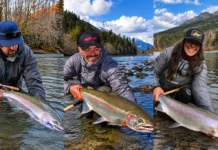
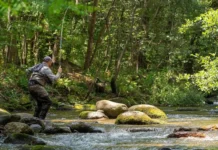
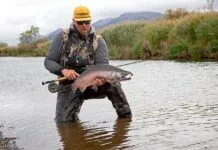
We’re diving into Newfoundland fly fishing with Kastine Coleman, a professional fly fishing guide, certified casting instructor, and leader of the Salmon Preservation Association for the Waters of Newfoundland and Labrador (SPAWN). She’s also a board member with the Foundation for Conservation of Atlantic Salmon (FCAS) and has spent years balancing life on the water with hands-on conservation.
In this episode, Kastine shares how she’s helping protect salmon runs through fish ladders, counters, and habitat restoration projects. We also dig into what it’s like to guide across more than twenty salmon rivers in Newfoundland, her approach to teaching fly casting, and why late June is her favorite time to chase Atlantic salmon.
One recent project hit close to home for Kastine — fixing up a salmon ladder and counter on the river running through Corner Brook. The team made it safer for staff, easier for fish to move upstream, and even added a live camera so locals can watch salmon (and sometimes trout) making their way through. About a hundred salmon now pass through each year, a small win that shows a big impact in local conservation.
Kastine grew up fishing in Newfoundland and started fly fishing at age 10. By 16, she had her guide’s license and began taking people—especially women—out on the water to learn. Over time, she fell in love with casting instruction, earned her Fly Fishers International certification, and now serves on multiple conservation boards, including SPAWN, FCAS, and ASF.
She guides across roughly 20 salmon rivers within a few hours of Corner Brook. The runs vary by river. Some see salmon in June, others in August, so she stays on the move. Recently, she’s added a couple of new guides to her team. Still, she keeps things balanced with a catch-and-release focus, respecting the fish and the tough seasons they’ve faced.
While Newfoundland’s salmon populations have struggled the past two years, this season brought hope with stronger returns. Kastine continues to guide, teach, and protect these wild fish, always choosing to release them so they can return and spawn again.
Most of Newfoundland’s salmon rivers are small, which makes a single-hand rod the go-to setup. Kastine says it’s perfect for the province’s favorite style — dry fly fishing on a dead drift. When an Atlantic salmon breaks the surface, you’ve got to react instantly. That quick strike is tough to do with a two-hander.
Still, a spey rod has its place. On larger rivers like Portland Creek or the Humber, where there’s more room to swing, a two-hand setup can help when the banks are thick with trees or the water’s wide. Kastine uses both but admits she fishes single-hand most of the season — usually a 5-, 6-, or 7-weight rod, depending on wind and river size.
Salmon in these rivers can range from tiny one-pound grilse to giants over 40 pounds. The biggest ones are often repeat spawners, fish that return to the same river two or three times. You can even read a salmon’s story by its scales, each ring shows a year of life, like the rings of a tree.
If you want to learn more about Atlantic salmon, Kastine recommends checking out the ASF for research and species info, and the FCAS for local, community-based projects.
Despite all that, Kastine stays optimistic. She says it’s important to keep pushing forward, especially with so many dedicated people and groups now focused on restoring wild Atlantic salmon. As she puts it, “You have to stay positive. Otherwise, you’d give up and find a new sport.”
When Kastine hits the river, she usually starts with a wet fly. Since most Newfoundland rivers run dark, you can’t see the fish, so she uses a search grid approach. Cast short, let it swing, then add a foot of line and repeat. This helps cover every inch of the run until a salmon shows itself.
If a fish rises, it’s time to switch to a dry fly and be ready — the strike happens fast.
For gear, Kastine runs a 9-foot rod with a 9–10 ft leader, usually hand-tied from 15 lb down to 8 lb test, or a fluorocarbon tapered leader from Airflo (1X, ~13 lb). She says it’s the only pre-made leader she trusts not to lose fish. Water speed changes fast on Newfoundland rivers, so she adjusts her casts.
As our conversation wrapped up, Kastine shared a few exciting updates from the conservation world. The ASF recently released a film called Rock | Plastic | Salmon, highlighting the impact of plastic pollution from open-pen salmon farms along Newfoundland’s coast and pushing for greater accountability from the industry.
Meanwhile, the FCAS is reviewing new community project proposals across Atlantic Canada — from Newfoundland and Labrador to Nova Scotia and Quebec. Each year, local groups submit ideas to restore habitat, improve fish passage, and strengthen salmon populations. Kastine, a director with FCAS, says this is one of the most inspiring times of year because it brings “fresh ideas and energy into conservation.”
Episode Transcript
00:00:00 Dave: Today’s guest has spent her life on the rivers of Newfoundland, balancing guiding with hands on conservation. Kastine Coleman is a fly fishing guide board member with multiple salmon foundations and leader of spawn, the Salmon Preservation Association for the Waters of Newfoundland and Labrador. By the end of this episode, you’ll hear how Kastine is helping protect salmon runs through fish ladders, counters, and habitat projects. While Atlantic salmon are so tied to their home rivers and what it takes to guide anglers on over twenty salmon rivers across Newfoundland. This is the Wet Fly Swing podcast, where I show you the best places to travel to for fly fishing, how to find the best resources and tools to prepare for that big trip, and what you can do to give back to the fish species we all love. Kastine Coleman is here to share the story of guiding conservation and life with Atlantic salmon in Newfoundland. We’re also going to dig into her work with Fly Fishers International. We’re going to find out about her approach to teaching casting. She’s a certified casting instructor as well, and why she calls late June the best time to chase salmon. Here we go. Let’s get into it. You can find Castine at Spawn one dot or connect with her at tight loops. Tight lines dot com. How are you doing, Kastine? 00:01:12 Kastine: I’m good. Thank you. Dave. 00:01:13 Dave: Yeah. Just checking in with you today. We’ve got a big, really cool event we got going today. We’ve actually got a giveaway going on. We’re working with Mountain Waters West or Mountain Waters Resort, and we’re doing a bunch of cool stuff today. We’re giving away not only that, but a trip with you and a bunch of products and everything. So we’re going to be talking about that a little bit today. But also the important part is the group that you work with is spawn. And we’re going to talk about some of the good work you’re doing out there and also in your guiding. So does that sound like a pretty full program today? 00:01:44 Kastine: It does. I don’t know how much time you have, but, uh, let’s get in it. 00:01:49 Dave: Nice, nice good. So let’s just go back to spawn. Let’s just jump right back into that. I’ve been, you know, in all these events, I always try to have a conservation group that we can focus on. And and, you know, I think that this is really important. Maybe you could start there. What’s your connection there? How did you come into the role. And maybe talk about what your role is there. 00:02:09 Kastine: Okay. So spawn stands for the Salmon Preservation Association for the Waters of Newfoundland and Labrador. And we are a conservation group here on the west coast of Newfoundland, so east coast of Canada, but west coast of the island. And I got involved with spawn maybe maybe ten years ago now, just on a volunteer level, uh, joined the board and sat in on meetings. And we basically are a conservation group focusing on Atlantic salmon. And we are you’re a very small organization. There’s about a dozen of us on the board, and we just kind of give whatever time and whatever effort that we have. Um, so most of that happens during the summer months because our season runs from June first until October seventh. Here. 00:03:01 Dave: Perfect. Yeah. And so that’s obviously where we’re going Newfoundland. And it is a area Newfoundland and Labrador. It’s pretty when you add both of those together it’s a pretty giant area. We’ve talked a little bit about that. And you mentioned I know off air we were talking about another group. What is the other group you’re affiliated with kind of the I think there’s a larger conservation group out there. 00:03:22 Kastine: Uh, there’s a couple actually that have Atlantic salmon on the on the forefront of their minds all the time. So one of them is the Atlantic Salmon Federation, which is ASF, and the other one is Fcas, which is the foundation for conservation of Atlantic salmon. 00:03:38 Dave: Gotcha. And are the the roles um, talk about that how spawn is maybe different than some of these other groups. Um, you know, are they all doing similar things? Different things. What does that look like? 00:03:49 Kastine: The Foundation for Conservation of Atlantic Salmon, as well as the Atlantic Salmon Federation. They’re both, a mouthful, but they’re basically the larger organizations that have the funding available for salmon conservation projects. And then span is more of people on the ground or definitely boots on the ground in this case, as we always have our waders on. But we are the group that kind of gets in there and does the work as we, you know, other people that see it and just kind of identifying different projects that need to be done around the local area. 00:04:26 Dave: Okay. And what are some of those like with spawn? What would be a describe a project that you’re doing out there, maybe that we can get a feel for. 00:04:33 Kastine: One of the recent ones that we just finished was we have there’s a salmon river that runs through the center of the town where I live, which is corner Brook. And on that river there is it’s it’s been dammed to make like a little swimming area and a place where the swans hang out, and it’s a really pretty walking trail. So in order for the salmon to get up that river, there’s now like a salmon ladder. And so we have a counter at the top of that ladder. And that needs repairs. And you know, it needs a little bit of work. So our most recent project was bringing that up to standard so that it was it was safe for our staff going in there and an easy access for the salmon. And we’ve also installed a camera in there so that we kind of have eyes on the fish that are coming through. 00:05:23 Dave: Oh, wow. Yeah. That’s cool. And how does the camera work? Is it, uh, just run twenty four over seven? 00:05:29 Kastine: It does? Yeah. So it’s, um, Rogers, which is the local TV network here. They’ve been able to help us out with that, and they just got a camera installed. So it’s basically just a live feed of the salmon’s. You see them when they come in the counter and they kind of swim around. And every now and then you’ll get trout in there feeding. And it’s a pretty it’s pretty neat thing to watch. 00:05:50 Dave: Wow. That is cool. And are you counting. Is that the way you you pretty much count every single fish that is coming through there. 00:05:56 Kastine: We do? Yeah, the salmon in the river were basically eliminated. And so we’ve just been trying to get them back up. Now it’s a it’s a pretty small system and we might be at the max, but I think we get about one hundred and some odd fish through every year. So it’s a pretty fun little small project that just helps to engage the community and provide a little insight on species. 00:06:19 Dave: That’s awesome. Yeah. So that’s, uh, and the cool thing is, is that. Yeah, I mean, probably every single stream out there matters, right? Whether it’s one hundred fish or, you know, or a thousand. I mean, right, they’re all they’re all part of the same, I’m guessing maybe describe that a little bit. I’m not sure if, you know, kind of Atlantic salmon life histories is this are all the fish that are swimming into say, because we’re going to be fishing Portland Creek. That’s going to be one place we’re fishing with Mountain Waters Resort. But are those fish similar? Are they could they be turning into this stream you’re talking about as well? 00:06:50 Kastine: No, actually. So they’re all similar. But the Atlantic salmon returned to the rivers that they were born in, and a lot of the times they go back to the exact pool where they were born or a very similar location. So they don’t generally change their rivers unless something happens that could force them to do so. So save a river was dried up and they needed to spawn. I’m sure that they would adapt and go into another one, but for the most part, they’ll always return to the river that they were born in. 00:07:20 Dave: Gotcha. Okay, so and how far is the stream you’re talking about? Or maybe you’re the it was corner Brook where you live. How far is that from, say, the Portland Creek area? 00:07:30 Kastine: It’s about an hour and a half. 00:07:31 Dave: Okay. Hour and a half. Yeah. And you’re maybe describe that a little bit for somebody who hasn’t been there. Maybe. Let’s take it back a step. Maybe for Newfoundland. Let’s go go back there. So maybe describe that Newfoundland. You know the area, the towns. You know, what is the biggest town there and kind of and where are you at? 00:07:49 Kastine: Okay. So I am on the island portion of Newfoundland in Corner Brook, which is on the West coast. We’re probably around the second largest community in the in the province, the largest being Saint John’s, which is on the East coast. It doesn’t seem like a very big island, but it’s about seven and a half hour drive. 00:08:07 Speaker 3: Oh, wow. 00:08:07 Kastine: Yeah. 00:08:08 Speaker 3: So that’s big. 00:08:09 Kastine: It is. It takes a little while to get across. 00:08:11 Dave: And Deer Lake is, uh, is where I think we’ll be flying into. Right. Is that kind of a hub as well? 00:08:16 Kastine: Yeah. So Deer Lake is about forty five minutes from corner Brook, and it’s the airport that we have over here on the West Coast. So you’ll be traveling up the northern peninsula from there, which is the most amazing drive. 00:08:31 Speaker 3: Oh it is. 00:08:32 Kastine: Yeah. You pass right through Gros Morne National Park. 00:08:35 Dave: Oh, nice. There’s a national park in there. 00:08:37 Kastine: Oh, yes. It’s amazing. 00:08:39 Speaker 3: Cool. 00:08:40 Dave: I’m excited. I’m already. I’ve already been excited. But this is even better. So. Yeah. So you go through a national park and is that just like a the terrain, is it kind of mountainous or what makes it a national park. 00:08:50 Kastine: It has. There’s one section there called, um, the Tableland Mountains, and it’s actually a place where the Earth’s mantle is exposed. So it’s bright orange, like rust colored rocks. And, you know, it’s a it’s a really special place to, to visit because it’s not every day that you get to walk on the Earth’s mantle. 00:09:11 Dave: No. Yeah. No, that sounds pretty cool. Okay. And. Yeah. And obviously it’s this is a giant, um, you know, it’s seven and a half hours across, uh, in Saint John’s, you know, from, I guess that’s the thing across from west to east. But you can drive it, right? There’s plenty of there’s a main highway that. What is the highway that goes across the. 00:09:29 Kastine: Yeah, the the Trans-Canada highway goes right across from port aux Basques, which is if you’re driving to the province, most people take the ferry and then go to port aux Basques. So the only way in here is to take the ferry or to fly. 00:09:43 Dave: Yep. That’s it, that’s it. I think there might be some people that are doing the ferry and flying on this one, but cool. Okay, so that’s a little bit of getting our perspective here. And so back to spawn. So spawn you mentioned the project of the the fish counter which is important because knowing how many fish you have right obviously is big. So do you have a good feel for, you know, just in general on the creeks and rivers, streams on Newfoundland, how large the ups and downs of the populations or this kind of like a one off counter? 00:10:14 Kastine: Uh, there are a few rivers that are counted in the province, and I find there’s probably not enough places that are being counted, but it’s one of those things where you kind of like the information is important, is just getting the resources and being able to track the different rivers. So there’s a a list on the DFO website of all of the rivers that are currently being counted and the returns for each year, um, and then like, um, basically like an average over the years that that they were counted. So like the exploits River in central is a pretty, pretty large one. Those are counted. And then there’s, I don’t know, there might be a dozen rivers on the island that are counted, or a couple more and a few in Labrador. 00:11:05 Dave: And few in Labrador. Okay. And what was the website, the DFO, what is that website? 00:11:08 Kastine: I can send you the link for it, but it’s the Atlantic salmon Fishway counts. And actually you can access it from the spawn website. Spawn one. If you go down like probably on the homepage, you go to fishway counts. 00:11:22 Dave: Good. We’ll go do that. Go down. Oh yeah. You got tons of stuff here. I see it now. And so this is a good resource here. People can take a deeper look. I see the corner brook stream and everything. Okay. This looks like you’ve got some good stuff. So this project with the fish counter isn’t the only thing you have going. It looks like you’ve got some other things going throughout the year. 00:11:40 Kastine: We do? Yeah. We’re actually working right now with the Atlantic Salmon Federation on the lower Humber River, and we’re putting up some markers to kind of protect the spawning areas in the river. Um, so we’re they’re ordered in and we’re just waiting for them. We’re hoping to get them up before the spawning season starts. And that’s just to basically eliminate some of the, uh, the high speed water, uh, boat traffic that goes over those areas because we’re the our rivers here on the island, the most of them are fairly dark water. We have a lot of tannins in the water. And so you can’t see fish. So nobody would ever know they were going over spawning habitat. 00:12:23 Dave: Gotcha. Okay. Right. So they’re just zipping and these fish are spawning. Are they spawning in the big rivers, the small rivers, everything in between or what’s their prime spawning habitat? 00:12:33 Kastine: Uh, every single river that they enter is one that they’re going to spawn in. So. And they spawn right in the rivers, they may go into lakes, uh, just to kind of get a bit of a break from the temperature, but they’ll drop back down into the rivers to spawn. And that usually happens when the water temperature gets to about five to seven degrees Celsius. 00:12:53 Dave: And so and that’ll be typically in the what is the prime peak spawning time. 00:12:57 Kastine: I would think around November. 00:12:59 Dave: Yeah November. That’s right. And so we’re going to be there fishing I think in June. Well the the fishing time right. Is uh I guess they, it starts in June and goes through all the way. Until when do you stop. When’s the last the latest. You’re fishing for them? 00:13:13 Kastine: Uh, most of the rivers are closed now, but the lower Humber River is open until October seventh for catch and release only. 00:13:19 Dave: Okay. So. Yeah. So as we speak now, it’s September fifteenth and today is actually I’m talking in the future in the past. But essentially we’re recording this now September fifteenth, but we’re also launching this October twentieth as we speak. So the the season will be closed for everything at that point. And, and you’ll be waiting for back into June before you’ll be fishing again. 00:13:43 Kastine: It’ll be June first. Yep. 00:13:45 Dave: June first. Okay. Awesome. Well, this is already getting started. Good, because there’s a ton of information I love when I’m overloaded with information, including everything with spawn and the conservation, but also the fishing and I. And for you, you’re also guiding out there. So maybe we could talk a little bit about that. What? Um, let’s take it back to a little bit to the start here. Have you been guiding out there for quite a while, or what’s your experience around the fly fishing? 00:14:06 Kastine: I’ve been involved for quite a while. I started fishing when I was a little kid. I mean, you’re growing up here in Newfoundland, so that was kind of the norm. Um, started fly fishing when I was about ten, and when I turned sixteen, I got my guides license, basically just because I had everything that I needed at the time I was involved with biathlon. And so you need to have your firearm certificate and your, your boater safety course and your first aid. And I was like, well, I could be a guide too. And I remember my mom at the, the start of it was, uh, you know, of course there were no cell phones or anything like that. So she said, I don’t want you going into the woods with strange men, which is a legitimate concern. 00:14:50 Dave: Right. That’s legitimate, old girl. Yeah. 00:14:52 Speaker 4: And so I said, all right, well, I’m. 00:14:54 Kastine: I have it, but I may never use it. And after a while, I realized that I could kind of pick and choose when I went and I, I started, uh, guiding with women, mainly, um, just bringing people into the sport and trying to get them involved. Then I fell in love with the casting and the instruction side of fly fishing. So I pursued my casting certification with Fly Fishers International. So I added that to to my little list and just it’s been it’s been an amazing journey actually. So I’m on the the board for Fly Fishers International now as well. And just always trying to stay involved. 00:15:38 Dave: If you’re looking for a world class fly fishing experience, it’s time to check out Mountain Waters Resort, nestled along Newfoundland’s legendary Portland Creek. This spot has a history that runs as deep as the Atlantic salmon that call it home. Once a fly fishing retreat for the great Lee Wolf, today it’s your turn to step into these historic waters and swing up your salmon this year. You can head over to Wet Fly. Waters right now and make it happen. That’s what. Waters. Let’s get out there today. Experience the waters of Bristol Bay at Togiak River Lodge, where fly fishing meets Alaska’s rugged beauty. This is the place to complete the Alaska Grand Slam with all five salmon species, rainbow trout, Arctic char and more. Where each day offers a new Alaskan adventure, you can visit Togiak Lodge right now to start planning your Bristol Bay experience with Togiak River Lodge. You’ve got a busy schedule, you’re on the board of Fly Fishing and spawn. And then are you also affiliated with the other larger conservation groups as well? 00:16:46 Kastine: Yeah, I’m on the board for the Foundation for Conservation of Atlantic Salmon, and I’m a volunteer with Atlantic Salmon Federation. 00:16:54 Dave: Amazing. So how do you do it? That seems like being on the board for multiple groups and and then everything else. How do you balance all your time and all that stuff? 00:17:03 Kastine: It is a lot of work, but it helps me to stay involved. We live in a very small province. Um, we are, you know, disconnected from a lot. And you could be if you wanted to be. But in this day and age, with all the zoom transformations, it’s been absolutely wonderful. So a lot of my some of my meetings are in the mornings, but most of them are in the evening. So most of the the fly fishing ones with the Fly Fishers International, they’re on the West coast primarily and down in the US. So our meetings well for me, they don’t start till nine thirty in the evening. So there’s always lots of time. 00:17:39 Dave: Yeah, so tons of time. And you have the guiding is keeping you busy as well. What is. What does that look like? Maybe talk about that this year. Have you been out a decent amount going for it this year. 00:17:50 Kastine: Yeah. So our guiding season. So we have uh from in corner Brook where I am, there’s about twenty rivers that were are within a two and a half hour drive. So the Atlantic salmon enter those rivers at different times of the year. So you could have two rivers that are less than a kilometer apart from each other. And one river, the salmon enter in June. And the other one, they don’t come in until August. So we base our guiding off of whatever rivers are showing fish at that time of year. So it kind of keeps me on the move. Uh, basically just picking rivers the day before or two days before and driving to that river, fishing for the day, and then coming home again at the end of the day. So it keeps me on the road a lot. I enjoy it, I love it, and I’ve been able to hire a couple of guides this year to help me out with that. 00:18:41 Dave: So it’s oh, wow. 00:18:42 Kastine: Yeah. It’s nice. 00:18:43 Dave: There you go. So you’re kind of getting into more of like as an outfitter, right? You’ve got some other people coming on some other guides. Is is there enough work there that it looks like you could kind of, um, keep scaling up the operation there? 00:18:57 Kastine: I don’t know, it’s, uh, I find it really hard where, like, our Atlantic salmon population is declining. So we just had, uh, two of the worst years in history for Atlantic salmon returns. And so recognizing that is really important. You know, I don’t want to I don’t ever try to drag people here to make money when the fish are struggling to survive. So this past summer was well, it was way better than the last two years. So we had lots of fish returning and that was a really, really good thing. So yeah, I don’t know. It really depends. It’s a it’s going to change every year. And it’s a it’s a great province for tourism. So we get a lot of some people are just coming for like a week because they really want to come fish, fly fish for Atlantic salmon. And other people are just here for like a day or two on vacation. So it’s a it’s a mix of both. 00:19:53 Dave: And I could see the, you know, I think for me at least, and I think a lot of people are similar, is that the fishing is definitely a part of it. That’s why we’re all coming here. That’s why we’re all listening. But, you know, the travel and everything else is cool, you know? I mean, it’s like depending on where you are in the, in the world, every place has a special, you know, thing about it. Right. And so it feels like that, you know, that you also have that there. And it’d be cool just to see, like you said, the national park and just to learn about the area and the culture and all that stuff. Right. It sounds like it’d be pretty amazing. 00:20:23 Kastine: It is an amazing province. 00:20:26 Dave: Nice. So you mentioned at the start we were talking about the run. So did you say that the runs were gone completely at with Atlantic salmon in Newfoundland at some point or no. 00:20:36 Kastine: The last two years were. Yeah, they were scary. 00:20:39 Dave: The last two years were scary. But the runs have never gone like extinct on the island. They’ve always had runs there. 00:20:44 Kastine: No, that’s that’s right. Yeah. They’ve gone extinct. 00:20:47 Dave: Yeah. Because I know there’s some areas I think if you go over to Europe you could see these places where they have had that happen. They’ve reintroduced them, you know, and you see some positive signs. We’ve heard those stories. Right. But but yeah. No, that is a challenging thing. So runs are obviously up and down. And we’re seeing that with steelhead too. Like we mentioned. You know we’re doing some stuff in British Columbia. But on the other side of the continent you know you see steelhead runs that are definitely have been drastic declines as well. And we see some years it looks like maybe there’s they’re bouncing back decently this year in some areas. So you know we’re excited about that. But but I guess that’s why it’s so important to do the tracking of fish and knowing how many fish are there. I’ve also heard that you can actually keep Atlantic salmon. What’s your take on that. Is that still can you actually still kill Atlantic salmon? And while these wild fish in most of the areas. 00:21:36 Kastine: Where actually they changed the regulations almost every year or every second year, depending on. I believe we’re on a two year management plan right now, but we are still allowed to keep two Atlantic salmon per angler per year. So I actually run a catch and release guiding business. Um, so we let all our fish go. But and as myself as an angler, I don’t keep fish. I don’t have a problem with people that do keep fish, but I just choose not to. I’ve seen the population struggle and I just have such a love, such a soft spot for these fish that I just. I like to let them go and and see what can happen. 00:22:16 Dave: See? Yeah. See him? Let him go and let him make some babies. Right. They come back. So are there hatchery fish at all in that area? 00:22:24 Kastine: Not over here, no. Uh, the exploits has, uh, they did a restocking program years ago. Uh, but, no, none of the fish here are hatchery. It’s all wild. 00:22:36 Dave: So that is the the interesting thing I think in some areas where there are hatchery fish, it would make complete sense to take some fish because their hatchery fish and you know, and all that stuff. But so I guess I’m guessing that is probably a little bit of a, you know, some people probably controversy maybe. Right. Whether you need especially in the lower returns, you know, because every fish is probably super critical, but sounds like you’re running a pretty awesome operation there. Well, what else as we look at we’ve talked about spawn a little bit there. Do you want to highlight just maybe a couple more projects or something else we could look at, maybe that might be coming ahead in the future up there? 00:23:10 Kastine: Yeah. So every May we run an auction online and it’s basically a fundraiser for the organization. And we’ll people donate flies, fishing rods, trips and really random objects that have nothing to do with fishing but are still fantastic. Um, you know, sometimes there’s there’s heat pumps and there’s. 00:23:33 Speaker 5: Oh nice. 00:23:34 Kastine: Chainsaws. Like, it’s a it’s pretty awesome. Yeah. So it’s just a lot of the local businesses that, uh, see the value in what our organization is doing. And they donate little items and we have an auction online every year. So that’s our main fundraiser for the group. And then we just use that to do some of the smaller projects that were the day to day operations. 00:23:57 Dave: Okay. And if somebody was listening right now and they wanted to contribute, what is the easiest way? What would be the action? You would you would give them now to help support the spawn? 00:24:07 Kastine: Uh, shipping is usually a little bit of an issue on the island. A lot of times when we have donations from outside the province, it’ll just be money. And then you could say, like, I would like to donate this object, can you go get it? And then so it kind of makes it, then we get to support local businesses at the same time. So just like money for our group would be a great thing. And then we could pick something up and put it in the auction. 00:24:33 Dave: Okay. And how would they contribute the money there? 00:24:36 Kastine: On our website. On spawn oncaea. You can, uh, there’s ways to donate. 00:24:41 Dave: Yeah. Support. Spawn. Perfect. Okay. Good. Well, we’ll put links out to that. And I also see there’s some volunteer times. So you’re always looking for volunteers as well out there. 00:24:50 Speaker 5: We are. 00:24:51 Dave: Good. Well that’s a good rundown there on that. And then let’s jump into a little bit on the fishing because I think that’s something obviously we’re all coming there to fish. I think one of the cool things here is that the fishing, you know, we do a lot of, uh, Spey. I’m no expert in the Spey casting the two handed rods, but, you know, we’re all getting better at it and stuff like that. And so for steelhead, that’s a big part of it. And Atlantic salmon. I know that the single hand rods are still pretty popular. Are you running mostly single hand or are you doing double or what does that look like? 00:25:20 Speaker 5: A lot of our. 00:25:21 Kastine: Rivers are smaller. 00:25:23 Speaker 5: So. 00:25:23 Kastine: Single hand is ideal also because the salmon here really love taking a dry fly on a dead drift. So single hand is pretty key for that. And just being able to get it exactly where you need it to go and, and be ready to to strike. So it has to be the hook has to be set the second the fish breaks the surface. 00:25:47 Dave: Oh, right. 00:25:48 Kastine: Which can be a little bit of a, a little bit of a longer process, maybe on a, on a two handed rod. But there’s a time and place for everything obviously. So some of the larger rivers, you could probably get away with it at Portland Creek, uh, the lower Humber, the upper Humber, depending on the time of year, if there weren’t too many people around. And, and then there’s a few other rivers where it’s, uh, it would be great, especially because there’s a lot of alders and trees that are along the riverbank. So having that two handed setup is, is pretty nice to have in your back pocket. 00:26:23 Dave: Oh, so the two handed setup is is a nice tool to have out there. 00:26:27 Kastine: Absolutely. And it’s getting more popular every single year. 00:26:31 Dave: It is. And do you do a little of both? 00:26:33 Kastine: I do a little of both. I’m not awesome. I’m not gonna lie. 00:26:37 Speaker 6: But I’m getting better. 00:26:38 Dave: No, exactly. No, it’s funny because we have. I mean, like I mentioned, Brian is out in the bay. He’s an expert spey caster. I’ve talked to, you know, champions, casting champions and stuff, and I’m not even close. Right? I’ve just been, you know, I do it well enough to get the fly out there. 00:26:56 Speaker 6: Yeah. 00:26:56 Dave: You know, and I’m learning. But it’s interesting because when I started steelhead fishing there’s a lot of similarities. This is one of the reasons I love I’m excited about doing this trip because I’ve been fishing for summer steelhead. You know, with steelhead there’s two kind of there’s winter. There’s summer for the most part. And summer steelhead are way more active because the water is warmer and they’re a lot like Atlantic salmon that I’ve been told. I’ve never caught Atlantic salmon, but even some of the books that I’ve read as a kid were Atlantic salmon books that I learned from, you know, and but they’re the same techniques that we use for steelhead. So it’s going to be cool to see what that’s like. The similarities. But the cool thing is, when I started fishing and we were fishing a big river, our home water, you know, the Deschutes is a large river. We fished all single handed. This was before there were double handed rods, like back in the, you know, eighties 90s, you know, sort of thing. And but the Spey revolution started in the late nineties and then got going as we and I just never I jumped on late. Right. And but my dad was like anti he was like anti sp-a rods. He was a guide and he loved the single. But the challenge with the single hand rod on those big rivers is casting, especially when the wind comes up. We got an eight or nine foot eight weight and it’s you know, casting with that and trying to cast far as hard, are you pretty much using the, um, single hand rod until the conditions change and then you break out the two hander? Is that how that works? 00:28:14 Kastine: Not really. I pretty much fish a single hand all year. Unless I, uh, there’s just a couple of places I go where I would prefer to use a double handed rod, and I primarily fish. Uh, five weight, six weight. If it’s windy, I’ll go to a seven. 00:28:31 Dave: Yeah. So you’re using a five or six or seven? The two handed rod? 00:28:35 Kastine: No. Single. 00:28:35 Dave: Oh, wow. So you’re using a pretty light lightweight rod. 00:28:38 Speaker 6: Yes. 00:28:38 Dave: Gotcha. That’s interesting. So how do you if you get, let’s say, a big fish, right. Because some of these salmon get pretty decent. Is that a challenge on a five or six weight? 00:28:48 Kastine: Uh, if I’m fishing somewhere where I know there are big fish, then I’m usually at a six or a seven, but it’s basically just to, you know, drop the tip and play that fish off the reel instead of cranking on it hard from the tip of the rod. 00:29:01 Dave: Okay, so yeah, you pretty much know if you’re in an area that’s going to have large, larger salmon, what is the the size range? What would be a on the lower end salmon that have migrated out to the ocean. How big are those fish. 00:29:13 Kastine: Sometimes we have some micro grills returning which is just a really small grills, um, because of food availability in the ocean. And uh, those are down to about a pound and a half. And then the I would say the majority of the like first year returning grills are maybe three to five pounds and then they go all the way up to forty pounds. 00:29:41 Dave: Forty. Yeah, right. Which is crazy. And those forty pounders, I’m not sure if you know the life history, are those fish that are out in the ocean for like, you know, like five years. Like how long are, like those big the biggest ones you’ve seen or heard of? How long have they been out there? 00:29:56 Kastine: Uh, they are most likely repeat spawners. So they’re probably coming back for their second or third time. Back to the rivers. 00:30:04 Speaker 6: Oh, wow. 00:30:04 Kastine: Um, yeah. And so you can actually take a scale of a salmon and look at it under a microscope, and you can see the growth cycle, um, almost like rings on a tree. So the years that the fish are in the ocean, they’re feeding and they have a larger growth ring. And then the years when they come back into the rivers to spawn when they’re in fresh water. Atlantic salmon don’t eat. So there’s very little growth that happens on the years they return. So when you take a salmon scale, you can actually see, uh, like how many times it returned to fresh water to spawn. 00:30:38 Dave: And it’s really interesting because the repeat spawners, you know, again, another similarity to steelhead, which is really interesting because when you look at Pacific salmon, you know, we were up at Togiak River Lodge fishing this year for Chinook salmon. You know, all those fish are dying. All the Pacific salmon die. They don’t repeat spawn. But steelhead do repeat and so do Atlantic salmon, which is interesting. There must be more similarities than just the fishing of these species. 00:31:02 Speaker 6: I would say. 00:31:03 Dave: That is cool. Okay, so you have some of these larger fish. And I mean for me, you know, and I think probably a lot of people who haven’t caught one, I would be happy with anything. You know, I would, you know, just catching Atlantic salmon. And I think a lot of actually listeners aren’t necessarily in the trophy hunting, you know, category. Like, of course we all love catching big fish. It’d be great to get a big fish, but I’d love catching whatever. You know, just seeing that fish would be beautiful, right? It’s, um, with their colors. When they come in, they’re into, um, into these streams. Are they chrome bright, or is there a lot of diversity on coloration? 00:31:34 Kastine: So they’re always bright silver when they first come in out of the ocean. And then as they spend time in the freshwater, they’ll start to darken. So right now, so on the lower Humber there’s still fresh fish coming in. Um, I had a friend yesterday who caught a bright silver fish, which means it’s only just recently in. And then a guy this morning at the grocery store stopped to tell me that he hooked one last night, and it was. I asked him the color, and he said it was really dark. So you have a good mix of fish that are coming in right up until long after our season closes. So right now the small males are in the system already and the large females are in the system. Small females as well. And then the large males don’t enter until sometime after our season closes on October seventh. So here we don’t ever get to see those big males coming in all colored up with the big Jack there where their, uh, jaw drops away. You know that hook? But other rivers, you do like, uh, flowers river up in Labrador. They’re already in the system. They’ve been there for a while, so it just depends on the river and the time of year. 00:32:48 Dave: Gotcha. So the fish are. So you’re saying the males come in a lot later than the females are already in there, and the males come in later. 00:32:55 Speaker 6: And. 00:32:55 Kastine: The females are still coming in. So we have fish entering on most of the tides still. Uh, but yeah, on the lower Humber River, the larger males don’t come in until later in the season. 00:33:06 Dave: Oh, cool. Yeah. This is really interesting. You mentioned a couple of the bigger groups you’re working with there. Where would you go to find more information on kind of that stuff? Life history, just to learn about the fish species and things like that. 00:33:18 Kastine: So the Atlantic Salmon Federation has done a great job on putting out some of the actual details on Atlantic salmon, and so their website is ASF. And then the Atlantic Salmon Conservation Foundation, they focus more on like community driven projects. And so you’d you’d have a lot of findings there about just like local communities local streams and and things that are kind of driving the reason for the projects, I guess, which give you some better insight into the fish as well. 00:33:52 Dave: Yeah. And what are the you know, I could probably guess some of the challenges, but, you know, the numbers are up and down and you have ocean conditions, things like that. Do you have a finger on do you think it’s more ocean conditions that are impacting them, or is this a mix of fresh and salt water impacts? 00:34:08 Kastine: There’s a couple things. Uh, we have a crazy number of seals off. 00:34:14 Speaker 6: The coast. 00:34:15 Kastine: Of Newfoundland. So they are feeding on the kelp as they’re exiting the rivers in the spring, and then they’re feeding on the fresh fish that are entering back in the rivers. So that definitely is having an impact on our stocks. And then you’ve got some of the ocean, the sea cage, aquaculture au aquaculture. 00:34:39 Dave: Right. 00:34:39 Kastine: So they’re just off the coast. And some of our fish passed by those farms on their migration route. So they’re susceptible to some of the diseases and all that fun stuff that’s associated with those. So that has had an impact in my opinion. And then it’s just food availability in the ocean, which is, you know. 00:35:03 Dave: Fish fly guide service is passionate about sharing Jackson holes, world class fishing from its iconic rivers to hidden backcountry waters, the legendary mutant Stone and other fantastic hatches bring explosive top water eats during peak season. Backcountry Creek’s hold hidden gems where every band offers something new and wild trout rise in untouched waters. Jackson Hole sits in the Golden Circle for trout, home to the headwaters of three major river systems the snake, the green, and the Yellowstone. Here you can chase native cutthroat trout, big browns, wild rainbows, and even kokanee on the fly. If this is your kind of fishing fish, the Fly Guide service is ready to take you there. Book your trip right now at Fish Thefly.com. So you guys, when they come into freshwater, it sounds like there are some dams, but for the most part the habitat there is in pretty good shape. In Newfoundland. 00:35:53 Speaker 6: It is. Yeah. 00:35:54 Kastine: I mean, we probably still have some work to do. Um, just being able to keep those cold water, uh, refuges available in the rivers for when the salmon do come in, because our rivers lately are much warmer than they have been in the past. Um, probably there’s some cutting alongside of the rivers, which would have an impact on just water runoff and snow melt and that sort of thing. And we’re getting less snow than we normally do, so we don’t have a whole lot of cold water going into the rivers in the spring either. So there’s a lot of things going on. 00:36:30 Speaker 6: But yeah. 00:36:31 Dave: There are a lot. Yeah. No, I see it. I’m on the Atlantic Salmon Federation site. And you know, one of the top stories is investigation reveals extent of a salmon farm plastic pollution in Newfoundland. Right. So there’s all these things. But but you mentioned it. Yeah. The big climate change seals aquaculture. That’s the challenge I think. Right, is that none of these species have it easy. There’s lots of things that, you know, a lot of them are human influenced. But I feel like, you know, there always is I think there can be a negative thing, but I feel like I stay positive on it. Maybe because that’s the only way, you know, the best way to do it. But what’s your thought on it? Do you feel like, you know, we can make some changes here and have turn things around a little bit and keep seeing maybe some larger runs? 00:37:14 Speaker 6: I think you. 00:37:16 Kastine: Have to stay positive on it. Otherwise you would give up and go find a new sport. But, you know, yeah, there’s a lot of really good people that are involved and there’s some great groups that are, you know, everybody seems to have conservation and restoration of the wild Atlantic salmon at the forefront right now, more so than in the past few years. So it’s really nice to see that you’ve got other people on your side. So it’s really it’s a great time to be here. 00:37:45 Dave: Yeah. That’s awesome. No we’re excited I think that and the fact that there’s definitely still some salmon there to check in on is going to be cool. Well let’s get a couple tips. We’re going to take it out of here in a bit. But I want to talk. You know you’re on the river. We’re getting ready. We mentioned you know, Portland Creek, which we’re going to be at, but I’m sure there’s going to be some people that are going to want to hang around or come early, maybe check out some other stuff as well. But what does that look like? So if we’re on the water for you, if we were calling you, you would probably would you say, you know, if we were planning a trip a year out. Do you kind of say, well, let’s wait until, you know, we get there to decide where we’re fishing? Is that kind of how you take it day by day? 00:38:21 Kastine: We know the general area where the fishing will be good based on dates. So, you know, usually if somebody is booking the beginning of June, we’d be fishing in a specific area which is the middle or, you know, middle of July would be completely different. 00:38:36 Dave: So yeah. Gotcha. So what would be the place if we were let’s just say we were coming in that kind of late June. What would you be thinking about late June? 00:38:43 Kastine: That’s the best time. 00:38:45 Dave: Nice. 00:38:47 Kastine: There’s a there’s a lot of rivers at that time of year with, uh, with Grilse coming in, so. Yeah, it’s pretty awesome. You can’t really mess up on the rivers then. Now, I shouldn’t say you can’t really mess up, because there’s always factors that, you know, you could fish for a month and not catch a fish. Right, right. So it just depends on what the salmon and how they’re feeling on that day. And, you know, it just it gets exciting. And as long as you come here knowing that it’s about the opportunity to fish and the places that you’re going to get to see and visit along the way, that’s what makes it the best trip. 00:39:25 Dave: I think definitely just being open and checking things out and trying new areas, would we? If you’re going to be there for a few days, would you typically be sticking on one water or would you be mixing it up a little bit? 00:39:37 Kastine: If there’s fish there, you’ll probably stay. Although I do love changing rivers because it just it’s so nice to fish brand new water and try to figure out the pools and, you know, see where the fish are. And yeah, I really like changing rivers. 00:39:53 Dave: Yeah. Me too. So and you mentioned as far as the gear. So five six seven. So if we were going to be bringing some rods what’s your recommendation. So would we bring one of each or should we bring just a six. What will we do there. 00:40:04 Kastine: Most people will fish a seven or eight weight here in the province, Portland Creek. That’s where they make wind so windy. Yeah. 00:40:16 Dave: Why is Portland Creek? Because you have all these other things that are on the coast. Why is Portland Creek can be so windy? 00:40:21 Kastine: Uh, I don’t know. It’s just. It’s right. You know, we’re you’re close to the ocean, and you’re on the northern peninsula, so you can get some pretty windy days no matter where you are. But that’s just always the joke. We say that they make wind in Portland Creek. 00:40:36 Dave: There you go. 00:40:37 Kastine: Yeah. So Portland Creek, you’ll definitely want a seven or an eight. Uh, just because of the wind. And then the smaller rivers. Yeah. So you can get away with a seven weight on most rivers. 00:40:49 Dave: Yeah. You can. Yeah. Okay. So a nine foot seven weight. 00:40:51 Kastine: Yes. 00:40:52 Dave: And just, uh, bring sink or a dry line. That’s. Is that all you need? Just a regular, like, weight for just a dry line. 00:40:57 Speaker 7: Yeah. So we use. 00:40:58 Kastine: Floating fly lines here. Weight forward and single hooked flies. Uh, they can’t be weighted. 00:41:06 Dave: No weight. So you can’t use weight at all? 00:41:08 Kastine: No. And your barbs have to be pinched. 00:41:10 Dave: Yep. And pinched. Awesome. Well, those are all good regulations. 00:41:13 Kastine: Very good. 00:41:14 Dave: So. So there you go. And then when you’re on the water, maybe talk about that. Let’s say you’re in. We’re fishing. What should we be thinking about? What does that look like when you’re on the water? I know they’re coming to the surface. So are you fishing? Mostly. Talk about the fly that you would be using there. 00:41:29 Kastine: I usually start with a wet fly, unless you can. Like if a fish comes up and you know, you think you know exactly where it is, then you could use a dry fly. But for the most part, when you’re just walking into a river, you’re going to want to put on a wet fly and create this grid pattern to search for the salmon. Because I mentioned earlier, most of our water here is really dark, so you can’t see anything. So you’re basically starting with a super short, like just the tip of your leader out, and you’re going to work it out six inches to a foot at a time and let that cast swing all the way downstream. And you’re going to add on six inches or a foot and cast again. And so you’re creating this grid pattern as your fly swings through the water just as a searching tool basically. 00:42:18 Dave: Yeah. Searching tool. Okay. And then and is the cast like forty five down or is it straight out or were you how are you casting? 00:42:25 Kastine: It’s going to depend on the speed of the water. Uh, fly speed is really important for Atlantic salmon. So you don’t want to have it too slow. Obviously don’t want it too fast. Um, because Atlantic salmon are not feeding in the river you’re just looking for. I guess it’s like an instinct strike or you annoy them. We don’t really know what it is, but you’re just happy it works. 00:42:51 Dave: And what is the common fly? What’s one of your favorite? I know flies aren’t necessarily, uh, the game changer, but what is one you would start with or you like? 00:42:59 Kastine: I think one of the most popular wet flies here is probably a blue charm. 00:43:04 Dave: Oh, a blue charm. 00:43:04 Kastine: Yeah. And it would probably catch a fish with it on any river. 00:43:09 Dave: Yeah. Blue charm. Yeah. And that’s a it’s interesting because it’s got the yellow which is a cool color. Then it’s black and then but it’s got that really blue. The what color blue is that, that it’s got on. It’s kind of a super blue. 00:43:21 Kastine: Uh, well I guess here everybody changes the colors because it’s probably not a whole lot of material available. So it’s basically whatever you can. 00:43:31 Dave: Whatever you got. 00:43:32 Kastine: Yeah. And so the color blue is going to change on everybody’s fly. Uh, the but color is going to change. So sometimes it’s a, a green but blue term or you got a blue term. And then there’s the dark wing and the light wing. So that is probably the reason why it’s such a successful fly is because there’s so many variations of it. 00:43:53 Dave: It’s so diverse. Right. Because you could have you could have the wing, a squirrel, you could have the wing as whatever. Right? 00:43:59 Kastine: Yeah. Calf tail. 00:44:00 Dave: And yeah. What’s your what’s your favorite color? Do you have one that you really love as far as Dark Wing and all that stuff? 00:44:06 Kastine: Uh, white wing, blue charm. 00:44:07 Dave: Okay, so white wing. And then what would the tail on that be? 00:44:11 Kastine: Probably you could put like a little bit of red floss or green floss on the butt of it, or even two colors if you’re feeling up for it. 00:44:19 Dave: Yeah. Okay. And are these flies? I know I love flying. In fact, I was there last night with my family. We were tying steelhead flies and getting ready. It’s really cool because my kids are, you know, they’re nine and eleven or. Sorry. I say that every time. They’re they’re thirteen, they’re thirteen and eleven and they’re really getting into it. In fact, I was giving them a little incentive. I says, all right, so for every fly you tie, I’ll pay you, I’ll give you some money. 00:44:41 Speaker 8: Oh that’s awesome. 00:44:42 Dave: Yeah, I’m kind of, but they’re really awesome. They’re super like because I started them really young, but they never got fully into it. But they’re good enough now where they’re pumping out these wet flies like, like the blue charm is one we got definitely Add because I’ve never fished that one. But what is the are you tying these really sparse or are they kind of fully dressed. What does it look like? 00:45:02 Kastine: I’m not a super particular fly tyer. Like I throw anything on there. Whatever. My the muddlers are probably my favorite because they’re so random and messy. 00:45:14 Dave: Mothers are great, and they’re kind of a different fly to right, because that’s not necessarily wacky or that’s not like a wet fly, right? It’s kind of making some commotion out there. 00:45:22 Speaker 8: Yeah. 00:45:23 Kastine: You’re great. The sun starts to set. 00:45:25 Dave: Okay, so muddlers in the evening are good. 00:45:28 Kastine: Um, I’m giving you all my secrets here, Dave. 00:45:30 Dave: Oh, man, these are amazing. No, I’m taking it in because the blue charm. I would love to catch a fish on a blue charm. The muddler is one that I know. I’ve talked to a lot of anglers. Steelhead anglers who have said, like they love the muddler. It’s their favorite fly. Purple muddler. That’s awesome. You know, so if you haven’t used purple bed purple muddlers. Um, but I feel like there’s also we’ve talked to, you know, we mentioned the crew at the Portland, you know, at Mountain Waters, they say the, the Portland hitch. Right. Which is this. Describe that a little bit is the Portland hitch. Do you do any of that hitching stuff? 00:46:00 Kastine: You know, it’s funny because there are very few rivers that I hitch my fly on grey River is one of them and Portland Creek is the other. 00:46:08 Dave: Why is that? 00:46:09 Kastine: You just have to. 00:46:10 Dave: You have to write because that’s the, well, Portland Creek. And I think that’s again, another reason why it’s so cool to be going there. Is that Lee Wolf. Right. Obviously, you know, he’s this famous fly angler who, uh, that was his lodge right back in the day, I think. I’m sure you’re you’re much younger, so you probably don’t remember those days, but do you still hear about that a little bit? The Lee Wolf and the fact that it was this place that used to fly into and all that? 00:46:32 Kastine: Yeah, yeah, there’s still a lot of talk about Lee Wolf. I mean, he was a wonderful influence on Newfoundland and fly fishing on catch and release. And so we have a lot to be, uh, to thankful for, for his, uh, for his work here. 00:46:46 Dave: Yeah. Definitely. Nice. So, so. Okay, well, there’s a little bit on the fishing, and like you said, it sounds like it’s pretty easy. So put on a wet fly. You’ve got your your line. What is the leader look like for you. Are you a short leader? Long leader. What size leader should we be building. 00:47:00 Kastine: On a nine foot rod? You’re going to want about Vote nine to ten feet of leader. 00:47:04 Dave: What’s your leader build look like? Are you building it or is this. Just grab one out of a package. 00:47:08 Speaker 8: Well, I’ve. 00:47:09 Kastine: Always built them. So going from maybe, you know, fifteen pound test down to eight pound test probably, and just tying them with, with blood knots in between the sections. And then this year I started experimenting with, uh, it’s a tapered leader from airflow, and it’s the only one that I’ve never lost fish on because the majority of those tapered leaders will taper down too thin for Atlantic salmon, and you lose a lot of fish on them, which is why I’ve always built them out. But, uh, yeah, it’s it’s pretty cool. 00:47:45 Dave: Nice. So airflow leaders, that’s a good tip there. 00:47:48 Speaker 8: They do a really good one. 00:47:49 Dave: I was just looking at actually, I just picked up some new, um, a couple new lines and some flies, floating tips, and I’m just in the market, so I’m kind of thinking like, what would be a good one to grab and be all ready to go? 00:48:01 Kastine: Okay, so it’s a fluorocarbon taper leader, nine feet long and it goes down to one x oh one x. 00:48:08 Dave: Yeah one x okay. 00:48:09 Kastine: Yeah. So that’s about thirteen pounds. 00:48:11 Dave: Perfect okay. So we got that in. So that’s pretty much the setup. And then like you said depending on the speed. So if you’ve got an area are you fishing the water. What’s your typical speed of the perfect speed of water and depth. Is it because these fish hold a little bit heavier water? Is it kind of that walking speed water that you’re looking for? 00:48:28 Kastine: You know, the rivers here are really interesting. Uh, you’ve got some the sections change really quickly. So you might have a section that’s about say, I don’t know, fifty feet long where it’s fast water. And then just down below it you could get into something completely different. So if you’re going into a river and fishing your way down through, then you’re going to be changing your your technique and your fly speed. And based on the water speed the whole time that you’re going. 00:48:59 Dave: That makes sense. So you’re going to be so yeah, you might be a section where it’s slower and then you jump in, it’s faster. So you’re not always just doing the straight forty five down. You’re adjusting it. And when would you. So if the water what happens slow versus when would you go kart straight out versus say down more downstream. 00:49:16 Kastine: If the water is running pretty fast, I’m going to cast at about a forty five degree angle and maybe make a an aerial bend, an upstream aerial mend, and every other time, probably I’m casting about ninety degrees and and making men’s just to get my fly to do what I think it should be doing. 00:49:37 Dave: What you want. So if it’s so, if it’s slower water, you’re going to be casting more at a ninety and then adjusting. 00:49:44 Kastine: That, going to make some downstream men’s to speed up that line. 00:49:47 Dave: I see. And then if it’s really fast you wouldn’t want to. Yeah. So that’s what you’re saying. The difference is if it’s really fast then you’re just casting it forty five and letting it go. 00:49:55 Kastine: Yep. And sometimes maybe an upstream men to slow it down if it’s too fast. 00:49:59 Dave: Gotcha. Okay. Well and that’s the cool thing about the the guided. It’s always we always recommend it’s always a good idea. You go to a new place, get a guide, at least for the first day. You know, just to kind of get some of that dialed in because that’s that’s stuff. Those are those little nuances that you might not know about. 00:50:12 Kastine: Yeah. Actually, in Newfoundland and Labrador, you have to have a guide with you. 00:50:16 Dave: Oh, and you have to have a guide. There you go. 00:50:18 Kastine: Yeah. 00:50:20 Dave: There’s no there’s no way around it. Yeah. You got the guy. This is great. 00:50:23 Kastine: And now unless I think if you have an immediate family member that lives here, you can fish with them. Uh, but there’s regulations on that as well. But, yeah, you you need to pick up a non-resident salmon license in person is not an online thing. And you need to fish with a guide. 00:50:40 Dave: And so you get your guide. But there is no are there restrictions on, you know, like what’s the system in Quebec. Right. You have the ZEC. Is it the ZEC system where it’s like a limited entry draw sort of thing? 00:50:50 Kastine: Yeah. We don’t have any of that here. You can. There’s one river that limits the number of rods, and you have to go in on a draw for it, but everything else is public water? 00:50:59 Dave: Yes, public. And do you find that that is not a challenge? We talked about some of the impacts. Do you find that the pressure isn’t bad? You know, as much as Quebec where you need that sort of system? 00:51:09 Kastine: No, it’s, uh, there’s a lot of rivers here, and it’s we don’t get the number of people that they get. So it’s it’s always pretty easy to go and find somewhere where you’re not fishing with anybody else. You might need to to walk a little bit, but it’s. Yeah, it’s a pretty it’s a great place to fish. 00:51:27 Dave: Okay. Another big bonus of, uh, making the journey out there, right. Is that it’s just you’re on an island and it’s going to be a little more remote. Well, good. Well, this has been awesome. Let me let’s just leave this today with some of the things you have going, the events and things there. Anything else we left? You want to give us a heads up on what you have going, what we should know about maybe Atlantic salmon. Anything going there? 00:51:46 Kastine: The Atlantic Salmon Federation, we just finished up a tour with the film that they just put out, which is called Rock Plastic Salmon. Um, that just talks about some of the garbage that was is left behind on the shorelines of Newfoundland from the open pen salmon farming. 00:52:02 Dave: And. 00:52:03 Kastine: Just kind of encouraging the organizations and the businesses to take responsibility for for their garbage, which is, you know, pretty important. That’s probably it. You know, it’s yeah, it’s an ongoing with the Foundation for conservation for Atlantic salmon. This is the time of year where all of the new proposals come in. So right now we’re just reaching out to all the communities and the conservation organizations, and they do a proposals and submit them to the foundation. And then they’re they go through a board process. So there’s a board in every province that looks at all of the proposals that have been submitted, because that one is for New Brunswick, Quebec, Nova Scotia, P.E.I. and Newfoundland. And so then they just kind of take all those projects, they look at them and decide which ones are going to get the funding for this year. And, uh, yeah. So that that’s always an exciting time of year because it’s like new, fresh ideas coming in. 00:53:04 Dave: Oh, right. So you got ideas coming in from all over and then. And are you on the board. Are you part of the review process on those? 00:53:11 Kastine: I’m a director with the Foundation for Conservation of Atlantic Salmon. So I’m not on the board that decides, um, kind of on the ground level with these projects. Those are more, you know, we’ve got biologists on those teams, uh, scientists and people that are kind of next level. Yeah, yeah, really, really great group of people that get to look at these projects first and see what’s really important for the for the fish. 00:53:38 Dave: Nice. Great. Well, this has been awesome. I think, uh, you know, like we said at the start, this is I was excited about this one. I think there’s a lot we can probably follow up on, like you said, that some of the scientists maybe dig more into some of these topics, but, um, yeah, I think we’ll leave it there today. We’ll send everybody out to tight loops. tight lines. If they want to check in with you and find out about availability on trips and everything else you have going. But yeah, I wanted to thank you for all your time today and appreciate you for coming on. 00:54:04 Kastine: Thank you Dave. Now don’t go sharing my fly tips with anybody. 00:54:08 Dave: Yeah. No nobody’s going to hear these today. Between you and me, we got it covered. All right. We’ll talk to you soon. 00:54:15 Speaker 9: All right. Thanks. 00:54:17 Dave: You can find Castine right now if you head over to tight loops. Tight lines, dot com. You can learn more about all the work she’s doing with conservation, with all the great foundations and groups we’ve talked about. And if you want to connect on this trip, the best way to do it right now is go to. Sign up there and get access to Wet Fly Swing Pro, our members community, and make sure to send me an email Dave at com if you’re really interested in this trip. Uh, we haven’t announced it yet publicly. It’s filling up fast. So if you want to get in on this, I know, uh, there’s been some good fish runs. This last year was a great year, so we’re hopeful for another big year if you want to get in, get on that right now. Obviously, as we mentioned, we’ve got a bunch of episodes coming out here. If you’re interested in anything we have with new with Mountain Waters Resort as well. Check in with me. We’re going to be doing this stuff all year long. Want to appreciate you for sticking in all the way till the very end. Hope you’re having a great afternoon. Hope you have an excellent evening. And if it’s morning, maybe it’s first thing in the morning. You’re just getting out the door and you’re listening to this one as you’re cracking open a cracking open that car door and getting ready to jump in. I hope you’re getting thinking about fishing and getting out on the water. And I appreciate you checking in with me anytime, Dave. I wet fly swing. Would love to hear from you. We’ll talk to you then. 00:55:31 Outro: Thanks for listening to the Wet Fly Swing Fly Fishing show. For notes and links from this episode, visit Wet Fly. Com.
Kastine’s story is a powerful reminder that conservation and fly fishing go hand in hand. From guiding anglers on wild salmon rivers to working behind the scenes to restore their habitat, she’s helping ensure that future generations can experience these incredible fish. You can learn more about Kastine’s work at spawn1.ca or find her through tightloopstightlines.com.