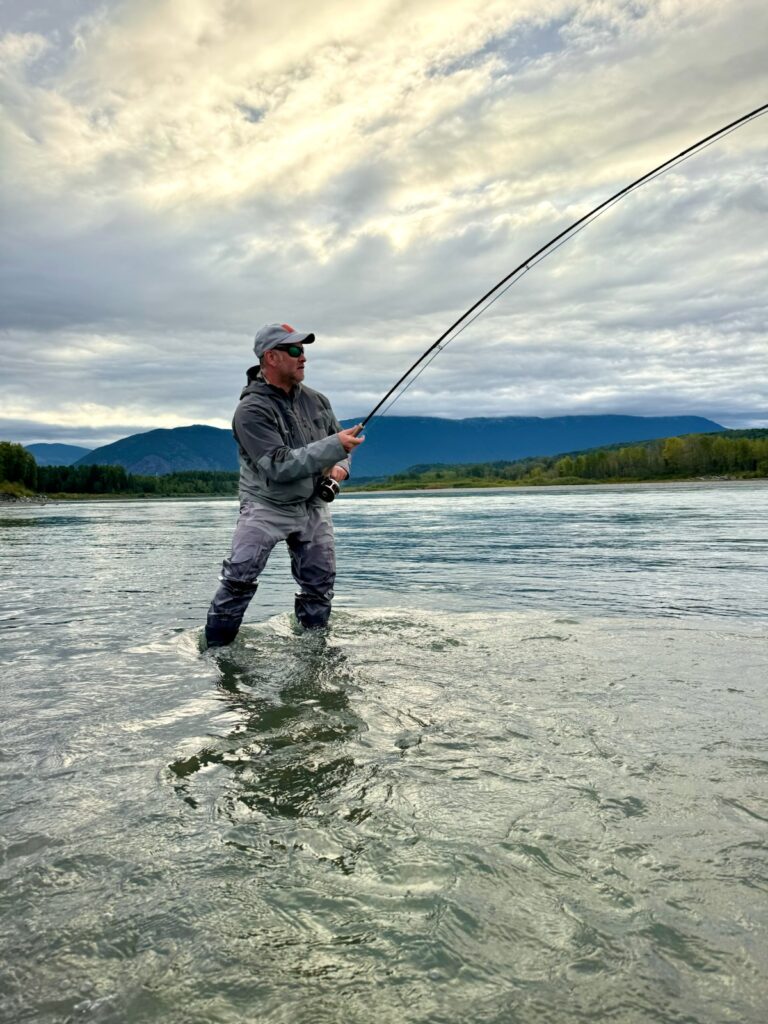
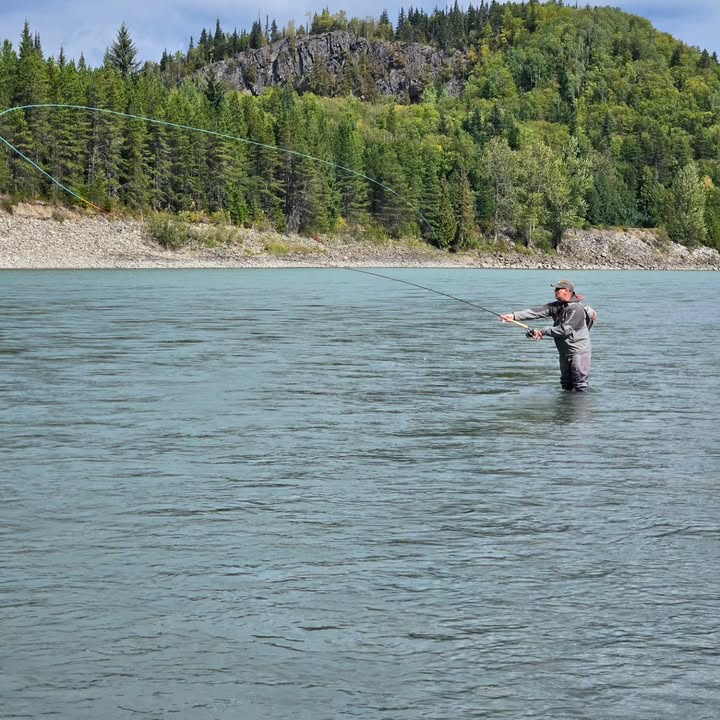
Few fishing experiences compare to the thrill of pursuing Atlantic salmon on a fly rod. In this episode, Calvin Tull shares his passion for Atlantic salmon fly fishing and the art of Spey casting, offering a glimpse into the patience, precision, and technique that define this timeless pursuit.
From scenic rivers to unforgettable encounters on the water, Calvin reflects on the lessons learned through years of fishing adventures and the subtle details that turn a good cast into a great one. Whether you’re an experienced angler or just beginning your fly fishing journey, you’ll find inspiration and practical insights in this conversation.
02:47 – He talks about how he transitioned from conventional gear to using fly rods and why that change completely reshaped his fishing journey.
05:28 – He recalls the moment he realized the power of the swing while learning to chase shad, describing how it sparked his obsession with fly fishing.
10:36 – He discusses the excitement of planning his first major salmon trip and the nerves that came with trying something entirely new.
13:12 – He explains how preparation—fly selection, line setup, and practice—can make or break a trip before you ever step into the river.
15:47 – He tells a story about catching his first Atlantic salmon and the pure adrenaline that came with landing that unforgettable fish.
18:34 – He laughs about the challenges of learning Spey casting and how it took dozens of tangled lines before things finally started to click.
21:05 – He opens up about the mistakes most new anglers make and how trial and error taught him lessons no book could ever explain.
24:02 – He shares his favorite types of flies, explaining why he prefers simple, durable patterns that hold up against powerful fish.
26:48 – He reflects on fishing local Pennsylvania waters, explaining how each season brings new species and fresh challenges to chase.
29:37 – He talks about how patience and rhythm matter more than technique when you’re learning to feel the water’s flow.
32:10 – He recalls one of his toughest fishing days when nothing went right—and how those experiences often teach more than perfect ones.
38:09 – He opens up about the community aspect of fishing and the importance of sharing stories, tips, and time on the water with others.
41:03 – He explains the subtle connection between casting and mindfulness, saying both require focus, timing, and presence.
43:57 – He shares his love for exploring new rivers and the excitement of not knowing what each cast might bring.
46:44 – He gives practical advice to beginners—keep your gear simple, watch the water, and don’t rush the process.
49:22 – He tells a story about mentoring a young angler and how seeing others grow reignited his own passion for teaching.
52:15 – He reflects on how fishing has evolved for him—from catching fish to appreciating the journey, nature, and the friendships built along the way.
52:15 – He reflects on how fishing has evolved for him—from catching fish to appreciating the journey, nature, and the friendships built along the way.
55:03 – He wraps up by sharing what keeps him returning to the water year after year: the peace, the challenge, and the endless lessons the river offers.
57:36 – He ends on an inspiring note, encouraging listeners to find their own rhythm, stay curious, and never stop learning from the water.
Episode Transcript
00:00:00 Dave: What does it take for an angler from Pennsylvania? S farm ponds to build a life
around two handed rods and anadromous fish, and a hundred days a year on the water?
Today’s guest went from chasing bass with a fifteen dollars K-Mart rod to swinging flies with Jay
Peck on the salmon River, and even turned Shad on the Susquehanna into a casting classroom.
And what it feels like to land one of these fresh Atlantic chrome from the ocean. This is the Wet
Fly Swimming podcast, where I show you the best places to travel to for fly fishing, how to find
the best resources and tools to prepare for that big trip, and what you can do to give back to the
fish species we all love. Calvin Toll is here to talk about mountain water resort in Newfoundland
and the difference between the riffle hitch, traditional fly and modern tube flies. You’re also going
to find out what you need to know before booking your next Atlantic salmon adventure. We’re
going to talk about the area, the trip, what it takes to get up there, and what you need to know
before entering this epic journey. Plus, we’re going to get a little update on the Skeena Spey
Lodge how that trip is going. He’s going to be out there on the other side of the country as well,
chasing steelhead. So we’ll be talking the difference between steelhead and salmon but
focusing today on Atlantic salmon. All right. Here he is Calvin Toll. You can connect with him on
Instagram at and here we go. How you doing Calvin.
00:01:23 Calvin: Doing good Dave.
00:01:24 Dave: Awesome to have you on here. We’ve been talking about this one for a little
while. You’ve been on some of the big trips that I’ve been on. Well we’ve kind of been
connected, you know, for quite a while actually, now. And we’re going to be putting one of these
trips together soon. It’s hopefully going to be Mountain Waters Resort next year. So, um, so I
want to check in with you on that because I know you’re just there. You had a good trip. You’re
also heading up to, uh, Brian Niska’s the Skeena Spey Lodge. We’ll probably touch on that. It’s
kind of Atlantic salmon. It’s steelhead. It’s swinging right. Your thing is swinging. You’re pretty
much anything on the swing is what you’re about.
00:01:56 Calvin: Yeah, it’s it’s not to say I don’t do some Euro nymphing every once in a while
for trout, but I mean, if you break down the season, I’m probably easy. Even though I have a full
time job doing something else, it’s easy that I’m one hundred days on the water and then after
that I’m easily one hundred days at the bass. Time flies. So it’s basically two hands or no hands.
00:02:18 Dave: Right. There you go. So this is great because I think we have a lot of people and
you know, obviously listening that are into they’re fully into it like you or they want to learn about
it. You know, the two handed game and all that. And Atlantic salmon. Well you got Atlantic
salmon, you got steelhead. But there’s other species that you’ve swung for, right?
00:02:35 Calvin: Absolutely. Um, so I pack up in Pulaski, New York. The first time that I got a
spey rod in my hand, we went to a particular stretch of Douglas and Salmon Run. I had a
conversation with him about two days prior, and he said, look, bring a ton of egg sucking
leeches. And when I say egg sucking leeches, it’s just the basic woolly bugger and some sort of
bead head on there, whether it’s, you know, a star or whatever the case may be. But, uh, I had
thirty six flies that I counted, and he was in my hip pocket when we swung this particular stretch
of run. And I left that day with six flies left. Just learning, you know, blowing cast, you know,
snapping flies off. And we encountered a a lot of hot steelhead. I’ll never forget the first one I
landed fresh out of Lake Ontario, thirty one and a half inch buck. So it was an experience, no
doubt. I actually got the rod taken away from me three times for bad swings, and he hooked the
fish all three times.
00:03:33 Dave: So now what? Now what happened there? What do you mean by bad swings?
00:03:36 Calvin: Just the swing wasn’t straight. It had crooks in it. Your flies. Not your lines, not
tight. You got goofy layout of line. It’s not swinging properly. It’s not fishing. So, uh, that’s what I
learned that whole day. And interestingly enough, I went to the same run by myself two straight
days later and caught fish. so it was a good experience. But on the five hour ride back home,
you were talking about Shad. That was that was my thought. You know, I get up to the salmon
River and I’m doing about two, two and a half, uh, weeks. And I went, you know, to really get
good at this Bay game. I gotta find other fish that I can get involved in that. And I had fish for
shad with conventional gear, probably about twenty years. And I picked up a small switch rod, a
five weight, and, uh, I started swinging flies for shad, and that got productive. But I started
tweaking it and getting into things like, uh, triple density lines because the river that I fish on the
Susquehanna River, depending upon what they do below the Conowingo Dam with
hydroelectric generation, it could be eleven thousand cfs at two small units, and then they turn
seven small and four large on. And it’s coming ripping down at seventy five zero zero zero cubic
feet.
00:04:51 Dave: Oh, wow. No kidding. Seventy five thousand.
00:04:53 Calvin: Yeah. it changes quick. And, uh, you know, I have a army of Spey rods that I’ll
take down there in that river, depending from, you know, trouts, bass from three, raid on up to
Spey, rod to six weight. I’ve gotten to the point where they turn the water on. I know what I’m
doing. And, uh, you know, I have a reasonable expectation of getting into some fish on that. So.
And then not long after that, that’s when the trout spey stuff really started kicking off. So got into
some lightweight trout spey and say that I’m checked out on Spey completely. When I took that
first trip with Jay, I had one thirteen, six, eight weight, and now I’ve got a spey rod in the quiver
anywhere between one one weight right on up to ten weight.
00:05:38 Dave: Oh you got you got them all.
00:05:39 Calvin: Got them all.
00:05:41 Dave: Nice. This is great. Well, and you’re actually where are you physically located?
Where’s your hometown?
00:05:46 Calvin: So I live in a town called Felton, Pennsylvania, in southeastern, uh,
Pennsylvania. I’m about nine miles from the Maryland line. So a lot of my fishing, uh, whether if
it’s trout, it’s it’s probably about an hour away. Wherever I decide to fish, if it’s for trout, it’s going
to be up on the yellow breeches. And if it’s for shad, it’s going to be below the Conewago Dam
in Maryland. And it’s a stone’s throw from the Chesapeake Bay. So when those things, when
those shad come up into that river, it’s a stone’s throw from the Chesapeake Bay.
00:06:15 Dave: That’s so cool. Yeah, you’re in this area. Every time I do a podcast, it’s pretty
amazing because, you know, I’m on the other side of the country and I just don’t know it as well.
But there’s all these famous, you know, everything you’re talking about, like not only famous
waters, but famous states and towns and all the names and the history. You know, that’s what’s
amazing about it. You got this amazing history of the country, the whole, you know, that’s where
it all started. What’s that? I always love to hear that. What’s that feel like for you? Do you think
about that much the where you’re at and the fact that all the history and the amazing people that
have been through there.
00:06:44 Calvin: Yeah, I do, uh, when I first got into fishing, I was an only child. So I grew up on
a twenty acre farm, And mother was looking for me. She knew I was in one of three places. I
was either in the stream below the house or over at the two neighbor’s pond. And that’s how I
got into fly fishing. I started out like everybody else, you know, conventional gear. And then I
saw, you know, we had three channels when I was growing up. Two of them were the same.
They actually put a program called Sports Afield. Lasted about a half an hour. I saw a guy catch
a largemouth bass on a fly rod, and that was it.
00:07:18 Dave: Oh, wow. No kidding. Sports afield was the show.
00:07:20 Calvin: Yeah, I went into Kmart and they had a fifteen dollars fly rod, and within a
couple of weeks, I’d done enough chores around the house to buy that fly. Rod came home and
very rudimentarily rigged that thing up. I still remember my father just trying to direct, not with a
fly line right onto the arbor of the reel. No backing up anything we caught. Uh, you know, I
caught a bunch of bass, crappie and bluegills out of the pond, but my fly fishing career kind of
really got underway and started getting good at it when I picked up Joe Humphries Trout Trout
Tactics book. And he’s he’s a Pennsylvania guy too. So, I mean, I picked that book up and I’ve
read it so many times, the binding’s coming apart and I, I would tell anybody, you know, if you
want to figure out how to locate trout, catch a trout on anything fly rod related. That is the book
to pick up.
00:08:10 Dave: That’s the book. What was that one called again?
00:08:12 Calvin: Joe Humphries trout tactics.
00:08:13 Dave: Trout tactics.
00:08:15 Calvin: Yeah, yeah. Great.
00:08:16 Dave: Okay. We’ll get a link to that in the show notes for sure. And everything we talk
about today, we’ll have some good stuff, including we had Jay Peck on episode four hundred
thirty seven. Yeah. So we chatted with him about brown trout. It was awesome. Yep. So yeah.
So you’ve had some good mentoring. So in that kind of segues us into what we’re going to talk
about today, a good part is not only the Bryansk is at the skin of Spey, which you have coming,
but the Mountain Waters Resort. That is something that’s been on my mind, and we’ve been
talking a lot about it lately, you know, and there’s a lot of fly tying there too, because of all the
history of Atlantic salmon and kind of fly tying and stuff.
00:08:47 Calvin: Absolutely.
00:08:47 Dave: Tell us about that. Where did you. because you’re then actually the person that,
you know, kind of, uh, made me aware of this. And it seems like it’s a pretty amazing spot. So
talk about Mountain Waters Resort. How did you first find it and what’s been your recent
experience up there?
00:09:01 Calvin: So it’s interesting, uh, again, with all these spey rods and stuff, I’m, you know,
looking for, you know, different things. And, uh, I had actually called a guy named Tim Pants,
and, uh, Tim owns Paco Reels and, uh, called Tim up about a reel as I’m driving home from
work. It’s late at night. I think it’s about November and it’s cold. And, uh, talking to him about this
reel. This is what I’m thinking about. And all of a sudden, he just says, have you ever fished for
Atlantic salmon? And I said, no, it’s on the bucket list. He said, well, I got a spot that’s just
opened up at Mountain Waters Resort. And I went, okay, it was just about to buy reel. And then
all of a sudden, next thing I know, I purchased a trip. So that’s how I ended up there. And, uh,
yeah, actually bought the trip before I brought the real. Had several conversations with Ryan
and I did a whole bunch of research. Uh, usually I do a ton of research before I go on a trip, so
that was a little bit backwards in that I bought a trip, and then I’m trying to find out as much
information as I can about Atlantic salmon. So.
00:10:05 Dave: Right. We’ve done a few episodes now, and with the guides that I know you’ve
been up there with, the unique thing is, is that it’s well, it’s amazing because it’s the history.
Again, going back to the history is that, uh, Lee Wolf. Right. You’re fishing the waters that the
famous Lee Wolf, that was his lodge right back in the day. He used to fly in with his plane. And
so you’re on those historic waters, but then it’s also like single hand, right? They do a lot of
single hand. It’s not a huge spey thing. So if you want to do Spey, you know you can kind of
bring yourself. So talk about that. It’s a lot of people doing the single handed right for Atlantic
salmon.
00:10:37 Calvin: Absolutely. And I’ll tell you the first day that I had got there, it actually gotten in
early. And I was prepared to just really relax. And because traveling from, you know, PA, you’re
going to go from PA, you’re going to get into Toronto, then you’re going to go to Toronto to Deer
Lake. So it was a long day. And you know, yeah, I’m not going to turn down an opportunity to get
out on the water. So, uh, you know, we go out there, I’ve got my spey rod, and rod walks out and
he locates this fish and he said, Bring Calvin up here, see if he can catch this fish. So I go up
with rod and he says, I got the right amount of line out. Go ahead and try it. He’s got a single
hander. So I flop a cast out there and it’s swinging. And by the way, the flies riffle hitched and I
cannot pick this fly, this riffle hitch fly up to save my life I take three more casts. Nothing
happened. I pulled twelve inches of line off. I lay this cast out here, and next thing I know, this
arm’s coming across and sets the hook. And the rod is just screaming out across the river. And
that is one of the things that I would tell someone if, if you go after These, you know, Atlantic
salmon in Newfoundland, unlike steelhead, when they come up to the surface to grab the fly,
you do not wait for the weight of the fish. You see the fish take. You better set the hook.
00:11:57 Dave: Oh, really? You need to set the hook.
00:11:59 Calvin: Do not set the hook. They’re gonna expel the fly.
00:12:02 Dave: Oh, wow. Okay.
00:12:03 Calvin: Long story short, we’ve got this fish on. I go down to try and reel the fish in, and
rod fish is left handed. I fish right handed. So the reels on the opposite side. And by the way,
they’re filming this whole thing. So I’m thinking, please do not lose this fish. I’m not going to be
able to live this down. So we get the fish in. Uh, it’s about ten, twelve pounds. Uh, reaching the
net, we try and get a photo and it slips out of my hand, so no big deal. But, uh, I go back to the
cabin and I call home immediately. I said, well, I’ve got my first Atlantic salmon, but I think I’m
screwed the rest of the trip. And the comment was, well, why? I said, I can’t find the damn fly.
Skating across the. Eventually towards the end of the second day, I’m now starting to see the fly.
That’s a whole ordeal. And by the way, this is not the tube flies.
00:12:51 Dave: Okay? This isn’t the tubes.
00:12:53 Calvin: These are the traditional, you know, your traditional Atlantic salmon fly. Such
as, you know, an undertaker.
00:13:00 Dave: Okay. Tie down like a what? Like a size four. Traditional up by steelhead hook.
00:13:05 Calvin: Exactly. Size four, size six. And, you know, obviously if you talk to rod or less,
they’re going to tell you, hey, you know, as it’s earlier in the season those bigger flies are better.
They get towards the tail end of the season. You know you’re fishing ten and twelve.
00:13:18 Dave: Oh you are. And why is that now. Why is the smaller stuff towards the end of the
season?
00:13:22 Calvin: I think it’s just because the fish have been in there so long and they’re more apt
to, you know, just nip, you know, nip at something that’s that’s small like that, walking across the
surface. We didn’t get anything that morning session. And we come back from lunch and I start
a little bit higher. And I am using a spey rod at this point on my own. And I’m picking the fly up
as the fly is skating across the surface. I see a boil and I’m frozen because I’m waiting for the
the weight of the fish. There no weight and I’m cussing myself because I just blew this. I just
completely blew it.
00:13:55 Dave: So on that take, you’re not feeling anything from the fish. You have to see it and
set it you.
00:14:01 Calvin: Exactly. You do have to feel. I’m not saying that every once in a while you won’t
get one that grabs it and the rod just starts screaming and all you gotta do is hold on. But I find it
common with those larger fish. As soon as you see either a boil or you actually see the fish out
of the water, if you don’t have the slack out of that line, by the time you see the dorsal fin, you’re
not touching them. You are not getting the hook set. So, uh, I went right back at this fish again.
Nothing. And I thought, well, that’s that’s done. I and actually I took a step down the run and the
next thing I know, fish comes back, I do set the hook and we get them. And that’s actually the
fish I think that you’ve had on, uh, several of the that you’ve had.
00:14:45 Dave: Oh, right. That’s the fish.
00:14:47 Calvin: Yeah. Where, um, Ralph’s holding the fish, and I’m kind of sitting there. Uh, so
that was my first Atlantic salmon that I had caught by myself. And and by the way, what a rush.
00:14:59 Dave: Wow. What is the fight of an Atlantic salmon? You’ve caught some in that ten to
twelve pound range versus a steelhead.
00:15:05 Calvin: Totally frank. And I think they’re worse than steelhead.
00:15:08 Dave: Easy or harder?
00:15:09 Calvin: They’re harder. I mean, once you get one, it’s it is just pandemonium, really. I
mean.
00:15:17 Dave: So they’re screaming. I always make the now that I’ve fished for Chinook and
I’ve caught some nice Chinook salmon, you know in Alaska the comparison. Right. Chinook
versus steelhead. It’s crazy because Chinook are just sometimes you can’t do anything. You
have no control. Exactly right. And with steelhead for the most part you can kind of you know,
you have some control. But so you’re saying Atlantics, they can kind of be crazy like a Chinook.
00:15:41 Calvin: Yeah, I mean, it’s there in the water. They’re out of the water. Uh, you know,
you’re trying to stay tight to the reel. Sometimes you can’t stay tight to the reel, and you just
gotta start stripping, stripping, trying to keep the keep the line.
00:15:53 Dave: Because they’re running at you.
00:15:54 Calvin: Yeah. And the other part about that, you know, that particular stretch, uh, that
we’re fishing in there in Newfoundland, you’re a mile away from the ocean. These fish that are
coming in, they are fresh out of the ocean and they are hot. Most recent trip that I was up there
last year, as, uh, les had said, I hooked seventeen fish on a tube fly in a week. I can’t tell you
how many fish turn right around. Large ones. Uh, we saw. I didn’t have a chance.
00:16:22 Dave: No kidding.
00:16:23 Calvin: Right back towards the ocean.
00:16:25 Dave: Oh, really? So you couldn’t even stop? You just. They just ran and you just
broke them off?
00:16:28 Calvin: No, you’re holding on. You’re holding on. Uh, we actually had one that we got
in. I would estimate that was probably in the high teens, maybe twenty years ago. We took
another pass at it with the with the net and it just pulled. But, you know, at that point you created
the arc. You know, you’ve made something that is wild. Grab a fly and it’s just awesome. And
I’ve had, you know, that’s a thirteen, six, eight weight. And I’ve had grills get me into the backing.
So it just tells you what, you know, the strength of these fish being that fresh coming in from the
ocean. And yes, you’ll see sea lice on them.
00:17:06 Dave: You will.
00:17:06 Calvin: Yes. Absolutely.
00:17:08 Dave: Okay. What is the when you’re out there on the water, there’s, um. Tell us again.
What what time were you there? What was the dates?
00:17:15 Calvin: Very tail end of June. So that’s the first week. And, you know, as they tell you,
very unlike steelhead, you’re not stepping down to run. Uh, you know, you are just working an
area, and you may only pull a foot of fly line off. Uh, and a foot can make a difference is whether
or not that fish takes that one particular fish that I was speaking of. I had actually missed. I was
late, uh, wasn’t that I wasn’t paying attention. I had a fair amount of line out fish took, and I
couldn’t get the slack out of line. Never felt the weight less. Said, you know. Did you see him? I
said, yeah, I saw him and I missed him. He said, did you, did you prick him? I said, no, I did not.
He said, go right back at him again. So strip in line, take a breath, relax, throw a cast out fish.
Hit very next.
00:18:07 Dave: Oh.
00:18:08 Calvin: Did um. Now sometimes that will happen, that they’ll come back immediately.
Sometimes they won’t. They’re just very, very finicky fish. Um, and you and I can understand
why people get addicted to them.
00:18:20 Dave: Right? I feel like the fish that get people get addicted to. I mean, we get
addicted to it, any of them. But especially the more you’re in this fly fishing, the harder ones. It
seems like those are the ones that because they’re. You know what I mean? There’s more pain.
You know, you’ve got the steelhead, the muskie, because if it was easy, it wouldn’t be as fun. So
Atlantic salmon is not easy, right? It takes some work. But. But the reward is amazing.
00:18:42 Calvin: It is amazing. And the fact, for whatever reason, those fish in Newfoundland
are so surface oriented. So you have, you know, what’s any better. And catch a fish on surface
skated fly. Not not much.
00:18:58 Dave: Nothing. You’re seeing it. You’re basically it’s like dry fly fishing. You know.
00:19:02 Calvin: It’s exactly what it is.
00:19:03 Dave: Well, this is cool. And you’re into the fly is interesting too, because, you know,
last all the guys, they’re using the traditional stuff, single handed rods like probably, what, nine,
ten weights or something like that.
00:19:13 Calvin: Yeah.
00:19:14 Dave: See, you know, traditional hooks and flies. But you come up there with Spey
and the two fly. So so talk about this two fly. I want to hear about the history of this. How did you
have you been fishing tubes. Are you like with your steelhead. Are you a fifty over fifty tube guy
versus a shank, or are you both or are you kind of one?
00:19:30 Calvin: I’m both. I think you’re like any other fisherman. You you You have way more
stuff than what you need, but it seems like a lot of times. Well, I don’t have that in the box.
00:19:41 Dave: Right? Yeah, exactly.
00:19:42 Calvin: Sometimes that happens. But, um, after the first trip, uh, usually that’s when
my mind really starts kicking in and thinking, okay, what was successful on this trip? And you
know, what else can we add into the tool belt? And, uh, when I came back, I got on a site called
Fish Madman. And it talks about how with also steelhead and Atlantic salmon, it talks about
these riffle hitch tubes and how these things evolve. And a lot of people in Europe are using
these riffle hitch tubes. And the tube that I used was only it’s some of this proprietary tube that
fish madman has. It’s, uh, three point two millimeter outside diameter tube, no junction tubing on
this whatsoever. So the tube is actually about I think it’s twelve millimeters long and you can cut
it into sections. Well, the tube that I’m using is only a half inch long. There is no junction tube on
it, and I just inserted a small number eight salmon Stinger Patriot hook in the back of that. The
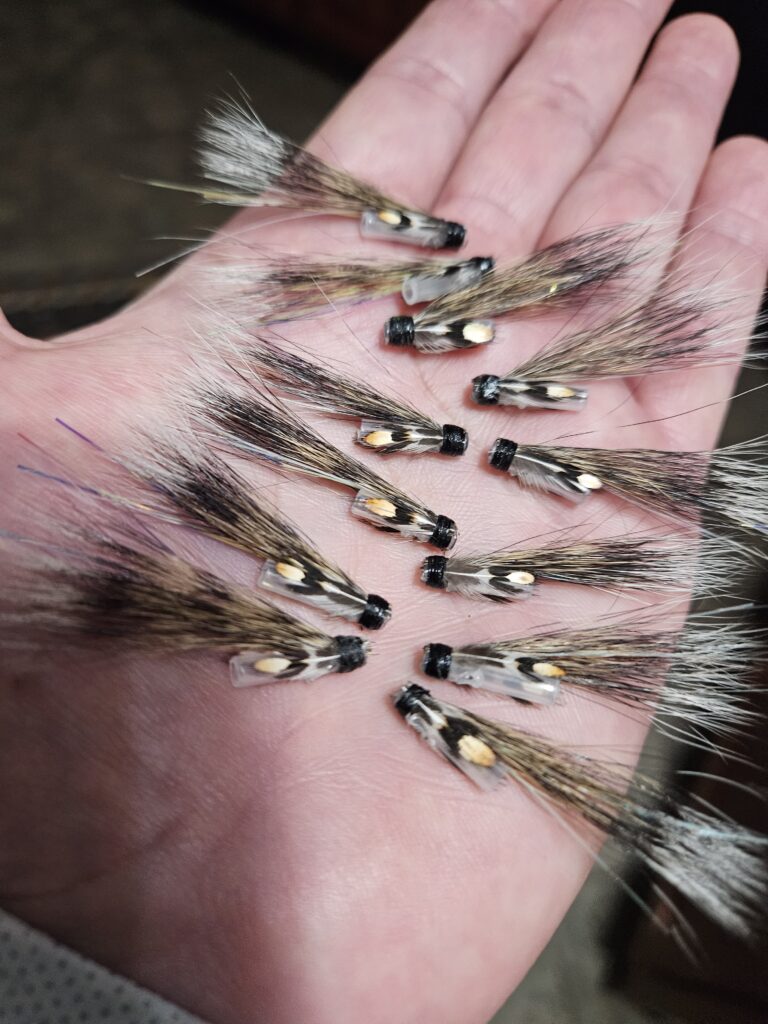
twist on the tube was I made it into an undertaker body. You know you’ve got the chartreuse, but
the red but little peacock herl all the way. You know the rest of the way up. And really, it’s, to be
honest, it’s a no tie tube. Meaning I’m not putting, you know, any whip finish on any of the stuff.
I’m just using super glue. It’s all super glued together. And by the time it’s finished, when I take it
off the tube adapter, I’ll take a needle, hit that needle up and burn a small hole right behind the
thread head. And that’ll be, I would say, probably about, oh, maybe an eighth inch back from
that head to which you insert your leader in. I’ll go through the back of the tube, tie your hook
on, pull your hook in snug. And that’s what causes that little tube to riffle hitch across the top of
the water.
00:21:37 Dave: Oh, wow. So you’ve got a tube. So you’re not using the, um. What did the
Portland hitch on that?
00:21:43 Calvin: Well. No, they’re you’re not using the hitch. The actual hole is in the bottom of
the tube, and a lot of these tube flies, people will insert it right through, you know, at basically
that spot behind the thread, but it’s on the left side and the right side. And the reason for that is
different, you know, different sides of the river. River left for river. Right.
00:22:04 Dave: Oh, wow. Wow. This is cool.
00:22:06 Calvin: Where you want to hitch. But you know, rod will even tell you when he does his
traditional Portland hitch on a, you know, a regular hook. He puts it on the bottom. That way you
don’t have to worry about, oh, what side of the river I’m on and change the hitch.
00:22:20 Dave: Right. Wow.
00:22:22 Calvin: And you don’t have to do that with these tube flies either. And it was kind of
funny before I had come up the year prior, I guess somebody had brought some tube flies up
and they showed them to rod and they said, we use these all the time. And Rod’s comment is,
well, you must not want to catch any salmon because I’ve never seen anybody use these things
before.
00:22:40 Dave: Right.
00:22:40 Calvin: Yeah. It was uh, it was extremely, uh, kind of, uh, you know, investigative.
00:22:47 Dave: Oh, yeah. No, it sounds like high level. The riffle hitch in itself is pretty, you
know, high level. So you’ve got this fly that if you skate it or if you not skate it, if you just swung a
normal wet fly, just the undertaker essentially what that does or the Portland hitch gets the fly
kind of waking. Right? Is that what it’s doing? Creating a disturbance. So that’s a big reason you
do it.
00:23:05 Calvin: It’s getting awake and more more than awake. It’s a small V, and, uh, you
know, everybody will tell you, you know, the narrower that V is, for whatever reason, it that is
productive. And when fish get really picky that Portland hitch seems to to do the trick and I
would say probably doesn’t matter if you’re fishing Spey or you’re fishing single hand. And less
brought this out when he talked about it on your last podcast. You have to make one hundred
percent sure when you lay that cast out, that leader is straight because you want that flight up
the water and start swinging immediately. You do not want, you know, you don’t want slack in
there, because if you got slack in there, the thing’s not hitching, especially if you’re using a
traditional wet fly.
00:23:50 Dave: Yeah. That’s huge. So is your cast. And for me, sometimes that’s a struggle,
right? Because my spade isn’t always perfect. But how are you feeling about your spade cast?
Are you kind of at the upper level or are you pretty much, you know, get lining out straight
casts? Or how does that look?
00:24:04 Calvin: Not even close. So my my spade casting I’m pretty good on the sustained
anchor. And this is something that I’m starting to really, you know, try and hone in and work on.
And this is why I do a lot of stuff with trout, because it gives me the opportunity to work on touch
and go casting and get some feedback. I’ll tell you if you can cast these trout spades, because
everything has to be so tight and concise. You cast well on a trout spey. You’re going to do well
with a full size spey.
00:24:32 Dave: No kidding. So the practice you go out there with a whatever, two, three weight
or something like that. If you can do that. It’s the turnover to fish in a eight. Weight is going to be
the same.
00:24:41 Calvin: Yeah it’s George Cook really gets in there. Says it’s you know akin to you know
his quote is trout is casting in a phone booth. Everybody everything has got to be tight. Um, and
you really have to be precise with that. And, you know, he’ll actually he has actually said these
are not easy to learn on better off with a, you know, full spey. It’s it’s a lot easier. But if you can
do it on a trout spey you’re going to have no trouble on a full spey.
00:25:08 Dave: So that’s your spey. You got your setup, your leader, you’re out there fishing and
you’re in the the late June. So that period is the start of the run. When is the because we’ve had
some people asking about brook trout right. There’s brook trout. Is that brook trout in there. Is
that when are they in there.
00:25:22 Calvin: They’re actually in there. When when I’m up there in June. It’s not uncommon.
You know, that you’ll you’ll catch a pa, you know, an a pa is a a salmon that that is in there. Part
of the reason they don’t want you using barbs on the hook. Because if you do hook a PA, the
barbs just going to be detrimental to fish. It is not uncommon to start reeling a PA in and, you
know, see a huge brook trout inhale a PA.
00:25:46 Dave: Oh no kidding.
00:25:47 Calvin: Uh, when I say a huge brook trout, we’re talking six pound.
00:25:50 Dave: Wow.
00:25:51 Calvin: They’re in there.
00:25:53 Dave: And probably I’m guessing the challenge is, is just like when we were up in
Alaska, we were focused on Chinook, although there were all these other species, including
giant rainbow trout. And we ended up not fishing for rainbow because we were so focused on
Chinook. Is that kind of how it works?
00:26:06 Calvin: That is exactly what happens. And I would say there are people that do want to
do that. I would say bouncing back and forth in a day is is not a good idea. Just stick with one.
And if you decide, hey, I want to take a, you know, I want to take a day out and I want to go for I
want to go for brook trout. Yeah, you can do that. Uh, and I know another thing that they will
offer to, um, they actually offer to me while I was up there. If you wanted to try and go catch cod
out in the ocean, that’s an opportunity that’s available to you, too.
00:26:37 Dave: Oh, Cod. Atlantic cod.
00:26:39 Calvin: Yes. Absolutely.
00:26:40 Dave: No kidding. Atlantic. And that is just like that. Just a giant ocean fish.
00:26:44 Calvin: Yeah, right. And actually, at one point, I believe, uh, Newfoundland may have
been the cod capital of the world.
00:26:52 Dave: No kidding.
00:26:53 Calvin: Yeah, they’re like a lot of things that had gotten decimated, but it is starting to
come back. Um, and actually, Newfoundland now is the lobster capital of the world because of
the just the way that the the temperatures of the ocean are going, all these lobsters are starting
to go north. And oh, by the way, if you do get a trip with mountain waters or you’re going to eat
some lobster the last, last day there, you get lobster, no problem.
00:27:21 Dave: Yeah. That’s why I want to hit on two a little bit here. Just the experience
because, you know, obviously the fishing is you know what we’re all kind of coming here for. But
there’s everything else and yeah, the food, you know, the atmosphere. So in Newfoundland, just
the place right where it’s at. What is it. So describe that a little bit. Let’s, we’ll circle back around
on some of the fishing. But you know so your trip when you jumped in there tell us that like what
is the what day did you arrive. How did that look on the logistics.
00:27:46 Calvin: Yeah. So um, again, living in, you know, southeast PA, I had flown out of
Philadelphia into Toronto, um, and then Toronto into Deer Lake. And, uh, Ryan or somebody
else will be gracious, grateful enough and gracious enough to pick you up at Deer Lake Airport
and from Deer Lake into, uh, you know, into the lodge is about an hour and a half. Um, and
you’re going to see some absolutely breathtaking scenery as you’re driving in. The ocean’s
going to be on your left hand side, and on the right hand side is the mountains.
00:28:23 Dave: No kidding.
00:28:23 Calvin: Yeah. So you’re gonna you’re going to see some really breathtaking scenery.
So it will not be one of those things where, you know, you’ll be having a conversation with Ryan
if you’re driving in, but, you know, you’re also going to be looking around. And I took numerous
cell phone pictures and, you know, he asked, hey, do you just want to stop and get out and take
some pictures? And I’m like, no, I’m fine. But I mean, it is, it’s it’s breathtaking.
00:28:46 Dave: You could.
00:28:47 Calvin: Yes, you absolutely could.
00:28:48 Dave: Yeah. So you’re in the so you got the mountains, you got the ocean. And what is
in the ocean is. Yeah, the Gulf of Saint Lawrence I guess. But it’s.
00:28:55 Calvin: Yes, that is correct.
00:28:57 Dave: Gulf of Saint because you’re right across Newfoundland is part of Labrador,
Newfoundland, Labrador. It’s the island out there. But you’re north of Nova Scotia, you know,
kind of northeast of Maine, right? Yeah, you’re out there. There’s not much else. When you look
at a map, you’re like, you’re pretty much about as far as you can get out there. Although it’s not
too bad. You can get out there in a day from from the East Coast pretty easy. Sure.
00:29:16 Calvin: Yeah, absolutely. You can get out there today.
00:29:18 Dave: Okay. So and then you did you guys arrive on like a Sunday Or what day was
that first day you got there?
00:29:23 Calvin: I believe I got in on a Saturday and then, you know, I the package usually
starts on on Sunday. Uh, and you’re wrapped up now, one of the things that they will tell you, I
believe if you get in after six pm and Ryan can get into this more, they, they want you to get a
hotel overnight because just the the danger of driving at night and moose the potential for
moose impact. Those do not go well if that happens. Uh, we had actually saw a vehicle on our
way back, uh, sitting on the side of the road. No doubt it was a moose involved. And it was. It
was demolished.
00:29:59 Dave: So there are moose on on Newfoundland.
00:30:01 Calvin: Oh, yeah. Yeah, absolutely. Rod, actually. And that’s that’s something else
about rod. You know, he shoots a moose by himself every year.
00:30:09 Dave: No kidding.
00:30:10 Calvin: Quarters it up and carries it out.
00:30:12 Dave: So that guy’s an animal I love it.
00:30:15 Calvin: That’s another opportunity that they actually offer to, you know, if you do want a
moose hunt? I don’t know if it’s directly through them. They approach somebody else. So if
somebody’s looking for a moose hunt, they could engage them about that as well.
00:30:30 Dave: Yeah. Moose, I’ve heard, you know, they’re really good tasting. I didn’t realize
that. But, yeah, moose are awesome.
00:30:35 Calvin: We actually had it when we came in for lunch one day, and it was fantastic.
00:30:39 Dave: Yeah. There you go. So. Okay, so you get there on Saturday. You’re fishing. Um,
you know, Sunday. And then is it kind of like fish, like five days out there and then. Or how many
days were you fishing?
00:30:49 Speaker 3: Yeah, I think it was five days.
00:30:51 Calvin: You’ll get up, you’ll go into the, uh, you know, the the lodge there, the I call it
the community lodge. And you’ll have your, you’ll have your breakfast. Uh, you know, some
people go in there all suited up, ready to go. Some people go in there and, you know, jeans, t
shirt, sneakers, whatever the case may be. Have breakfast, go back, use the facilities, get it, get
all geared up. And it’s a short trip down, down to, uh, Portland Creek.
00:31:17 Dave: Is it is it like a drive down to the creek?
00:31:20 Calvin: Uh, it’s it’s either a drive or a very short ATV ride, depending upon who your
guide is to even just walk down. Uh, it’s not it’s not far at all. So, uh. Yeah, you’re you’re there.
You’ll fish till lunchtime, go back, grab a sandwich, uh, relax a little bit, and then, uh, go back.
Have a nice meal. Whatever. Whatever they’re cooking. Get a good night’s sleep and go back at
it the next day.
00:31:48 Dave: If you’re looking for a world class fly fishing experience, it’s time to check out
Mountain Waters Resort, nestled along Newfoundland’s legendary Portland Creek, this spot has
a history that runs as deep as the Atlantic salmon that call it home. Once a fly fishing retreat for
the great Lee Wolf, today it’s your turn to step into these historic waters and swing up your
salmon. This year, you can head over to Wet Fly Complex Waters right now and make it
happen. That’s what. Waters. Let’s get out there today. Yeah, and you’re ready to go. And did
you guys fish? Is it like Lee Wolfe’s waters? Did you know kind of some of the pools he fished? I
mean, because the cabin, it’s in the same spot, right? I think his cabins have all been. They’re
not there anymore. But did you talk about that a little bit?
00:32:34 Calvin: Oh, yeah. Well, and that’s, that’s one of the things it’s a reality that sets in.
You’re like, well, I’m, I’m fishing on an area that, you know, Lee Wolfe fish pretty pretty amazing.
And actually one of the, the areas where one of the strings of the cabins are the road, this area
was the actual original landing strip, uh, when Lee Wolfe used to bring his clients in. So, you
know, that’s that’s interesting too.
00:32:59 Dave: Yeah. It is.
00:32:59 Calvin: Yeah. All that stuff is there. And it’s kind of a cool experience that you’re sitting
there going, yeah, I’m fishing some water. That was, you know, Lee Wolfe found.
00:33:07 Dave: Yeah, I know it’s I mean, you talked about Joe Humphries, you know, Joe
Brooks. I mean, Lee Wolfe is definitely up in that. Those names of all the famous fly anglers of
the twentieth century, right?
00:33:18 Calvin: Absolutely.
00:33:19 Dave: The wolf, of course. Right. I mean, the wolf, that’s what somebody was saying.
Is that the wolf pattern he made that actually for those trips up there, he did. You know, and it
makes sense because it’s a it’s a fluffy, you know, that thing would kind of skate across the
water, right?
00:33:31 Calvin: Absolutely.
00:33:32 Dave: Yeah. Okay. So so that’s a little on the trip. And it’s like like any trip, you know,
um, any great trip, you’re going to have awesome food, you know, lobster, you’re going to have
everybody there. And I’m hoping, um. Well, do you think are you is this something you’re going
to be maybe going back to again, or what’s that looking like for you?
00:33:48 Calvin: Well, I’ve already had the conversation with Ryan. Unfortunately, I didn’t make
it this year. Um, the reason I didn’t make it this year is that, you know, some family, some family
issues. And there was another trip. I just had competing initiatives with that trip, uh, because
that would have been something very interesting to talk about, the logistics from the previous
trip and trying to get over the mountain waters. I could not get it figured out because what would
have happened and been interesting was I’d have caught a king on the West Coast, and a week
later I’d have caught a, you know, hopefully an Atlantic on the east coast of Canada.
00:34:25 Dave: That would be awesome.
00:34:26 Calvin: So it just, you know, money was a little tight and the travel logistics just did not
work out. But that is in the back of my mind that I’m going to try and do that at some point. But
yes, absolutely. I’ve already talked to Ryan. I will be, uh, their usual time at first week of the
opener. Also on another point, a month before that, I’ve actually got a trip booked to the
Restigouche too.
00:34:51 Dave: Oh, really? Now the Restigouche. And where is this? Uh, where is this located?
00:34:56 Calvin: That is in Quebec.
00:34:57 Dave: Oh, in Quebec. Right.
00:34:59 Calvin: Uh, and is noted for, you know, some of the biggest salmon out there going.
00:35:05 Dave: Yeah. And it’s got the the ZEC system, right. The ZEC system is out there.
00:35:09 Calvin: Exactly. So I will be at Restigouche Lodge. I believe it’s the last week of May.
00:35:17 Dave: Oh, wow.
00:35:18 Calvin: Actually, be really good. It’s the potential for catching a large fish during that
time, because the larger fish do come in earlier. Earlier they ride those high water in. So very
hopeful that, uh, you know, I could connect with, you know, one of those Restigouche giants or
thirty pounds. Get to write your name in the book of what pool you caught it on and what fly you
caught it on. So, uh, that’ll be something that’ll be interesting in twenty.
00:35:47 Dave: That will be something. Do you know? You already know what fly you’re going to
be using for those Restigouche fish?
00:35:52 Calvin: I have no idea. I’ll be trying the traditionals. Um, but, uh, you know, also
listening to your podcast and some of the stuff that that Topher said during those high water
conditions, you know, you might be using more larger flies, tube flies type deals. The thing is,
the water never stays static. It’s always constantly changing. So yeah, you know, I think he even
talked about on one of one of your podcasts, he said during the early part of the trip to fly was
was the ordeal. And towards the latter part of the trip, a size four was the ordeal. So it’s, uh, you
gotta be flexible.
00:36:29 Dave: Yep. You gotta be flexible. This is cool. So, yeah, you got a good year. And I
think that this will be a time where we’re going to be able to, uh, to hook up finally and, and chat
over, you know, some evening, uh, beverages and all that stuff and hang out with the crew
because I’ve been talking a lot about it and it’s just one of those species. Again, it’s just kind of
that bucket list. We we talk about that, you know, quite often, but you kind of kind of have to do it
before. And I feel like the, the cool thing is that you do have those brook trout because there are
some people that fish a lot, you know, shout out to Brandon, I know he’s he’s in our wet fly swing
pro group. He’s he loves trout fishing. He fishes those little tiny, you know, brook trout which are
amazing right. Those small fish out and out of Virginia. Um, but you know, for him, I think
catching a six pound or anything bigger would be cool. A brook trout. So there are those
options, right? He could go out for a day and try to track one of those big brookies down.
00:37:17 Calvin: Absolutely, absolutely. And I mean they’re very flexible, you know. Yeah. What
do you want to do. Some people are up there to get salmon, but I mean brook trout are on the if
that is something that you want to do it’s there.
00:37:29 Dave: Yep. Did you when you were there at Mount Waters, did you have the same
guide all week?
00:37:35 Calvin: I was so the first week I had went up, um, the first time. Excuse me, I had gone
up, um, I started with, with Ralph. Um, and then the second time I had gone up, um, it was a
combination of, of both less and rod. So I had yeah, I had about the best knowledge that I could
have had. So, uh, those guys were instrumental in getting me in the fish. Usually that is the way
it works. When you come in, they’ll say, hey, this is who you got for the week. You know, that’s
usually the way it works and you’re going to be around some really fishy people that, hey, they
know where these things live and pay attention to them, right?
00:38:17 Dave: So you’re on the river and, uh, and listening to your guide, obviously they know
where these fish are holding. Are they kind of describe the the run a little bit. Is this your typical.
I think it’s a bit a good size river. What is the water. Is this like a gravel bottom. Talk about the
runs a little bit.
00:38:31 Speaker 3: Yeah. So it’s it is sort of a gravel.
00:38:35 Calvin: Bottom mixed in with some some large boulders. I will sit here and say, you
know, the the waiting is relatively easy. It’s not treacherous. Yeah. You know, but if you are
somebody that’s getting older and you know, the guide’s going to be right there with you, so you
don’t have to really worry about that. Staff may be recommended, depending upon, you know,
how well you can navigate the bottom. But as I said, you know, they’re going to put you out
there in a spot and they want you to fish that spot for an hour or two. And if they think there’s
another spot better, they’re going to move you. So it’s it’s as he said, it is not like steelhead
where you’re casting and stepping through the run. You’re going to put you, you’re going to be
fishing every type of fish. That is the part, you know, be present because you could be swinging
every type of fish the whole time and never know it. Like I said, the ocean is a mile away and
they’re they’re constantly coming in.
00:39:32 Dave: So that’s the thing. So you hook a fish in the evening or maybe even in the
morning. There could be a new batch of fish coming in later that day.
00:39:39 Calvin: Absolutely. One hundred percent correct. Um, and the one thing you better be
prepared for is the Newfoundland wind.
00:39:45 Dave: Oh, right.
00:39:46 Calvin: It is windy. I have heard you know, they don’t say it for any reason. For no
reason. But good casting goes and dies at Portland Creek.
00:39:54 Dave: Yep. How do you battle the, uh. What’s your tips on the wind? How do you get
the thing out there?
00:40:00 Calvin: I I’ve taken some time and I’ve watched rod and less that are really good at
that. That loop is incredibly tight. It is very tight. It knifes through the wind and it it goes out
straight. When it lands, it is straight. Um, and that’s part of the reason they talk about oversizing
the line. So you can deal with that wind, the miserable wind condition blowing up river and in
your face. And you hate it. They they will swear and declare those fish come in on that wind.
That’s what you want. Yeah.
00:40:32 Dave: You need the wind. The wind isn’t that bad. I mean, it’s tough to cast, but it’s
actually doesn’t doesn’t take away from the fishing.
00:40:37 Calvin: It does not. I mean, we’ve had some wind out there where there have actually
been whitecaps on the river.
00:40:42 Dave: No kidding.
00:40:43 Speaker 3: Oh, yeah.
00:40:44 Dave: And you’re still catching. You’re still hooking fish.
00:40:46 Speaker 3: And you’re still.
00:40:47 Calvin: Catching fish. It it’s tough to see that darn fly riffle hit you. And you would go,
why does this even work? Because I can’t even see the fly. Really? Riffle hitching across. You
have to tune your eyes that you may not see that fly. But if you’re casting straight, your leaders
laying out straight, use your peripheral vision. and by God. If you see any type of boil, set the
hook.
00:41:09 Dave: Yeah. I mean, the wind is cool because I’m used to the wind. I fish the
Deschutes, which is known for the wind coming up the Columbia River Gorge. And it can it can
rage in there, you know. And so and it’s not easy, you know, especially if it’s it’s in your face. Oh,
yeah. You’re trying to punch it. But but I feel like this is, you know, we’ve had a lot of saltwater
episodes and the wind is something with saltwater, too, and you just keep it, you know, like you
said, keep it low, tight loop, and you just punch it through. And the double haul, right? Especially
single hand is what you’re using when you’re doing the spey rod. And how are you keeping a
tight loop. And you can’t double haul. But describe that a little bit. How are you punching it out if
the winds stay in your face?
00:41:45 Calvin: These things, you know, these spey rods nowadays. And I think this has been
talked about numerous times by people much better than me. It really isn’t a bad rod out there
anymore. And you know, if if you get the thing lined properly, literally, it casts itself. If you hit if
you hit everything proper, it’s going to go. And. Really, it’s it’s counterproductive to try and
muscle that thing. You just don’t need to do it. A lot of these lines, they you do everything proper,
it will cut through that wind. It is kind of hard. You just feel like with what it’s blowing, I gotta
punch this harder. And really it’s it doesn’t work that way. Yeah, it really doesn’t work that way.
Just your marks and it’s going to go.
00:42:32 Dave: Just do it. Cast normal, like stay calm and do your normal cast. And and I feel
like with the, uh, the Spey, that’s one of the big advantages because, you know, again, I grew up
fishing for steelhead on the Deschutes with a single hand rod, you know, nine foot eight weight.
And it was not easy. You had to be a really good caster at times. But I feel like the Spey rod
gives you that opportunity to even in wind to have, you know, kind of some benefits. Do you find
I mean, I feel like Portland Creek could eventually evolve into more Spey rods out there. Do you
think that’s the kind of a bonus for you fishing that versus the single?
00:43:02 Calvin: I would say this even when you go on your trip, if you take a spey rod, take a
single along because you may want to fish your eyes. You may want to fish some dries, or if you
know you, if you get to a point where, like, I’m just not comfortable Spey casting use your single
hander.
00:43:18 Dave: Yeah, use your single. Because if you’re not totally on your Spey game, then the
single hand is actually could be a better tool.
00:43:25 Calvin: Oh yeah. No. No doubt.
00:43:26 Dave: I was thinking about that. I think that for me I’m just as much. Well, probably not
just at the level of Spey as you or some other guys, but I feel like I, you know, I love it, but I’m
also out there and I’ll listen to, hey, I would love to catch one on a single hand rod. That’d be fun.
And then there’s going to be some people going, I know that don’t Spey cast. So this is a good
opportunity to actually you could do both which is cool, right?
00:43:47 Calvin: It is. And I think the other thing, you know, with those leaders, like they were
talking you were talking about it, uh, the Belize episode about, you know, practice your casting. I
know that a lot of times rod will just use a twelve foot straight mono leader, um, and part of the
no taper. And part of the reason for that is if you start putting knots in there, those knots are
effectively pushing V’s across the water. We’ve had salmon come up and eat knotted leaders.
00:44:19 Dave: Oh my gosh, this is so crazy.
00:44:22 Calvin: Yeah.
00:44:23 Dave: These fish are just it’s, uh, it’s hard to figure out, right, with this because they’re
so surface oriented. Right. They would they take would they take, um, that’s the thing. If you
sunk something down, I guess nobody’s doing it, but. Right. They they’re just not down there. I
guess they’re looking up, right?
00:44:38 Calvin: Yeah. I and I, you know, I think a lot of people feel that, you know, they harken
back to, you know, when they were a PA in the river, probably eating caddis that that’s somehow
imprinted on them. And rod talks about Lee Wolf going in after or somebody else going in after
him. And Lee Wolf’s comment was, well, they’re not going to catch anything. They’re not using
Portland Hitch. and they didn’t catch anything.
00:45:03 Dave: Right. Love it. Yeah. The Portland hitch is cool because it’s it’s a famous you
know, for that area. It’s it’s Portland Creek, which is awesome. Okay. So and then what are on
your ride. So just give us the breakdown there. So with the Spey what do you use in there if
people are going to bring their setup. What gives the rod reel and or rod line sort of set up?
00:45:19 Calvin: I’ve heard people taking, you know, six weights and seven weights. I really I
feel like a thirteen six. That’s what I use, a thirteen, six, eight weight. And you know, there are I
still I still take a six along. Uh, I, I stick with the eight just in case you get one of those, you know,
fifteen pounders, you want to have something where you can try and wear them down. It’s not
uncommon that, you know, I have not. I don’t think I’ve gotten anything over fifteen pounds yet.
I’ve had them on the line, no doubt. But in the blink of an eye you’re down to your backing. So
it’s a thirteen. I’m using a thirteen, six, eight. Uh, unfortunately, Rio does not make the Scandi
short, but that’s what I’m using to Rio. Scandi short at five ten. And the other thing that I did use
also was a airflow ten foot poly leader. And then off that poly leader, I was either running ten, ten
pound or eight pound maxima to do the tube fly. So I and and that’s maxima ultra green. Now
they they kind of like chameleon up there. Uh you can get that brownish stain that, that tea stain
so that, that chameleon kind of blends in uh, from that perspective. But yeah, I’ve used I’ve used
ten and eight pound ultra green with great success.
00:46:44 Dave: ten, eight pounds. And is that just straight? Just a one long section of like, like
seven foot.
00:46:50 Calvin: Yep. It’s it’s probably about six foot from that, uh, airflow poly leader.
00:46:57 Dave: Yeah. From the poly right.
00:46:58 Calvin: Yep. So yeah, sixteen foot might sound a little long, but that’s that has been
what I’ve used.
00:47:05 Dave: Yeah. And on the poly leaders give us a rundown on that. How is the poly leader
work in your system. Uh airflow. Do those, do those kind of work with any any line setup?
00:47:13 Calvin: Oh, yeah. You just, you know, loop it on your, you know, your Scandi head, uh,
you know.
00:47:18 Dave: It just gives you a more it gives you a, uh, kind of a transition. It’s like still having
a fly line that’s, uh, getting down. So it’s a better, um, transfer of energy. Is that kind of the idea?
And it’s clear?
00:47:29 Calvin: Yep. It’s clear. And it’s a floating poly leader, too. And it also back to the point
of, you know, tapered leaders and knots in there. Um, you don’t want fish coming up eating,
eating your knots.
00:47:39 Dave: And then it’s all dry line. So there’s no, um, you know, triple density. None of
that. This is just dry lines.
00:47:45 Calvin: Yep. For whatever. Again, for whatever reason, there’s fish just extremely
surface oriented.
00:47:50 Dave: Yeah. Sweet. Okay, so that’s it. And then fly wise, it’s, uh, did are people using
pretty much any fly out there kind of works. Or do you have to have a, you know, a green butt or
something like that or a hot spot?
00:48:01 Calvin: I think, you know, you get kind of addicted to whatever. Yeah, whatever you get
your first win on. Uh, but, I mean, an undertaker is really hard to beat. And, you know, rod talks
about this and, you know, the podcast where you had him on, they have some of their own
special flies that, you know, they make specifically for the river. So if you do engage them for a
trip, the opportunity is there to, hey, I need you to tie some flies for me and they’ll tie the
traditionals, but they’ll also throw some, you know, flies in very, you know, very much geared
towards Portland Creek. Um, so however many you want, they’ll time you’ll pay for them. And,
you know, you got a little can of little can of flies. But, you know, as long as you have, you know,
your undertaker’s probably going to be a good one. Your, your blue charm’s going to be another
one. That’s, that’s very highly thought of green Highlander. Just your basic traditional salmon
flies.
00:48:57 Dave: Could you also, we’ve been doing some of this on the Atlantic salmon stuff,
which has been pretty interesting. Right? The The Feather Thief and this whole story about this,
this kid stealing the feathers. But these are these really super traditional, highly dressed flies.
Could you is that something where you could actually fish one of those out there? Do you think
those would catch a fish?
00:49:15 Calvin: I’m sure they would. You’re talking about the traditional stuff. Mine. I’ve tied
mine. They’re not they.
00:49:22 Dave: They’re not that level.
00:49:23 Calvin: They are not in any fly tying contest by any stretch of the imagination. So if I
tie, let’s say we tie a green Highlander. My green Highlander, it’s, you know, going to be the
traditional yellow green a little bit of usually what I’ll do is I’ll have some slopping laying around
the house, a little bit of slop and yellow and green mixed that together, kind of throw it in. The
hair wing is actually squirrel tail. That’s it.
00:49:49 Dave: Oh, squirrel.
00:49:50 Calvin: Yeah.
00:49:51 Dave: And sparse right is sparse flies. Is that better out here.
00:49:54 Calvin: Yes. Do not. And I think that’s the thing with any traditional Atlantic salmon fly,
you don’t want that thing overdressed. Sparse is good. And I will also say on that tube fly, it’s
amazing how much a sparse pattern actually works in that. So that tube flies probably inch and
a quarter long with maybe twenty hairs. A squirrel in there.
00:50:16 Dave: Really? Yeah.
00:50:17 Calvin: Very very sparse.
00:50:18 Dave: Yeah. Sparse. That makes sense. Okay, so that’s the fly. Well, let’s, uh, let’s
take it out of here. We love to, uh, have a segment to kind of wrap things up, or we were right
around the corner. I’ve been talking a little bit about this, but we have a fly casting challenge
coming up here. And actually, when this episode goes live, we should be right in the middle of it,
which is we’re going to be bringing on a, um, we’re doing a couple of, um, live events with a
single hand casting, uh, some gurus, Marty and Caitlin. And then we’re also bringing Jeff
Putnam on to talk Spey casting. He’s kind of a West Coast guy. So we’re going to help people
really just improve their game. I think casting is a struggle for me. I think everybody can
probably improve their casting. So we’ve got this big challenge going, which is which is going to
be cool because we’re going to give away a a custom rod as well as we go. Um, but on this
casting challenge, I want to say, first off, we mentioned that Wet Fly Swing Pro, you’re a
member in this group, which is really just still at the founding level. We’ve kind of been trying to
kick this off. And and the casting challenge is our way of kicking it off kind of more out to more
people out there. And and so I want to give a shout out to Wet Fly Swing Pro. People will be
hearing more about that as we go. My idea for For the Shop, you know, which is what we call it
in there, is to have a community for people to engage, interact, maybe learn more about trips
and kind of have a safe place for you. You know, even though we’re still kind of early on it. Um,
what is it for you, Calvin, when you think about coming into a group like that, that is like a
benefit. What would you say in the, you know, perfect world?
00:51:39 Calvin: Yeah, I think the benefit of it is you’re going to talk to people that have actually
taken a trip and they can talk about their experiences. And I think that’s another thing, you know,
kind of a segue way that that I would have into that is I just really started taking these trips post,
post Covid.
00:51:58 Dave: Oh, really?
00:51:59 Calvin: Yeah. And I think what really put a point on that. My father was a union
carpenter for many, many years, and he he bird hunted a lot and he really wanted to do a bunch
of stuff when he retired. And he finally went on one of these bird trips and they were walking
about eight miles a day, and he said, I can’t do it. So he he had all this, you know, he finally
amassed the money. Um, and then, you know, physically, he just can’t do it. And that would be
that would be my comment, you know, kind of a to everybody if, if the excuse is I don’t have the
time, you better make the time because, you know, at my age I’m not getting any younger, my
age I’m not getting any younger. Um, so do them while you can. But, you know, again, the
benefit is I think you’re going to be talking to like minded people that may have gone on these,
and they can tell you about their experiences. And I would also say on these trips, I think
everybody wants to catch a fish. That’s why you do it. But before you say, ah, I didn’t catch any
fish, it was a waste. Be honest with yourself. The first time I went out with Jay was August.
Salmon just started coming into, uh, New York, and, uh, we had a heat wave. Didn’t catch
anything, and I could have said that was a total waste. But what I learned on that trip was how
to do a proper snap tee. And I learned how to manage running light. Well, how many times do
you think that skill is paid off? Winging flies. So I, you know, be honest with yourself when you
come back from a trip, you know, what happened? Did you evolve as an angler? Did you learn a
skill, uh, that is going to probably pay off more than catching a fish? Um, so I would say be
honest with yourself about that when you do take one of these trips.
00:53:47 Dave: Yeah. No, those are all awesome points and I agree. I think that you can’t. You
can’t wait because you never know. You know what I mean? In this world, this life, you never
know what’s going to happen. So you might as well if you’re into it, you know. And again, these
trips are you know, they cost money and time is money and all that stuff. But but it is pretty,
pretty sweet. And, um, I think something that I’m excited to hopefully, you know, this will be the
year, Calvin, that we could, uh, connect and, uh, you know, kind of in person, have that whole
thing going on, like, with the full trip. So, so I think we got that going. Um, and then, um, so let’s
just take it out here a couple tips. So we, we talked about the fly casting challenge. So if
somebody is doing this mountain waters trip, uh, for Atlantic salmon, what are a few things
you’re telling them that you haven’t mentioned already? Getting ready for this? What would you
what would you tell me as I’m getting ready for this trip?
00:54:34 Calvin: Obviously, I think, you know, make sure you get, uh, you talk to somebody
about travel schedules, plane flights. Uh, I am a firm believer. If somehow you can get a single
flight without having a connector. That’s great. That’s going to be really hard to do with this,
because you’re probably going to have to get into Toronto and you have to go Toronto to Deer
Lake. Uh, I would also maybe, maybe say bake an extra day in there for, for layover purposes.
Um, I would say at least make sure you got a three hour layover just in case. Bags don’t make
where they need to get to and delays and so on and so forth. So I would say bake an extra day
in those in that travel. Uh, just just in case.
00:55:20 Dave: Just in case I agree. I think that if you can that’s huge because stuff happens.
I’ve had my bags, um, lost now twice, one one on the front end when I didn’t have my bag there
that first, I think it was with Jeff, with the list. And then on the way back on this last one from
Alaska, they lost my bag. And, uh, and it was gone for like five days. No. And you know what I
mean? I was like, okay, what’s going on here? So I drove back to the airport because I wasn’t
getting any through for the phone system. And and I went there and I’m like, hey, you know. And
I was like, I had an Apple AirTag in it. So here’s another reminder. You know, have an AirTag in
your bag. I was like, it’s showing it right here. Yeah. And they said, oh, and they were looking.
They couldn’t find it. So I literally walked over there, crossed the you know, it was only like, you
know, five hundred yards away. And I went up to I flew Alaska Airlines and I went up to the it
was a Delta area. And I was like, what? And so I went up this guy was there, looked in the back
in this room in the very back was my bag tucked in the Delta airline. The wrong airline, you
know? Yeah. Without the AirTag I think could have been there for for forever. You know what I
mean?
00:56:20 Calvin: Oh yeah. I had that actually happen to me when I came back from mountain
waters. Uh, thank God I had the AirTags in there because I was actually telling them, you know,
when I called in about my luggage, I was telling them, hey, this is where it is. So I that I think
that’s a great piece of advice to tell everybody, you know, it put the AirTags in your bags.
00:56:41 Dave: Yeah. When I was thinking at first, I was thinking maybe the AirTags were going
wonky with something and they weren’t showing because when I first got there, it showed it was
there, and I even asked the person, I said, hey, it’s showing my bag right here. And they went
around and looked for it, but they were looking on the back side of, you know, whatever. It just
didn’t it was just it was confusion. So, um, so yeah, AirTags work. Definitely. They work really
well. So cool. Calvin well, I think that we could probably wrap it there until, um, you know, the
next time we chat, which is uh, which is going to be fun because hopefully, you know, we’ll be
doing some of these trips. And I also want to hear, actually, before we get out of here, give me
one on. Um, you’re also heading up to the skin of space. I didn’t want to miss that. Just real
quick. You’re going up there to fish with probably one of the most epic trips ever, because you
know you’re going to have not only Brian, you know, he kind of runs the, you know, is the lodge
lead and, you know, in the bucket and all that. But you’ve got Jeff Linsky is going to be hosting it
this year for us. He’s going to be there and John McMillan’s going to be there. And Eric
Leininger, yes, are all going to be there while you’re there. Like, what is what are you thinking
about that that’s pretty much like all star cast.
00:57:42 Calvin: Yeah, I don’t know. I’ll be doing a lot of talking. I’ll be doing a whole bunch of
listening that’s sitting around either the the table or, you know, the bar in there. Uh, but you
know, yeah, that’s being exposed to those type of people. And I think another interesting person
in there, uh, is going to be Zach Caruthers.
00:57:59 Dave: Uh oh. Zach’s going to be there.
00:58:02 Calvin: Zach. Yeah. Zach. For those that don’t know, Zach was actually a drummer in a
band called Portugal. The man. And, uh, he just decided one day he’s not, you know, he’s not
drumming anymore. He’s going to be a full time fishing guide. So, uh, yeah, it’s, uh, it’s going to
be interesting.
00:58:19 Dave: Now, in Portugal, the man isn’t just like a, uh, you know, kind of a band in the
bar. I mean, they want, I think a whatever, a Grammy or something. Huge right there.
00:58:29 Calvin: They want a Grammy. Uh, actually, Zach talks about that. Zach and Eric talk
about that with the, uh, in the Bucket Project, uh, podcast with Brian. So.
00:58:38 Dave: Yeah.
00:58:38 Calvin: Yeah, it’s it should be a very interesting trip. And, uh, I always look look forward
to that. Um, no you don’t. You’re not. You don’t necessarily catch a lot of fish, but you catch
quality fish and, you know, just absolutely breathtaking part of the country to be.
00:58:54 Dave: And you got a chance there to catch, you know, at any point. Brian just sent me
a photo of this Cromer somebody caught that was just like thick. It was like a slab. But you have
a chance to get a giant fish. I mean, that’s the cool thing about that. There are twenty pounders
even even bigger out there, right?
00:59:10 Calvin: I’ve heard, you know, people getting crabs and never seeing it.
00:59:15 Dave: Yeah. Same thing.
00:59:17 Calvin: And that’s that’s what keeps you coming back.
00:59:20 Dave: Yeah it does, it does. Good. So, so that’s that’s that trip which is again I feel like,
you know, I can’t be there for, you know, all these. So that’s the thing I’m thinking, well the only
way to make it better is to have a crew like that there. And I’m kind of thinking I’m going to be
there in mountain waters here this year and hopefully we’ll be there with you. But in the future, if
I’m not there on the trip, we’re going to try to put something together. Similarly, you know, I’ve
been chatting with some people and I think hopefully, like Rick will be able to make it up there.
We’ll have some people that are sp-a gurus, you know what I mean? So they can actually be
there to do an even better job at the hosting thing. So. So I’m working on some of that. Um, and
you mentioned Topher Brown. Of course, he would also be awesome person to get out there.
It’s, uh, everybody’s got limited time, so it’s hard to track some of these, some of these guys
down, but, uh. Yeah, man. Well, anything we missed today on on mountain waters or Atlantic
salmon. Do you feel like, um, you’re preparing or. I’m ready for the trip at this point?
01:00:14 Calvin: Yeah. Uh, then, uh, you know, I’ll be at device probably the first, first part of the
year be tying flies for, you know, the Newfoundland and probably also the Restigouche. So, uh,
you know, we might have to touch base after after that trip, too.
01:00:28 Dave: We will for sure. Yeah. We’ll, uh, we’ll keep in touch and, uh, and go from there.
Cool. Calvin. Well, we’ll send everybody out if they want to check out in with you on Instagram,
Calvin. And on Instagram, they can follow you. And if, uh. Yeah. Anything else here? You know,
we’re just going to keep in touch in the shop, in our group there. And also just kind of as we go
on these trips, I’m excited to hear about this trip. Um, and all that. So thanks again, Calvin, for
the time.
01:00:51 Calvin: No thank you. Appreciate it Dave. Have a great day.
01:01:15 Dave: If you get a chance, follow Calvin at Calvin on Instagram. Uh, you can also find
him on Facebook as well. If you’re interested in an Atlantic salmon trip or steelhead, check in
with us anytime you can go to. Just as Calvin has wet fly dot com slash pro. Sign up there and
we’ll get you some information on how to connect and get into our community. Our paid wet Fly
Swing Pro community, where you’re building trips together and you’re not doing this alone. We
are giving away a trip right now. This Atlantic salmon trip. If you go to Wet Fly, swing away. This
is your chance to win a huge trip to fish with Calvin and myself for Atlantic salmon. If you want to
get in on this, now is the chance. Wet fly Swing giveaway. It’s a big week. We’ve also got spawn
coming up later in the week to talk conservation about this area in Newfoundland, and we’re
going to be going deeper there. So please check with me. I want to thank you for stopping in
today. Hope you’re having a great morning. Hope you’re having a great afternoon. If it’s evening,
hope you’re enjoying that evening. And it’s nice and cool wherever you are. And and we hope to
see you and talk to you very soon.
Remember, the key to becoming a better fisherman is to embrace the learning process and enjoy the adventure. Keep casting, stay curious, and above all, respect the river and its fish. As Calvin says, every cast is an opportunity to grow.
If you enjoyed this episode, be sure to subscribe for more expert tips and fishing stories. Have any fishing adventures or questions to share? Drop them in the comments — we’d love to hear from you!
What’s one tip or lesson that helped you improve your fishing skills, and how did it change your approach?