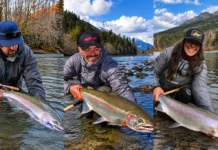
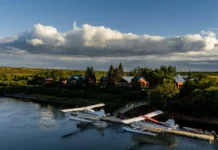
Fresh off hosting our Steelhead School at the Skeena Spey Riverside Wilderness & Lodge, Jeff walks us through what makes the Skeena River such a magnetic place for traveling anglers.
We dig into the small details that make the biggest difference like how shorter sink tips can unlock big water, why swing speed and fly angle matter more than you think, and how Great Lakes techniques translate perfectly to the wild rivers of BC. Whether you’re new to two-handed casting or have been chasing chrome for years, you’ll find plenty of tips and stories to level up your next swing.
The group explored multiple sections of the Skeena, from near the saltwater to upriver stretches. With four distinct zones to fish, every day brought a new challenge and new scenery. For Jeff, guiding meant teaching, mentoring, and sneaking in a few casts between lessons.
The Skeena is home to some of the biggest steelhead on earth. Jeff shared stories of 20-pound fish that test every skill and even a 34-pounder caught this season. He says using 20-pound tippet is the key. Lighter leaders often break when fish wrap around rocks or charge upstream.
We dive into how pink salmon affect steelhead fishing on the Skeena. Early in the season, pinks flood the river and hit flies hard—sometimes when you’re really aiming for steelhead. As they move toward spawning in late summer, their bite slows down, giving steelheaders a better shot at chrome fish.
Jeff notes that warm summers can shorten the Skeena’s main season, but the upper tributaries keep fishing well later. Early-season runs are especially fun since some steelhead will still take dry flies, a rare treat in such big water.
Even with lower numbers, Jeff had his best Skeena season ever. Years of fishing taught him how to adapt when fish are scarce just like I do on the Deschutes River. The secret?
Jeff keeps it simple. For the Skeena, he likes 12-ft T11 most days, and T14 when the front of a run is heavier. The longer tip gives better line stick so you can cast in the wind. For dries, he runs a full floating Scandi with a nylon leader a bit longer than the rod, and small foam skaters (even size 10) when the water is low and clear. He rarely uses poly/versa leaders for dries, but will add a sink-3 leader on a Scandi with a wet fly to break the surface film. Thin leaders stay at depth longer, and a sparse fly can still get 4–5 ft down in walking-speed water. Steelhead may sit just off the bottom or rise near structure—so adjust your depth and keep the fly moving right.
Jeff has been a Patagonia ambassador for over 20 years, helping test gear that often won’t hit stores for another three to five years. He’s currently working with the new Swiftcurrent wader line, built around Patagonia’s balance of durability and sustainability.
He says the Swiftcurrents are the real deal — comfortable, tough, and built to last through wild Alaska weather swings. “It’s hard to make something eco-friendly and bombproof,” Jeff admits, “but Patagonia’s close.” He also highlights their unmatched customer service, noting that anglers regularly get full replacements even after years of use.
As for field testing, Jeff laughs — “I just take them out and wreck them.” From freezing rain to sliding down banks, he puts waders through real-world abuse, then reports back to Patagonia’s design team.
Episode Transcript
WFS 833 Jeff Liskay 00:00:00 Dave: Today’s guest has spent a lifetime chasing steelhead, from the Great Lakes to British Columbia, teaching, guiding and living the two handed life every step of the way. Jeff Liskay just wrapped up hosting our Steelhead School and Skeena Spey Lodge, where anglers swung through legendary waters under the shadow of the coastal mountains of BC. By the end of this episode, you’re going to hear what makes the Skeena such a magnetic river for traveling steelheaders. Why fishing Shorter sync tips can be the key in big water and how small adjustments fly angle, swing speed, or depth can make or break your day. This is the Wet Fly Swing podcast where I show you the best places to travel to for fly fishing, how to find the best resources and tools to prepare for that big trip, and what you can do to give back to the fish species we all love. Jeff Liskay is here to take us inside the Skeena Spey experience, from beginner breakthroughs to twenty pound kromer’s, and to share why this trip continues to redefine what’s possible with the swung fly. We’re going to discover the mindset it takes to fish moving water. What Jeff learned from Brian Niska and the Skeena Spey crew, and how lessons from the Great Lakes translates perfectly to one of the wildest steelhead systems on the planet. Here he is, my man, Jeff Liskay. You can find him at greatlakesflyfishing.com and GreatLakesDudePodcast.com. Let’s get into it. How’s it going, Jeff? 00:01:20 Jeff: Great. Dave, how about yourself? 00:01:22 Dave: Good, good. This is awesome, man. This is really cool to to have you back here and doing. We’re doing a cool thing here where we’ve got video going. Usually we do audio only and usually I’m just looking at a screen. I’m looking at my notes. But now we’re looking at each other. We’re going to have this video out on YouTube, probably so people can take a look if they want to. It’ll be more of a probably a not as edited version. But first off, I want to check in with you on the trip. We’ve got the Skeena Spey school. That whole trip you did. I heard it was great, I wasn’t there. You were hosting it essentially, and doing great work. But but yeah, maybe give me an update. What’s been going on? I know you’ve been busy all around the. Does it feel like you’ve been traveling, like, for all summer here. 00:01:59 Jeff: Yeah. You know, I closed my season up, um, warm water. Right? And the end of July. Then I got an invite to the dean with, uh, Hickman got home from that, and, uh, early August, I had a couple trips to run. And then I headed to Skeena Country to see and meet Brian Niska for the first time. An unbelievable in the whole two handed world. You know, he’s probably one of the best in the world. So it was really, really great to meet him. And then I stayed there all the way till the end of September. Got home for two or three days and just got back yesterday late from an Alaska swing trip up on the NAC NAC River. So I’ve been like you, I’ve been pretty busy, you know. Got the fish actually. 00:02:40 Dave: Yeah. You got the fish right. Yeah. So that’s cool. So and actually I did hear from, um, Raphael in our wet fly swing pro community. He was on a trip with you. He just. I didn’t even know about it, but he went out. He said, I guess the steelhead fishing wasn’t quite right. So you took him out on the water, and he had an amazing trip. 00:02:54 Jeff: Yeah. You know, Raphael came in for a bridge engineering project in Cleveland, and I swung by like you picked him up with the boat, and, uh, we fished at Cleveland Harbor. Excellent angler. Yeah, he’s awesome man. Yeah, it was really good, man. Cool. Passionate. It was really cool. 00:03:08 Dave: Yeah. He is. I know we’re we’re kind of building up our community, and part of the stuff we’re doing here is, is part of it, you know, because, Calvin, I think we’re probably going to talk about today and there’s a few people that are well, I think we’re all hardcore. Right? If you’re in the fly fishing, it feels like it just sucks you in and you know, it doesn’t let you go. We’ve got that passion. But but I want to talk about the trip today because, you know, I haven’t been up there for a little while. You know, the steelhead numbers have been up and down. But I really wanted to talk about not only the trip, but what it’s like going to a big water like the Skeena versus, say, the home water. Like when we fish your home water on the south shore of Lake Erie. We’re fishing small rivers. Do you change a lot when you get into these? Bigger is the Skeena, that whole thing, especially fishing. The main stem does that a lot different than everything else you’re doing. 00:03:50 Jeff: I think it’s a mindset, but I think the value, um, if any true migratory species angler that wants to chase fish. The Skeena has to be on your bucket list. Because what’s unique about the Skeena system is that you’re getting an opportunity to catch these fish fresh from the salt, but you are getting an opportunity. These fish that are migrating up to all the natal rivers of the Skeena system. You have a chance to catch a bright chrome fish heading to the Babine. The Sustut, you know, Chloe tan tan. So you have this shot at world class fish right there that are coming from the ocean, rather than targeting them up in their natal home waters where they’re getting a little more stale. They still fight really, really well, but there’s nothing like tangling with a fresh salt fish in the Skeena. So that’s the major comparison I’ve seen. But you do have to have a mindset, Dave. I mean, as you know, this is one of these things that these are, you know, moving fish and here today, gone tomorrow. So there is a mindset of being prepared for fishing for fish that are not in that location at the time. That’s all. 00:04:57 Dave: Okay. So a lot of the things you’re doing, whether it’s on maybe up on the Bulkley or even on Lake Erie, you’re some of that stuff is applying to what you guys are doing out there on the mainstem Skeena. 00:05:08 Jeff: Absolutely. I think fishing the water’s surprisingly. You have this huge Skeena system, but the fish are fairly shallow, right? They’re not out in the super big deep middle of the river. So you’re actually fishing lighter sink tips. You know, you don’t have to cast far because these fish are migrating near the shore, where a lot of times when you were with me, the water’s up. It’s gritty. We’re fishing some pretty heavy sink tips and some pretty big flies just to get in there. You know the wheelhouse of the fish. So I think it’s unique that sometimes you’re like, oh geez, big rivers. You know, you think you got to use all this big stuff and it’s not the case on the Skeena. 00:05:47 Dave: That’s interesting. So and on the trip we had some anglers there. And actually John McMillan was he did he arrive for the event? 00:05:55 Jeff: No, he never did. He had some passport issues. Oh, wow. Yeah. So he never arrived. But, um, everything worked out great because of all the great people that came. And we also had some other anglers that were at the lodge at the same time. And we all it’s just a very unique experience when you get that many people passionate about, you know, the steelhead, it just it was a great trip. 00:06:17 Dave: Yeah, definitely. And I know one of the we mentioned Calvin who we’ve talked to, um, we did a Atlantic salmon episode, which is out, uh, with Calvin. He had a great trip on. I mean, he’s he’s kind of on fire. I feel like Calvin’s on fire. He’s on, uh, you know, Newfoundland going crazy with Atlantic salmon. Now he’s over on the Skeena. And he had a good trip, right? He got some fish. 00:06:37 Jeff: He did. Calvin stayed an extra few days, but Calvin, of course, was our star angler. This was his third time at Brian’s lodge, and he sort of knows the program. He has his flies and he’s confident in. But I think what really makes Calvin, um, an extraordinary angler is that when he gets done swinging a run, the guides will recommend, you know, hey, use this sink tip or use these flies. You would present a fly or sometimes they just, you know, give them one of your, you know, their flies. But he’ll run through a run and he’ll say, you know, that just didn’t swing right. And I think that’s the difference between someone who’s just getting started. I think, as you know, I mean, you know, like what sink tip how deep are were Calvin would run through a run and say, you know, that just didn’t we call it like, did I fish that run. Well, yeah. Where he’s like, I didn’t fish it the way I wanted to. He would go back, change out his sink, tip or change out his fly and then go through again in multiple times. 00:07:32 Dave: Oh, wow. 00:07:32 Jeff: That minor adjustment paid off. Big time. 00:07:35 Dave: No kidding. There you go. So that’s huge. So it’s not just one run through the run. Well we talked about right. Sometimes you’ve got multiple people going through. You might if you’re a guide and you’ve talked about this on the Great Lakes Dude podcast, right where you you might have somebody come in with a lighter line or a different fly, and then the second guy comes through with something different, right. To cover. Is that kind of the same thing? And Calvin’s basically doing that on his own essentially. 00:07:57 Jeff: Yeah. He is he has his like I say, you know, he has his control flies that he really relies on. But you know, sometimes, you know, we’re too high in the water column a little bit. These fish aren’t quite as they’re, you know, active and they’re going to come up no matter what. Then other times it’s down and dirty. I had an experience in Alaska that the fish are so full, um, and it’s big water like this that they just, they just won’t come up with it. And we just made a slight little adjustments to how fast it was moving. And then the fly not dredging, but just, you know, moving a little faster. And we went back in the run and within, you know, you do the right thing is when within like the next half a dozen casts it’s on. So that’s adjustment was like, oh my. That that adjustment really paid off. 00:08:42 Dave: Yeah definitely. Do you notice on the Naknek because that is a different system. You’re actually it’s really unique and interesting because you’re up that John would be a great guy to have here to talk about this because, you know, he’s in that realm a lot more. But you’ve got these trout, right? Essentially they’re trout, but there’s the size of steelhead. And so is it a lot different than fish in the NAC NAC versus say the Skeena other steelhead stuff? 00:09:02 Jeff: I think it is because I think in the NAC nac um, yes, they are migratory fish, but they are more in a holding position, right? They come up and then, you know, you have this captivated audience now day to day they move around to find and adjust to the water speed they want. And, you know, the angling pressure, getting away from angling pressure. But in general there are captivated audience. And you can they’re not moving through. It’s a day to day thing. But um, that’s Skeena system. I think a lot of the, you know, thought process with is that depends on the pink salmon run. Have you heard any correlation with like the amount of pink salmon to migratory steelhead? 00:09:42 Dave: Um, not, you know, not real I know Brian’s talked with John again about the the impacts of pink salmon out the billions of fish in the ocean that are affecting all the they think, right. But no, I’m not sure about how that affects in in the stream. I mean, other than you’re catching them, sometimes you’ll catch a pink where you’re hoping to catch a steelhead maybe. Right. 00:10:00 Jeff: Right. Yeah. I mean, that’s what we’ve encountered during our week was, uh, there was no shortage of pink salmon from the bank out even into the run. So multiple engagements with the pink salmon. And I think in the correlation of, like when they enter the river, if later as they get more towards the spawn, they don’t get as grabby. So I think you have a little more opportunity to get the the lesser populated steelhead that are in the river. What I noticed on the bark is like, well, when the pink salmon first come in, they’re pretty grabby and it’s I wouldn’t say a nuisance, but I think they’re moving to the fly better because there’s higher numbers more than the steelhead. So, um, but once they started getting spawning and they started to set up their their deal. At that point in time, you might just get a little nip, but they were intent on in the boom boom room and then the steelhead. It seemed like the steelhead increased for engagement once they started getting closer to spawn. 00:10:56 Dave: So that’s how. So basically these pinks are coming in in huge numbers sometimes. And then early they’re hotter and they’re biting. But as the season goes on, they get closer to spawn, which I’m not even sure the spawn time. I think it’s August September, right. Something like that. But as they get closer, that tails off less biting pinks, so you have a better chance to maybe get some of those steelhead. But is there lesser numbers of steelhead as you go later in the season? 00:11:16 Jeff: Two I would say on the Skeena, um, depending on Mother Nature, we had extremely warm summer. Their season ends a lot sooner than the upper stream tributaries of the Skeena System, for sure. The allure of going early is that you’re getting these fish that are genetically heading way upstream into the Morris and the upper Bulkley, and they are really actively chasing dry flies like it’s not. You know, if you really wanted to target a fish on the skin with a dry fly, you could. If you wanted to chase steelhead on a dry fly on some of the early run steelhead into tributaries. It’s a thing like it’s time come towards Halloween or maybe a little bit before Halloween. The water temperatures are not quite ideal. 00:11:59 Dave: Yeah. Were you doing some of that because you’re up on the Bulkley this year as well? Were you doing some dries? 00:12:05 Jeff: Yep. I would say at least fifty percent of the day that we would do the dry fishing was a lot tougher than it normally is, but we sort of figured out the game starting with the Skeena. Everybody sort of week one in Skeena system. I think the guides and the lodges sort of figure out that, hey, the numbers are a little lower, but this is the water they’re using and within a week or two, that’s one nice thing about not do it yourself. And going with an outfitter is that they have this communication network with multiple guides spread out through the whole system, and they sort of get an idea. Brian talks to, you know, Whitey and talks to Jimmy Allen and they’re like, hey, I’m catching fish up on the, you know, the kispiox or the water’s low, but they get a vibe of like where the fish are, you know? Yeah. And you get a vibe of how many fish really came in. There was plenty of fish to catch this year still. 00:12:50 Dave: Yeah, that is it. Now that’s cool. Yeah. Brian’s got his finger on the pulse. Not only in his main stem, but the whole river because he’s into it, right? He knows exactly what’s going on. 00:12:59 Jeff: Oh, yeah. You won’t find anybody better than Brian. His demeanor and his knowledge from back in his days in Whistler. Up to there. I think he was one of the very first to get, you know, certified in his two handed lessons too. So just not only his certification with casting is a world renowned caster, it’s his knowledge of how that system works. 00:13:21 Dave: Yeah, exactly. And so for you, you were up and you mentioned Whitey because you had a podcast you did on the Great Lakes Dude podcast with Whitey, right? Where you guys talked about that. And he I listened to that one because I listened to all the podcasts. And it was great because he talked about his history there and the dry flies and how they’re really surface oriented and how he didn’t even realize at the time that’s all he did, right? Early on he was just fishing. But is that the boat? Is that what they. There’s probably a time when maybe surface flies aren’t working as well, but you guys are going for it up there whenever you can. 00:13:49 Jeff: Yeah, I think that’s the individual anglers goal. Right. Would be to say, you know, hey, I want to catch a steelhead for sure. So I think you would use what the guys recommend, a lighter sink tips. And you know, uh, and you go for, you know, get engage with a few fish, but then maybe in the afternoon you’re like, hey, you know, I caught a fish today. Let’s, let’s try this dry fly thing or vice versa. Have one angler do a dry fly, um, and then come through with, you know, a sink tip behind you angler to check your work to. 00:14:17 Dave: Discover Smitty’s Fly box for premium flies, their monthly subscription service delivers expertly crafted flies and materials tailored to your fishing environment. Boasting over thirty years of experience, Smitty’s is your trusted source for a diverse range of flies. Enhance your fishing experience and make life easier with their carefully created selections. You can subscribe right now at xbox.com and join a community of passionate anglers. And you did on the with Brian at the lodge you were essentially hosting, you know, which is cool because the first year that we went up there, I was up there. It was great, had a great experience, but obviously time is limited. We’re all trying to do these trips and get new trips in and stuff. So you went up this year as a host. What was that like doing that? Because I know when I went up there the first time, it was great because I was out there. I did get some fishing in, plenty of fishing in, you know, but you also are letting the clients kind of go and you want to make sure they get some action. How does that feel for you? Because you’ve done a little bit of this. Did you get any fishing in? First of all, there’s the question, I guess at the top. 00:15:20 Jeff: I absolutely did. It was unbelievable trip because the four anglers that they all were knew each other, all came from Kamloops and they basically were pretty new or beginner level of two handed. One who was the Kevin who was, uh, he was basically the ringleader who got him all involved. We actually had a six month year old baby with us in that group. 00:15:44 Speaker 3: Oh. That’s right. 00:15:45 Jeff: And it was so cool because they split their time. They’ve never, you know, even engaged with it. You know, they had some experience with some trout around Kamloops, but, um, it was unbelievable. They caught some pink salmon. Everybody hooked a steelhead. Some didn’t land one. But I think when we started out, Brian did an awesome job. Uh, probably the best demonstration of a beginning Spey cast I’ve ever seen. And that’s one of the key things about, you know, everything we do, Dave, is just having that school. Yeah. You’re going to catch fish, but you’re surrounded with three hundred and sixty five day a year anglers who spend it using the two handed rod or that method. So we we spent the whole afternoon doing some casting and into the evening. And then the next day jump into boating, go and then work on your skill set, right, like, hey, let’s catch a pink because that’s a grab how to feed them line. So that worked out really well. But we’re super cool. You know, I fished in the pockets of a few of the guys and we like stepped down the run and said, hey, this is sort of where you want to be, you know? And when you were up there, did you do all four sections of the Skeena? 00:16:49 Dave: Uh, let’s see here. We did. So the first day we did the same thing, we went out was great. Day one, I think because you kind of get Brian the way we do it, it’s three full days and then like a half day bonus, you get there early. And then I think we went out on the water that first half day with everybody. And Brian did his session. We were out there on the bar right across, like you could almost walk out there to that first little bar. We did that and then I think we covered. Yeah, we covered everything around there. We went upriver and then we did go way down below through that. The, you know, the, I don’t know, the ridge or whatever, it went down below. So I think one day we did get down below, I’m not sure. Is that covering everything? I think we did. 00:17:22 Jeff: Yeah. So they have a which is unique about Brian’s Lodge and unique about the, you know, that, uh, our school is that we just don’t fish the home waters, which that’s one of the draws of this, is that they have this great home pool, like you said, that you could literally walk to or take a small little raft. We had this small little paddle raft paddle across us. You paddle across the channel and then you have these options that fish these three great home pools. You know, if you want to do it super early in the morning, if you wanted to add on a day, you just do it yourself or even after dinner, go over there and pop over for an hour or two. So that’s the allure there. But then we would have a boat that would leave the lodge and go down and fish. Uh, Shayna three up and down. And then Mikey, you know, he’s probably the most craziest guy who fishes and guides in blue jeans, right? 00:18:13 Speaker 3: Right. 00:18:14 Jeff: Yeah. 00:18:14 Speaker 3: He’s old school and. 00:18:16 Jeff: Yeah. And then he went up and he fishes the upper section of the skin and skin of for. And then we would actually get in a boat in a trailer. You probably did that where we trailer about forty five minutes away and we go all the way down towards the salt in Skeena, too. So you have these four sections to use. We didn’t use Skeena one, the lowest section, but we fished all three other sections, which was it was crazy, you know, very diverse. 00:18:39 Dave: Yeah, yeah it is. It’s a big river. I was talking to Brian about that when we did the last podcast. Is just the size and magnitude of the Skeena. I might have been wrong on my CFS numbers, and in Canada they don’t talk CFS. You know, it’s. 00:18:51 Speaker 3: Oh, but. 00:18:52 Dave: It was I think it was like at some it runs at like sixty thousand cubic feet per second in some flows and probably gets bigger during floods and stuff. But I mean, that’s massive. The Deschutes runs at like four thousand, five thousand. So we’re talking the Skeena is a gigantic river. So you think, you know, it would be daunting to say, man, where am I going to catch a steal in this giant river? And it is broad, right? But like you’re saying, if somebody was going to fish the Skeena, you know, what is your advice for somebody listening now who maybe isn’t going to be at the Skeena Lodge but is going to be up there on their own, what would you tell them? 00:19:20 Jeff: So that’s pretty interesting because I fished a Skeena on foot multiple times, even this last year. My last week there was founded running around with a buddy. When it comes down to migratory fish, you have to find a feature that slows them down. I think that’s the key. You know you’re not going to find waterfalls, but you’re going to find a feature that once they start navigating up this river that they’re like, hey, this is this is something I’ve got to navigate through. It slows them down just enough so they might even have to rest. So like if you see a really long section of, you know, fast water, once they get through that, they’re probably going to dump into that tail out and rest for a little bit. Sometimes what you’ll notice is like the elevator pools, like in a lot of Skeena situations, you’ll see the front that has a little bit of like it’ll drop a little bit, drop a little bit, and then it’ll run into this big long bar. Sometimes they lay right up on that very, very front before they progress up the river. You know, it’s not and they’re not really big sections. It’s, you know, maybe fifty foot by twenty five foot that these fish rest because we’re only fishing for a handful, right? That are migrating through a time. It’s not like a salmon. We have hundreds. But that’s sort of what I like to do is look at those areas. And the best suggestion to, you know, I could have any would be like, Google Earth is your friend, right? 00:20:38 Dave: Just look for a Google Earth. And yeah, you could zoom in and see I was just doing that on the Deschutes because we were down there and we’re doing some, you know, some cool stuff and looking. But yeah, you can zoom right in, you can see bars and you can see all sorts of stuff. So that’s it. And you’d be looking for those things, whether that’s a, a riffle like you said above to a tail out above, or maybe there’s a giant boulder or something like that. 00:20:58 Jeff: Yeah, right. Just any feature. And when you see it straightened out you’re saying like that. And what’s unique about the scheme is the road follows it a lot of its journey. So as you’re driving along you’ll be saying, oh, look at that. There’s a big bar there, and there’s river right and river left, but you then you have to sort of figure out how to get in. Right. That’s one thing. Sometimes it’s like unachievable to get in with a walk in. Wade. 00:21:23 Speaker 3: Right. 00:21:23 Dave: Because it’s private property. You still have the private property. You can’t just. I’m not sure even what the regulations are up there, but there’s. You got to find the access points. 00:21:30 Jeff: Correct. And some are not accessible. That’s what makes getting in a boat at a lodge very alluring, because, you know, you could travel four or five, six miles on a boat, and then all of a sudden that’s been a higher productive bar. So that is the allure of going to a lodge and being guided over do it yourself. 00:21:49 Dave: Yeah, I think it is. I mean, steelhead is is one of the ultimate species because it can be, you know, you can get skunked at any day. You know, we all get skunked. And so it can really put you down. But you know that one fish can be all. And I was looking at another Carlo, who’s also I’ve known since I started this podcast, and he was actually on one of our first steelhead trips we did way back in the day. I just saw a picture Brian sent me that he got on the Skeena. It was a twenty three pounder. 00:22:13 Jeff: Sure, man. 00:22:14 Dave: Just a beautiful fish. Right. And and Carlo, I heard him. He just sent me a text. He’s like, man, words don’t even describe it. Right. And it’s not just about having a giant fish, but, you know, you work so hard for so many years, ten years, and you know, you’ve been dreaming about. I’ve never caught a twenty pound steelhead, you know. You know, my dad has. I haven’t been the biggest fish still in my is upper teens, which is great. You know, I’m happy with that. But what it for you because you’ve done a lot of this. Do you have a goal, do you think, like, oh man, I would love to get that thirty pound or the twenty pounder? How do you look at it. 00:22:43 Jeff: Yeah, thirties were my goal is now during that course of a month up there, I had a friend that took a thirty four pounder out of a four. 00:22:51 Speaker 3: G’s. 00:22:51 Jeff: So that was either heading to the Kispiox or the Babine, or one of those upstream rivers. 00:22:56 Dave: You saw that? You saw that fish? 00:22:58 Speaker 3: Oh, yeah. 00:22:58 Jeff: I saw a picture of it. Yes. 00:22:59 Dave: Dang, thirty four pounds. 00:23:01 Jeff: Is it thirty? Guessing it. Yep. They’re guessing at it. They did the math on it. So. But give or take, it was one of the largest fish I’ve seen, you know, over the years in the Skeena because there’s always a couple thirty pounders caught a year, you know, from spring skiing to Brian’s, but twenty pounders, very achievable if you can land it. 00:23:19 Speaker 3: That’s right. If you can land it. Well, let’s let’s talk about that. 00:23:22 Dave: So you get one of these fish on it. And I was just talking to somebody because I was fishing the Deschutes. You know, this is prime it’s prime time for steelhead a lot of places. But, you know, I love going light on the leader, you know, and I’m probably a little weird, but, I mean, I sometimes go down to eight pound, but even ten pound is pretty common. But the Skeena there, you know, you guys are using twenty at least Brian loves twenty pound. Do you think you know the gear? Does that matter at all for you when you think about tippet size. 00:23:45 Jeff: Absolutely. So I don’t think it’s the angler skill set or the drag systems or the rod. These fish will get so far from you that they’re going to abrade your leader system on the boulders. I’ve seen countless times where the anglers facing downstream and the drag is peeling out. I’m sure you’ve seen it. They’re facing downstream and the drag is peeling out, and you see this fish jumping upstream, if you like. What’s that? Fish? And then you realize that it went downstream, did a buttonhook around a big rock and it’s heading back up, and now you got to drag it through the rocks. Every guy that I’ve ever seen on the Skeena, because of experience and losing trophy fish, they have one word. 00:24:28 Dave: Twenty pound and twenty pound is good, say, versus fifteen or even twenty five or thirty, because it must be just that sweet spot if it’s not too super thick, right? Not too light. 00:24:39 Jeff: I guess we have a point in time where I guess twenty five pound wouldn’t fit through our eyes of our fly, right? 00:24:46 Dave: Well, that’s cool because you also have this the loop, the open mono loop, right. Which is a game changer. And that’s where it gives you you know, I used to think back in, you know. Yeah. Lighter gives you more movement. But with the open loop the twenty pound is great. You’re still getting all the movement you want on your fly right. 00:24:59 Jeff: Right. But so this is the debate right. So the interesting thing is is that I use tube flies. So there’s no movement. I go straight through that eye of that small tube. And twenty pound barely fits through the small tubing that I tie on. And then I have another guide friend, if you know, in Michigan, Kevin Feenstra, he ties direct. So interesting. I asked George Cook this information when I was up in Washington. He ties direct to ties direct. 00:25:25 Dave: So with a mono loop or something like that. 00:25:28 Jeff: No, just straight clutch. 00:25:29 Dave: Not oh, just a clinch not they do a straight clinch not yeah. 00:25:32 Jeff: Just because they feel there’s no animation of you stripping. They just it’s always under tension. And when I’m fishing a tube fly and Mike up a ski lodge and Adrian they both in uh they all just if you’re using a tube fly there’s no loop. They we’re catching just as many fish. So that is the debate, right? 00:25:50 Dave: Right. Do you need the. Yeah. My thing is and I’ll shout out to Jay Nicholas, some people probably know Jay. He’s a he’s an awesome dude. The first time on the chutes I fished with him. I was just using the clinch knot back in the day. But I remember always I was checking my fly a lot because that clinch knot would and I these were talking traditional wet flies right. But that that thirty six eight nine zero mustad hook style right. Would would get on a right angle because it would be tight and then the hook would be at a right angle right from off the hook. And so I was always checking and I checked my fly. Oh, dang. And then Jay was like, man, I use this mono loop. And as soon as I started using the mono loop, I don’t check my fly almost ever because I just know it’s going to be good to go. So it saved me a lot of time of stripping in the fly. Checking. But what you’re saying is, some of these other people are using the clinch knot and they’re not having that problem. It sounds like at all. 00:26:38 Jeff: They are not. 00:26:39 Dave: It might be my casting. It might be my. It’s probably my casting. 00:26:43 Jeff: So I do use the mono loop with the wet fly myself. So I guess in my situation, because I use very little shank flies, I’m just using that tube fly. Right. So it’s like, hey, it’s a straight pull. I don’t have to worry about it following a whole lot and then I don’t have to worry about, you know, I can change a hook out or whatever too. 00:27:00 Dave: Yeah. So there’s lots of ways to do it, but that’s that’s one part of it. You got the leader and the gear and then. So what do you guys talk about a little bit on the gear? I always love to hear this because I think when I was up there, we were fishing on Lake Erie. You were in my pocket two a couple times and you gave me a couple tips that really changed the game. You probably remember that day I hooked that brown trout and then got a steelhead. I think I got a steelhead that day, I can’t remember, but it was awesome. And it was in that long run. We were casting towards the far bank, swing it down. Just one of those memories I’ll never forget about. You know, again, we’re talking about the Skeena, but you on the other side of the country, you know, Lake Erie, have a pretty spectacular place yourself. Maybe. Let’s take a little tangent on this for a little bit. I want to hear have things change much there? Are you doing the same game as when we were there a few years ago? 00:27:40 Jeff: Oh yeah. I think we are in like any fishery, we’re in a decline of population, even though it’s an artificial trout fishery. You know, it’s a migratory trout. They’re coming up. Well, Covid sort of put a little bit of a hiccup into the stocking program. And because as you know, it takes a couple two, three years for it to cultivate an hatchery program. So we had definitely with the warmer falls, our spring fishery was pretty much as slow as I’ve seen it in twenty five years. Fall fishing was still okay, but we’re dealing with drought conditions like you guys are in areas so. 00:28:14 Dave: And these are fall. So we fished at the fall. Now are these fish. Because they do have some Great Lakes fish that are wild. Do you have or is it all hatchery or are there some wild fish returning. 00:28:23 Jeff: Well, thanks to the Canadian ministry, they believe in more natural reproduction. So they have a pretty good self-sustaining populations on Lake Erie, Tribs and up, of course, on Lake Huron and Superior. But in Ohio, it’s undocumented. But New York does have reproducing, you know, stock on the Cattaraugus Creek, which has a clear creek. But there is minor. And I think if somebody did a study, I don’t think it would be every year, but I think we’d be a very low percentage of self-sustaining trout that migrate up my home rivers year to year. But we’re on a definitely a downturn, which is actually it puts it in more of a realistic numbers game rather than, you know, like I think when you came, that was pretty a pretty good fishing, pretty good average, what I call peak fishing, where you’re encountering, you know, maybe one to three on a on a swung fly. Five would be a good day. We would struggle now to get three on the last fusion. So we’ll see what this season brings here in the next couple of weeks. 00:29:21 Dave: Interesting. Yeah, it’s kind of interesting because the steelhead on the West Coast, which is what we’re talking about here. You know, we’ve seen those natural fluctuations as well and we’ve seen some downturns and similar numbers. You know I guess I think we had a little bit of a bigger year this year, you know, in the system, which I think the Skeena, you guys obviously caught some fish. So there’s fish to be caught out there, right? 00:29:40 Jeff: Absolutely. You know, they said that the numbers were really low because they had used that tie nets. But I talked to Brian about that. And it he doesn’t use any of those deciding factors. I feel that if you just go steelhead fishing and skiing a country or just go fishing on the Deschutes or even in a Great Lakes, and you give yourself a three day window or four day window, you will encounter a steelhead or more, right? That’s the goal, right? We’re going to do it. And then as you learn the fishery, you know, I had my best year ever in Skeena Country this year. 00:30:10 Dave: Oh. You did. 00:30:10 Jeff: Yeah. So I mean, I had some spectacular days, but sort of figured out the program. And because I’ve been going up just, like would be you on the Deschutes, you know, that water. And when the wheels fall off, like, we had this podcast, it’s like, Dave, you can adjust it to Deschutes. I’ve been learning how to adjust to the Skeena System in my home rivers, to just that little adjustments when there’s not as many fish like on the Deschutes, there’s not that many fish. You probably have backup A, B, and C, right? Yeah. Like when there’s no fish around. What do you concentrate on? The Deschutes when the numbers are low. 00:30:41 Dave: Oh, you mean A, B and C for other rivers. The Deschutes are different or within the Deschutes? 00:30:45 Jeff: No. Like if you’re on the Deschutes and, you know, let’s just say a couple years ago and was super tough, are you looking are you looking to change your program or what do you do to change when it gets slow on the Deschutes? 00:30:56 Dave: Yeah, the Deschutes is unique because you have this section of in the Columbia system. You’ve got Deschutes fish that are coming into Deschutes going all the way up. Then you’ve got these B run fish that are turning into Deschutes, the lower river, and they’re chilling out before they have to clear water and some of these other places. So the lower you get on the Deschutes, the more fish you’re going to encounter. And like you said about where fish are holding, there’s a couple of areas there in the lower river where pretty much you’re going to find fish. So that’s typically what I tend to do is go down lower as we get, you know, less fish, you know, and that’s but I mean there’s, you know, again and I’m not the super I’m not a guide. So I’m not like these guys. You talk to some of the guys that are on the river every day. It’s been interesting because one of those areas, it’s kind of this is my, I guess, my complaint about some of the guides. And, you know, obviously it’s pretty minor, but there’s this one area that’s just known for its combat fishing. You know, like everybody could be down there. It’s a zoo. It’s a wild, wild west. My dad’s got stories of being down there and some crazy I mean, you name it, it’s happened because people can you can literally walk up there, you can bike, you can float. And for the most part, I don’t remember ever seeing guides down there, you know, because it was just so crazy. You know, I like I’d see guys almost getting fights down there. And but now you’re seeing on a certain side of the river a giant guide camp. And they kind of monopolize it for a lot of the peak of the season. So it kind of feels like, man, what used to be that Wild West of now it’s like half of that. That spot is not fishable unless you want to go battle with the guide and say, hey, I’m going to jump in here and you know what I mean? So I’m kind of going off on a tangent, but I feel like, um, fishing, you can get caught up in a messy, you know, it can kind of get ugly, right? If you don’t. What’s your take on that? Maybe pull me out of this. What’s your take when you get really pressured areas and I know the skinny you guys probably don’t have it because of the you know what that’s like. But how do you deal with that? 00:32:46 Jeff: So when you get pressured areas like that I always say, and this is back from tournament days, is that you have to split those fish up with other anglers. So if even though that run might have twenty fish in it, people are going to catch them, but you still got to split it up with other anglers, so you’re better off. I usually just say, heck with it, I’m going to fish be water, but I just have to cover more water. I call it fishing with your feet. Right? Just move through water. Eventually you’ll find areas that the fish will say. You know, there might be fishing for one. You’re a hunter. Fish for one on a weekend. It’s almost impossible to get an A run. It’s almost impossible. So we just concentrate on moving on. 00:33:26 Dave: You get out and. Yeah. So I mean, in this situation, I feel like again, it’s it’s me complaining about small stuff, but it’s like, you know, you got an operation down there. They’ve got jet sleds. The other thing, you know, so it’s tough when you see somebody that’s got this amazing water and then they head up river to go fish some other water. And that’s where I feel like I guess that’s my point here. I’m getting to the guys. The guys are really good at finding those little buckets. They know every little nook and cranny, and I actually don’t because I’ve been really I fished the river, but I don’t know it as well as the guides, you know, and these guys, they can go to these little tiny buckets, drop a guy off here, drop a guy off here. And that’s what they do with the sleds there. Boom, boom, boom covering the water. But you know, and then also in this area they got this giant run, which is like four main long runs, you know, just this huge area of beautiful water. And it’s been out of touch for me this year, to be honest with you, every time I’ve gone down there, there’s been a huge guide camp on it. So, you know, I haven’t really and to be honest with you, the last few years I haven’t been fishing as much down there because the runs have been down. So I’ve also been taking a little bit of a break. It’s interesting. I find myself, you know, and I’m trying to get my kids in it. That’s right. Right now my girls are eleven and thirteen. They got the Spey rod, which is another amazing thing about the Spey rod. They’re out there casting and they’re you know my eleven year old she’s she’s booming it out there. You know what I mean. It’s so for me that’s my focus I guess I shouldn’t get too caught up in all this, this other stuff and just focus on the kids. But I do want to bring it back to the gear, because that was a question I had for you on the Skeena. Let’s talk about that a little bit. What was your perfect setup? Do you have one you use for the Skeena and what’s your line, rod? 00:34:54 Jeff: You know, I think on an average in Skeena Country’s eight weights for sure. I don’t think it’s a power thing. I think a lot of times the Achilles heel is when the wind blows. Not that a seven weight can’t handle the fish when the wind blows. You need that extra grain weight just to get the darn thing out. As a beginner, as you get, you know, advanced casting, um, you can start getting, you know, that mid four hundred grain outfits to high four hundred seconds and maybe five hundred. That’ll work. But in general, when the wind starts cranking and working its way up through the Skeena Valley, it’s nice to have that eight weight. Some anglers even go nine weight when it’s really windy. I usually like to take two heads. I like to have that head that’s more pleasurable to cast, you know, on an eight way, a little bit lighter than when the wind starts up. I’ll just bump it up one window, class a couple twenty five grains. It just gives me a little more. My casting might not be the best, but at least I’ll get it out there one way or another. And I think that’s the key. It’s not a far cast, but as you know, You know, you get twenty mile an hour gusts or thirty mile an hour gusts. It’ll even knock a Skagit head down. 00:36:05 Dave: Yeah, and that’s pretty much what you’re talking about using here because we had you know, there’s a lot of lines out there now. And to simplify it for somebody listening now let’s just take somebody who’s kind of new to it. They’re going to be fishing the Skeena because you’ve got, you know, you’ve got the rage, you’ve got the fist, you’ve got all these different things. Talk about what somebody could pick up or what you’re using there. 00:36:23 Jeff: Yep. I think just a standard Skagit Head brand doesn’t matter. I use you know I’m with SA but we have the standard Skagit head. We use the SA products, but they all have it. I think then at that point in time you should have a fairly a fairly good selection of sink tips. I know a lot of the guides there like the float sink because it can work into the bank. So it’s amazingly, it’s difficult for me to accept the fact that when you’re going to the Skeena that the fly has to go right to the bank. So it’s not like, oh, by the way, we need T14 to get them out there in that deep green water. We need a fly sink tip that’s roughly going to get you fishing within the water column right to your hang down. It’s a crazy mindset compared to like sometimes in the Great Lakes, where we’re always out in the middle where the water is, you know, we don’t have any flow against the bank. So, you know, a fishing, a very light sink tip is is very key on the Skeena. I will say, Dave, though that was interesting, is that some of my largest fish, those twenty pounders, do lay a little farther off the gravel bar than the average sized fish. So my go to is when I’m trophy hunting. There is that, of course, we have one angler working down the inside, but I prefer to fish that next level of depth in current out. And then when I get into the super skinnies I don’t even care. I just drip in. I mean, just because of what I feel like there’s those fish are just like the king salmon. They have no problem holding in heavier current in that, you know, just at least heavier current. 00:38:04 Dave: Some places are just different. You feel it the second you step into the water. Mountain Waters Resort sits on the legendary Portland Creek, a place where Atlantic salmon runs strong and where fly fishing history was written. Lee Wulff himself fished these waters, and now you get to experience the same world class fishing in a setting that feels untouched by time. Whether you’re swinging flies for fresh chrome or kicking back in a cozy riverside cabin, this is the kind of trip you’ll be talking about for years and years to come. And guess what? I’ll be there this year as well. But here’s the deal Prime time season fills up fast, so don’t wait. Check in now and join me on this historic river. This year. You can head over to Wet Fly Waters. Right now that’s Mountain Waters Resort. You can go to Wet Fly Swing. Waters right now and save your spot for this epic Adventure. What would be the sink tip you’d be using for that little bit out a little bit further? 00:39:01 Jeff: Um, you know, you’d be talking now like T11, you know, stuff like that. I match, you know, twelve foot with an eight weight over twelve foot. You know, I always use twelve foot tips or, you know, rather than a short ten. They like ten footers there because they fish. They fish into the bank bar. But what I found with me is that when I get, uh, too shallow, it’s really hard to keep a anchor system on the water. You prefer ten foot tips yourself or. 00:39:26 Dave: Uh, you know, I’ve just been experimenting with that. I feel like I feel like I do lean to the ten, although sometimes the fifteen. I even have some fifteen foot like, dry tips that I put on. I’ve been putting on some of these other lines. Yeah, I probably am closer to the ten, ten and twelve range. 00:39:41 Jeff: Okay, so there’s a good thing just spending a whole week with Timmy Arsenault up in Alaska and we chat about it a lot, is the line stick? Like with a Skagit system, you have a sink tip. You have to have something to pull against. So if you don’t, if you have a ten foot tip and a big eight way, thirteen and a half foot eight weight and you start yanking on that thing, a lot of times if you’re looking to fight the wind or whatever, you don’t have enough stick to really pull on and it goes fine. But to take it to your next level of thought process, you know, I’m using twelve foot tips and I’m able to really get a good line stick so I can really have something to put tension on and really launch it out there, or at least fight the wind. 00:40:23 Dave: Yeah, right. So a little longer. Yeah. And that’s so you go T11 twelve foot, just T11 and then you add your leader on to the end of that I do. 00:40:30 Jeff: Yep. And I, I’ll go as much as T14. Like a lot of times I was using T14 and some of those fronts of the runs where I had to get right into the heavier current. But hopefully you have a fishing partner, right? Right. You know, it’s like, hey, mix it up, let’s see what works. 00:40:46 Dave: Yeah. Okay. So that’s your thing. And then you’re also doing some dry. What was your dry line setup like? 00:40:50 Jeff: I actually used just a normal Scandi, you know, full floating. Then I always run just a nylon leader the length of my rod, but I usually lengthen up at least a foot or so longer than my rod. And I’m always using, you know, I did use deer hair in that, but the foam’s nice because you don’t have to dry it off, right. So I usually use some foam skater, you know, pom pom or something in that neighborhood. And it was interesting this year that you had to scale way down, way, way down from size wise. The waters were lower, they’re clearer. You know, I’m using dry flies that were substantially probably more like your Deschutes dry flies. Really small. 00:41:28 Dave: Yeah. Small like size eights or. 00:41:30 Jeff: Yeah, really small. This year. Um, I think they were, you know, I even went down to a ten because I don’t know if it was just because of low or what it was, but that seemed to be one of the key adjustments. 00:41:41 Dave: Wow. That’s cool. Okay. Yeah. And there’s a lot. And I was also thinking poly leaders. Right. Which I think is, uh, Rio. Right. Has the poly leaders which are kind of clear dry tips that you. Well, they could be sinking too, but you put those on the end of a. I don’t know if you put them on the end of a Scandi or a Skagit, right. But they just give you that extra length to balance out your setup. Do you know much about the poly liters? 00:42:00 Jeff: Yeah. So anytime you have a leader system, regardless if it’s the, you know, the versa leader, the poly I think the poly leaders airflow and then Rheo is versa leader and then say is sonar leaders okay. 00:42:11 Dave: And those are all the same thing. It’s a clear. 00:42:13 Jeff: There’s a normal leader that’s coated right. That gives you more stick in that. So it’s still tapered. 00:42:19 Dave: So do you ever use those. 00:42:20 Jeff: I usually don’t when I’m dry fly fishing. 00:42:22 Dave: Yeah. Because you have the Scandi. You don’t need to put anything on the scandies. Just add your leader. 00:42:26 Jeff: Yeah I mean if I did so a lot of times what I did was I would use like a sink, three liter, twelve footer on top and on my Scandi with a wet fly just to break that surface down. 00:42:37 Dave: Just to get down a little bit. 00:42:39 Jeff: Just a little bit. Yep. 00:42:40 Dave: All right. And not a so a sink three in the next lighter would be what intermediate or what’s less than the sink three. 00:42:46 Jeff: So the next might be a sink three. And then and need to have intermediate. And then you would have a hover, then a float, and you won’t need a float. 00:42:53 Dave: So sink three. Sink five three seven is three inches per second right is on the. How does that compare. Remind us again on the T11, T14 all that stuff. 00:43:01 Jeff: Yep. So basically the sink rate of a sinking leader is at the butt section. So if you throw it in a swimming pool because there’s less tungsten or coating on towards the tip, it won’t sink as fast, right? So the sink is always at the butt section. But generally like a I would say I compare it in my home waters that if I’m using T, say T10 or something like that, I would compare that to like a sink leader, sinking leader, you know, something like that. And it’s pretty comparable. A very interesting thing is, is that you probably have more because you do a lot more fishing with sinking leaders than I would, but the thinner diameter, it stays at fishing depth longer the diameter of that sink tip. I mean, when you’re fishing your wet flies and it it shoots you, you can maintain with a heavy iron a fairly decent depth, right? 00:43:49 Dave: Yeah. I mean, I’m usually using small stuff, pretty light. I’m trying to keep it light, but yeah, I mean I’m not exactly. That’s always a question I have is like, how deep am I down there? Right. I mean, fish are definitely coming and they’re moving a lot. So I don’t think I’m that deep. And I use small stuff. Size sixes for the most part. Size eights, light stuff very sparse. So I’m I’m imagining I’m right in the below the surface film a few inches or, I don’t know, maybe six. 00:44:14 Jeff: You’re right. I mean, imagine a current, but I know I have one run on the Berkeley and I’m in my home waters that it’s just a nice walking pace. Steelhead stream with a twelve foot liter nylon leader with a heavy iron, sparsely tied fly. I can get around four or five feet. 00:44:30 Dave: Oh, wow. 00:44:31 Jeff: You can they sink like a rock? 00:44:33 Dave: Four or five feet. So yeah. So? So I might be totally off. Maybe these little flies I’m using are getting down a lot further than I’m thinking. I mean, that would make sense because they’re definitely the fish are not up at the surface. They’re down somewhere I mean, maybe let’s answer that. So do you think steelhead summer falls skiing of steelhead? Do you think they’re in column lower up. Where do you think they’re hanging? 00:44:54 Jeff: Um, I think if they have a major structure that they can utilize, they could be up off the bottom a couple feet. But it all depends on the structure. I mean, if you find going back, like you said, the guides on the Deschutes, they have the spot on the spot. They have three rocks out of one hundred yard run. And that’s like that’s where they live. And those fish could be up, you know, up off the bottom a little bit there because it’s got the current break. And then if they the farther back you get from that structure or whatever, they could start hunkering down near that, you know, nine inches to twelve inches off the bottom. But the nice thing is, is that they can come up off the bottom, right? 00:45:30 Dave: Yeah. They can exactly. They can move. They’re going to move a lot more than a winter. Winter fish. Yeah. 00:45:35 Jeff: Yeah. 00:45:35 Dave: That’s awesome. Yeah. There’s so much here to we could chat about because it’s really interesting. Like what are these fish doing under the water. Did you guys get when you were swinging when you’re there were people getting little plucks, little tips and taps and stuff before a hookup. Did you see that? 00:45:50 Jeff: You know, the pink salmon? That was their M.O., right? You sort of get an idea that they would peck at it, peck at it, and then get it. The steelhead. Um, we did have a couple where they showed themselves and then like three seconds later, they just climbed all over it. And then depending on the speed of the current, I think a lot of times they it’s that cat and mouse game and the slower pools, you know, where you were trying to fish in that, that singer, they weren’t that aggressive. They might like peck at it and then they start progressing towards that super skinny. Then they would have to commit either let it go to the bank or just climb on it and then vice versa. A lot of times if they’re in the fast water and you’re down there, they have no choice but to grab it instantly and just hook up. Better hook the landing ratio. I noticed in a faster water for sure. 00:46:34 Dave: Oh it is. Yeah. Okay. 00:46:35 Jeff: Yeah, just they grab right on it than right on it. 00:46:38 Dave: Yeah. That’s so cool. Well I think, um, you know, we’ve definitely covered Chunker. I wanted to give a shout out to people who are listening now, because we’re going to be we do as we’re talking, have a few spots available. I’ve already been talking to some people that are interested in this Skeena trip, but what we’re doing is we already have somebody who won the trip. And so as we’re talking, it’s twenty five, but this trip we’re going to be doing next year is twenty twenty six. I think we’re going to do about the same time end of August, early September, maybe first. On that. On the timing. I feel like that’s a really good time because it’s not too early, not too late. What are you thinking? What’s your thinking about that late August period? 00:47:10 Jeff: It’s still the best time there is if you wait longer. A lot of these upper Skeena River tributaries, those fish are already moved through this system this year. I think we sort of hit it right on the nail on the head, give or take a week or so, but we had just extremely warm temperatures, right? Which is sort of unusual. Like all of us are experienced this climate shift stuff. But when I got there, there were fish already up in Skeena for and there was fish down in that Skeena three seemed to be fishing the best water seemed to be fishing right in front of the lodge, which is a pretty good chunk. So I feel where the where Brian’s lodge is is like the focal point. It’s right by the copper River. It’s unbelievable. You know, there’s fish going up that so right now. 00:47:52 Dave: Yeah. The copper is just downstream. River left. Right. 00:47:54 Jeff: Yeah. Just downstream. And it’s really amazing that, you know, if anything is coming up, it’s you got a shot at it. So I don’t think you could get a better week. I would call it peak peak, you know season. 00:48:04 Dave: Definitely. Yeah. And that’s so that’s the plan this next year. So we got the same dates. We’re going to be shooting roughly about the same time. So if people are listening now they want to get on this. I’ll just put my email Dave at com. They can check in. And this is like um again I wish I could be up there every year, but I think you’re going to be able to do it again, which is actually the way I look at that. It’s even better than me being there, because you know what I mean? Because you’re, you’ve got you could sit there in the pocket of somebody and like, um, you know, we talked about Kevin and, uh, and it was like, man, he just loved fishing with you and the whole experience. I was like, hey, so how’d it go? And? And he’s like, man, unbelievable. And you know, and it just shows you. I mean, he didn’t land a ton of steelhead, right? I mean, it’s like, didn’t land any steelhead, but he had some fish on, so but he learned a lot. Right. And so that’s what’s cool about having you up there is not only do you have Brian, but they’ve got you on there and you bring this whole nother you just elevate it. So I feel like I’m excited to hear about the next trip. Who’s going to go? Because I think anybody that goes on is going to at least learn a ton, right? They might not hook that twenty pound steelhead or maybe not land one, but they’re going to have a shot, right? That’s what the seed is because you do have a legitimate shot at a twenty plus pound fish. 00:49:11 Jeff: Oh my goodness. Yes. Absolutely. Have a shot at that. Plus some pinks and the cohos. And then the guiding staff that Brian has acquired is you won’t find any better. They can help you with your casting. Just everything in general. So not only you know me, I’m just I’m like you. It’s like that’s their water. You know, they’re intimate with it. They’ve. They’ve forgot more than I know. But the guides and then having Brian on there as the head coach and leader, It’s it’s a must do steelhead adventure for sure. 00:49:41 Dave: Yeah it is, it is. Yeah. And I always go back to my on that year that I was there with the coho that I hooked. I was with Adrian. We had the client. I can’t remember who it was, was down below in the run. I walked up above, she said, hey, go up to that high bank and fish that. And you know, I just hooked this great fish. It tore me up. And I was just, you know, thinking steelhead the whole time. I got that thing in there. And those, it was so chrome bright, you know, because I’m not used to chrome bright coho. I’m used to seeing lots of red. But, I mean, it was just like, wow, that’s a coho. That is coho. And I was as stoked as I could be, you know, of course we’re all there for steelhead, but. And same with the other stuff, right? Pink’s the one thing that’s unique about the the Skeena is that, you know, it used to have the Chinook fishery, right. Which again, we went up to, you know, you’ve probably done some of this. We were up at Togiak Lodge chasing Chinook on the swing. The Skeena. I can’t even imagine adding that to the, you know, the week. But that’s not happened because the runs are down, right. 00:50:33 Jeff: The runs are down. And I think we’re at the tail end of that. You know, they’re going up to their neighbors, but, you know, so you’re at the peak pink season. The cohos this year were a little slower because it was just warmer. They came in right behind us. But you have that opportunity to both. But it’s just the fishes, um, meaningful to just kill your fly. Yeah. 00:50:53 Dave: That’s right. 00:50:54 Jeff: They’re just going to kill it. They’re not going to peck at. They’re going to kill your fly. 00:50:57 Dave: Right? Yeah. That’s it. Nice. Well, let’s take it out of here. Um, I had I was kind of thinking about a segment. I always love having a segment to take it out, you know? And I was thinking conservation. I was thinking, you know, some things. But I really want to go back to the podcast because we are talking on the Wet Fly Swing podcast, but you’ve been doing this Great Lakes Dude podcast, part of our it’s kind of been a hybrid approach, right? Because you for those that haven’t heard it or don’t know if you’re brand new, it’s kind of like a network, but you’re actually within the feed of the wet fly swing. So everybody that listens to this will also get this same year episode. So how has that been going for you? I know the last one we put, I don’t have the title, but I know one of my assistants who wrote the title. It was like a skunked anglers. I don’t know if you saw it, but it was like a skunk angler or something, right? It was like, what do you do? You know, talk about that last episode you did because was that a solo? 00:51:42 Jeff: Yeah, I did, um, I did a solo episode of like, When the Wheels Fall Off the Bus, which I think every guide. We are very simple creatures of habit. If we catch a fish that evening, we are going right back to that run in the morning. Hence why your Deschutes camp, right? And hopefully when a lot of times though, Dave, when you get to that home pool, you go to that water where you had and you’re the first fifteen, twenty minutes. It’s like nothing, right? 00:52:07 Dave: Yeah. You’re in the you’re in the best spot, the place, you know, that you’ve caught lots of fish and all of a sudden you go through it. Maybe you do the whole run and you get nothing. Like now it’s like, oh my God, I just fished the best run I can imagine. What the heck do I do? 00:52:21 Jeff: Right, exactly. That’s sort of what that was about. And making those adjustments and learning how like, you know, getting skunked is just a really good day. But I thought that was a pretty good one. And then I broke out of the box and interviewed two one of Zeno, Whitey. But then we have another one coming up is the head guide out of Bulkley River Lodge and the Dean, Pat Behan, and he is probably the most analytical steelhead guy that ever fished with. So it was pretty good to interview him. He gave a lot of these questions that we asked, but he breaks it down to the nano detail of why. 00:52:53 Dave: That’s cool. Yeah, and I do love when you do the solo everything I love. But those solo episodes, because we get you, we get you for an hour breaking something down. And that skunked episode was so awesome because it just gets your mindset thinking exactly that. Like, okay, what’s plan B, what’s plan C? And you as a guide, you know, you’ve been tweaking your program, right? The steelhead numbers have been a little bit down. So you’ve been going out to Lake Erie and doing some creative stuff, right? 00:53:17 Jeff: Yeah, I do the and even the warm water stuff. The challenge has been just the changing weather patterns and learning. I think the key is putting the the client or the angler and matching their skill set with expectations, right? It’s one thing to be taking a world class two hander that can cast fire and understands how to present the fly, but I think the most favorite thing I enjoy is like when we had at The Skin of Spade was watching an anglers skill set progress over the day’s course of the host event, or even during the course of the day we start out. Casting is not the best. We take a little lunch break and man, by two o’clock we’ve made adjustments that we are going to catch fish, and then they feel they feel good about themselves, right? Yeah. And then I can put him in the hot seat so I can put them in, you know, a little more difficult waiting. I can see that they can I can put him in the hot seat, um, and use him as a crash test dummy. So some of my clients that have been with me for a long time, I can fish them in some pretty aggressive, challenging positions. It would be like fishing you and your crappiest waiting position in a Deschutes. 00:54:25 Dave: Yeah, with something a tree behind me, I’ve got to make a different cast that I’m not very good at and I’m trying to how do you get it out there? And you got to hit that rock that’s out there a little ways, right? 00:54:36 Jeff: That’s what we we strive for as anglers is to be able to do that. 00:54:39 Dave: Yeah. That’s it. I mean that’s the cool thing about the Spey, you know, I mean you’ve been in it, you know, longer than I have. And it’s just it’s been cool because it’s just opened up a lot of this more creative stuff. You know the single handed rod was had and it still is good. You know, it still is awesome. But there’s limitations to what you can do with that rod for steelhead at least, right? I mean, did you ever have a single hand steelhead day? Do you remember those days? 00:55:02 Jeff: Absolutely. So I was on the Deschutes, being guided with the single hand rod. I in the wind kicked up, as you know, at nine thirty, I might as well went to the farm pond somewhere near. Yeah, because I was incapable of making the cast at the guide asked. It was, um, hey, by the way, if you could get off that ledge. Well, the ledge was sixty, seventy feet away. Yeah. I’m like, I couldn’t do it. And I was like, hey, I wasn’t the greatest, you know, single hand caster. But I felt like with less experience now that two handed rod would put me in that wheelhouse. 00:55:34 Dave: Yeah, you could have done it right. Well, who was that when you did that first trip? Was that a guided trip on? How did that come to be? The Deschutes trip back in the day? 00:55:42 Jeff: Um, that came through the gorge anglers, you know. Yep. So that came there, and it was just, uh, I forgot the guy. It was Mike Duffy, I think. 00:55:49 Dave: Okay. Yeah. Duffy. Right, right, right. 00:55:51 Jeff: Yep. I think it was. It was a long time ago, but it was pretty cool. 00:55:54 Dave: Yeah. Nice. Yeah. Well, good. Well, I think that we can leave it there. I do want to get. I want to talk Patagonia just a little bit because they’re awesome. We just had an episode I did with, um, a lodge out in Idaho, and he was talking. He’s good friends with Yvon Chouinard, and I always love getting a a Patagonia. You’re I want to talk about that because we’ve been using the Swift current waders. That’s the waiter’s I’ve been wearing. I had never used any Patagonia waders, although I love Patagonia gear and my R2 and stuff. But man, the swift. I mean, again, you hear horror stories about some waders. I really love these waders for a number of different reasons, but talk about that for you. What are you doing for Patagonia? And, uh, you know, what have you been doing for them the last few years? 00:56:32 Jeff: So it’s been twenty some years I’ve been, um, I’ve been currently an ambassador for them. I do a lot of field testing where we are testing the product three to five years out, and then eventually it comes to fruition. I am now currently just brought up the new SST material super tree hugging friendly. During those heavy rains in Alaska, we are evaluating the new materials, those basically all the Swift current line was a formation of durability. Sustainability met in a perfect a perfect nest, right? It’s really hard to expect us to wear raincoats underneath these waders. Like that’s all they are and get durability out of them, right? 00:57:14 Dave: Right. 00:57:15 Jeff: You know, climate change from going from twenty five degrees out to fifty degrees ice on it, but between comfort level and durability Stability and matching the sizes with more increased sizing. I mean, I’m super stoked that I’m involved with them. I think we did a really good job. And their customer service. Dave, let’s face it, I know you know and I know that every breathable waiter is going to get returned, right. Exactly. And I don’t think there’s a platform for customer service that anybody can touch over Patagonia. That’s it. You know, that’s huge. 00:57:47 Dave: And at the end of the day, of course, a good product, a great product is huge. But service when you know you have to serve. And I heard somebody talking about Patagonia, I can’t remember who it was, but they were talking about how and there’s some way to do this, I guess. But literally they haven’t bought a new pair of waders because Patagonia has either fixed their waders every time or they’ve just given them a new pair. And I don’t know how all that works, but like people, once you get in that world, you realize, wow, the service is what maybe is the biggest thing of everything. 00:58:16 Jeff: There is no bad waiter, there is no bad waiter. The thing you have to or a bad ride. You just have to tell yourself that it’s going to go bad. And then do they have your back or not? The joy for me is seeing other anglers going to a consumer show, and I have never once in my entire career have anybody said that. Patagonia sort of said, oh, by the way, they didn’t replace it. Usually the answer is, oh, I feel guilty. Return it because it’s seven or eight years old. 00:58:42 Dave: That’s exactly what this person was saying. Yeah. 00:58:44 Jeff: And I say, no, return it. And so I see him the next year. They said, you won’t believe me. They gave me a full credit. And I’m like, that’s what they do. 00:58:51 Dave: That’s cool. And that’s what I’m learning, you know? And that’s what I really love, the fact that, you know, I’m kind of working with Patagonia this year now and just learning about all this stuff, right? It’s really cool. And the waiter’s like I said, I’ve been wearing those, you know, all season, super comfortable. They got some features that are kind of unique, aren’t on some of the other waders I think. So that’s been cool. What’s your take on I heard, um, Kelly, maybe you don’t have a take on this, but I heard Kelly Gallop, some other people out there on the Sims thing because I have worn Sims for years to love Sims. Great waders, and I think he was saying something about the fact that there’s been some changes in ownership or whatever, and there’s some folks going away from some of that. Right. Do you get caught up? I guess you’ve got your brand you work with. You probably don’t have to think about any of these other brands out there. 00:59:34 Jeff: I’m so confident that even if I wasn’t professionally involved with Patagonia, I would still use their product. I’ve been using it for mountain climbing when I’m in younger days and early. And the washability. I mean, I’ve got fleeces and stuff I’ve wore from thirty years. You do? I mean, yeah. So I mean, it just I don’t I mean, I think Sims is a great brand, but I mean, I usually judge the temperature of the culture by people knocking on the brand door. Other pros asking me, can I get on? 01:00:05 Dave: Um, right. So you’ve had people hit you up for that? 01:00:09 Jeff: All my brands are like, hey, can you hook me up? I go, what’s wrong? 01:00:13 Dave: Yeah, right. 01:00:15 Jeff: And they don’t say much, but I says, oh yeah, let me see what I can do. 01:00:17 Dave: Right. That’s awesome. Yeah. That’s so good. Yeah. Good. Well, and I and I always go back. I love going back to the Yvon Chouinard podcast because that was such a high point for me with this podcast is having him on and looking across, doing the same thing, you know, with him and just trying to ask him questions. Man, he is just he’s just so on the conservation piece and the fact that, yeah, I can’t remember if I asked him about being pessimistic because we do have these climate change, we have stuff going on and but he is just all about making the product better to help save our home planet. Right? I mean, he’s all about that’s like his number one focus. 01:00:49 Jeff: Yeah. I mean, the hardest part for us is when you try to put durability and sustainability in the same sentence. A lot of times I will say, Dave, that we fail, right? Because we’re going to we tested as much as we can and but b learn from those like the different glues and things that we have to we have to do with the diverse, you know, climate changes and weather conditions that allow the pros are using and anglers are using. But we it doesn’t take us long to adjust. Right. That’s the key. 01:01:16 Dave: That’s the key. Okay. And And what are your wares that you wear now? What are the Patagonia? Where are you testing new stuff out. Are you still using older? What have you got there? 01:01:23 Jeff: I am currently using the zip and unzip swift currents. I am working on a new project with the ultralights and they don’t tell me. The cool thing about it is they don’t tell me what they’re doing to me. They just say, take these out and wreck them. 01:01:38 Dave: Oh, they do so they don’t. They just like, here you go. Just go for it. 01:01:41 Jeff: So, you know, it’ll be like a one booty will be one material, the other will be another material. 01:01:46 Dave: Oh, wow. No kidding. That’s cool. 01:01:49 Jeff: And then, you know, I turn in like my, you know, I turn into spreadsheet. The spreadsheet says, oh, one hundred and five days. This is what happened. And they’re like, oh. And then I ask them what they did and eventually they will tell me, but not until the actual introduction of the new product. 01:02:04 Dave: That’s crazy. How do you reckon? Do you just do your normal stuff? Because I could imagine, you know, there’s different ways you could trash on gear, right? What do you do there? 01:02:12 Jeff: What do I do? I beat them against trees and knock the ice off. 01:02:14 Dave: Yeah. Oh, right. 01:02:15 Jeff: Yeah, I leave him, I leave him in the truck, as you know, because sometimes you can’t get to dry them out there, wet the boots, never dry. Starting here in about two weeks. They’ll never dry out. Go through shoelaces. I mean, you name it. Slide down hills, right? 01:02:30 Dave: Everything. Yeah. You’re just everything. You’re normal. Just you as a guide on the water. You’re getting it abused. 01:02:36 Jeff: And I think it’s. I think, as you know, a drift boat angler or a jet sled angler will the durability has to be more of in a few different unique features, right, compared to what a walk and wade angler would do. Right? So I think they weigh both of those criterias out and try to split in the middle to keep everybody happy. 01:02:55 Dave: Yeah. Do you like the I find myself I’ve always been a regular waiter. Not the piss zip, you know, not with the zip but just the straight. I’ve always loved those for a number of reasons, but the Patagonia, the ones that I have now are the zip, and I do. I’m actually I’m learning to love them, you know, I’m learning to love them. But what’s your take? Do you like either one or. 01:03:13 Jeff: Well, I am sixty five, so you can imagine how many times I take a pee. 01:03:16 Dave: Yeah. You like this? You like this? I know. And that’s the biggest. That’s why it is awesome, right? Because you have that. So I guess you can’t. You can’t beat that. Yeah. 01:03:25 Jeff: We struggle with how low the zipper goes, right? 01:03:27 Dave: That’s true. That’s what they could go a little bit lower. 01:03:31 Jeff: But we’re short right. 01:03:32 Dave: Yeah. Exactly. 01:03:33 Jeff: Yeah. So we struggle with that with the way it gets down there. But other than that I like not taking my raincoat off when I have to take a, you know, relieve myself. 01:03:41 Dave: Yeah. That is huge. Yeah. Not having to go through all that so good. Well I’m glad we ended on that, uh, that prime perfect, uh, part of the gear. So I just want to say thanks, Jeff, for doing, you know, what you do out there and everything. This has been awesome. The fact that you were able to go up to the Skeena Country and kind of, you know, work with the, you know, the anglers that were there, meet Brian. I mean, it’s been awesome and and the Great Lakes dude Podcast.com like right now people can go to the Great Lakes Dude podcast and they can see all of your episodes and they can listen to everything you have there. So, yeah. Any last words you want to leave people with today as they start thinking about steelhead in the future? 01:04:15 Jeff: Yeah. You know, I think it’s, uh. I really appreciate you, Dave, allowing me to share, you know, some of my experiences with everybody. I say, you know, feel free to reach out to you or myself with any questions. Really looking forward to hosting this next trip, I think would be super fun. And, uh, just thanks for the listen for me and you both. The support is just great. 01:04:34 Dave: Sounds great. All right, we’ll, uh, we’ll keep in touch and see you soon. 01:04:37 Jeff: Thanks, Dave. Bye bye. 01:04:40 Dave: There you go. You can check with Jeff right now. We mentioned at Great Lakes, dude dot com. You can check out the podcast with the same name as well. Uh, we were up to, I think, fourteen episodes as we speak right now if you want to fish Lake Erie Tribs we talked about today, Jeff’s got it going coast to coast. And, uh, we’re excited to have another Bay Riverside wilderness and lodge trip coming up with Jeff as the host. Amazing stuff. If you want to get involved in this trip, the best way is to go to Wet Fly. And if you join Fly Swing Pro, you get first access to some of these upcoming trips that we’re going to be doing here and some other areas around North America. All right. Uh, I just want to give a shout out, uh, like we said, if you want to get in on this trip, we’ve got a also the Atlantic salmon trip. Atlantic salmon right now is, uh, is going on. If you want to get information on that, check in with me, Dave, at com. And I want to thank you for stopping in today and listening all the way till the end. And I hope you have a great morning. Uh, maybe it’s afternoon or maybe it’s evening. Wherever you are in the world, I appreciate you for stopping in and listening, and we’ll see you on that next episode. Talk to you then. 01:05:47 Outro: Thanks for listening to the wet fly swing Fly fishing show. For notes and links from this episode, visit Wet Fly com.
Jeff Liskay has spent a lifetime teaching anglers how to read water, refine their casts, and stay connected to the heart of the swing. His time at the Skeena Spey Lodge proves that the lessons learned on home waters can open doors across the world.