Home Blog Page 3

885 | Rethinking Bamboo Fly Rod Materials for Modern Rods with Peer Doering-Arjes

Bamboo Fly Rod

For more than a century, bamboo fly rods have been built from the same bamboo. It was accepted as tradition, rarely questioned, and almost never tested.

Peer Doering-Arjes decided to test it.

Instead of relying on history or feel, he approached bamboo like a scientific problem. He traveled through Vietnam and China, worked with botanists and universities, and ran controlled tests on hundreds of bamboo samples. He measured strength, flexibility, and durability the same way engineers test modern materials.

What he found led to a different bamboo species that is lighter, easier to work with, and especially interesting for modern and two-handed bamboo rods.

Hit play to start listening! 👇🏻🎧


apple podcasts

Find the show:  Follow the Show | Overcast | Spotify

Subscribe on Apple Podcasts

Subscribe on Android

Subscribe via RSS

(The full episode transcript is at the bottom of this blogpost) 👇🏻

Sponsors and Podcast Updates

Bamboo Fly Rod

Show Notes with Peer Doering-Arjes on Rethinking Bamboo Fly Rod Materials

Peer Doering-Arjes is a biologist based in Berlin, and today we’re digging into bamboo fly rods, material science, and rod design.

We talk about how Tonkin bamboo became the standard, what real mechanical testing shows, and why smooth timing beats power in both casting and materials. We also touch on sea trout, Atlantic salmon restoration, and why restraint matters on the water.

Fly Fishing in Germany Today

I asked Peer what fly fishing looks like where he lives, and he said it’s growing, but still a small niche. In the Berlin–Brandenburg region, he joined his local fly fishing club when he was member number 11. Today, that same club has grown to more than 160 members.

Even with that growth, fly fishing remains a small part of the overall angling scene in Germany. Peer estimates around 10% of anglers fly fish, and fewer than 1% fish with bamboo rods.

Bamboo Fly Rod History

For more than 100 years, nearly all bamboo fly rods have been made from Tonkin bamboo from southern China. Before that, builders used Calcutta cane from India, but Tonkin eventually became the standard.

Peer explains that Tonkin was never really tested against other species. As a biologist, he wanted real data, not tradition. So he traveled through China and Vietnam, collected samples, and ran mechanical tests at the University of Hamburg, focusing on bending strength and flexibility.

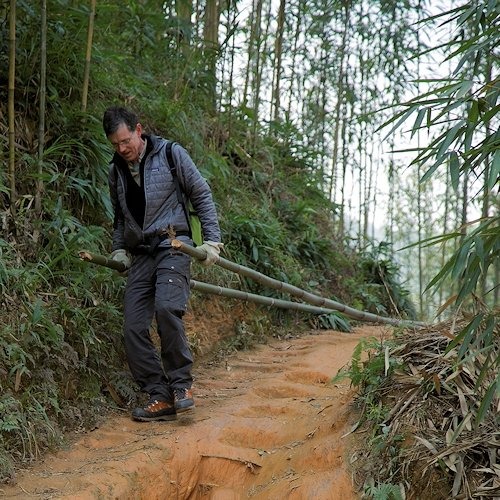
Peer collecting Tonkin samples in China.
Photo via https://www.instagram.com/peeruwe/?hl=en

Testing Bamboo

I asked Peer if he was actually breaking full rods during testing. He said that would take too much time and too many finished rods. Instead, he made hundreds of small, standardized bamboo samples and tested those.

He focused on mechanical properties:

  • Bending strength – how much force the bamboo can take before it breaks.
  • Flexibility – how it bends and recovers.
  • Heat treatment – testing different temperatures and durations to find the best balance.

He found there is always a compromise. The temperature that gives the best flexibility is not the same one that gives the best breaking strength. You cannot maximize both at once.

We also talked about weight. His Vietnamese species is slightly lighter than Tonkin but very close in performance. In single-hand rods, that difference is small. In double-hand rods, especially 11 feet and longer, it matters a lot over a full day of casting.

This reminded me of Tim Rajeff’s durability test video. It’s a great visual of how modern rod makers test materials in a controlled way. Watch it below:

Solid vs. Hollow-Built Bamboo Fly Rods

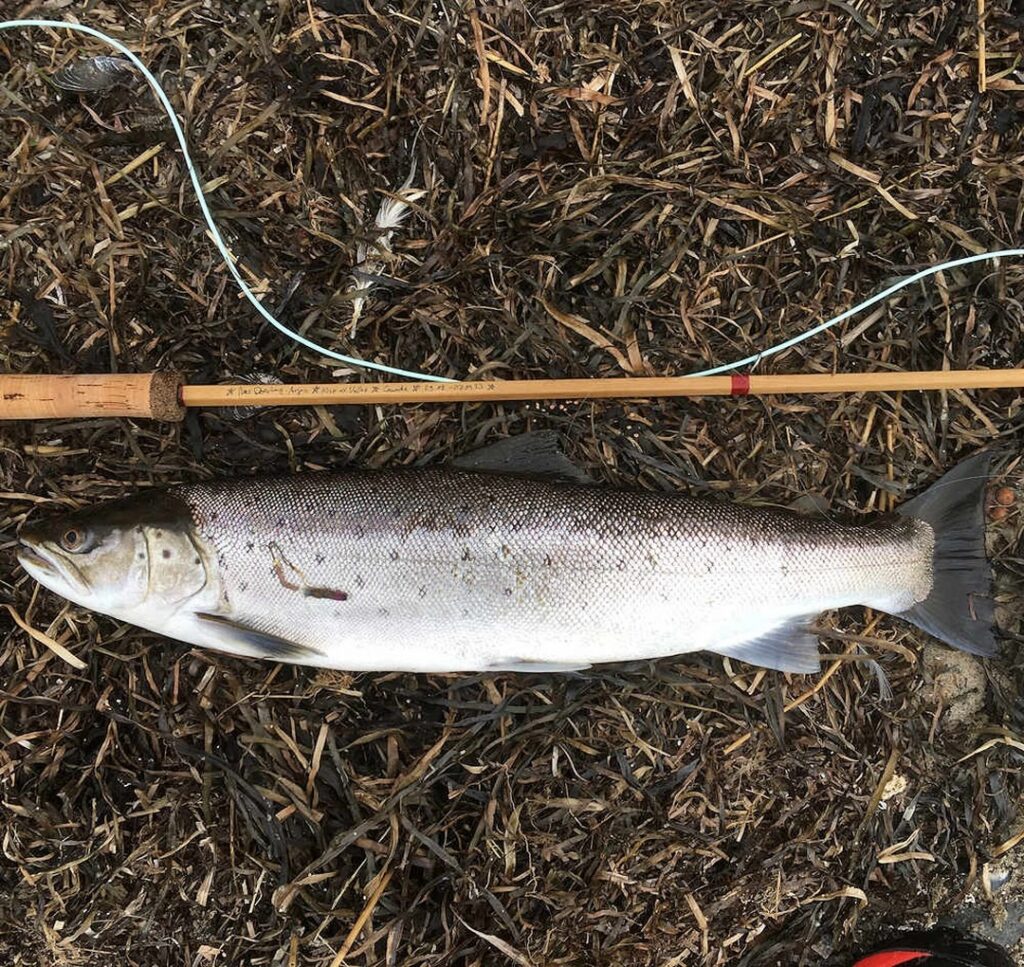
Peer fishes with an 11-foot bamboo rod for sea trout from the beach. He says 11 feet is enough, especially with a two-handed rod. When you’re working with both hands, the extra length does not feel heavy. And if the rod is built hollow, it can be surprisingly light.

He explained that there are two ways to build a bamboo rod:

  1. Solid build – You make the rod from six strips. Each strip has a triangular cross section. When you glue the six strips together, you get a hexagonal rod that is completely bamboo inside.
  2. Hollow build – Before gluing the strips together, you plane down the tip of each triangular strip to one or two millimeters. When assembled, this creates an empty space inside the rod.

Peer compares it to a metal tube. The strength mainly depends on the outside. Making it solid does not increase stability, just like a tube can be as strong as a full cylinder.

Left: Wild-growing Lồ ô ‘bush’ 66 feet tall in South Vietnam, right: Freshly harvested and drying pieces.

Bamboo Fly Rod: Tonkin vs Lồ ô

Peer said both Tonkin and Lồ ô have advantages. But Lồ ô stands out in a few key ways.

The biggest difference is the internode length. Bamboo is segmented, and those segments are separated by nodes.

  • In Tonkin, the maximum distance between nodes is about 20 inches.
  • In Lồ ô, it can reach up to 47 inches.

That longer spacing does not automatically make the rod lighter. Peer explains that weight mainly comes from the density of the bamboo itself.

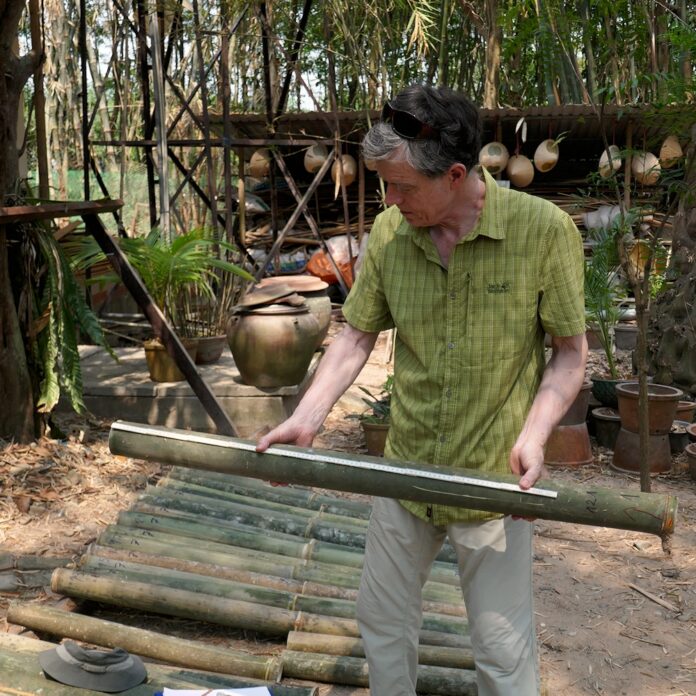
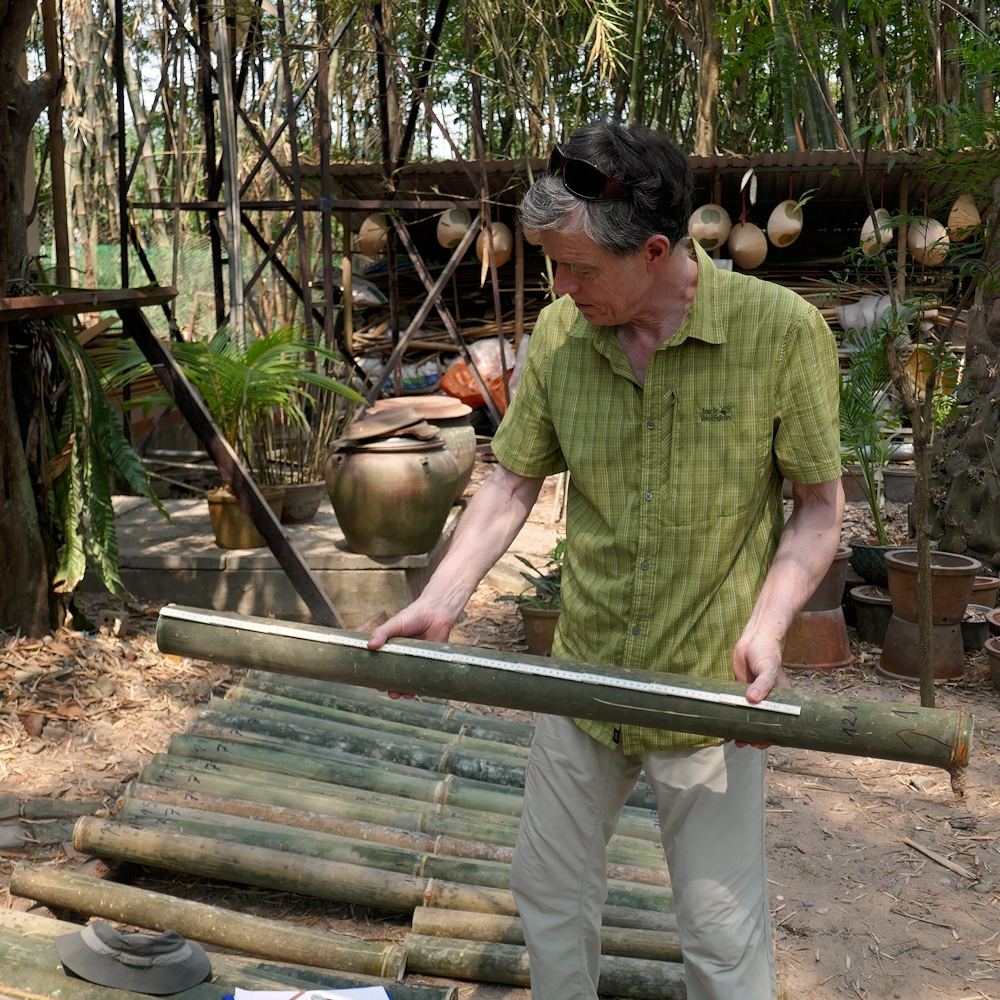
Peer holding one of the extremly long Lồ ô internode (47 inches)

Where the longer internodes really matter is in the building process. Tonkin takes a lot of time and effort to straighten at the nodes, especially when building multi-piece rods. With Lồ ô, you can cut the nodes off and get longer, straighter sections more easily.

He also found that Lồ ô splits much more easily. With Tonkin, you have to work harder to get strips that stay even from bottom to top. With Lồ ô, it cracks more cleanly and produces more evenly spaced strips with less effort.

From Research Project to 140+ Rod Makers Worldwide

Peer did not keep this research to himself. He started offering Lồ ô in 2023, and the response was fast. He says more than 140 rod makers around the world are already using it.

He is shipping to:

  • Australia
  • Japan
  • The United States
  • Europe

Peer published his findings in Power Fibers, an online bamboo rod-making magazine focused only on split cane.

Bamboo Fly Rod
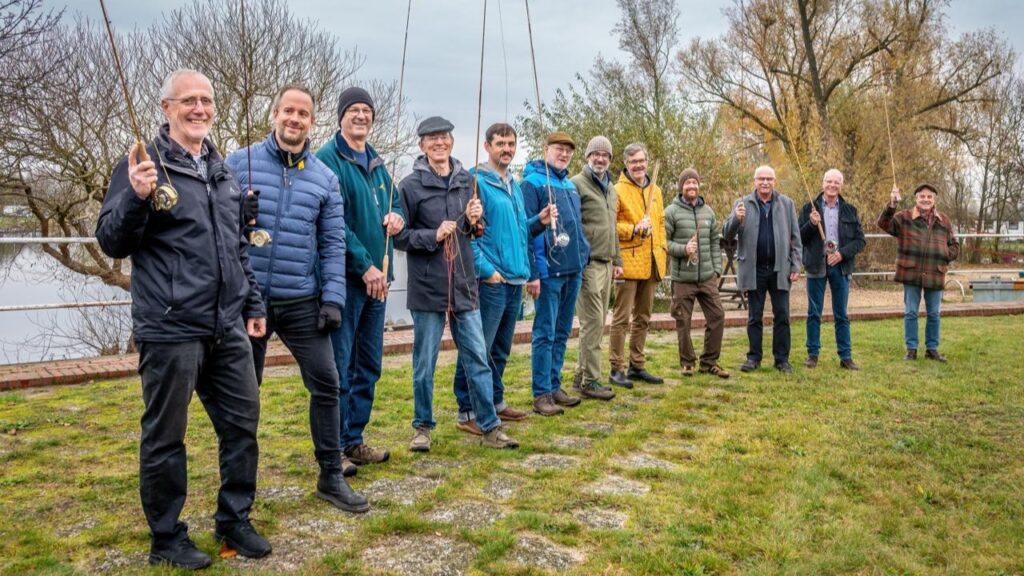
International Lồ ô Rod Makers Gathering in Milow
Photo via: www.mehle-hundertmark.de

Getting Lồ ô to market was not simple. Unlike Tonkin, which has been cultivated for a long time, Lồ ô grows wild. There is no large-scale cultivation. That made sourcing and exporting more complicated. Peer had to:

  • Work through a Vietnamese botanist
  • Connect directly with farmers
  • Find a licensed exporter in Vietnam

Even today, shipping raw material can be tricky in some countries. But finished rods and bamboo are still available.

If you want to learn more about Lồ ô, read Peer’s research, or inquire about rods or raw material, head over to his website and reach out directly.

So why do anglers still choose bamboo fly rods?

Peer believes a big part of it is the craftsmanship. People like owning something made by hand, not something that came off a factory line. Bamboo also allows true customization.

With bamboo:

  • You can change the length easily, like turning a 7-foot model into an 8-foot version.
  • You can build it in multiple pieces.
  • You are not locked into preset factory models like with carbon rods.
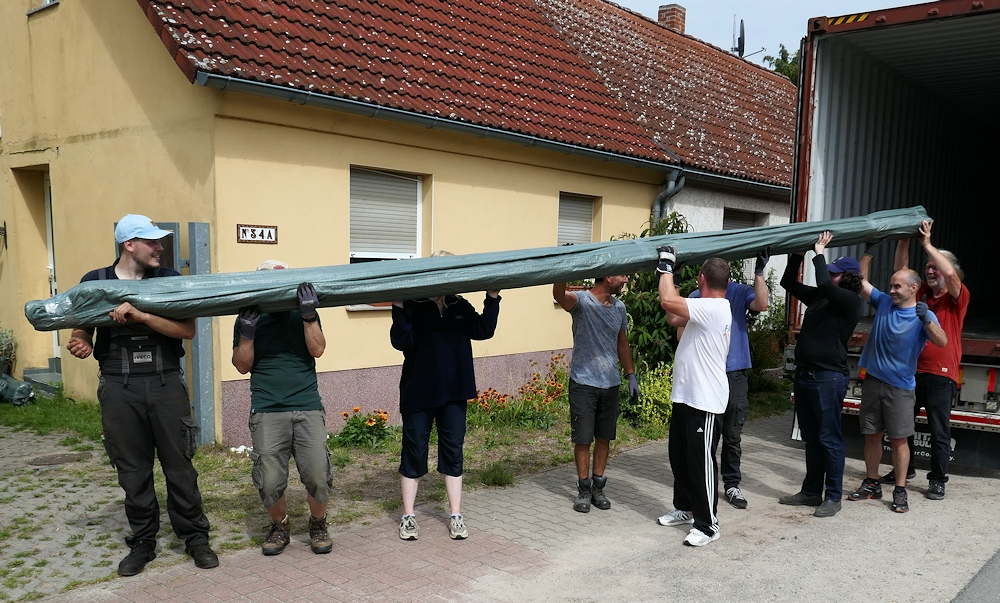
Unloading bundles of Lồ ô at Peer’s warehouse.

Peer likes short sections so he can pack rods into a rucksack. He has built four-piece single-hand rods with very short sections. Instead of using heavy metal ferrules, which add weight, he prefers splice joints. That means joining the sections with a splice and tape instead of metal fittings.

For him, bamboo is not just about tradition. It is about flexibility in design, durability, and the freedom to build exactly what the angler wants.

Mel Krieger and the Essence of Fly Casting

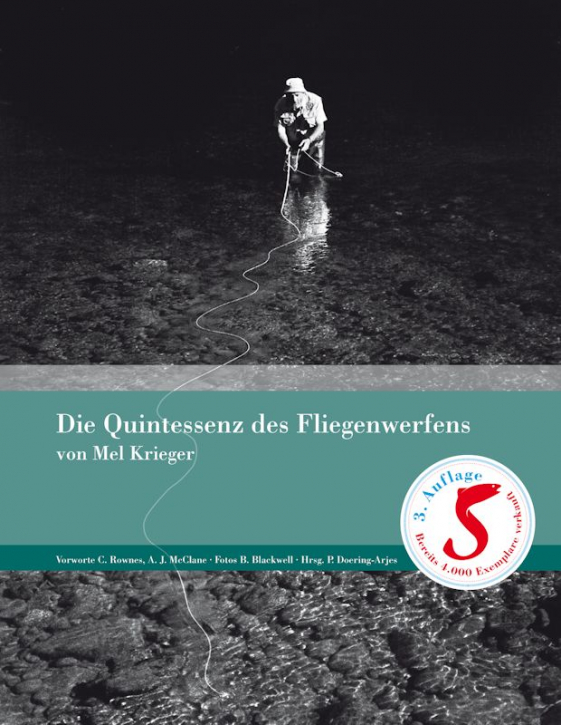
Casting has played a big role in Peer’s journey. He helped translate The Essence of Fly Casting by Mel Krieger into German and even toured with Mel as a translator during workshops.

Peer says the book stands out because it focuses purely on casting technique and breaks it down in a simple, clear way. If you want to sharpen your fundamentals, you can find The Essence of Fly Casting on Peer’s website.

Bamboo Fly Rod
Photo via https://www.springforelle.de/en/book

Peer’s Casting Advice

Peer has given lectures on casting and translated Mel Krieger’s work into German. While he does not call himself an expert, he has spent many years studying casting.

His biggest tip is simple:

Most people use far too much power. Casting should feel effortless. It is about timing, not force. If you use too much power, you usually destroy the cast.

  • Make two stops: one in the back, one in the front
  • Accelerate smoothly, then make a hard, abrupt stop
  • Start with no slack line
  • Keep the rod tip low before starting the cast

He says you must practice. Like riding a bike, it feels awkward at first. With repetition, it becomes natural.


Connect with Peer

If you want to learn more about Lồ ô bamboo, his rods, or his published research:

Visit his website: https://www.springforelle.de/
Email him at info@springforelle.de

Bamboo Fly Rod


Follow Peer on Socials:

Sponsors and Podcast Updates

Videos Noted in the Show

Related Podcast Episodes

Full Podcast Transcript

Episode Transcript
WFS 885 Transcript 00:00:00 Dave: For more than a century, fly rods have been built from the same bamboo, largely unquestioned, rarely tested, and passed down as tradition. Today’s guest decided to test it instead of relying on history or feel he approached bamboo as a scientific problem. He traveled through Vietnam and China, worked alongside botanists and universities, and ran controlled tests on hundreds of samples, measuring bending strength, flexibility and durability the same way engineers evaluate other materials. What he discovered opened the door to a new bamboo species that’s already changing how modern bamboo rods are built. Lighter, easier to work with, and especially relevant for two handed designs. This is the Wet Fly Swing podcast, where I show you the best places to travel to for fly fishing, how to find the best resources and tools to prepare for that big trip, and what you can do to give back to the fish species we all love. Today’s biologist pear is here today. He’s gonna talk about bamboo rods. We’re going to get into fly rods. Uh, Building bamboo rods, and he’s based out of Berlin. And this conversation, we’re going to go deep from the broad science and casting fundamentals to sea trout, Atlantic salmon restoration, and why restraint matters more than power. In today’s episode, you’re going to discover how Tonkin Bamboo became the default material for fly rods, what it looks like to test bamboo using real mechanical data. Why this new species offers advantages for lighter, modern rod designs, and how rod design influences casting efficiency and fatigue. Plus, we’re going to find out why smooth timing beats force in both casting and material choice. This is going to be a fun one. Let’s get into it. Here he is. Pair. You can find him at spring. How are you doing today? 00:01:45 Peer: I’m fine. And thank you for inviting me to this interesting place. 00:01:49 Dave: Yeah, yeah, thanks for doing this. I think what we might do today is dig into, um, you know, really bamboo rods and what, you know, you’ve got a species that you’re going to talk about that you’ve been studying a new bamboo species and I really know nothing about this. So this is exciting to share. I know, you know, a lot of the people we’ve had on the podcast, we’ve had Chris Sparkman, Bob Clay, a number of rod builders. So we’re going to try to bring things together, but maybe just start off first. Obviously I struggle sometimes pronouncing names. So tell us, what is your full name? 00:02:21 Peer: Full name? The full name is Pierre during Arias. 00:02:25 Dave: Yep. That’s so obviously why I didn’t say it. There’s no way I would have got that one. But. And where are you coming from today? 00:02:31 Peer: Well, today I’m in my flat at home in Berlin, Germany. 00:02:34 Dave: Nice. Good. This is in another exciting part. I always love being able to expand out a little bit. You know, we’ve done a number of episodes. I think we’ve been up in Norway and Denmark and even in Sweden was a good one too, because we’re learning more about some of these opportunities. I think people feel like with Atlantic salmon especially, that it’s this unique thing where you got to have a lot of money to fish, but it sounds like Sweden and I’m not sure maybe you could start off there. I mean, Germany, we haven’t done anything really in Germany. What is the. And the crazy thing is. Right, because German browns are probably one of the most prized species all around the world. Talk about that a little bit. What is fishing in Germany like right now? 00:03:09 Peer: Well, I think it’s not so much different from any other country. I mean, fly fishing is becoming more and more popular. I mean, I noticed that from our fly fishing club here in twenty years ago, I was a member number eleven, and now we have more than one hundred and sixty members. 00:03:27 Dave: Wow. That’s awesome. 00:03:29 Peer: That’s for the area. Berlin Brandenburg Brandberg is one of the lender, which Germany consists of several lenders, you know, and, um, quite a lot of members now, which. 00:03:41 Dave: Yeah. So it’s growing. So you’re seeing more fly anglers coming in and fishing in Germany and around the area. 00:03:47 Peer: Yes, yes, there are more people. The numbers are increasing. Although I fly, fishing is still a small niche. I mean, if you say, okay, all the anglers here, that’s one hundred percent, maybe ten percent are fly fishing and less than one percent is fishing with a bamboo rod. So that’s about the percentage, which I would guess. 00:04:09 Dave: Yeah. It’s small. Well, let’s talk about that with the bamboo because that’s your specialty. Describe what you’ve been doing with your new the species. Maybe go back a little bit to the history first. What are all the bamboo rods, these beautiful rods we see out there that are made by all the great companies now. And the older ones too. What sort of bamboo was it all made by coming from the same region in the world? 00:04:30 Peer: Yeah. Well, um, the one which is still used nowadays is Tonkin, which comes from southern China. But before Tonkin there was Calcutta cane from India, which was used first and then somebody. I’m still trying to find out who or why, but it’s I think it’s gone into uh, it’s not possible to trace it down, but at some point Tonkin was there and it’s used until today. So it’s more than one hundred and forty years. Four hundred and forty years used nowadays. 00:05:03 Dave: So today, all the new rods and probably the rods that, you know, maybe from the fifties or the last hundred years or more have been Tonkin from the southern China. 00:05:11 Peer: Yes, yes. 00:05:12 Dave: And now when what do you describe the research you’ve been doing? What has been the project this last ten years you’ve been working on? 00:05:18 Peer: Well, I was reading when I started making rods. It’s more than twenty years ago, and I started reading textbooks. And many of them say, okay, the best bamboo in the world is Tonkin for making rods. And it’s certainly very good bamboo species. But nowadays we have almost one thousand seven hundred bamboo species described in the world, and there was no record whatsoever if anybody has been comparing bamboo species. So as a biologist and Term scientists. I thought, okay, that’s I don’t believe that Tonkin is really the best. Maybe it is, but nobody searched for other species. So out of curiosity, I started looking into different bamboo species, and I traveled to Vietnam and China. I was also in China, in the area where Tonkin is harvested and grown. I was with with Andy Royer on his final trip. He was the main supplier of Tonkin in these days. And, um, altogether I was three times in Vietnam and was looking around for the other species, and I was lucky. I got in contact with a Vietnamese botanist who created a bamboo garden close to Ho Chi Minh City. She sampled all species of Vietnam, Cambodia and Laos and planted them in a in a garden And, um, I got in contact with her by, um, um, and, yes, a veteran in bamboo research. It was an old, uh, old professor, a German guy who is known as a one of the pioneers of bamboo research. And he had traveled all places in the world. Bamboo grows. And he put me in contact with many bamboo scientists. And so I also got in contact finally with, um. Yep, that’s her name. And she created this huge bamboo garden. And I could walk around in this garden and look at so many species. And then I took some samples home, and then I started testing. I did some scientific tests. I was a guest researcher at the University of Hamburg, where. Walter, this is an old professor, he was still in already in his nineties when I met him, and through him I could go into the or use the facilities as a guest researcher. And in the University of Hamburg, in the Institute of Wood Science. And I could make my first tests. I wanted to do something which is reproducible. Um, I didn’t want to go into the just saying this is better or worse comparative species. Just by my opinion. I wanted to have some hard facts. So I did some standard testing, which, um, the colleagues in the institute say they are doing this every day. So I brought my bamboo and carried out the tests there. 00:08:40 Dave: What was the test? What were you were you testing the structural like the strength, the flexibility or the just the actually genetics of it? Like, what was the test? 00:08:49 Peer: Yeah, not the genetics, but the mechanical properties. So the bending strength and the flexibility. 00:08:56 Dave: The bending strength. And I go back to you probably know, uh, you know, Tim Rajeff. Right. With Echo Fly rod, you’ve probably heard of his name. Yeah. So he’s got this funny video out there. We’ll try to get in the show notes where he he would take his rods and he would put him in this machine and he’d bend them until they break. And it’s a great video and echoes known because Tim’s such a huge you know, he’s kind of a scientist himself. I think he’s an engineer, actually. I think he has a background, but it’s really cool because his rods are really durable. You know, that was what he said with fly rods, you know, you can’t have everything. You can’t have the most durable, the fastest and the lightest rod. You kind of have to pick, you know. And I’m not sure if bamboo is the same way, but with graphite you have to pick like one or two. You know, you can’t have all three. Is that what you did too? Did you take these rods and actually, you know, break them? 00:09:40 Peer: Well, breaking the rods would have been too much effort to build many rods. I mean, you have to do a lot of breaks. 00:09:46 Dave: Build. 00:09:46 Peer: It. So. 00:09:46 Dave: I write, write. 00:09:47 Peer: Write plain small samples, a few hundred small samples and broke them. To get some, you have to do a lot of tests and change just one variable. I also heat treated them at different temperatures to find out what temperature is the best and the duration. And as you said, you can’t have an optimum of flexibility and breaking strengths. The optimal temperature for flexibility is much higher than for breaking strengths. So you have to compromise. 00:10:21 Dave: Gotcha. So it is a compromise. And then weight is another thing with bamboo rods right. I think everybody they’re just heavier. They’re heavier than a graphite rod or something or a glass rod. Right. Yeah. Or is that different. Does that depend on the species? 00:10:33 Peer: Um, it also depends on the species. Is this Vietnamese species, low, which I imported now is a bit lighter than Tongan, but very close in his properties. So especially for Spey rods, you can build the same rod lighter in low than in Tonkin. 00:10:55 Dave: Okay. And is that your focus? Are you focusing on a two handed rods? Is that over single handed rods. Are you kind of thinking about both? 00:11:03 Peer: No. No, both. I mean, um, I like fishing sea trout from the beach with, uh, with a double handed rod. It’s much, much easier because you’re casting so many times during the day. And, uh, I prefer the double handed rod, but other fish. I fish with single handed rods and. But the weight difference doesn’t matter so much in single handed rods. But if you have a double handed rod eleven foot or longer, it makes a big difference. 00:11:32 Dave: Yeah. What’s the rod you love if you’re using a bamboo for casting out on the beach? Like what length of rod bamboo rod would you love to use for those sea trout? 00:11:41 Peer: Yeah, I’m using a eleven foot. 00:11:44 Dave: Yeah, so you don’t need to go bigger. Is that the challenge that you go to twelve or thirteen? It gets too heavy. 00:11:50 Peer: No. Because you’re working with both hands. Um, it doesn’t matter that much, but eleven foot is enough. It’s. If you build it hollow. It’s so light. I mean, if you give it to a person which has no knowledge or hasn’t used a split cane rods, they’re always surprised if you give them a hollow build rod how light they are. 00:12:09 Dave: Okay, so there are two different types. Maybe describe that because I think a lot of listeners now don’t know the background. You know, you mentioned, I think off air, we were talking about Chris Sparkman, Bob Clay, two people we’ve had on the podcast that have we’ve talked about bamboo rods. They’re obviously experts as well. But what is that? Maybe describe that a little bit of the hollow versus are there different ways to do these bamboo rods now. 00:12:30 Peer: Yes. You can build them solid. So if you make a cross section it’s completely bamboo. But um, you know, let’s say you build a normal bamboo rod with six strips, and each strip is in the cross section. It’s a triangle. And if this triangle, if you put six together, you have a hexagonal rod. And if you take the strip before you glue them together and then, um, um, plane off the tip of the triangle, you can plane it down to one or two millimeters. And then inside you have a hollow area where there is no bamboo. It’s empty. So it means the the strength of the bamboo mainly depends on the outside. It’s like a metal tube. It the stability doesn’t increase if you make it full of metal. Just a tube is as strong as a full a full cylinder. 00:13:35 Dave: Okay. And are you doing that. Are you in your building rods too? Is that something you’re spending a lot of time doing? 00:13:40 Peer: Oh yes. 00:13:41 Dave: Yeah. yeah. You’re in fully into the whole every every aspect of it. 00:13:45 Peer: Oh, yes. Um, that’s also why I, I went out to search for another species and. Yeah. 00:13:53 Dave: So what did you find? What’s the take home? Break down the science. Because, you know, I think a lot of people might miss exactly all the details, but what did you find? Did you have a scientific conclusion that you’ve come out of this research? Um. 00:14:07 Peer: Well, let’s say the science is a basis to have some reliable results. So the conclusion is going back to the the properties of the bamboo. I mean, both species, Tonkin and lo, they both have their advantages. But the advantages of the new one is, as I already said, uh, lo is lighter than Tonkin. But the big difference is that the the internodes are much longer. You know, bamboo culm is segmented and you have nodes, and the distance between the nodes is very different. 00:14:46 Dave: Is more so in the in the the new one that you found, the distance between the nodes is much wider than the Tonkin. 00:14:52 Peer: Much wider, and Tonkin. The maximum distance in Tonkin is about twenty inch and in low it can be up to forty seven inches. 00:15:02 Dave: Forty seven inch. And what that does and the nose is that where the other plant, the stems are growing off? Is that what a node is? 00:15:08 Peer: No, I mean the the stem is segmented. It’s not. 00:15:11 Dave: Oh okay. 00:15:12 Peer: If you go high up the branches are coming out. But the main part of the stem is just one big cylinder which is tapering down. 00:15:21 Dave: Okay. And what is a node. What is an actual node. 00:15:24 Peer: Um, the node is um, you can imagine the calm is a long pipe. The bamboo calm is a long tube which tapers down to the tip. It becomes smaller and smaller the diameter. And along this tube you have segments and they are separated by nodes. So that’s inside the car. I like like the hollow rod. The calm inside is hollow. And in the node area there is an area where it’s not hollow. The hole. 00:15:58 Dave: That’s right, that’s right. Okay. Yeah. The nodes and you see them on the outside because you’ll see a little almost a ring. Right. Or something like that around. Yeah okay. That’s the node okay. So more spacing makes it a lighter rod. Right. The less nodes you have the lighter. 00:16:10 Peer: No, not the nodes. Um, it’s it’s the, um, the density of the bamboo itself. The main thing about the internodal distance is you have much less work if you build a multi-piece rod, let’s say three or four piece. It’s a lot of work to straighten the nodes, and Tonkin takes a lot of time and effort. If you want to have a flat surface and in low, you just cut the nodes off and you have a long piece which is very straight. And it’s also splitting much easier. Splitting in Tonkin, you have to exercise quite a bit to get strips which have the same diameter in the bottom and in the top, and with low it’s very easy to just to crack it and you get very evenly spaced strips. 00:17:00 Speaker 3: Fly fish with me Utah discover year round blue ribbon trout fishing on the famed Provo River. Choose a guided walk and wade or a scenic float and experience big trout, stunning canyons and unforgettable days on the water. You can book your adventure right now at Fly Fish with me Utah.com. World class water. Incredible fishing that’s fly fish with me Utah. Com check out Jackson Hole Fly Company today. Premium fly gear straight to your door without the premium price. 00:17:31 Dave: Jackson Hole Fly Company designs and builds their own fly rods, reels, flies and gear, delivering quality you can trust at prices that let you fish more and spend less. Whether you’re picking up a fly rod for the first time or guiding every day. They’ve got what you need. Check them out right now. That’s Jackson Hole fly Company.com Jackson Hole Company.com from the work you’ve done, what impact do you think this will have on fly fishing rods and and what do you think the future like what are you going to use this information for or is it just for you, or do you think the broader industry can use this to actually maybe start changing, adding this to the rods? 00:18:13 Peer: I mean, I started offering this bamboo species in twenty three, and now there are already more than one hundred and forty rod makers around the world who are using it. 00:18:26 Dave: So this is already going. So you’ve already got this. The ball is rolling. You’ve got people using this around the world. 00:18:32 Peer: Yes, I get orders from Australia, from Japan. From the states, from the states, from Europe. I mean, I’ve been publishing the results in power fibers. You know this online magazine from Todd Talsma. 00:18:46 Dave: What’s it. 00:18:46 Peer: Called? Power fibers. 00:18:48 Dave: Okay. Power fibers. 00:18:49 Peer: Power fibers. It was one of the very few magazines which are available. Just. They concentrate just on bamboo rod making. First there was a planning form which is not in existence anymore. This was something still on paper. Then came the planning form, which was from the beginning was already online. And then from Italy came, um, the Bamboo Journal. And so the Bamboo Journal is the only one left because, um, last year the editor of Power Fibers talsma from the States. Unfortunately, he passed away. 00:19:27 Dave: So that one’s not out there. So the power fibers is not going either. 00:19:31 Peer: No. Power fibers is gone. 00:19:33 Dave: Oh, it’s gone. 00:19:34 Peer: It’s gone. Yeah. Um, but in the last volumes. Volume sixty five, I published some of my results about this new species. 00:19:43 Dave: Okay. How could we find that? Can you still find that in power fibers that your the work you published? 00:19:49 Peer: I mean, you can find it on my website. And I think the last because it’s the last edition which was made I think it’s still online. If you look at power fibers. 00:20:01 Dave: Yeah it is I see it now. Yeah. It is online. So they still have you can still see it. I’m looking at your article now on there. Okay. So it’s still there for now. And I see some of your rods. They’re beautiful too. Yeah. You’ve got they. Yeah. Again I don’t know the whole history but of the bamboo. But these are some pretty amazing rods I’m looking at here. So that’s basically what is your what do you think the future holds for what you have going. Do you think I’m I’m going back to you’ve got this industry that’s built around these Tonkin bamboo. Do you feel like there’s a potential to have more of the new species that you found around the world. And is there a limit to how many rods we can get? Is there a as far as the numbers that we can use this, you know, out there? 00:20:41 Peer: I mean, the difference between, um, availability of Tonkin and oh, is that Tonkin has been cultured for a very, very long time and the oh is growing wild. So it’s more difficult to harvest. And there is no cultivation. So it’s, um, the number is not it was very difficult to get hold of it, to find somebody who would sell it to me and many other obstacles. Finally, I got in contact with the farmers through the through the botanist who made the bamboo garden. But this was still not enough, because in Vietnam you need a license for export, which the farmer didn’t have. So I had to find somebody who was allowed to export. So, um, it was not easy to get it. 00:21:33 Dave: Oh, right. Right. See that? Have you got that process down a little bit now of getting it and exporting it. And you got the whole challenge. Now as we’re sitting here, I’ve been talking to a lot of people around the world. We’ve got the US has changed and we’ve got these tariff things that are making things a little bit crazy for people. And, and it’s kind of this crazy world we’re in. But do you find is that a challenge for you or are you able to send stuff or let’s just take it to the to you as a like, if somebody wanted to get one of your rods, do you actually could somebody purchase that or call you up and check in with you? 00:22:03 Peer: Yes. That’s no problem. I mean, there’s a little problem when I send out the raw material for other rod makers. Um, for example, DHL doesn’t accept any, um, any commercial packages anymore with a value above, I think one hundred dollars. So I have to send it as a gift. 00:22:26 Dave: Oh, right. 00:22:27 Peer: Yeah. But with other countries, there’s no problem. 00:22:30 Dave: Yeah, it’s just the US now. It’s just the US. Yeah. That’s. Yeah, I know I’ve heard a lot about it because we’ve got a lot of listeners all around the world, you know, and it’s. And so it’s been kind of crazy. But the point is, is that somebody could reach out to you, and the best place would be to just, um, go to your website, probably start there if they wanted to get some information. 00:22:48 Peer: Yes. You can find all the information about this bamboo species on my website, uh, different length classes I offer and surprises, etc. and also information about the bamboo itself. I mean, there are the two. Actually, I published two papers on power fibers, and you can find them both at the bottom of the bamboo page if you’re interested in the details. 00:23:15 Dave: Okay. Anything else you want to make sure we understand about your research, what you did. Um, it sounds like it’s pretty. You’ve created something that, um, is lighter. What about on the strength? Is this new species stronger than the the Tonkin bamboo, or what are the main features of a bamboo rod you’re thinking of? Is it just like a graphite rod? You’ve got strength, you’ve got lightness, you’ve got, uh, what are the big ones? 00:23:40 Peer: I mean, the strength of low is slightly lower than than Tonkin. But if you want to make a same rod from Tonkin at low, you have to increase the diameter by three to five percent, which is not visible by eye. Um, and then you have the same properties as Tonkin. So it’s very close to Tonkin. And if I also looked at other species, you have, um, I mean, in Japan, for example, they’re using madake bamboo and other bamboo species, which are quite a bit lower in bending strength and breaking strength. But, um, you can still make good rods out of these bamboo species. And I think within these One thousand seven hundred species which are available. There are many more which are suitable for road making because when you are casting, you won’t apply so much power until it breaks. You have to do something wrong and you jam it between your car door or something. 00:24:44 Dave: Yeah that’s right. Yeah. You got. I’ve heard that before. Like bamboo, you can literally run it over with your car. It’s probably the strongest rod out there, right? It’s pretty durable. 00:24:52 Peer: Yes, yes, if you don’t, if you build a solid bamboo rod, you can step on it and nothing happens. I mean, of course the guides will be bent, but. Right. The rod will survive. 00:25:04 Dave: Yeah. It’ll survive. What do you think? Is that in this? And I know bamboo has been getting a you know, it’s been a resurgence of bamboo out there. We’ve been hearing and I think it’s because it’s this beautiful thing. Right. You got all the history I feel like I would love. You know, I’ve got some old bamboo rods out there. What do you think is the biggest advantage or why do people buy bamboo if they haven’t done it before, why would they want to think about getting one? 00:25:26 Peer: Well, I think people appreciate more the handwork. They don’t want to have something which is made by the industry. And and, um, I like bamboo because you can make any rod out of it. I mean, if a customer comes and says, no, I don’t want this model in seven foot, I want to have it in an eight foot. It’s a piece of cake to change it and make it. I mean, with the rods, with the carbon rods, you are bound to to the models which are on the market and you can’t, um, as a rod maker, you could make it a different one. You can. Yeah. 00:26:04 Dave: Yeah. So it’s customized. You can make anything you can. Somebody could call you up today and they could say, hey, I want a seven foot, three inch whatever. You can make that rod. Yes. 00:26:13 Peer: And you can make it in as many pieces as you want. I mean, I like very short pieces so I can put them into my rucksack. 00:26:21 Dave: Okay. How many pieces? What’s a good piece? Like a six piece rod or what? How many? 00:26:26 Peer: Well, I haven’t made a six piece, but I have made a single handed four piece rods. So you have very short pieces, and. And I don’t like the metal joints usually. Um, you have a metal ferrule to connect the pieces, but for a four piece rod you would have three pairs of ferrules, which makes the rod far too heavy. So you, you use an old. What I like are splice joints. 00:26:55 Dave: Oh splice where you actually put and then use tape. 00:26:58 Peer: Right, right. 00:26:59 Dave: Yeah. Yeah we have and I want to give a shout out I was going to do this a little bit later. But Ed who’s in our group, he’s going to love this conversation because he is a bamboo rod maker. And he’s got this really cool story. I fished with him up on the south shore of Lake Erie with the guy and one of our steelhead schools, but he, um, he had this goal on the trip that he wanted to catch all traditional. He built the bamboo rod. He had a silk line, he had a horsehair leader, and he had a traditional wet fly. And I was there to see him to catch a steelhead. It took him a little more work, but he did it. And I feel like this is I remember him talking about this because he had the rod spliced together, and I think that’s because he was a spey rod, right? Same idea. You can’t have the metal. It’s just too much weight. Yes. Yeah. Okay. So what would you be? What would be your editor if you were talking to editor and he was listing because I know he’s going to love this. Would you be telling him he needs to check out this new bamboo? This would be a helpful thing for his spey rod. 00:27:50 Peer: Yeah, it would be quite a bit lighter than if you make it from Tonkin. It’s, uh. And you will notice it. It will make your casting a bit lighter, easier. But I think that all this talking about the weight, comparing a bamboo rod and a carbon rod. Um, usually you fish with one rod, right? You can’t handle more than one rod at a time. 00:28:16 Dave: And although we have a lot at our at the house. Right. You want to have a bunch of rods. 00:28:20 Peer: Yes. But on the water you are. If you’re casting five rod, which weighs five one ounce more, uh, it doesn’t, doesn’t matter. Doesn’t matter. 00:28:32 Dave: But does it matter with the two handed rod? What if you wanted to build a a fourteen foot spey rod? Right. That matters, doesn’t it? On that. Getting that right as far as weight. 00:28:42 Peer: Yes. I mean, the longer you get and if you get in the real long, long rods, you will feel the difference more because of the lever and everything. 00:28:52 Dave: Yeah, but it’s just part of it. What is your talk about your fishing a little bit? I want to hear about this because I think that you are. I’m assuming you’re fishing just heading up north in Germany and you’re fishing some of those same waters for sea trout. Are you also getting Atlantic salmon turning into those? Some of those German? Uh, is that where you maybe describe the town? Are you in Hamburg or what’s your closest town where you live? 00:29:14 Peer: Well, Hamburg, you can reach within in two hours from Berlin. Yeah. 00:29:19 Dave: Oh, yeah. You’re in Berlin. That’s right. You’re in Berlin and Hamburg. So Hamburg is about two hours. 00:29:23 Peer: But, um, actually, um, our fly fishing club has a, um, got involved in reestablishing sea trout and salmon in the area here. So if you drive, um, an hour from my home, you you can visit our brewhouse, where we started many years ago to, together with a fisheries institute to re-establish, um, salmon in our area. And yeah, we have salmon and sea trout returning. 00:29:57 Dave: So, so salmon used to historically would return to streams through Berlin in that area. 00:30:03 Peer: Also also through Berlin. We are working on a small river which flows into the Elbe, which flows out of Hamburg into the North Sea. But, um, yeah, historically there were Many rivers. You had sea trout and salmon, but they were completely eradicated. Germany had no salmon. Fifty years ago it was completely. All the stocks were gone. And we had to start with salmon fries, which we which we got from Denmark. I mean, not like Sweden where salmon were never extinguished there. 00:30:46 Dave: Right. So in Germany, because of impacts from human whatever, everything, they were extirpated, extinct from that area. But now you’re bringing them back to. And what does that look like now? Do you have can you go to these streams you’re talking about and actually see returning Atlantic salmon there and fish for them? 00:31:02 Peer: Yes, you can if you like. You can come in the autumn and we when we fish once a week for the salmon and sea trout returning to, to strip off the eggs and to breed to breed them because, um, breeding brings them, um, you get a much higher um, the success rate is much higher than letting. 00:31:29 Dave: Yeah, yeah. Because you probably have a out of those fish that go out if you release, um, you know, a thousand fish that go out to the ocean, probably one percent, if you’re lucky, you’re going to come back as adults, right? 00:31:40 Peer: Yes. 00:31:41 Dave: Plus Atlantic salmon for a lot of reasons. Climate change. You know, it’s not easy. Right. We’re hearing stories of some of these places around, including Scotland, you know, and things like that where the numbers are going down. Right. We’re still having struggles out there. And it’s so, so I feel like. But there are some good success stories. I think what you’re talking about here, I’ve heard some of these success stories where you can go and see these hatchery fish that have become reintroduced, but now they’re actually self-sustaining. Is that is that kind of the goal, do you think, for Germany that you’re able to. 00:32:09 Peer: That would be the the final goal. But so far I don’t know any. There are quite a few breeding stations all over Germany nowadays, but we have no self-sustaining stock yet and nobody knows if we will ever reach that. 00:32:25 Dave: Right, right. It’s a good goal. It’s a good goal to have. I mean, again, it’s lots of challenges out here, but this is good to hear. I love because we really haven’t talked about Germany again. And what about the so you got Seatrout are you do you also have resident brown trout fishing opportunities just for fish that actually are or were those all kind of extinct as well? 00:32:44 Peer: No. Brown trout was not extinct. 00:32:47 Dave: Okay. 00:32:48 Peer: No. Um, actually, it’s also just one hour. If you drive one hour in the direction of of Hamburg, you have a nice trout stream which our club takes care of. And this very nice brown trout. I mean, you never know if if it I mean, the chemical pollution was heavy all over Germany and the obstructions in the river where the fish couldn’t migrate anymore. So you can’t be sure if this was not if it’s not nowadays originates from Stockfish or if they’re really wild. 00:33:22 Dave: Right? Right, right. Gotcha. Okay. But but there are. That’s cool. Cool to hear. And yeah, we’ve talked a little about this just from our I know doing our competitive, you know, series. You know because there’s a lot of uh, Euro nymphing right is a very popular technique. Are you getting into that. What’s your rods that you’re building? Do you build everything from big rods? Are you building euro nymphing rods? Do you kind of cover everything? 00:33:45 Peer: Well, I’m I’m myself. I’m not very much into euro nymphing or I’ve done it with a friend, but I didn’t like it very much because you’re just using a nylon, a no fly line. It’s not. Um. 00:33:58 Dave: Yeah. There’s no fly line. Right? You’re not casting. 00:34:00 Peer: I mean, I went into the details of casting very much. I, I translated the book of Mel Krieger, the essence of fly casting into the. 00:34:11 Dave: Oh, yeah. 00:34:11 Peer: German version. 00:34:13 Dave: Yeah. tell me about that. Let’s hear about Mel, because Mel Krieger is probably, maybe the most famous casting one of them for sure. Right? In history, at least for the US. How do you connect with Mel Krieger? Because he’s a he’s been passed away a while. How do you make that first connection? 00:34:28 Peer: Yes. Um, yeah, quite a few years ago, my my friend Chris Rounds, he is now also quite well known caster here in Europe. He met Mel Krieger, and Mel asked him, could you translate my book into German? Because there were already versions in Japanese, in Spanish, many languages. And Chris said, yes, I do that. And Chris lived many years in Berlin, and he told me that stories. And I said, okay, if you need some help. And and so we translated it together finally. And I added it in in as a book book of demand because the publishers here in Germany, they were not interested in something black and white. They wanted to have color and they didn’t believe me. I said, for this book, it’s good to have it black and white. You can see very well how what you should do while you’re casting and what you shouldn’t. So finally, I published it myself and it was quite successful. Until today, there are almost four thousand copies sold. 00:35:47 Dave: No kidding. 00:35:48 Peer: Yeah. 00:35:48 Dave: What was the. And what’s the name of the book? 00:35:50 Peer: Um, well, the English title is The Essence of Fly Casting. And you also find it on my website. This is German edition. I mean, that’s the one book which Mel Krieger wrote. He was working on a second one, but unfortunately, then he passed away. 00:36:08 Dave: Oh, he was he was working on a second one. 00:36:10 Peer: But, um, when he was still there, we did some tours here in Germany and Switzerland giving workshops together. So I was a translator and he was an instructor. 00:36:21 Dave: Yeah. 00:36:22 Peer: That was fun. Yeah. 00:36:24 Dave: That’s awesome. The casting is such a and I agree with you. You know, the Euro nymphing is a challenge because, well, you’re not casting a line, right? So it’s different. And I feel like fly fishing. The casting is, is just as much a fly fishing as anything. Or it’s probably maybe the most important thing if you’re not casting, are you really fly fishing? Right. But that’s that’s the thing. A lot of people have struggles, right? That’s the first thing you have to learn. The big thing about when you get into it. And books like do you think the Essence of Life and I’m seeing it now, the essence of fly casting on Amazon for thirty five dollars right now, you could go pick one up. Do you think that’s a good book for somebody who is maybe new to it, or maybe struggling with their cast to read that? Do you think that would help a lot? 00:37:01 Peer: I think it’s still one of the best books, because it’s just about the technique of of casting. I mean, there are hundreds of fly fishing books, And there’s one chapter about casting and. But you don’t learn anything. And I think together with his videos, um, hardly anybody has a video player nowadays. 00:37:23 Dave: Yeah. 00:37:24 Peer: For for DVDs. But I was also selling his films on, on, um, if you have both together, the films and the book, you could almost learn it yourself. He was such a good instructor and really bringing it down to the essence and explaining it in a way that anybody could understand it, and just pointing out the important points. I learned a lot while I translated the book, and I think it’s also a good basis. It was a good basis for me. If you’re making rods, if you know the the basics of casting. 00:38:02 Dave: Yeah. Okay, so we got a good resource there on the book if people want to take that further. Do you think buying a bamboo rod can help your casting at all? If somebody’s struggling, maybe with wind casting in the wind, do you think is a bamboo rod more forgiving than a than a graphite rod in any way? Would it be a benefit there? 00:38:18 Peer: Um, I would say simply, yes, but but if you can, um, because graphite rods are so fast nowadays and they’re I mean, over the years, every company wanted to build a fast and a faster rod, and it’s more forgiving if it’s not that fast. That means if it’s not so stiff, faster rod is stiffer than a, um, the other rods which are softer. But there’s also a misconception. The traditional bamboo rods, everybody who hasn’t been using a split cane rod thinks, okay, they are heavy and wobbly, and if I have a customer here in and coming to my home, I give him several bamboo rods, a traditional one, and and also very fast. You can make a extremely fast bamboo rod. 00:39:16 Dave: Oh you can. 00:39:17 Peer: Yeah. My my friend Ulf Lovdahl is Swedish rod maker. He’s very well known in Sweden. He likes only fast bamboo rods. So. And finally I give my customer who wants to explore the varieties of bamboo rods. Give him in the end, this bamboo rod from my friend. And then every. He’s always astonished. That’s bamboo rod so fast. It’s incredible. 00:39:44 Speaker 4: It’s fast. Yeah. 00:39:45 Dave: So you can’t make them fast. 00:39:46 Peer: It just depends on the taper how quick or how slow it diminishes in dimension. 00:39:52 Dave: Okay. And then when you make that rule, if you make a really fast bamboo rod, is it now become less durable or easier to break. 00:40:01 Peer: No. Bamboo is. So I mean I mean, there are persons who can break anything. 00:40:07 Speaker 4: But. Yeah. Right. Right. 00:40:08 Dave: But just comparing it to I always go back to the graphite because it’s hard to compare this. But graphite you know. 00:40:13 Speaker 4: You can is you. 00:40:14 Peer: Can break a graphite rod more easily than a bamboo rod. 00:40:17 Dave: In general you can right. In general. Yeah. 00:40:20 Speaker 4: Yeah. 00:40:21 Dave: What about glass? Have you messed with. Have you used glass before? Have you built rods with graphite or have they always been. 00:40:28 Speaker 4: Um, yeah. 00:40:28 Dave: I guess that’s a different thing. Right. But you’ve compared them, it sounds like. 00:40:32 Peer: I mean, when I started fly fishing, when. When I studied fish ecology in England, I started fly fishing in seventy eight, seventy nine, and then only glass rods were available. Um, it was still some years away from carbon, but I I’m not collecting rods. So I was fishing for, for many years just with this one glass rod class. 00:40:58 Dave: So you had glass. What was that? So go back to there a little bit. Fish Ecology England, was that your background or how did you. I can’t remember if we got that whole story, but how did you get into where did fish ecology come and then when did the fly fishing all come together? Bamboo? 00:41:12 Peer: Everything you mean? I studied biology and I was always interested in fish. I was hooked when my grandfather took me fishing when I was a little boy. And I only could do it when we were visiting him up in the north of Germany. He lived in the city Kiel. And I didn’t do any angling then in Berlin. So I was very, always very curious, looking forward to the holidays and go fishing with my grandfather. And later on I started biology studying in Germany, and then I, I went to England to study fish ecology, and in the same year I started fly fishing, buying a I think it was a fiber tube rod, the same company who made the blanks for Hardy Brothers. 00:42:01 Dave: So that’s when you got your fiberglass. What were you studying? Uh, the fish ecology. What was that? Did you go into, like, uh, was that your degree or what were you studying? 00:42:11 Peer: I mean, what I studied, there was a diet of, uh, two different fish species, small fish species in a river. But I the degree I took later on here in Berlin, I studied the fish populations in a lake of Berlin, did some population estimates, and then I specialized in fish aging, which I have done quite a bit later on. 00:42:33 Dave: Okay. And how do you fish aging is the using the otoliths to age. Is that is that what you’re doing? Yeah. 00:42:40 Peer: Um, otoliths are the best parts because otoliths are still growing, even if the body doesn’t grow. Otoliths are always growing. 00:42:49 Dave: And the oldest are kind of like it’s the inner ear and it’s like a tree ring. Right? The same sort of idea where you can count the number of rings and that’s how old the fish. And then you can also see whether it was in the saltwater or freshwater and, and changes. Right. And so you were studying all that with different species in the lake? 00:43:04 Peer: Yes. But it’s not so easy. You can see many different rings, but not every ring represents a year. So like a old long play records, LP records, you could you have many rings, but you differentiate. The songs on the disc is quite easy, but not on the fish. Okay, so it’s, um, you have to validate it by known age fish. So you have to stock some fish which are marked. And then if you recapture some fish, you know, how old, how many years he lived since you marked them. It’s quite tricky. 00:43:39 Dave: Today’s episode is brought to you by Trout Routes by Onex, the ultimate mapping app for trout anglers. Whether you’re planning a big road trip or sneaking away for an afternoon session, Trout Routes helps you find and explore new waters fast. You’ll get detailed maps that include public land boundaries, stream access points, regulations, and other extras like hiking trails and parking spots. I’ve been using it to plan my trips, and it’s taken the guesswork out of the process. No more bouncing between multiple tools. Everything you need in one spot. Give it a try right now at. Routes and download the app to start exploring smarter today. And what were the species you were studying in the lake? 00:44:22 Peer: Um, it was um, I worked mainly with eel also the years after that. The European eel, which. 00:44:30 Dave: Oh, the European eel. 00:44:31 Peer: Yeah. Which migrates to the Sargasso Sea. 00:44:35 Dave: Oh, right. It does the opposite. Right. The eel. Is it born in the ocean and migrates. It’s the opposite of salmon. 00:44:40 Peer: Right, right, right. 00:44:42 Dave: Cool. So eel. So. And we have the American eel, I think, here. But you have. Yeah. So the the European eel. 00:44:48 Peer: Yeah. They both meet in the Sargasso Sea, so. 00:44:51 Dave: Oh they do. 00:44:52 Peer: Um, I think because of the continental drift in ancient times, they were close together, but because of the continental drift, the European eel had the, um, I don’t really know the German word for it. So he was unlucky. So he had to migrate thousands of kilometers to reach the mainland. 00:45:15 Dave: Okay. 00:45:15 Peer: And there’s still some mystery about the eel so far until today. Never, ever. An eel has been seen or caught in the Sargasso Sea. 00:45:27 Dave: Oh, wow. 00:45:27 Peer: Yeah. 00:45:28 Dave: So the eel. And what is the life history of eel? Do they. So they’re in the. The sea. The Sargasso Sea. And then they migrate back to freshwater to grow. Or is that how or why are they going back to the lake? Because they’re in this lake that you’re studying, right? 00:45:42 Peer: Yeah. Well, you could say they they’re migrating in general, migrating back to freshwater. 00:45:48 Dave: Um, like, what’s the advantage of the freshwater? Why would they want to get to the freshwater? Because that’s where all the that’s where some of the problems are at, right? They got to go through these dams and pollution and all this stuff. 00:45:59 Peer: Yes. But, um, my Swedish colleague, he was a Swedish EAL expert. He did some very detailed studies of the otoliths, and he could, um, analyze the trace elements in otoliths. And he found that quite a big part of the eel population stays in brackish water. And it seems to be when when the eel population was still huge. I mean, one hundred years ago, a certain time of the year, you could see white bands migrating up the rivers and millions of glass were migrating up the rivers, which is not the case anymore. So nowadays there are only a few percent of year compared to the eel stock one hundred years ago. 00:46:46 Dave: Yeah, I think of the salmon. I always go back to the salmon life history because Atlantic salmon, all these species, they, you know, they’re born in freshwater and they go to the ocean because that’s how they can grow. You know, there’s It’s the only way they can grow big fast, right? Is that so? That’s the advantage there. But there’s some like steelhead, you know, rainbow trout are the same species as steelhead. Some of those steelhead are born. But because changes in the environment they might not go to the ocean. They might just stay in the freshwater because it’s safer. I wonder eel I’m going back to that. So they’re born in the ocean, right? And then so they’re out there and then they want to go in for some reason, I guess maybe it’s for growth. Maybe it’s the same thing. Maybe they’re going into grow because there’s food in these areas or something like that. Right. It’s got to be some sort of life history thing there. 00:47:26 Peer: It’s um, I think there’s no good answer to that. I mean. 00:47:30 Dave: Yeah, they don’t. 00:47:31 Peer: Know. There’s a lot of food in the ocean and there’s a lot of food. It’s a question of the how the evolution went. 00:47:40 Dave: They’ve just done it. 00:47:41 Peer: They’ve just done it. And, um. Yeah. Um, all the freshwater eel, also the one in in New Zealand and Japan, they’re doing it the same way. 00:47:52 Dave: Yeah. Interesting. So you studied those fish in college. And then eventually did you keep studying or did you get into the bamboo, all the bamboo stuff in your in your life? 00:48:02 Peer: Um, I mean, I went into the bamboo stuff in detail. Yeah. When, when I had retired and then I, I went into the bamboo in detail. I started searching literature. Um, I mean, for example, Tonkin. I nobody knows why is this bamboo species called Tonkin? It’s, um. 00:48:27 Dave: Yeah. Why is it called Tonkin? What is Tonkin? 00:48:29 Peer: It’s, um, the original name in China is charcoal. That means it’s not pronounced correctly, but it means bamboo. 00:48:38 Dave: Okay. TI stick. 00:48:39 Peer: TI stick bamboo. And it was, um, first mentioned as being procured from Tonkin by, uh, in a paper or in a gazette, a fishing gazette in nineteen oh two. That’s the first time this name comes up. And it was later adopted by the Montague City Road Company, which used it since eighteen ninety eight. But the name Tonkin in Vietnam, Hanoi was um in the fifteenth century, Hanoi was called Tonkin, and that was by the Europeans turned to Tonkin and later the French colonists called the north part of Vietnam Tonkin. The Vietnamese never used this name. And I mean looking from the States or here from Europe. Uh, this Tonkin is not that far away from China. But if you are in Vietnam, it’s quite a bit it’s the same. It’s not the same area. But, um, the interesting thing is that Tonkin, if you read about Tonkin, they say Tonkin occurs only in the southern China. But Vietnamese scientists, they also took me to a place where Tonkin grows in northern Vietnam. And interesting enough, when I was in London, um, in Kew Garden, the botanical garden in London, they have an economic botany collection and they have, um, some pieces of, um, from a hardy rod Hardy bamboo rod from nineteen thirty five, which says on the little tag which is connected origin Vietnam. But I couldn’t find any traces that Hardy really used Tonkin from Vietnam. And nowadays there is no cultivation of Tonkin in Vietnam. It grows wild. 00:50:39 Dave: So Tonkin was in Vietnam. There was Tonkin bamboo in Vietnam. And at a point in the past. 00:50:45 Peer: Well, there still is growing wild. 00:50:47 Dave: There still is. Yeah. 00:50:48 Peer: And internodal distance is even longer than the Tonkin from China. And but the the strength, the bending strength is almost exactly the same. So it’s, um, seems to be another branch of Tonkin. 00:51:07 Dave: Oh, I see okay. Wow. Do you feel like there’s a lot of research left to be done on your end to figure out more? Do you think there’s another species out there that maybe is even lighter than the one you found? Do you think there’s a possibility of that? Or could you do some genetic manipulation of these species and create something that, you know, has that been done at all? 00:51:26 Peer: I think it wouldn’t be worth the effort to trying to create something that because there are so many species out there and you just somebody else should go out and try some other species. 00:51:38 Dave: And bamboo is interesting because, I mean, I love bamboo, not just rods, but the plant itself. It’s such an amazing because if you see it, I mean, it’s an invasive species, right? It can take over, like if you get it, if you put it someplace, it really grows crazy. It grows fast. But it’s amazing to see, right? To watch it. 00:51:55 Peer: Yep. I mean, you have to be. If you want to grow it in your garden, you have to know that there are two kinds of bamboos. One is growing like Tonkin, which grows via rhizomes, and each column comes out separately and lower belongs to the group which grows in clumps. So coming out of the same plant, more or less. 00:52:16 Dave: The same plant. Oh, wow. 00:52:18 Peer: If you buy something species like Tonkin in your garden, you might your neighbor, two blocks further on might be astonished that something pops up which originates from your garden. 00:52:28 Dave: Oh, right. So which one is the one that really spreads more? If you plant it all over the place, or they both spread pretty fast. 00:52:35 Peer: Growing all over the place. 00:52:37 Dave: Yeah, like if you plant it in your yard, could it just start spreading and take over the whole the whole area? At a certain point, yeah. 00:52:44 Peer: Well, if it’s a species like Tonkin, which grows by rhizomes, then it could take not take over, because it’s not adapted to your climate. I mean. 00:52:56 Dave: No. 00:52:56 Peer: Except Europe. You have bamboo species in every continent. 00:53:01 Dave: Well, and there are. I mean, I have a friend who grows. He lives up on a farm north of me, on the river, and he sells bamboo, and he’s got a ton. I don’t know where the bamboo species are from, but, I mean, I feel like bamboo is just that species that all around the world, people are growing it. It seems like it grows everywhere, right? I mean, maybe up north it doesn’t grow as much. But, I mean, I’m in a temperate rainforest where we live, and it grows great out here. It’s probably a specific species, though, right? 00:53:25 Peer: I mean, I, um, Tonkin, the original species, grows best in the area where it originated. And I mean, the McClure. Who? The botanist who found the location where it grows. He gave plants, living plants to many botanical gardens all over the world, and it didn’t grow very well only in a few places. For example, in Puerto Rico there was an experimental station. It’s still in existence, but unfortunately they don’t have Tonkin anymore. And I was going through the through the estate of molecular, which is kept in the Smithsonian Institution in Washington, DC, which was quite interesting because, um, there is one opinion which says Tonkin grows only very well in southern China. But during my research, I also got in contact with some farmers. And in the southern states, United States, where Tonkin obviously grows very well up to the height which it reaches, also in China, and I think it would be worthwhile to test these token varieties which are available in the States. 00:54:55 Dave: Yeah, there might be some varieties right in our backyard that could be good to go. Could be good to use. Tell me this before we’re going to take it out of here in our this is our, um, our segment. We always call our wet fly swing pro shout out segment. So we’re going to start today. I’ve got a couple random questions for you as we get into this. And um, but I want to give a shout out I mentioned it earlier. So Ed’s in our community, we have a community of members that are in there building trips together and, you know, asking questions and stuff. So but like I said, Ed is a big bamboo guy and he’s going to love this chat. But my question today for you is I want to get some tips on casting, because a lot of people in the group have casting challenges, right? Do you have. I’m not sure. Do you consider yourself kind of a casting expert, or would you have some tips for somebody if they were, let’s just say, struggling with casting or the wind or something like that? What would you tell them? But first off, are you a casting expert? Do you consider yourself like an instructor at that level? 00:55:48 Speaker 5: Um. 00:55:49 Peer: Well, I have quite a bit of knowledge about casting and also give lectures about casting, so. 00:55:57 Speaker 5: Oh you do? 00:55:57 Peer: Yes. 00:55:58 Dave: Then you are an expert. Yeah, I’d say you’re an expert. 00:56:00 Peer: I wouldn’t call myself an expert, but because I’m not an excellent caster. But I think, um, nowadays I can see the faults which people are making. And the, the most common fault is that usually they are using far too much power. And casting has to be effortless. It’s a question of timing. You have to get the timing right by a split second, and then it’s so easy and without any, any power. I mean, not any, but, um, people think if they’re using more power they can cast further out, but usually they’re destroying their cast. And, um, McGregor was also teaching kids and he just said to them, make two stops, stop, stop. And the cast goes out. So one stop in the back and one cast in front. And then but if if you can’t make a proper stop and you have to make a continuous, you have to make an acceleration. You have always to reach the next point faster than the point before. And then suddenly a hard stop. 00:57:10 Speaker 5: Yeah. 00:57:11 Dave: Abrupt stop. Yeah, yeah. We had a casting instructor. We have that in our group. We actually have a couple of, uh, experts who are will analyze your video if you take video of your cast. But the one thing that, um, Marty was saying was when you’re casting your rod, it’s that tip. You want to keep that tip in a straight line path. That’s really important because as you if you drop it or dip it or do anything there, it really can mess your cast up. So you try to keep it in like a twelve inch tunnel. You can imagine that and keep your tip as you’re going back in that, and that keeps your rod tip and then that’s going to help. So that’s one thing. But there’s a bunch of those little things I’m sure Mel’s book, he probably talks about that and a lot of these little things. 00:57:47 Speaker 5: Yes. 00:57:48 Peer: And you have to start without any slack line. 00:57:51 Speaker 5: Yeah. No slack. 00:57:52 Peer: When I’m teaching, I say keep your rod tip in the water and then start from there. Okay? I turn around and then I see him exercising. He starts a few feet above, above the water surface, hanging with a big slack. Then you can’t make a proper cast. And for some people it’s not easy. And I had some rare occasions I could say do this like that and this person did it. It was amazing. But these are the exceptions. I mean, the, um, as an instructor, you can give tips on how to do it, but you have to exercise and exercise. It’s like driving a pushbike first time you do it, you fall over and it’s not going straight. But once you reach a certain point, you do it on your own and you can learn yourself. 00:58:48 Dave: Yep. Good. Well, I think that that covers a couple of good tips. I think it’s always a good reminder on fly casting and and and Spey as a whole is a different thing. But it’s similar, right? Two handed casting. You have to do the same sorts of things as single handed. It’s pretty much the same, right? 00:59:02 Peer: In principle it’s it’s the same. But the rod is a bit bigger. 00:59:06 Speaker 5: Yeah. 00:59:07 Dave: When you’re doing the when you’re doing the big casting out to the beach, um, are you really using a lot of bottom hand or is there a lot of top hand when you’re doing the beach two handed cast? 00:59:17 Peer: I mean, I like to have the upper hand just using it as a rotating point and not push the rod forward with the upper hand. Keep it still. 00:59:28 Speaker 5: Yep. 00:59:28 Dave: So it’s the same thing because we talk a lot about the the Spey casting, right. The Skagit and the Scandi and stuff and all the snap tees and stuff. But what you’re talking about is literally you’re on the beach, you just pick it up and one false cast. Are you doing multiple false casts when you’re casting off the beach? 00:59:42 Peer: Well, it was a double handed rod. It’s not necessary. That’s one of the big advantages. You make a switch cast and then you’re out again. Maybe one. One false cast to. If you want to have more line in the back to cast out further. And your fly is much longer in the water than fishing with a single handed rod. And in the end of the day, you’re much more relaxed than fishing all day with one hand. 01:00:09 Speaker 5: Yeah. 01:00:10 Dave: That’s right. Okay, good. Well, I got a couple random ones. Then I’ll let you get out of here. One of them we loved when we can talk about music. Uh, you know, I’m not sure if you’re a big music buff, but I always go back to. Because of the place you’re at. I always think of one of my favorite. One of the greatest groups of all time. Of course, the Beatles. Right? Yeah. And I think their first. And I have this I’ve heard it before, but I think the first time that they became, I think it was in the sixties or whatever they played in, I think it was in Hamburg. Yes. They were playing at a club or something down there, but that’s kind of where they really became famous, I think was started in Germany, but. So what’s that look like in Germany? Have you do you have a favorite group band in your history? Do you have a, you know, any music out there you love listening to genre or anything like that? 01:00:50 Speaker 5: I mean. 01:00:50 Peer: My music tastes switched over the years. I’m. I’m seventy one now. 01:00:56 Dave: Yeah. So where were you in sixty five? So sixty five. How old were you in, in, say, the that Beatles era, the Beatles mania. Right. The sixties. How old were you? 01:01:04 Speaker 5: That was. Yeah. 01:01:06 Peer: In the sixties. I was ten years. 01:01:09 Dave: Yeah. So you’re a little bit younger. So you’re actually. That was even before your time. But. But you remember the Beatles, I’m sure. Right. Do you remember when they were kind of, you know, popular, right? 01:01:16 Peer: Yes. I mean, I was unfortunately, I was too young to go to any concert, but my parents were very, um, open minded, and they bought some LPs from them. 01:01:27 Dave: Oh they. 01:01:27 Speaker 5: Did. 01:01:28 Peer: Yeah. 01:01:29 Dave: That’s cool. What did your parents do for a living? 01:01:32 Peer: My father was an engineer and my mother was, uh, she was a housewife, but she had. Unfortunately, she stopped studying ceramics. But later on, when my brother and I were out of the house, she restarted doing ceramics. And she did it until she was ninety six. Yeah. 01:01:52 Dave: Oh, amazing. So she got back into it. That’s really cool. Let’s take it back to where we’re at. I was I was asking you about music, so tell me that. So go back to the music. Give me to take it out of here. Do you have any band? What’s the first band that comes to your mind or that you’ve been a fan of over time? 01:02:08 Peer: Okay, well, when I was young, it was, uh. Um, Creedence Clearwater Revival. 01:02:13 Speaker 5: Oh, yeah. 01:02:14 Dave: Yeah, there you go. CCR. 01:02:15 Peer: CCR yeah. 01:02:17 Speaker 5: Nice. 01:02:18 Peer: Um, what else? But that’s a long time ago. There was also a crazy band, Country Joe and the fish from the States. 01:02:29 Speaker 5: Oh, fish. 01:02:30 Peer: Country Joe and the fish. 01:02:31 Dave: Oh, Country Joe and the fish. Okay, we’ll look that up. Country Joe and the fish. I’ll work on that one. We’ll get something in the show notes if we can. And if not, we’ll get some CCR music in there. 01:02:40 Peer: But that’s that’s not my favorite band anymore. I mean, um, I have such a variety, which what I like, I like classic music and could also be some very strange music, um, former times punk music and. 01:02:57 Speaker 5: Oh yeah. 01:02:58 Dave: Punk. 01:02:58 Speaker 5: Right. 01:02:58 Peer: Um, lately I was to a jazz concert. There was a jazz musician. Um. 01:03:07 Speaker 5: Yeah. 01:03:07 Dave: Well, we’ll start with CCR and and that’ll be good to get us going here, but we’ll send everybody out to, uh, spring for, uh. Well, I’ll just spell it out. S p r I n g f o r e l l e. 01:03:22 Speaker 5: Yes. 01:03:23 Dave: That’s the website. And then they can also find you on and mention your name again. So we can make sure to track you down on Instagram. 01:03:30 Speaker 5: Yeah. 01:03:31 Dave: And it’s uh Pierre. It’s p e e d o e r I n g. 01:03:37 Peer: Yeah. No. Um, okay. You can find me either on my full name. That’s. But that’s, um. It’s not one word. It’s pare. And then during Arias. 01:03:47 Dave: Oh, yeah. 01:03:48 Speaker 5: Right. 01:03:48 Dave: Yeah, yeah. Okay. Well, we’ll have links in the show notes to that so people can take a look. And, um. Well, this has been great today. I appreciate all the knowledge on bamboo rods. I think that, like I said, we’ve got a lot of listeners that are interested in that, I think here in the history. So we’ll follow up with you, um, as we go. And, uh, and thanks again for all your time today and talk to you on the next one. 01:04:06 Peer: Thank you for having me on your podcast. Very nice. 01:04:13 Speaker 5: There you go. 01:04:14 Dave: Hope you enjoyed that episode with pare. Uh, if you want to check in on bamboo rods, I know there’s a few people out there that are loving the bamboo. Uh, give him a call. Let him know you heard this podcast. Would love if we could support the good stuff he has going there. If you’re interested in anything we have going on at Wet Fly Swing Pro or the Fly Fishing boot camp, please get back to me. Send me an email Dave at Netflix. I’d love to connect you with all the great stuff we have going here, including our trips and events. One of the big trips coming up this year is Teton Valley Lodge. We are heading back to Eastern Idaho and we are going to be fishing the Teton River. Some of the amazing rivers. We talked about this earlier in the year. Not only is the South Fork of the snake and the Henrys Fork, but the Teton River, another great river in that neck of the woods. So we’re going to be heading there this year. Uh, just to let you get out of here. Uh, it’s been a great, great episode. I hope you enjoyed it and look forward to seeing you and hearing you on that next episode. Uh, I hope you have a great afternoon. Great evening. Or if it’s morning, bright and early in the morning. Hope you’re enjoying your day and hope you have a good day. We’ll talk to you on the next episode. We’ll see you then.


Bamboo Fly Rod


Conclusion with Peer Doering-Arjes on Rethinking Bamboo Fly Rod Materials

Hope you enjoyed this one with Peer. If bamboo rods have been on your radar, this is a good time to check out what he’s building and the work he’s doing with Lồ ô. Reach out to him and let him know you heard him here.


884 | How to Combine Tight Line Nymphing and Streamer Fishing with Brian DeLoach

Episode Show Notes

Progress in fly fishing often happens when you stop treating techniques as separate lanes and start combining them. In this episode, Brian DeLoach shares the hybrid system he’s developed by blending Euro nymphing principles with heavy jig-style streamer fishing to efficiently target predatory fish.

Brian explains why stout leaders and heavier rods protect fish during the fight, why drift matters more than tippet visibility, and how changing retrieves—including dead drifts, jig motions, and active strips—can trigger aggressive eats. If you’ve ever wondered how to fish streamers more efficiently without sacrificing control, this episode gives you a complete system to try.

Hit play to start listening! 👇🏻🎧

apple podcasts

Find the show:  Follow the Show | Overcast | Spotify

Subscribe on Apple Podcasts

Subscribe on Android

Subscribe via RSS

(The full episode transcript is at the bottom of this blogpost) 👇🏻

Sponsors and Podcast Updates

streamer fishing

Episode Recap

00:02 – 01:25 — Innovation Happens When You Blend Techniques
Brian explains that real breakthroughs come from hybridizing methods—combining Euro nymphing control with streamer aggression to create a versatile predator system.

09:46 – 12:00 — Use Heavier Rods and Stout Tippet to Land Big Fish Quickly
Fighting 20-inch trout on 6X tippet may look skillful, but it exhausts fish. A 7-weight rod and 10-pound tippet allow you to land fish in under a minute, improving fish survival.

streamer fishing

12:00 – 13:23 — Build a Heavy Mono Rig with a Jig Fly and Swivel Weight
The system uses a white marabou jig (around 1/16 oz) as the point fly, a swivel for added weight and anti-tangle control, and a dropper like Pat’s Rubber Legs for contrast and depth.

13:23 – 14:15 — You Should Feel Bottom Contact Occasionally
If you’re not ticking bottom or occasionally hanging up, you’re likely not fishing deep enough. Weight—not invisibility—is what drives effectiveness.

14:26 – 15:13 — Fish the Entire Water Column with Drift and Retrieve Changes
Start with a dead drift, then transition into jigging action, quarter-down swings, and active strips. There’s no single “correct” retrieve—variation trigger strikes.

21:45 – 23:47 — Use High Contrast Fly Colors to Cover Both Bases
If your confidence fly is light, pair it with something dark. A salt-and-pepper combination covers visibility differences in changing light and water clarity.

trout

28:51 – 30:10 — Change Your Retrieve Every 10 Minutes
Don’t mindlessly strip the same way. Use rhythm changes—like matching a song tempo—to vary movement and imitate wounded baitfish behavior.

30:42 – 31:11 — Strip to the Beat of a Song to Vary Retrieve Speed
Instead of overthinking technique, strip your streamer to the rhythm of “Jingle Bells” or another song, then switch tempos to create natural inconsistency.

35:51 – 36:12 — The Biggest Fish Often Eat on the Pause
Pauses allow marabou or articulated materials to continue breathing and moving. Many aggressive strikes happen when the fly stops, not when it’s moving.

streamer fishing

38:33 – 39:15 — Jig Hooks Improve Hookups and Reduce Snags
Upward-facing jig hooks ride point-up, reduce bottom snags, and help drive the hook into the upper jaw plate for stronger hook sets.


Sponsors and Podcast Updates

Resources Noted in the Show

 For people interested in becoming a casting instructor (CI), either single or two-handed:

LeeUAnglers.com

For those interested in Shad jig heads Brian uses: 1/16 oz – best general-purpose weight for this.

fly fishers international

Related Videos

Related Episodes

Full Podcast Transcript

Episode Transcript
00;00;02;00 – 00;00;25;22 Dave A lot of fly fishing. Progress happens when you stop treating techniques as separate lanes and start asking what happens if you combine them. That curiosity is a center of today’s conversation. Brian DeLoach, a certified FFI casting instructor who spends his time fishing and teaching throughout the Southeast from the legendary tale Waters of the South Holston to the warm water, rivers and carp fisheries that he’s deeply involved with with Fly Fishers International. 00;00;26;14 – 00;00;45;21 Dave In this episode, we’re going to get into the technique Brian’s been developing that blends your own living principles with streamer fishing, using heavy jigs style flies, stout leaders and intentional retrieves to start and target predatory fish efficiently and ethically. This is the Way I Fly Swing podcast, where I show you the best places to travel to for fly fishing. 00;00;46;01 – 00;01;03;25 Dave How to find the best resources and tools to prepare for that big trip and what you can do to give back to the fish species we all love. Today, Brian DeLoach is going to describe how he combines the only thing concepts and streamer fishing in one versatile system. Why wait, drift and retrieve matter more than tippet visibility in this approach? 00;01;04;14 – 00;01;25;00 Dave To find out why jig hooks are key and why you don’t need to spend a lot of money on them. And when pauses, changes in retrieve and contrast trigger the strike. All right, we’re going to get into it. There’s a ton of information here today so you can find Brian at Fly Fishers International. Here he is, Brian DeLoach. 00;01;25;09 – 00;01;30;09 Brian Aidy Bryant doing great, getting ready for this huge winter storm set to hit us this weekend. 00;01;30;16 – 00;01;33;02 Dave Oh, Roy, are you guys getting some good winter weather there? 00;01;33;08 – 00;01;44;06 Brian Oh, yeah. I’m excited about it. Looking about 12 uninterrupted days, a hard freeze. So it’s going to be better for the rivers, better for the trout, and it’ll send the mosquitoes and ticks back to hell where they belong. 00;01;44;09 – 00;01;48;02 Dave All right. And remind us again what part of the country you’re in right now. 00;01;48;07 – 00;01;53;08 Brian I’m in Cleveland, Tennessee, just outside Chattanooga, about an hour and a half south of Knoxville. 00;01;53;16 – 00;01;58;09 Dave Knoxville. Okay. Yeah. And so this time of year, has it been pretty warm or pretty mild so far? 00;01;58;17 – 00;02;10;09 Brian It’s been freezing cold. I went fishing last weekend and I had to keep cleaning the ice off of my guides. And or as my buddy Mike Helms says, my homemade tank car right after the guide’s freeze. So. 00;02;10;23 – 00;02;31;25 Dave Right. Right. That’s right. Nice. We got a bunch of things to cover today, but I will probably going to break it down a little bit and focus on casting because you’re a casting instructor if you’re certified FFI, we’re going to chat on I know we’re going to talk a little about airflow. We’ve got a bunch of things, I think, and also you’ve got a technique of nipping with streamers that I think is really interesting. 00;02;31;25 – 00;02;43;23 Dave That sounds like it’s been working really well for you, but maybe take us back first on, you know, kind of fishing, the area you cover there. Can you walk us around that part of the the state, the country and talk about what you do, you know, throughout the year? 00;02;44;06 – 00;02;49;13 Brian Yeah. So are you talking about the fishing techniques in the species that me and my club target around this region. 00;02;49;18 – 00;02;55;17 Dave Yeah. Yeah. Maybe talk about. Yeah. Species. And maybe if there is a main river or waterway, whatever. You guys are fishing. 00;02;55;19 – 00;03;23;23 Brian Oh, yeah. Okay, perfect. So probably the the area that Tennessee’s most famous for is the South Holston River. Yeah. Yeah yeah. It’s legendary for its and very consistent sulfur patches from May till about July cold clear water even in the heat of June and just fantastic consistent dry fly patches probably most of your listeners have heard of the Puff Daddy fly. 00;03;24;06 – 00;03;48;28 Brian That’s the most successful pattern on that river. In addition, we’ve got the Clinch River for a really healthy brown trout trophy. Brown’s it’s some people call it the Grinch instead of the clinch because the trout can be very finicky and ultrafine, you know, six x tippet, 6.5 tippet, things like that. We also have the caney fork, which is 2 hours away, the Toccoa River, which is 45 minutes away. 00;03;49;06 – 00;04;01;08 Brian We have access to all those rivers in North Carolina, which is just about an hour drive from Cleveland. And we’ve also got my home waters, which is the Horsey River tail water. 00;04;01;14 – 00;04;14;26 Dave Oh, yeah, right. We’ve talked about that one too. So you’ve got you’ve got a number. I mean, that’s the thing. I guess this makes sense of why, you know, where you’re at is pretty famous, right? As far as the waters you’ve got at least, you know, a handful of pretty, you know, waters that a lot of people. Right. 00;04;14;26 – 00;04;25;06 Dave Heard about around the country. And I know we’ve done a few podcasts over the years. What’s that look like for you over the year? Like I know we talk FFI and some of that stuff. What keeps you busy? 00;04;25;19 – 00;04;48;29 Brian So obviously I’ve fished for Trout hard in the fall and the spring in the wintertime when I actually do get out, it’s very rare. I mainly spend that time at my vice, but if I do get out, it’s going to be bass fishing, deep bass fishing on a fly rod on conventional, whatever. And then in the summertime it’s bass fishing, trout fishing, if the water is cold enough. 00;04;48;29 – 00;05;13;10 Brian But where my heart is is carp fishing on the fly and the river for that in my region is the portion of the French Broad River concentrated around Knoxville. You can sight fish for carp just like you would hillbilly bone fish from a flat boat. And it’s my favorite thing to do on a fly rod. For me, it’s if I’m out for 8 hours and I get four eats and two to the net, I consider it a banner day. 00;05;13;11 – 00;05;20;27 Brian Carp fishing is the most fun yet the most frustrating time you can have with a hour on my opinion. But yeah, that’s that’s what my season looks like. 00;05;21;06 – 00;05;36;12 Dave And so, yeah, I’m just looking around. I always love to kind of take a look at the map and look at where you’re at. You’re you’re smack dab in the middle of a few things we’ve been talking about. You know, I think that down south of you and, you know, you get the white over to the west. What about just to the north? 00;05;36;12 – 00;05;47;20 Dave What’s going on there? When you think Kentucky, Indiana, Illinois, you’ve got this little area that maybe isn’t the hot spot that you hear as much about fly fishing out there. But Tennessee, you do hear a lot about the why is that? 00;05;48;07 – 00;06;10;09 Brian We just have a wonderful confluence of streams and it’s geography has a lot to do with it. But also we have a really strong trout, unlimited presence for our presence here in the whole state of Tennessee, but also in western North Carolina, most of my time in Tennessee. But I do love the Cumberland River, which flows through Kentucky and has some really healthy and hard fighting trout. 00;06;10;29 – 00;06;31;02 Brian It’s a pretty technical, dry flat fishery. GRIFFITHS Nats try Cosigners, ultra tiny zebra midges, things like that and you can sit there in the evening and instead of, you know, just throwing it out there and getting eaten during a prolific hatch, you’re looking at a single feeder and you’re hunting that single feeder and that can be really excited on the Cumberland. 00;06;31;02 – 00;06;54;13 Brian And also it’s a great streamer river. There’s some gigantic fish up there, but it’s on that really mountainous portion of Kentucky rather than the more hilly side as far as fishing in other parts of the country. I’ve put in many, many hours on the white with some incredible guides. Matt Milner’s Rising River Got Service comes to mind. If you’re planning a trip out to the White River, contact Matt Milner. 00;06;54;16 – 00;07;17;21 Brian The Rising River Guides. They have got some of the most knowledgeable, patient friendly and fun guides out there, and they’ve. They’ve taught me a lot on the White River. So I love the Cumberland, Kentucky, the White, of course, the little red out in Arkansas. Georgia’s got the Toccoa, the Chattahoochee, which is an incredible fishery. And the Chattahoochee River keepers have played a huge role in that, keeping that river healthy and safe. 00;07;17;21 – 00;07;47;08 Brian It’s pretty incredible that you have a trout stream flowing right through downtown Atlanta and it’s healthy and the trout are happy. And that’s thanks to people like the Chattahoochee River keepers in Alabama. I love the bass streams in Alabama. Crappie, Shell Crackers, Bluegills bass, all that on a fly rod There’s tons. Yeah. And if you’re in South Carolina or Georgia, you got to mention the incredible saltwater opportunities for redfish and other species and everything else. 00;07;47;08 – 00;08;00;18 Dave Yeah, your ear. And I mean, the more you talk about all of this, the more of the. Yeah, you’re definitely in a hot spot here in a place that I think a lot of people, you know, if they haven’t been there, you know, we’ve talked about some of the species, right, Redfish and then all the bass and all the unique species. 00;08;00;18 – 00;08;17;03 Dave So we might touch on that as we go. I think today we’re going to focus a little bit on Tennessee and, you know, because I think that’s what you do you spend most of your time doing here. But maybe before we jump into it on a little bit, the techniques talk about your casting instruction. FFI Maybe describe first on FFI versus TI you. 00;08;17;03 – 00;08;24;01 Dave I know there’s a lot of similarities. Are you working with both of those groups or what’s the difference between the two, if you had to say between those two groups? 00;08;24;09 – 00;08;53;00 Brian Sure. So I would say the majority of the people in FFI in the United States also hold a membership with TI you. I would consider ti you and FFI to be sister organizations, whereas FFI does do some lobbying and conservation work, scholarship work and research, as well as donating both volunteer and financially to a lot of charities and conservation organizations like Casting for Recovery Direct clean up groups, whether they’re affiliated with TI or not. 00;08;53;00 – 00;09;15;21 Brian But our main thing is education and community. And as you said, there’s plenty of crossover there because ti values that as well. But t U is mainly about conservation and direct lobbying and direct cleanups and we really honor that. And there’s been instances where FFI has donated to T U led products, so we don’t consider them competition, we consider them a partner. 00;09;15;21 – 00;09;35;13 Dave That’s all working together. That’s great to hear. Nice. So maybe talk a little about I think we want to talk casting, you know, for somebody getting into it. But before we jump into that, maybe talk about I love start with the technique first on, you know how you catch it. And when you talk about streamers and your anything, is that mostly for trout or do you use that technique for all species? 00;09;35;13 – 00;09;36;17 Brian I use it for all species. 00;09;36;27 – 00;09;46;01 Dave You do? Okay. What is that look like? Describe that. The euro, because we’ve talked a lot about your sniffing, we’ve talked about streamers. It sounds like you’re kind of bringing these two together. How do you describe what you do out there? 00;09;46;08 – 00;10;21;05 Brian All right. And I find that in sports like this, innovation comes between, you know, hybridizing two seemingly disparate techniques like streamer fishing in your own thing. But I notice that with your own knitting, you’re limited to the size of of you have specific streamers that are micro streamers, tungsten, head and they’re little bitty. And although we know that a streamer on the smaller side can still elicit strikes from big trout, if you’re hunting for a predator to get that aggressive strike rather than that hungry strike, sometimes a bigger flash or louder pattern is what you need. 00;10;21;13 – 00;10;40;24 Brian And using ultra thin tippet on a for weight is tough. Not to mention after you get the eat on a four weight ten foot six, say Cortland or Syndicate or whatever euro stick you’re using. And I don’t call it tight, like let’s call it what it is. It’s your own thing. It’s fine. Yeah. 00;10;41;05 – 00;10;44;20 Dave Yeah, right, right. Is there a difference between your sniffing and tight lining? 00;10;45;02 – 00;11;07;09 Brian I’m sure the the parents would say so, but I consider it underneath the same umbrella. I mean, you can talk about Spanish style and mono leaders and the French curlicue style, Czech versus Polish. It’s all European. It was all born from that 1980s World Cup that went down where, according to legend, they didn’t have rules. And we’re just tying mono to the end of their tip tops. 00;11;07;09 – 00;11;07;21 Brian Oh, that’s. 00;11;07;21 – 00;11;12;29 Dave Right. Yeah. Yeah. There’s that. The one where Vlad won. Like he beat all the countries all combined or something like that. 00;11;13;07 – 00;11;35;08 Brian Yeah, it was, it was back in the eighties and Yeah. Again this is a lot of that’s lost to legend. So that was what actually happened. But I believe it. I believe it. Yeah. So once you get the fish on, if you’re looking at a 20 plus inch trout and you’ve got a four weight rod with six sex tip it, we need to quit thinking about that in terms of, oh, look at the skill that we used to fight this fish. 00;11;35;08 – 00;11;59;26 Brian And that’s going to take you at least 5 minutes. I mean, a four weight on a 20 inch hard fighting wild trout. That’s going to take a long time. That’s terrible for the trout. It’s not really good for you because the longer you keep in mind, the greater the likelihood that he’s going to come on buckle. So I’d prefer to have some really stubby tippet and a big backbone rod to be able to drag that fish to net quick in under 60 seconds. 00;12;00;09 – 00;12;29;13 Brian And so what I’ve started doing is keeping a ten foot seven weight in the boat or carrying with me. And so my terminal fly is always a white, crappy jig tied up fly style with marabou and the chenille of your choice. I prefer the Hobby Lobby chenille personally, but then that fly was actually a fly that I stole that pattern from Jeremy Gilmer, who was a guide for Matt Milner’s Rising River guys. 00;12;29;21 – 00;13;02;21 Brian And we had a lot of luck fishing that style out on the White with just a five weight. But again, a big old trout comes on that thing and it just takes forever to turn that big old head and get him into the net. So by bypassing the fly line and just treating it as a big monolithic style, culminating in £10 test, tip it are you see GWAR, Black Dragon or Tatsu, and I use £10 test and I come up from that marabou jig to a patch, perhaps rubber legs or a girl bug or a turd. 00;13;03;05 – 00;13;23;14 Brian And it’s really heavy and I attach those with a swivel rather than doing it with a tag or it coming directly off the hook. I use swivels. That’s two reasons. It keeps it from getting untangled and b a heavy swivel adds just a touch of weight and functions effectively as a split shot. So it’s getting down fast and getting down heavy. 00;13;23;25 – 00;13;31;06 Brian And I know you’ve heard the old adage, What’s the difference between a great day fishing and a lousy day fishing? It’s split shot, baby, right? 00;13;31;06 – 00;13;31;17 Dave That’s right. 00;13;31;17 – 00;13;57;18 Brian Split shot. It’s split shot. That’s the difference. Yeah. So you can use a big heavy swivel and have it serve that dual purpose, both to keep it from tangling, but also add a little bit of weight. I found that the majority of your infers and other types of numbers are not using enough weight either. They’re their flies are too light and you want to feel it tumbling along the bottom when you’re fishing and you want to be getting hung up sometimes. 00;13;58;01 – 00;14;15;07 Brian But I’ve just found that it’s never heavy enough. And those who say that, oh, adding a pinch of split shot to your euro rig is going to decrease sensitivity. You should never do it. Yeah, it’s going to decrease sensitivity a little bit. But guess what? I’m still hooking up and getting my flat out. So there’s a trade off there. 00;14;15;14 – 00;14;26;15 Dave Yep. So you get down and that’s a key part of the sounds like this technique. Are you trying to get down with these flies? You know, stay close to the bottom. Are there any times where you’re getting them higher up in the water column? 00;14;26;29 – 00;14;56;07 Brian So I try to fish all parts of the column. I always start with a dead drift, just a dead chad floating in the water. And then I follow that up with a couple of active jigs. And then I followed up with a couple of a dead drift and then a head turn at the end and a jerking it back like the old school quarter down term streamer Retrieve technique and then I will cast it out and strip it across and strip it downstream because George Daniel says you want the head to be facing downstream. 00;14;56;07 – 00;15;13;03 Brian That’s a natural presentation. And the thing about there being no wrong way to fish streamer, ultimately that’s correct. There are more correct ways to fish a streamer, but with this technique there’s no wrong way to do it, which is why it’s a great technique for beginners as well. 00;15;13;07 – 00;15;21;27 Dave Yeah, and essentially kind of like a mono rig in your casting. It is that typically what you’re and what is the rest of the leader of the £10 what is the all the way up to the flat line. 00;15;22;13 – 00;15;42;29 Brian Stops at about 15 just so I have a slight taper in case I want to actually make a long cast across the stream. And that’s another advantage of the versatility of this technique. But you’re looking at about 20 feet of fly line, culminating in £10 test. And because you’ve got a heavier lure on the end, you can cast it really far, right? 00;15;43;11 – 00;15;48;18 Dave Can you cast it like effectively like a normal cast? So you kind of hook it and Chuck and Duncan and all that stuff. 00;15;48;27 – 00;15;59;12 Brian It’s not going to Chuck. And I mean, if you want your arc enough, you can get a wide loop. But as with most heavy streamer fishing, it’s not the prettiest thing in the world. 00;15;59;21 – 00;16;07;25 Dave Yeah, you’re trying to get down in Is this technique better for, you know, faster, deeper rivers or can you fish this in pools and other shallower habitats? 00;16;08;09 – 00;16;30;02 Brian Both. And again, I’m going back to conventional wisdom. The only difference is in fast water, I’m more likely to dead drift with small micro jigs, micro jigging action, whereas in that in slow moving water, I’m moving it very fast to force the fish’s hand the whole like in fast water. Move it slow and slow water. Move it fast. 00;16;30;10 – 00;16;31;22 Dave Yeah. So you follow that mantra. 00;16;32;00 – 00;16;34;17 Brian I do. And I’ve found that it’s that it’s effective for me. 00;16;34;24 – 00;16;53;00 Dave Okay. I love that. That’s something good to be thinking about. What is the difference? You know, if you think you mentioned a tight line tipping, you know, streamers, what is the difference between what you’re doing versus, say, Thailand and fishing? And then same thing V versus say, streamer fishing. It sounds like you’re bringing them together, but do you feel like there’s more similarities and differences? 00;16;53;17 – 00;17;08;09 Brian I do. I’m using streamer equipment and a tight line your own employing leader philosophy, but I could not cast this heavy jig with five x tip. It just couldn’t do it. 00;17;08;18 – 00;17;22;22 Dave Yeah, that’s the biggest thing is the way. And the other thing on that is, you know, what do you get the advantage of going really thin, right? You hear some of this sometimes that there is an advantage of going thin. Maybe it cuts through the water. Is that true? And then is there a difference between what you do? 00;17;22;22 – 00;17;25;25 Dave How do you deal with that? Or is it not an issue because of the weight? 00;17;26;08 – 00;17;42;28 Brian It’s not an issue because of the weight. That’s the beauty of it. And we can’t say this enough. I’m sure that hundreds of people that you’ve had on your podcast have mentioned this in some form or fashion. I’m not concerned with the visibility. I’m concerned with the drift that dictates my tippet selection. A big heavy, stubby tip it. 00;17;43;07 – 00;18;08;20 Brian I don’t believe that visibility is going to be a significant factor. If I was fishing, say, £8 test fluorocarbon versus £4 test fluorocarbon, I think its drift rate and the interference and the drag that’s being caused from the line, not the visibility of it. So I think it’s the way that it makes the nymph behave. But as you said, because the shag is so heavy, it’s behaving somewhat normally. 00;18;08;20 – 00;18;13;24 Brian Like if it’s just a scaled up big nymph on stubby or tippet. 00;18;13;24 – 00;18;33;06 Dave Would you like to level up your fly fishing game this year? Head over to Smitty’s fly boxcar, your one stop shop for top quality flies, tying materials, gear and accessories online whether you’re hunting trout in riffles, stocking, steelhead in a slick or tie in in your garage late at night, Smithies has the hooks, beads, dubbing and everything you need to get the job done. 00;18;33;06 – 00;19;00;12 Dave Check out Smitty’s right now at Wet Fleiss. Wine.com slash smitty’s. That’s s m i t t y s smitty’s. Get what you need at Smitty’s fly Vox.com Check out Montana fly fishing Lodge a 2024 Orvis endorsed Lodge of the Year finalist where luxury meets adventure on 1.5 miles of private, wild and scenic East Rosebud River Frontage Experience world class fly fishing on numerous Yellowstone Basin streams. 00;19;00;12 – 00;19;24;00 Dave Gourmet cuisine made from locally sourced ingredients and rustic luxury accommodations surrounded by breathtaking wilderness. You can book your all inclusive Montana fly fishing adventure today and discover why they are the premier destination for unforgettable fishing experiences. Head over to Montana, Fly fishing, lodge ecom right now. Describe the fly of a pattern in that jig pattern that you’d be fishing. 00;19;24;00 – 00;19;27;04 Dave Is there a name of one out there? What is your fishing typically? 00;19;27;16 – 00;19;50;20 Brian Jeremy Gilmer just called it a shad jig, and I want to make it again clear that he is the inventor of this pattern. As far as I know, it’s just a crappy jig with a white head. I prefer red eyes and pinch of marabou for the tail and some Palmer chenille. Coming up, you could use 3D Chenille from Orvis, or you could use some Hobby Lobby stuff, which is what I use. 00;19;50;25 – 00;19;57;19 Dave Yeah. So it’s pretty straightforward. So it’s pretty much white with a red head or red eyes or something like that. And size wise, what do you use? 00;19;57;19 – 00;20;04;10 Brian And let’s see, maybe 116 ounce will take you everywhere you need to be. 00;20;04;17 – 00;20;09;18 Dave Okay. And what size? What would be the hook that you would be using there? So I wanted to tie some of these up. 00;20;09;29 – 00;20;13;29 Brian You’re looking at about a size I’d say a size 626. 00;20;13;29 – 00;20;15;23 Dave 4624. Okay. 00;20;16;00 – 00;20;18;07 Brian Yeah. So you’re going big. It’s streamer size. 00;20;18;15 – 00;20;24;00 Dave Yeah. And it’s got a tail, marabou tail chenille, some type of chenille body and a red hat, essentially. That’s what it. 00;20;24;00 – 00;20;36;21 Brian Is. That’s it. And you can throw some for higher, dirtier water. You want a little bit of visibility, you can put some flash of blue in the tail to give it some sparkle. And you could even put some wire along the body to give it a ribbing effect. 00;20;36;28 – 00;20;48;29 Dave Right, right, right. Okay. And then the secondary fly on the dropper that goes right off the swivel and then that’s some sort of other, you know, turn or tractor paddle. What’s your favorite one to use in tandem with this parts? 00;20;48;29 – 00;20;54;27 Brian Rubber legs. Parts. Rubber legs is a devastating bug in the southeast. How does it work up in Oregon? 00;20;54;28 – 00;21;04;29 Dave Oh, wow. I mean, everywhere. I think it’s great. Yeah, it’s just the I mean, it’s imitating. I think a lot of times maybe the stone fly or something out west. But what do you think it’s imitating out there? 00;21;05;16 – 00;21;26;00 Brian Obviously, it’s advertised as a stone fly. I like to think of it as a drowned wolf spider or a drowned cricket, especially if you tie it with a dark nickel head in that coffee brown color, man, It just looks like a there’s just a general bugging. Is that that I think arouses their their mind and in their response, I don’t know if they know what it is either. 00;21;26;06 – 00;21;27;03 Brian Right. So. 00;21;27;03 – 00;21;28;05 Dave Right. That’s awesome. 00;21;28;13 – 00;21;45;13 Brian But fishing this in tandem, you can also strip it back and it looks like a little baitfish chasing something and whatever color you choose, it needs to be on the other end of the spectrum from whatever your terminal fly is. I like a salt and pepper pattern. So white jig and then something dark up above it. 00;21;45;24 – 00;21;59;26 Dave Gotcha. White jig on the bottom, something dark about it. So you have that contrast. And what is that? Is that just covering it? What does that do when you put the controls? Like what would be the biggest between white and say, black? Is that different color? You throw a flash on someone. What is the biggest difference there? 00;22;00;11 – 00;22;20;13 Brian So about that, this is just a hypothesis. I don’t have any citation authority to back this up, but I believe that if I’m coming up to a new stream that I’m unfamiliar with and there’s a lot of strong opinions over color, there’s no use if it’s not chartreuse and any colors, flying is fine as long as it’s black. 00;22;20;13 – 00;22;21;24 Brian So what I’ve heard for best. 00;22;21;26 – 00;22;25;18 Dave And pink is the only thing you need in Alaska, right? There’s all these places. Yeah. 00;22;26;00 – 00;22;54;29 Brian Right. Yeah, right. And so whatever your confidence pattern is, I believe that if you’re saying multiple fly rigs, whatever your confidence pattern is, the other pattern needs to be the opposite of what your confidence pattern is, not necessarily in size, but in color. So if you just look at the spectrum of what your terminal fly is favoring and look at what the corresponding and equal distance color spectrum is from that, I think that’s a good model for tying your bugs on. 00;22;55;11 – 00;23;31;09 Brian So if I’m approaching a stream and you’ve got unfavorable turbidity, okay, well, I’ve got I’ve got black to compensate for that, that lack of visibility in the water, the high flow, dark day maybe. However, I know there’s a shad kill happening. Well, Wahoo, I’ve got both. I’ve got both bases covered. But I found that the contrast is going to give you greater visibility and cover more of your bases if you have an unknown fishery, because you can look at Kelly Gallop’s recommendations for approaching streamer fishing and bright day bright fly, dark day, dark fly. 00;23;31;14 – 00;23;47;11 Brian Well, a lot of the times the sky and the conditions are very ambiguous, so it behooves us to play towards the middle. And by doing a salt and pepper light, dark or high contrast combination, we cover both our bases. Despite all the conflicting law. 00;23;48;01 – 00;24;01;14 Dave When you’re setting this up with, I mean, kind of heavier duty, right? You’re almost like steelhead gear is what you kind of use in your seven way. But I guess technically, since it’s a zero rod, right? This is a lighter, more like a five. We describe that a little bit is what are you going for here on the way to the rod? 00;24;02;02 – 00;24;13;27 Brian First off, is stiffness. And I need that rigidity when I’m reaching far out to make those tight line drags. You can’t have a floppy rod with heavy bugs and high currents. 00;24;14;01 – 00;24;23;21 Dave Does this still have a really soft tip on this ten foot rod you’re talking about here? No, no. Okay. So this is not a euro sniffing type rod, right? This is what would be the action of the rod. 00;24;24;03 – 00;24;38;22 Brian It is a salt. Okay. I’m just going to go ahead and tell you what it is for this purpose only. It is a seven weight Redington predator and ten foot. So it’s a tank. It is designed for the salt and heavy streamer fishing. 00;24;38;22 – 00;24;44;00 Dave Gotcha. So any subway for steelhead or whatever salt is would do well for this. 00;24;44;11 – 00;24;48;24 Brian Yeah. Just make sure it’s ten foot long. Or if you can get something custom, get it even longer. 00;24;48;25 – 00;24;50;08 Dave Even longer. Okay. 00;24;50;19 – 00;24;55;16 Brian Yeah, maybe a six way you could get get away with, but I’d drop everything down to £8 test. 00;24;55;25 – 00;25;13;23 Dave Yeah I see. Okay. So heavy stuff. And then, and then you’ve got the lidar set up in the lidar. You mentioned. Is that have you tried some other stuff for a view like you know we talk about Maxima and I have heard Dom also make some really good heavy duty LiDAR. What’s your favorite You mentioned I think, but what is your favorite LiDAR for this whole setup? 00;25;14;03 – 00;25;40;20 Brian So I’ve done the, the mono rigs that have been advertised by, I think fly fish food and several other publications have really good mono lidar formulas. And by the way, if you do conventional, conventional your own thing, you have got to transition your set up to a monolayer. It’s about 30 feet and you can drive full out the dang thing if you run into a hatch out to about 35 feet and if you’re waiting, the stream’s like we wait around here 35 feet enough. 00;25;41;02 – 00;26;06;14 Brian But for this, I like tapering down from 15 to 12 to £10 test. Think of just a three section based lidar about 10 to 15 feet long and it still casts beautifully. And I also trim the the blood knot tag’s extremely close and seal them up with UV resin. So make kind of a bubble that clicks through the gods and doesn’t you go. 00;26;06;23 – 00;26;11;01 Dave That’s a good tip. So you build your sounds like you’re building these leaders ahead of time before you get out there. 00;26;11;11 – 00;26;24;16 Brian Yes. Yes. I highly recommend getting in. The leader building will actually save you money, unlike getting into flight time right? Yeah. Everybody said I would save money when I started tying my own flight. Nope. 00;26;24;23 – 00;26;28;09 Dave No, it’s not. No, no, it’s the rabbit hole. It just keep going down deeper. 00;26;28;15 – 00;26;47;01 Brian It’s terrible. But yeah, if you actually commit to time your own leaders, you can save so much money and you need to be tying your own leaders anyway for bass fishing. You’re talking about three sections for tarpon fishing. Yeah, you got to learn some specialized knots and all that. But if you’re trout fishing, there’s a formula for everything. 00;26;47;19 – 00;26;55;05 Brian They’ve even got formulas that taper up and then taper back down to intentionally kill the cast for, like, try go fishing. 00;26;55;12 – 00;27;01;28 Dave Oh, wow. Right. That’s pretty cool. Yeah. So a tapered so fat in the middle and then on both ends. 00;27;02;13 – 00;27;03;15 Brian Yep. That’s right. 00;27;03;23 – 00;27;18;05 Dave Yeah, that’s cool. Okay, so we got a little taste of what you have going here. This heavy set up. Let’s say I was going to be meeting with you, but where are we? We ought to be a good place to go and test this out on the river. Which river do you think is maybe the most popular one out there? 00;27;18;15 – 00;27;39;27 Brian I’ll take you to the whole RC for a very specific spot. It’s right below what we call Fox’s cabin. We park the boat on a on a back eddy, and we’d sit there and we’d essentially be fishing eight feet down and jigging this streamer and girl up. And we would, we would slam absolutely slam Really? Oh yeah. Oh yeah. 00;27;39;27 – 00;27;48;09 Brian Any place where you’ve got a deep pool. And by the way, there’s some myth going around that says that you can’t your own from a boat. Hmm. Yes, you. 00;27;48;09 – 00;27;49;10 Dave Can. You can. 00;27;49;11 – 00;27;53;26 Brian What are people talking about? Especially with the mono leader, where you can really reach out and touch it. 00;27;54;04 – 00;27;55;11 Dave Right, Right. Yeah. 00;27;55;14 – 00;28;04;24 Brian I mean, are you going to are you going to tell me that syndicate makes an 11 foot check rod and you can’t fish from a boat? Namath Yeah, that’s right. 00;28;04;24 – 00;28;14;01 Dave Yeah, the boat is. It seems like the cool thing about the boat is it gets you, like, above out there, right? You’re above the water. It’s probably easier. It would seem like it’d be easier to get down to those fish. 00;28;14;06 – 00;28;16;08 Brian Absolutely. There’s no danger of falling in. 00;28;16;15 – 00;28;24;29 Dave Yeah, right. Nice. So the pools are the end. Define those big fish. Is that where you got to go? Do you got to find those deep pool, that slack water. 00;28;25;11 – 00;28;42;03 Brian This time of year for sure. And in the spring, there’s no telling where you might find the rainbows and spring, especially on the horsey. But in the summertime like this, it’s usually deep. And if you can’t get them on the midge, we can always force them out of their complacency by a big flashy streamer. 00;28;42;14 – 00;28;50;16 Dave If I want to do this technique, what would be and I was there. What do you think would be the most common mistake I may be making? Are you see when people are doing this for the first time? 00;28;51;01 – 00;29;17;16 Brian All right. I got to not doing an active jig and changing up the retreat just like when you’re with conventional streamer fishing or sink tipped streamer fishing, you need to be changing up your retrieve every 10 minutes. And a good way to do that is when we took CPR training. You know, you’ve got the stayin alive retrieve I like the jingle bells retrieve because it’s inconsistent and a wounded baitfish is not going to be moving with rhythm. 00;29;17;25 – 00;29;42;06 Brian So changing up the retrieve is very important for conventional streamer fishing. And with this technique, it’s equally important to change up your drift. As I was saying earlier, starting with a dead drift and then going to a jig and then going to a quarter down, down stream retreat, right. And doing the slow zigzag lift and then of course casting it across and retrieving it both directions. 00;29;42;19 – 00;30;10;17 Brian So I would say that that’s that’s the biggest thing is just trying to dead drift it and treat it as a just standard ero drift instead of treating it like a streamer, which is what it is. Yeah. The second thing is being scared to lose your fly. I’m a firm believer in that if you’re not losing fliers hanging up, you’re not fishing hard enough, you’re scared of losing your book and not casting into the gnarly stuff is there’s plenty of people not casting into the gnarly stuff. 00;30;10;17 – 00;30;19;08 Brian Everybody’s fishing the holes that are obviously holding fish, but the ones that aren’t and the ones around, the gnarly stuff you got to cast into it. 00;30;19;18 – 00;30;24;03 Dave And the gnarly stuff, could that be like, like heavier, like water, even rapid sort of stuff? 00;30;24;03 – 00;30;35;12 Brian Sure. Absolutely. And also the undercut the stuff close to the undercuts where you’re likely to snag. Yeah. Need to be fish in those you need to be you need to be losing bugs or you’re not taking risks right. 00;30;35;16 – 00;30;41;28 Dave That’s right. So on this technique you want to be occasionally if you’re getting down, you want to feel the bottom occasionally tipping it. 00;30;42;07 – 00;30;46;09 Brian Yes. Yes. And that’s where the euro influence comes in. 00;30;46;19 – 00;30;54;25 Dave I see this and you mentioned the the couple of the jingle Bells and the Stayin Alive. Describe those two. What are the techniques there? What is the jingle bell? 00;30;55;20 – 00;31;08;25 Brian All right. So think about the so think about everybody knows Jingle bells, jingle bells, jingle bells, jingle all the way. So if you think about that rhythm and that tempo, that’s what you should be retrieving your streamer to. 00;31;08;26 – 00;31;11;11 Dave Oh, nice. Right, Right. That’s perfect. 00;31;11;11 – 00;31;19;29 Brian And just retrieve your streamer keeping time with the song. And then when it’s time to change up, change the song, just start humming. Just start humming your favorite song. 00;31;19;29 – 00;31;24;01 Dave A different song. So change to Stayin Alive and that gives you a different retrieve. 00;31;24;09 – 00;31;38;23 Brian Exactly. And so instead of getting on YouTube and trying to figure out, okay, what type of retrieve should I have? If you’re teaching a beginner to say a strip to the strip to the beat of your favorite song, Oh, that’s good. And then change it every 10 minutes. 00;31;38;23 – 00;31;42;22 Dave Man, people are going to love this. This is this is the greatest ever. Maybe so. 00;31;43;08 – 00;31;46;11 Brian It’s what I. It’s what I do on the river, man. And I swear it works. 00;31;46;11 – 00;31;54;10 Dave That’s great. Although you have the tendency now to get that song stuck in your head the rest of the day. Does that ever happened to you? Did your wish that you didn’t? He didn’t have that. 00;31;54;11 – 00;31;56;23 Brian Yeah. But if you got great taste in music, it’s all good. 00;31;56;23 – 00;31;59;18 Dave That’s right. And if you’re kitchen first, should probably. I’m sure it doesn’t matter. 00;32;00;19 – 00;32;14;03 Brian And if you’ve got it, although this goes against the ethos of the thing, you could always get the Bluetooth speaker going on in the boat and just have a playlist built up of completely like eclectic music and just change up. You retrieve every time the song changes. 00;32;14;03 – 00;32;22;13 Dave That’s good. I love it. Yeah, the music is always a funny one because I think, God, what was it to Turtle Box? I think back quite a few years ago we had Turtle Box. 00;32;22;14 – 00;32;23;18 Brian Oh yeah. Familiar with that. 00;32;23;18 – 00;32;37;22 Dave But yeah, we had some somebody I think it was, I can’t remember we had some hate mail that came in because I think we were talking about Turtle, but I think it was more on Stillwater like fishing. They’re like why would you have music out? But, you know, obviously every place is different, you know what I mean? I think there are places where music is probably fine. 00;32;37;23 – 00;32;38;13 Dave Not a big deal. 00;32;38;26 – 00;32;46;25 Brian Yeah, yeah. I’ve listened to some music on the on the boat before, much to the dismay of some fellow anglers. But I’ll get over it. It’s all good. 00;32;46;26 – 00;33;05;07 Dave Yeah. Yeah. Nice. Okay, so. So it sounds like the technique or the big part of this is, you know, diversifying. Like you’re also mixing up streamers and euro and you’re keeping things diversified As far as your stripping and how you’re covering the water in rod length 11 foot 11 half, what would be a max on length if you go that far? 00;33;05;17 – 00;33;23;02 Brian I’d say 11, because after that, you’re getting into you’re getting into like trout spray, which is not necessarily the taper that you want for this kind of technique. But if somebody is using trout spray for this technique and the rod is heavy enough and the effective rod length is heavy enough, I’d be interested to see how that works. 00;33;23;02 – 00;33;24;16 Brian Right. I bet there’s somebody doing it. 00;33;24;24 – 00;33;32;25 Dave Yeah. And you could just do the two handed. You could probably. I’m not even sure it might. Could you do? Yeah, potentially. Some sort of a spray cast or something to hand the cast right to cast these things out. 00;33;33;16 – 00;33;35;08 Brian Who? I don’t know, man. It might. 00;33;35;08 – 00;33;35;25 Dave Be tough. 00;33;35;25 – 00;33;36;27 Brian That might be very tough. 00;33;37;06 – 00;33;50;12 Dave Yeah. The line you’re using is a Well, let’s hear about the line, because I think airflow is another. We’ve been talking off air about airflow and some stuff they have going. Is that your go to line? Do you just get a standard wait for line or do you want something special for this technique? 00;33;50;12 – 00;34;11;29 Brian So I use the the super flow flats universal from airflow. It’s a very versatile line. They don’t use the term universal lightly, but when I finish the whole, of course I make that long cast, but I’m really casting, really making those cast with this technique. But yeah, the airflow universal is is what I use. And now pretty much all my rods, I use air flow as well. 00;34;12;05 – 00;34;48;00 Brian I found that there, you know, they don’t use PVC. See like the rest of the manufacturers, they use polyurethane and they’re just they’re they’re service minded company. I’ve loved every single one of their lines that I’ve used, specifically the universal tape or the power taper and the tactical taper, which if you’re a fan of triangle or Delta style tapers such as Wolf makes and Rio makes with their single hand spray line, the airflow tactical taper is a magnificent evolution in that in that design thinking. 00;34;48;08 – 00;34;53;10 Dave Okay. The tactical taper and is that something you could use for this this nipping heavy, anything set up. 00;34;53;21 – 00;34;55;11 Brian You could on a six weight on a. 00;34;55;11 – 00;34;55;23 Dave Six way. 00;34;55;24 – 00;35;03;02 Brian Maybe on a six way. But this is you know, this isn’t a subtle technique. It’s still streamer fishing. Yeah. Without the delicacy. 00;35;03;12 – 00;35;13;19 Dave Right. So what is the biggest when you think of say, just stream or fishing If we had Kelly here, somebody else talking about streamers, how they fish them, what’s the biggest difference from what you’re doing here versus that. 00;35;14;13 – 00;35;35;09 Brian They would probably say something along the lines of we’ve been doing something similar to this for years. Yeah. And I’d say right on and I’ve read I’ve read Kelly’s books, I’ve read George Daniel’s books, and looking at some of the things that they’re doing, this is just kind of putting some of those things together in a tight line, your own package and and rolling with it. 00;35;35;09 – 00;35;38;23 Brian It just seems to be working. And so I’m going to keep doing it. 00;35;39;00 – 00;35;50;27 Dave It’s working. What is when you’re out there, what do you think is the biggest thing that triggers ultimately the kind of the eat when you’re fishing? These things? Is there a pause? Is there a type of, you know, when are they hitting it and when are they even? 00;35;51;13 – 00;36;12;15 Brian I found it on the pause. I found that not only for a trout, but for bass. The idea that you don’t want to ever pause your fly because it turns off the predator response from the from the fish. I understand the thinking there, but from anecdotally, I found the pause to be the place where my biggest fish heavy. 00;36;13;11 – 00;36;39;18 Brian And that’s not just using this technique that’s also unconventional streamer fishing, the pause. There’s something about it, especially if you have a if you have a bug that keeps undulating after the pause so for example, a game changer or a squirrel pattern or something with a lot of marabou or like a shaky headed slug. So that is still undulating and and breathing and moving even though you have stopped the retrieve. 00;36;39;29 – 00;36;46;23 Brian Yeah right Sometimes giving the fly a chance to do what it was designed to do can make all the difference. 00;36;48;24 – 00;37;16;11 Dave Do you think you need a Bush plane to fish Alaska’s legendary waters? Think again. Fishing expedition specializes in road accessible adventures that don’t skip on excitement. Picture yourself fishing for massive rainbow trout, arctic grayling and plenty of salmon species all within epic road system. It’s doable. I fish the road system on our first day with Adam and the crew, and it did not disappoint the largest leopard rainbow I caught and landed was right off the road system. 00;37;16;20 – 00;37;38;16 Dave And we’ll be driving up again this year, heading up from the lower 48 all the way up to Alaska to hit those streams again, you’ll experience the breathtaking beauty of Alaska’s wilderness from mountain streams to hidden rivers perfect for anglers of all levels. Fishing expeditions makes it easy to explore Alaska. Why wait your Alaska adventure is just a drive away, but you’re spot now before spaces fill up. 00;37;38;16 – 00;38;08;19 Dave That’s fish out expeditions dot com. FISA hh0. U n d expeditions dotcom. Don’t miss out. Today’s episode is brought to you by Trout Roots Bionics, the ultimate mapping app for trout anglers. Whether you’re planning a big road trip or sneaking away for an afternoon session, trout roots helps you find and explore new waters fast. You’ll get detailed maps that include public land boundaries, stream access points, regulations and other extras, like hiking trails and parking spots. 00;38;08;28 – 00;38;31;04 Dave I’ve been using it to plan my trips and it’s taken the guesswork out of the process. No more bouncing between multiple tools. Everything you need in one spot. Give it a try right now at web fly swing, dot com slash trout roots and download the app to start exploring smarter. Today. When you’re fishing that jamming, could you do some of these techniques without a jig hook? 00;38;31;12 – 00;38;33;11 Dave Is the jig hook important part of this? 00;38;33;24 – 00;38;41;17 Brian I think it is. And it’s because when you look at the tungsten headed euro style flies, comp style flies, all of them are on jig hooks. 00;38;42;08 – 00;38;43;18 Dave They are, they say. 00;38;43;27 – 00;39;03;29 Brian You know, ostensibly to keep the point facing up so that we don’t get as many hang ups. And that’s probably true to some degree. But also, what if you got an upward facing hook? The idea is that it’ll pierce the that bony upper jaw plate of the fish and lead to a better fight. I mean, if you’re controlling the nose, life’s good. 00;39;04;07 – 00;39;15;00 Dave That’s right. So that’s a there’s a couple big things that the fly as the jig style gets down, the hook is riding up, which is huge. So you’re getting a better hook. So what are the other reasons the jig arc What that you’d somebody love the jig hook. 00;39;15;18 – 00;39;35;16 Brian It is the weight is built into it. So most of the time you’re not going to need more weight. You’ve already get that swivel in that parts rubber legs in there helping it as well. And if you need less weight drop sizes use the 1/32 ounce. Yeah, love jig style. And by the way jig style’s not just for your own dipping. 00;39;35;24 – 00;39;44;18 Brian You can throw a jig out there. Jig style nymphs and jig style streamers out there on a thing of a bobber. And it works just as good as a conventional Jay Hook does. 00;39;44;23 – 00;39;48;01 Dave So you can do the indicator with all this, too, with a jig. 00;39;48;06 – 00;39;50;29 Brian Absolutely. You got to have a big old indicator, the. 00;39;51;01 – 00;39;55;17 Dave Big one here. What would be the big one? You need to float size four jig hook like this. 00;39;56;00 – 00;40;06;03 Brian Biggest one they make. Yeah. Just get the you know when you go into the slash up they have the big one that one. Yeah and don’t worry about disturbing water because you’re going to be eight feet down from that anyway. 00;40;06;09 – 00;40;22;22 Dave Yeah. Yeah. You’re way down. Wow, this is cool. So cool. Brian, What we’re going to do here is our this is our Toyota trivia segment. We’ve been loving this. It it rolls, it flows. And we’ve got a great partner on this year with Toyota on board. So what we’re going to do is we’re going to ask a question about your area. 00;40;22;22 – 00;40;39;14 Dave And it’s something that some people will probably know. You don’t have to answer this. You’re just going to enjoy this. But for folks listening now, we’re going to have a post for this up. So that’s going to go live on Instagram. So as the listeners are listening now, they can if they if you know the answer, just go over there to that post and just make a comment of the right answer. 00;40;39;23 – 00;40;52;23 Dave And then just at mentioned what fly swing in at mentioned Toyota Pacific. If you do that, you get entered to win. And actually we’ve been talking about this, we’re talking airflow, right? Or do we have something to give away today that that’s easy to give away to a winner? 00;40;53;04 – 00;40;53;26 Brian We do indeed. 00;40;54;01 – 00;40;56;10 Dave What do you got there? What’s something easy we can give away for this one? 00;40;56;21 – 00;41;02;14 Brian So I’ve got a super flow flats. Universal eight wake floating fly light from air flow. 00;41;02;18 – 00;41;19;16 Dave Perfect. There you go. That’s the exact perfect product we could do. So if you want a brand new air flow fly line today, you just have to answer. I’m not going to go over there as soon as we’re done with this and I’m going to just select from the correct answers. I’ll select one winner at random. It’s not going to be the first person, but it’s whoever I see there. 00;41;19;16 – 00;41;42;20 Dave When I click over to Instagram, I’m going to select a winner, and then we are going to give away a fly line and have some fun with it. So like I said, correct answer at mentioned went fly swing at mention Toyota Pacific and then we will choose a winner. Here’s the question. The question is you mentioned earlier, SLUG Oh, is this amazing pattern that we’ve heard about before And there’s a bunch of patterns around this, I think similar style. 00;41;42;20 – 00;41;57;20 Dave But the question is, is what does C.J stand for? If you know the answer to that, go ahead and post that and then I’m going to choose a winner and we’re going to do this and it’s going to be fun to give away some air flow stuff. And I think we’ve also got so that’s the Toyota trivia. A big shout out to Toyota today. 00;41;58;10 – 00;42;06;07 Dave We’ve been driving I’ve been in a Tundra lately, which has been great. What’s your go to? Are you more of a pickup person or what? What do you like to drive around there? 00;42;06;15 – 00;42;26;12 Brian Oh, I am I’ve got a pickup truck, a Ford F-150 with a rod volt. There you go. You had to have it. I attached a towing package to my wife’s Kia Sorento and then had to get basically towed out of the river myself twice by somebody with a truck. So after before that happened, the third time, I was like, okay, I need a truck. 00;42;26;14 – 00;42;41;04 Dave Yeah, I know, I know. Sometimes you got to. Yeah, you can do it for a while. But yeah, when you start getting stuck, that’s that’s never a good thing. So get So you work in the Ford, we go, we shout out to Toyota. So yeah, we talked about this. Give us a little summary on on FFI as we kind of take it out of here. 00;42;41;04 – 00;42;47;25 Dave What is, is the casting instruction is it for mainly for people that want to be pros or you talk about that a little bit. 00;42;48;08 – 00;43;14;11 Brian It is for anyone who wants to be better and learn how to teach. It’s for people who run programs and want to run their programs better to get their students casting more efficiently. The instructor pathway doesn’t necessarily doesn’t necessarily teach you how to make fish casts. We already have a program for that with fly casting skills development, and it’s for people just looking to to be proficient on the water. 00;43;14;29 – 00;43;41;14 Brian However, for an instructor, it teaches you to draw everything with big crayons and make exaggerated motions and slow everything way down so the student can see your casting. The good news is it doesn’t make you a worse thing, that’s for sure, because when you’re on the water and you’re getting tired and you start getting sloppy with your technique, you know exactly why you or your fish and buddy made the mistake they made and exactly how to correct it. 00;43;41;14 – 00;44;07;27 Brian And it saves a lot of time in that regard. Now, a lot of guys that I know do have either fire training, if not their certification or even master certification, because a good guide is not just a guy. A good guy is teaching you to cast while you’re on the water. A good day on the water should be as much of an educational experience as it is a fishing experience, and FFI provides that framework to professionals within the industry. 00;44;07;27 – 00;44;20;07 Dave Yeah, that’s exactly. And what is your what are you doing throughout the year? What’s taking your time? I know you’ve got a bunch of things going on here, but Oh yeah. What’s your biggest focus in the fly fishing space? Are you doing some guiding out there? What does that look like? 00;44;21;02 – 00;44;44;26 Brian No, not not formally. I don’t receive any money for guiding. I do it mainly through our fly fishing program at the university. We’re an affiliate chapter of Fly Fishes International, and I’m also the acting president of Southeastern Council of Fly Fishes International. So we run events, we donate to charities. We participate in direct lobbying for conservation and keeping public waters public. 00;44;45;09 – 00;45;15;09 Brian We partner with a thon. We partner with Trout Unlimited. We partner with all of our affiliate charter clubs, for example. We’ve got a huge spring tune up planned for Atlanta for, Georgia Women Fly Fishers, great nonprofit program, and it’s just a bunch of just badass lady anglers in the Atlanta region and they’re looking to get better. They’ve got a couple of aspiring instructors in their ranks and we all get together in a park and we focus on that technique. 00;45;15;09 – 00;45;37;19 Brian So in March, when the Browns start running, they will be ready. We’ll be having another one in Atlanta the following month. We’re working on a an educational event at Clemson University and we’re looking at having a major testing instructor testing event at the university in July. So it’s a it’s a busy time. And in addition to all this, we’re running the university fly fishing program. 00;45;37;19 – 00;45;42;26 Dave Yeah. And is that program set for describe that program there And where is where is that university? 00;45;43;06 – 00;46;05;01 Brian It’s in Cleveland. So about 20 minutes from Chattanooga. Let me tell you a little bit about that, the inception of that program. So when I was when I was young, like maybe 15 years old, my dad and I were hang glider pilots and we lived over by Memphis, Tennessee, in Jackson. And we would travel every other weekend to Trenton, Georgia, to fly. 00;46;05;14 – 00;46;32;22 Brian And my dad was a phenomenal pilot. I was okay at best, but we kept coming over and you can’t fly a hang glider and whiteout or a thunderstorm or when the wind is tailing on top of Lookout Mountain, you can’t launch in a tail it. And so we just hit a bad stroke of luck where we came up three times in a row, put our gliders up and were grounded the whole weekend and realized, hey, we need to figure out like a backup plan for when we come over here. 00;46;33;00 – 00;46;57;19 Brian Like, what else is there to do in North Georgia? In east Tennessee? Hey, I hear there’s fly fishing around here. So we went to YouTube videos and went to Mart, got some some cheap scientific rods. Wow. Went out there and gave it a shot and hired a guard one time. And then I ran into my first dry fly hatch on the Elk River and day. 00;46;57;21 – 00;46;58;17 Brian The rest is history. 00;46;58;17 – 00;46;59;20 Dave Yeah, the Elk River. 00;46;59;27 – 00;47;11;18 Brian Yeah. I ran into my first drive flash, and it was like, This is it. This is as good as it gets. This is the best that God has for us. It doesn’t get any better than this. I think within a year we sold the hang gliders, we sold the harnesses, we let our gliders. 00;47;11;18 – 00;47;12;21 Dave Got rid of the head gliders. 00;47;12;21 – 00;47;17;19 Brian Yeah, we we let our licenses expire so we could buy fishing. Crap. 00;47;17;23 – 00;47;20;20 Dave That’s so good. So you gave up hang gliding for fly fishing? 00;47;20;29 – 00;47;26;19 Brian Yeah. Yeah. And then ended up moving over to this part of the country so that we could pursue this passion. 00;47;26;23 – 00;47;30;10 Dave All right, So where were you at when you were? What part of the state were in when you’re hang gliding? 00;47;30;18 – 00;47;34;07 Brian So we lived in Jackson, Tennessee, about 45 minutes from Memphis. 00;47;34;07 – 00;47;37;21 Dave Oh, from Memphis. Okay. Yes. On the other side of the state, basically, Yeah. 00;47;37;22 – 00;47;39;12 Brian Driving for hours just to fly. 00;47;39;22 – 00;47;43;22 Dave Right. So you’re driving all the way over to where were you flying? What part of the state? 00;47;44;01 – 00;47;47;15 Brian Trenton, Georgia. It’s a it’s a north Georgia right across the border. 00;47;47;15 – 00;47;58;16 Dave Oh, north Georgia. Yeah. So just. Yeah. Okay. Gotcha. So you’re flying out across the state towards North Georgia to fly. Okay. Wow, this is crazy. And then you finally. And then you get into fly fishing. The rest is history. 00;47;58;28 – 00;48;08;15 Brian Yeah. The crazy thing is, I don’t even miss it. I don’t even miss hang gliding, cause it’s. If I had a choice to be in a drive, fly hatch or jumping off a mountain, I want to be in a dry fly hatch. Yeah. 00;48;08;19 – 00;48;22;27 Dave So what is that like as well? I’ve thought about that before. I’ve never been hang gliding, I’ve never jumped out of a plane, although I’ve thought about it. What is the. I’m sure there’s a big rush there. How would you compare that to I mean, fly fishing is totally different, but what is it like when you’re hang. 00;48;23;17 – 00;48;29;00 Brian After the initial adrenaline rush of jumping off a mountain? Right. You’d be shocked at how quiet and peaceful it is. 00;48;29;00 – 00;48;29;11 Dave Yeah. 00;48;29;20 – 00;48;33;27 Brian It’s just quiet and peaceful. All you hear is the wind and usually it’s a nice day. 00;48;34;03 – 00;48;35;02 Dave How fast you gone. 00;48;35;14 – 00;48;44;15 Brian So it depends on the airspeed, but your ground speed can actually be negative. You know, where you just kind of sticking it. You’re staying in a thermal lock and soaring. 00;48;44;15 – 00;48;47;28 Dave Oh, and soaring. Right. Like the bird’s like, soaring up. A thermal going higher. 00;48;48;05 – 00;48;58;05 Brian Right, Right. My dad had a knack for finding thermals. He can stay up for hours at a time. I mostly did what they called sled runs, where you just run off the mountain and go to the L.Z. because. Yeah. 00;48;58;11 – 00;49;04;12 Dave Wow. So your dad would catch a thermal just like a bird, and he’d just be like, be able to even climb in elevation. 00;49;04;18 – 00;49;20;10 Brian Yeah, that’s right. He had a knack for it. He had a knack for it. But like I said, having done both, I choose fly fishing. Yeah, it’s better for your mind. And it was a stressful job. This is what you want. But we’re all, you know, we’re all cults are our individual disciplines. 00;49;20;10 – 00;49;33;19 Dave Right in the hangar, I want to steer clear. Just a couple other random, but I’m on it. So, I mean, when you’re doing it, is it. You know what happens? There’s something ever happened. You have a you know what happens if I guess has ever been in close calls with it? 00;49;34;00 – 00;49;36;17 Brian Not me personally, but we do fly with parachutes. 00;49;36;27 – 00;49;39;07 Dave As I say. So you do have a parachute on, right? Yeah. Yeah. 00;49;39;07 – 00;49;53;01 Brian And the idea is, if you get into a situation where you have an equipment failure or maybe you forgot to clip in when you ran off the mountain, right. Ripped the chute off your chest and you throw it at blue sky. That’s what the instructors told us to do. 00;49;53;05 – 00;49;55;21 Dave Also, your wings pop off if you had to throw the chute. 00;49;55;26 – 00;50;04;11 Brian No, it actually is designed to bring the whole thing down. Oh, wow. As a complete piece, she’s. You might even be able to salvage it after a failure up high. 00;50;04;18 – 00;50;07;10 Dave That’s nuts. And your dad had some close encounters? 00;50;07;13 – 00;50;28;07 Brian Yeah, he broke his leg on the training hills. The way they start you off is they start you on the ground, and then you run off a 65 foot hill, and then you start running off 125 foot hill to practice turns and stuff. And then once you’ve proven proficiency there, they throw you off the mountain. Because the difference in a fall between 265 feet and half a mile up is nothing. 00;50;28;16 – 00;50;30;04 Brian You know, it’s all right. 00;50;30;04 – 00;50;31;00 Dave They’re both going to kill you. 00;50;31;01 – 00;50;36;15 Brian Yeah, No, it’s going to kill you. So my dad broke his leg. A brother broke half of his face. 00;50;36;23 – 00;50;37;11 Dave Ooh, I. 00;50;37;11 – 00;50;42;07 Brian Broke a lot of what you call down tubes, but I stayed pretty injury free other than some bumps and bruises. 00;50;42;15 – 00;50;48;16 Dave Yeah, they are people still. Do you still keep up with it or is hang gliding still popular sport out there? 00;50;48;22 – 00;50;57;03 Brian Oh, very popular. But I don’t keep up with anymore. As I said, if I got a chance to go outside, I want to be I want to be standing in a river, not jumping off a mountain anymore. 00;50;57;13 – 00;51;08;25 Dave Right. That’s okay. Get So the hang gliding is behind you. Yeah. What else should we be doing? I know we had a few things we were going to touch on. Any other items before we start to head out of here today? You want to make sure we touch on? 00;51;08;25 – 00;51;26;29 Brian Yes. So we came to this part of the country. We started the university program, and after we approached the university start the program, they said you have to have some sort of certification. You can’t just be like, Hey, I’m good at this. And All right, by the way, there is nothing more ignorant and awful than an angler with three years of experience. 00;51;27;05 – 00;51;47;11 Brian And yeah, I was. That’s right. Yeah, I was that guy like, yeah, hey, I had a 40 fish day and I had that simple, arrogant thought that so many guys with three years experience have a I should be a guy like. Right. No the stocking truck just left yesterday you moron. Yeah. So yeah. So they said yeah well you have to have certification. 00;51;47;11 – 00;51;58;09 Brian So that’s how we discovered FFI and they sent an evaluator out, Eric Cook, who’s a master instructor and former Board of Governors, to evaluate us. And we thought we were just going to just kind of breeze it. 00;51;58;09 – 00;51;58;29 Dave Zip through it. 00;51;58;29 – 00;52;17;13 Brian And he evaluated us and says, Yeah, you guys got about a year to go. Yeah. So right. He gave us, he gave us the curriculum and we practiced every day for we practiced every week for two days a week for like a year and a half. 18 months later, a test for the exam under Mack Brown. 00;52;17;22 – 00;52;19;06 Dave And under my board, I. 00;52;19;25 – 00;52;22;02 Brian Said, You know, Mack, he’s a legend. Of course. 00;52;22;08 – 00;52;24;02 Dave He is. Mack is a legend. I’ve heard. 00;52;24;06 – 00;52;52;25 Brian Yeah. And I’ll tell you, he doesn’t bring simplicity. He brings complexity. And for certain people, that’s a good thing. Yeah. Four years later, I tested for my master instructor license under Keith Richard and the late Dr. David Diaz, and we started the program. The demand has been steadily strong for the past ten years. We’ve had people come into the program and go on to work as guides and industry professional is in the tackle manufacturing business and we’re real proud of what we’ve done over the years. 00;52;52;25 – 00;53;02;02 Brian We also have a service learning component where our kids participate in direct stream clean up. So we’re real proud of that program. But yeah, about FFI, what do you want to know? 00;53;02;12 – 00;53;17;15 Dave Well, I didn’t know. I think that clarifies. I was interested to hear how the university program came to be. So there’s that. That is like an affiliated or accredited class. Like kids coming through there could take fly fishing, casting one on one or describe that, how it’s connected there. 00;53;17;15 – 00;53;20;24 Brian That’s correct. We are fully accredited. They receive college credit. 00;53;20;29 – 00;53;21;18 Dave Oh, nice. 00;53;21;26 – 00;53;25;10 Brian Yeah, it’s fully accredited program under under campus rec. 00;53;25;22 – 00;53;36;18 Dave That you mentioned. George Daniel. Right. I mean that’s the great thing, right? He’s up there and north of you, who’s probably one of the most famous I’m not sure if that was the first school but that that you probably know about that history a little bit. 00;53;36;27 – 00;53;44;13 Brian University, Pennsylvania. Yeah. Oh, yeah. We’re very envious of George and we’re looking forward to partnering with him very soon. 00;53;44;18 – 00;54;01;26 Dave Yeah. Sounds like it’d be a great partnership. It’s interesting because, you know, you hear about some of these university and I know they’re not everywhere. You know, it’s only a select few universities that have people like yourself that are starting them, right? You got to have somebody that’s leading it. What does that look like now? Is this something you hand off eventually down the line and just it works? 00;54;01;27 – 00;54;04;00 Dave Is there already working on it alone on its own? 00;54;04;14 – 00;54;23;18 Brian Man, I hope not. It seems to be working and fortunately, I have a lot of help. I have a lot of volunteers, just absolute fine human beings who are as committed to passing on being a custodian of the sport for generations to come. And it’s like Lee Wolf said, when you create a fly or you create a conservationist. 00;54;23;18 – 00;54;30;23 Brian So we’ve all got a vested interest into pouring into these kids. So I’m hoping to do it until I physically can’t anymore. 00;54;31;02 – 00;54;40;08 Dave Yeah, that’s sweet. Yeah, lovely. Wolf. I’m reading a biography on leave Off as I’m getting ready to head over to fish some of his waters from in Newfoundland, you know? 00;54;40;14 – 00;54;42;05 Brian Oh, man. Wow. 00;54;42;08 – 00;54;59;26 Dave Yeah. His story is really cool. He grew up, you know, in Alaska. It’s really right in Alaska, in Valdez. Can you imagine a better place? Right. Salmon out the back door. But but what happened is his dad had to move back to New York. Right? And that was like a bummer. But he found his groove and quite a story. 00;54;59;26 – 00;55;05;03 Dave Right? All these guys you imagine leave off, they have these really amazing stories, right, of how they got to where they are. 00;55;05;03 – 00;55;08;29 Brian So no doubt we all fall into this thing. It’s almost destiny. 00;55;09;09 – 00;55;22;09 Dave Yeah. Yeah. It feels like it is out when you look back. But you miss all of the work, the hard work to get to where you like yourself, to write, to get to where you are today. I’m sure it wasn’t easy getting all these things set up along the way. But let’s talk about just take it out here. 00;55;22;09 – 00;55;32;20 Dave A couple of tips. I always love to get a couple. Before we were talking Nifong today, you know, so we’re getting ready to do this trip out or maybe just somebody wants to try this technique around the country. What are a couple of the biggest tips you would be telling them? 00;55;33;16 – 00;55;38;13 Brian Well, the first thing is buy the cheapest shad jigs you possibly can because you’re going to lose. 00;55;38;20 – 00;55;42;10 Dave Oh, no kidding. So don’t worry about you don’t need high quality, expensive stuff here. 00;55;42;21 – 00;55;48;14 Brian Now you’re going to lose you be hanging up. You should be hanging up a lot with these and you’re going to lose them. So buy the cheap ones. 00;55;48;23 – 00;55;55;26 Dave And what would be those? You know, if you’ve never bought Shad jigs before, what would those be called? Or just search shad jig and pick up whatever. 00;55;56;16 – 00;55;57;07 Brian Crappie jig. 00;55;57;13 – 00;55;58;10 Dave Crappie jig. Okay. 00;55;58;17 – 00;56;02;24 Brian The type that a conventional angler would just shove into a plastic bait. Yeah. 00;56;02;24 – 00;56;04;12 Dave Okay. Just that. That’s it. 00;56;04;19 – 00;56;12;19 Brian Yeah. That should give you everything you need, but you can bomb anywhere on online or at your local tackle shop and just get the cheap ones. 00;56;12;28 – 00;56;13;18 Dave Okay? 00;56;13;18 – 00;56;16;05 Brian And make sure you snap that barbel. We want the fish harmless. 00;56;16;08 – 00;56;17;15 Dave Yeah, Fish harmless. Okay. 00;56;17;29 – 00;56;41;10 Brian Yes. The second thing would be you don’t need to feel like you have to go out and buy a brand new rod. You can get away with this with a nine foot rod and try it on a seven or eight weight, not a six. You’re going to be tempted to do it on a six. You need a seven or eight weight to do this, but if you’ve already got a nine foot one, do try it out before you go buy a new rod with that rod. 00;56;41;17 – 00;56;50;18 Dave Okay? Yeah. Try it out with that. Yeah. Okay. And could you go heavier? What if you had a seven or eight weight? That probably right. You wouldn’t need to go up to a nine weight or anything like that. 00;56;50;26 – 00;56;57;09 Brian Now, I don’t think you need a non weight to fight a trout. I’ve never been in a situation where I needed a non weight two to fight a trial. 00;56;57;19 – 00;57;03;01 Dave No. And you don’t need a nine weight to cast this heavy stuff. An eight weight would be the max. You’d be pushing it with this eight weight like a. 00;57;03;01 – 00;57;03;20 Brian Cigaret. 00;57;03;20 – 00;57;04;18 Dave Size rod. Yeah. 00;57;05;08 – 00;57;05;22 Brian Correct. 00;57;05;22 – 00;57;19;26 Dave For sure. Yeah. Okay. Now it’s great. Okay. And that’s awesome. I mean, keep it simple. Basically, it sounds like like all everything Get out there and start testing it out and trying it and, and being diverse that it seems like that’s our message today. Don’t stick with one technique. Just mix it up. 00;57;19;26 – 00;57;39;00 Brian Yeah, for sure. So for those of you who are wanting to wanting to become a casting instructor or master casting instructor, these links will be available to you on the show notes. But I can promise you that it is hard, but it is so worth it. It’s so worth it. It becomes very Zen. It’s like doing yoga with a fly rod when you practice. 00;57;39;14 – 00;57;40;00 Dave Right? 00;57;40;00 – 00;57;55;11 Brian There’s a resource that I’m going to send to Dave to be linked in the show notes. That is the CI roadmap that has all the resources you need and tell you how to get started and the exam is going to be available to you. And you can look at some of these tasks and say, Hey, I can do this, or Hey, what is this? 00;57;55;11 – 00;58;28;08 Brian Let me research it on YouTube. There are resources for you to find a mentor. I bet that if you’re listening to the show right now, there is a certified casting instructor or master casting instructor or two handed casting instructor 2 hours from you, a one hour lesson with one of these people will change your life. And if you’re just interested in just getting better on the water and being a more deadly angler, whether freshwater saltwater fishing, we have the fly Casting Skills development program, which is a fantastic place to get started and often does lead into people pursuing their instructor certification. 00;58;28;18 – 00;58;42;15 Dave Nice. Nice. This is awesome. There’s a ton of resources and we will we’ll definitely be linking up to all this. Like you said in the show notes, if people have questions and they can track I guess CC Phys.org right. That’s the main site for you guys. Southeast. 00;58;42;16 – 00;58;50;28 Brian Yes, in the Southeastern Council. But you want to go to fly Fishers International dot org to get the full service and access all these resources that I’ve mentioned. 00;58;51;10 – 00;59;05;27 Dave Okay, cool. Brian. Well, I think, you know, this has been great. Definitely we will have to bring you back on here because we got a ton more to talk about. I think we took a nice little dive into some napping and it has been great today. Appreciate all your time and look forward to keeping in touch with you. 00;59;06;08 – 00;59;10;02 Brian Sounds great, Dave. Really appreciate you having me on. 00;59;10;02 – 00;59;31;24 Dave All right. You can head over to Fly Fishers International right now if you want to check in with Brian and take this further. We’re also going to be doing our fly fishing bootcamp next month and Brian’s going to be teaching the bass segment and we’re going to also have potentially an entomologist on as well. Clark Entomology is going to be covered in our session, our fly fishing boot camp. 00;59;31;24 – 00;59;49;01 Dave You can go to where fly, swing, dot com slash fly fishing bootcamp. We’re going to get more information on that and save your spot for that. We’ve got at least right now 12 instructors and be covering everything in fly fishing this year and you can connect with Brian here further. I just want to give you a heads this week. 00;59;49;08 – 01;00;14;19 Dave We’re heading our next episode is out to Germany. We’re heading across the pond back to talk about some of the local fishing there. Stay tuned for that. And we are also launching this week the Teton Valley Lodge Give away. We’re giving away a trip to the Teton Valley in eastern Idaho and a bunch of gear as usual. So if you’re interested in checking out the Teton Valley giveaway, you can go to wet flight swing dot com slash giveaway to enter next week. 01;00;14;19 – 01;00;27;06 Dave And then also, if you want to get an access to this trip, just let me know. All right? That’s all I have for you today. I hope you enjoyed this one. We’ll see you on that next episode on Wednesday this week. And we’ll be heading back to Germany, like you said. Hope you have a good morning. Good afternoon or evening. 01;00;27;06 – 01;00;29;02 Dave And we’ll catch you on the next episode. Have a good one. 01;00;29;22 – 01;00;32;07 Brian Thanks for listening to the wet fly Swing fly. 01;00;32;07 – 01;00;33;00 Dave Fishing show. 01;00;33;06 – 01;00;34;05 Brian For notes and links. 01;00;34;05 – 01;00;35;02 Dave From this episode. 01;00;35;04 – 01;00;36;17 Brian Visit Wet Fly swing dotcom.
streamer fishing

Conclusion

Brian’s hybrid jig streamer system challenges traditional boundaries between nymphing and streamer fishing. By prioritizing depth, contrast, controlled drift, and faster fights, anglers can fish more efficiently and ethically. The biggest takeaways are simple: get deep, vary retrieves, use contrast, and don’t fear heavier gear. Sometimes the best way forward in fly fishing isn’t choosing a side—it’s combining them.


883 | New Zealand Fly Fishing and Patagonia Gear Testing with Simon Chu

new zealand fly fishing

Episode Show Notes

If you’ve ever wondered why some anglers seem to always be in the right spot at the right time, this episode digs straight into that idea. In this conversation with Simon Chu, we talk about New Zealand fly fishing, spring creeks in Montana, and why slowing down and walking often reveal what boat fishing hides.

Simon spends his seasons split between hemispheres, guiding and testing gear in some of the most demanding conditions on the planet. We get into Patagonia waders, sight fishing big browns, and the mindset shift that comes from hunting individual fish instead of covering water.


Hit play to start listening! 👇🏻🎧

apple podcasts

Find the show:  Follow the Show | Overcast | Spotify

Subscribe on Apple Podcasts

Subscribe on Android

Subscribe via RSS

(The full episode transcript is at the bottom of this blogpost) 👇🏻

Sponsors and Podcast Updates


new zealand fly fishing

Show Notes with Simon Chu on New Zealand Fly Fishing

Patagonia Gear Testing and Swiftcurrent Waders

Simon is part of Patagonia’s testing team, meaning he fishes new gear hard long before it ever reaches the market. His role isn’t about talking gear, it’s about breaking it in real conditions.

He puts waders and packs through 150-plus days a year of walk-and-wade fishing, guiding, and traveling across hemispheres.

Key gear notes:

  • Swiftcurrent waders designed to convert easily from chest-high to waist-high
  • Durable fabrics tested over 6–12 months before release
  • Emphasis on fit, mobility, and long-term repairability
Photo via: https://www.patagonia.com/product/mens-swiftcurrent-expedition-waders/82355.html

Walk-and-Wade vs Boat Fishing

One of the big themes in this episode is the difference between moving water quickly and slowing things down on foot. Simon explains how boat fishing can feel like a video game, hitting spots and moving on fast.

Walk-and-wade fishing forces patience. It creates time to watch fish behavior, read water carefully, and make deliberate decisions.

This approach carries over directly into spring creeks, New Zealand rivers, and anywhere fish demand stealth and precision.

Montana Spring Creeks and Small Water

Simon spends his Northern Hemisphere season based out of Bozeman, fishing southwest Montana. He focuses heavily on spring creeks and smaller waters that reward careful movement and observation.

He fishes waters like:

  • Shields River
  • DePuy’s Spring Creek
  • Armstrong Spring Creek

These fisheries mirror many of the challenges found in New Zealand, especially when it comes to sight fishing and pressure-sensitive trout.

New Zealand Fly Fishing Overview

New Zealand fly fishing is less about numbers and more about one-on-one encounters with individual fish. Most days are spent hunting visible trout rather than blind casting to water.

Simon recommends at least five full fishing days for a first trip, plus extra time to experience the country itself.

What to expect:

  • Browns and rainbows as the primary species
  • Sight fishing as the dominant approach
  • Fewer fish per day, but often the largest trout of your life

If you land two or three quality fish a day, that’s considered a very good trip.

new zealand fly fishing
Dec. 31, 2022 “Some fun fish to hand these past few weeks. Thanks to friends and family for fun times! #flyfishing #browntroutflyfishing @risingnets #flyfishnewzealand” Photo via: https://www.instagram.com/smwchu/

South Island Scenery and River Variety

Much of the iconic scenery anglers associate with New Zealand comes from the South Island. Rivers change dramatically within short distances, from braided glacial systems to spring creeks and coastal rivers.

Within an hour or two, you can fish:

  • Sea-run trout near river mouths
  • Headwater streams barely a few feet wide
  • Big open valleys with braided rivers

This diversity is part of what makes planning a trip both exciting and overwhelming.

Seasons, Hatches, and Terrestrials

Prime time for New Zealand fly fishing runs from mid-January through early March, when weather is more stable and dry fly fishing peaks.

While mayflies and caddis exist, much of the fishing revolves around terrestrials.

Common food sources:

  • Cicadas
  • Willow grubs
  • Mice during beech mast years

Fish are opportunistic and feed heavily, which contributes to their size and aggressive takes.

new zealand fly fishing
Jan. 10, 2023 “Back to Aotearoa in 3 weeks and stocking the boxes… Manic flies .. Cat3 flies.. some home spun go to… but I’ll just use Hare and Coppers eh..!😂😉… or an ugly… @cat3flyco3 @manic_tackle_project #flyfishnewzealand #fishingflies” Photo via: https://www.instagram.com/smwchu/

Observation Before the First Cast

Simon believes most mistakes happen before the first cast. The key is observation.

He emphasizes:

  • Watching fish behavior before entering the water
  • Planning approach, position, and presentation
  • Prioritizing a drag-free drift over fly choice

Your first cast is often your best cast, especially with pressured or sighted fish.

Anglers Academy and Skill Development

Simon works with Anglers Academy, where the focus is on skill-building rather than simply catching fish. The program prioritizes casting, presentation, and understanding process over outcomes.

The goal is to make anglers better long-term, knowing that fish will always have the final say.

Photo via: https://www.instagram.com/theanglersacademy/
Photo via: https://www.facebook.com/theanglersacademy/

You can find Simon on Instagram @theanglersacademy.

Visit their website at TheAnglersAcademy.com.

Sponsors and Podcast Updates

Full Podcast Transcript

Episode Transcript
WFS 883 Transcript 00:00:00 Dave: Simon Chu is booked years out. Fish s two hemispheres and spends more days on foot than most anglers spend thinking about fishing. He guides spring creeks in Montana. Sight fishes, wild trout in New Zealand and test gear for Patagonia by fishing it until it fails. Not by talking about it, not by spotlighting it. No noise, just time on the water and decisions that hold up when conditions get demanding. This is the Wet Fly Swing podcast, where I show you the best places to travel to for fly fishing, how to find the best resources and tools to prepare for that big trip, and what you can do to give back to the fish species we all love. Simon Chu is here today, uh, on the podcast, and we’re going to find out why Simon believes most errors happen before the first cast. We’re going to find out what walking and waiting reveals, that boat fishing often hides how sight fishing New Zealand reshapes patience and decision making. And we’re also going to get some details on how to test fly fishing gear in real conditions. We’re going to jump into all this about Patagonia. We’re going to talk waders. We’re going to go down some random tangents. We’re going to get on some serious history here as well today. So this is a fun one. I enjoyed it with Simon. You can check in with him anytime on Instagram. Or you can go to Patagonia Comm if you want to check out what they have going there as well. All right. Here he is. Simon Chu. How’s it going, Simon? 00:01:21 Simon: Good, mate. How are you? 00:01:22 Dave: Good good good. Great to have you on the podcast. We’ve got a lot to talk about today. I think we’re going to talk about, um, you guide in New Zealand. You’re back now for a little bit of a break. But we’re going to talk about New Zealand. Maybe give people a taste of that. We’re going to talk about Patagonia, because you’re an ambassador and dig into some of their waiters and what they do there. Um, and also you’ve got a fly fishing school that you also do and probably a bunch of other things I’m not thinking about here. But first off, before we get into all that, take us back real quick on fly fishing. What’s your first memory out there? You’ve been doing this a while. 00:01:54 Simon: Ah, yes. I’ve been fortunate enough to be doing it for the last forty odd years. Um, and probably my most, uh, maybe my first memory, apart from my dad bringing home an old fly rod was, um, looking upstream and, um, catching my first fish downstream when I wasn’t watching because, uh, he kind of took my fly. Um, but I really didn’t know what I was doing. But that was the start of a of a journey. Really? 00:02:18 Dave: Yeah. Where was that? Where were you at when you. Where did you grow up? 00:02:20 Simon: Yeah, I grew up in New Zealand. I grew up, uh, in the Manawatu. And, um. Yeah, I used to bike down, um, about ten minutes from my house to, uh, the Manawatu River. And, um. Yeah, it was, it was full of trout, so. And it’s still full of trout, which is kind of cool. So that was that was, uh, my childhood. 00:02:37 Dave: Really nice. How do you spell that River? 00:02:40 Simon: M a n a w a t u one oh two. It’s, uh, near Palmerston North, um, in the North Island of New Zealand. 00:02:49 Dave: The North Island. Gotcha. Yeah. This is going to be great because I think that we hear a lot about New Zealand. I think a lot of people want to go to New Zealand just because you hear about it. If you haven’t been there and it sounds like it’s amazing and you’ve got, you know, you’re not too far from Australia, but it sounds like New Zealand’s maybe more of the, the natural wonder and beauty and all that. So we’re going to talk more about that today for sure. Let’s let’s start with, you know, what is a topic that’s been on my mind a lot is the the swift current waiters. You know, I’ve got a pair of those I’ve, we’ve been talking a little bit about you know kind of what they do. What’s your first off on the connection to Patagonia. Maybe describe that. What’s your connection there and how are you affiliated? 00:03:28 Simon: Yeah. No, I’m very fortunate. Um, I’m part of a team of, uh, testers, uh, for Patagonia, and, um, I’m an ambassador for Patagonia. I’m very fortunate. I get to to test and try, um, a bunch of, uh, products before they come to, um, to market. We I get to bash them around. Actually, I get to I get to, you know, work the product as hard as, um, I can I I fished with them in all conditions. I primarily, um, walk and wade fish. So the waders get, get quite a, um, a workout. Hence I get an opportunity to test them because, uh, I guide and I fish probably about one hundred and fifty days a year. So, um, you can see if something’s going to work or not. 00:04:16 Dave: Right. What was your when you were first doing it? Because I have the swift current, whereas I have now, you know, I haven’t had any problems. I’ve got some features with them that I really love. But early on when you were testing them out, were there any anything that you were seeing that you were thinking, okay, this is something they could do differently or add this feature or something that’s on them now that you really love. 00:04:34 Simon: Well, I really do love the Swift Current Wader. We had an opportunity to test them. Look, there were several materials, I think, that were tested in the course of, um, of using them. And, uh, I just love how durable they are. They I mean, obviously the fit, it’s just basic pockets and stuff like that, the ability to push it up and down very easily. I probably I mean that’s clutch. 00:04:56 Dave: Yeah. What is that feature. That’s an interesting one because that’s one that I don’t think everybody has. I’m not sure if anybody has that. But it’s this feature where you’ve got them as full waiters that come all the way up. But then you can slide them with these kind of suspender systems down to be almost like waist talk about what that is. Is that what the feature is one hundred percent? 00:05:12 Simon: Um, you know, it’s not just specific to that waiter, but, you know, I mean, they’ve really got it right in that the amount of, you know, even to the extent, the amount of material and how the pockets are designed, you can actually push that waiter down. It doesn’t bunch. It doesn’t. I mean, obviously there’s material, but it sits very well, can be used as a waist waiter, which is about ninety five percent of the time for me. And then if I’m going to deep Wade or for instance, you know, it’s belting down with rain, I can pull it right up, um, be warmer, be drier, uh, way deeper, uh, and use it as a chest waiter. But the rest of the time, you know, from a comfort point of view, um, I essentially can wear it like a waist waiter. 00:05:55 Dave: Yeah. Waist waiter. Okay. What is the I mean, Patagonia to me is kind of, you know, blows me away. We had Yvon Chouinard on the podcast and he talked about his ethos and the company and the founding and stuff. But it seems like, you know, and I’ve heard people that want to become ambassadors, right? They’re like, how do I get involved? It seems like you’re there. How did that come to be? Is that something that was just organic, or did you, you know, did you reach out to Patagonia? 00:06:20 Simon: Well, thanks for asking, Dave. No. Look, um, my whole flyfishing career and and all my skill set is always, um, on the shoulders of others, honestly. So as part of the work I was doing at Anglers Academy and some of my previous roles, I was fortunate enough to be connected with a couple of folks, uh, like Brian Gregson, uh, Carl Toyama, and guys that were already involved in Patagonia. They kindly asked me to try a few things, and one thing led to another. And then, uh, I was I was fortunate enough to be to be asked to, um, contribute a little bit further. And, you know, as you said, Patagonia is such a great company, um, with such a great ethos, I loved it. I took that opportunity and, um, couldn’t say yes fast enough. 00:07:07 Dave: Right, right. So you obviously knew about them before you jumped on as an ambassador and are there, you know, other than the waiters, are there other products that you’ve tested or used before that they’ve gone out to the public? 00:07:18 Simon: Yeah. So, um, everything from, um, clothing to, um, packs. 00:07:24 Dave: So, yeah, I think that, you know, one of the things that I’ve been looking at is, you know, getting a new pack, right? Whether it’s a I’ve always used a vest before, I’ve been using slings and I got everything. But what’s your go to. Are you more of a vest or pack or what’s your go to pack. 00:07:39 Simon: Well, I have been since I’m an old guy. I’m generally a vest guy, but. 00:07:42 Dave: Well, I know they said on that podcast I did with with Nick when we did that one. I know I mentioned this and they said, hey, vests aren’t gone. You know, I think Patagonia might have something coming. Well, actually, they do have a vest out right now. I see one. The stealth convertible vest is out there. 00:07:55 Speaker 3: Yeah, the stealth vest. 00:07:56 Simon: Yeah, well, there’s that. And there’s also stealth pack vest. I mean, the stealth backpack. So that whole series, I actually think it’s the stealth series is what you’re thinking of. Not the Goldwater series. 00:08:06 Dave: Yeah, it’s a stealth I’m looking at now. Yeah. You got the stealth. The one I’m thinking of is the stealth switch pack. The nine liter, that one becomes a bunch. But I also see now there’s a five liter. There’s like a bunch. There’s a backpack, there’s the guy. There’s a ton of things. So again, I’m I was thinking there’s one. But obviously Patagonia has a whole lineup here. 00:08:23 Simon: A whole lineup. And I’m I’m a vest guy. But, um, I wear a pack to guide. And, um, increasingly when I fish by myself simply because, uh, again, we tested a lot of the stealth products, like the stealth, you know, sling pack and the backpack and so on. Increasingly, I find myself using, you know, maybe a sling bag or. Well, actually, I use what I’m testing, quite honestly. Um, yeah. So, uh. Yeah. And to and to give you an idea, one of the things that absolutely blew me away in this, um, role of elf tester was just how stringent and how Patagonia listened to the feedback. I mean, obviously useful feedback has to be good feedback. And there’s a team of us giving feedback, but, uh, I wore a top, for instance, and I’m very fortunate. I live pretty close to, um, who I report to as far as giving some feedback to. Well, you know, we test all these different materials. Well, the material pills, you know, wearing a pack or wearing my vest or it catches very easily. I’m just amazed at how quickly Patagonia. Well, that’s not good enough. We let’s put that aside and let’s try something else. You know, pedagogy really do. They do the mahi, the work. 00:09:41 Dave: They can tweak it. They can take that advice from you and feedback and tweak it and bring out a new one, a new product. 00:09:47 Simon: Yeah, they really do. And they’re not prepared to sort of settle for oh, that’s good enough. They really want to know does that really work. Does that you know, how would you change that. Um, what do you think’s interesting about that or how that look? I’m testing a sort of a sling bag thing now, which, you know, I don’t think it has quite a name yet, but, uh, like, the zippers are props. Um, they go they you can really open it up so it becomes quite a big workstation. And, um, in my world, some of my feedback has been, look, when I opened up these zippers, stuff falls out. Especially, you know, I’m in a hurry. I don’t know how you go with your stealth pack, but sometimes I leave a zipper open. Right? 00:10:31 Dave: Yeah, right. 00:10:32 Simon: And, um, when you leave a zipper open, you lose fly boxes and. 00:10:35 Dave: You lose stuff. 00:10:36 Simon: You lose stuff. And that’s quite an investment. So, you know, how can we create something that’s really useful. It opens up, it makes it accessible. But if I leave the zipper open because I’m in a hurry, I’m not going to lose stuff. 00:10:50 Dave: Yeah, no. That’s great. So basically that’s the yeah, that’s some of the feedback. And how long do you typically are you using these things testing them before they they maybe go out to the market. 00:11:00 Simon: Um, you know, at least six months to twelve months. I mean, so, you know. Yeah, because I’ve got a continuous season. So I, I’m very fortunate. I lead the summer. I guided Montana in the, you know, fall through to spring. I’m in New Zealand, um, fishing down there and guiding. So. Yeah. 00:11:19 Dave: That’s awesome. You got the best of both worlds. You’re guiding in two of the best places, probably to be in New Zealand and Montana. Well, I want to talk more about that because I do want to hear about Montana. You’re fishing there as well. But the product thing is interesting to me because products are not easy. You know, I mean, products can go fail like the best of the companies can have issues. But I think that what Patagonia has done is they’ve tried to get in the hands of people like you ambassadors to really just test it, tried to break it, and then hopefully by if that happens, they can fix it and then before it goes out to the market, because I know just recently, you know, it was Christmas here recently and I got a pair of shoes. I probably shouldn’t say the brand name, but it was a it was a company that I hadn’t gotten a while and I just picked them up and and man, I’ll tell you what, right out of the box, I put those things on and they started like literally giving me a, a sore on my foot. They were that uncomfortable, you know? And I feel like now is that, is that the company because they built a product that didn’t test it, or is that just my foot didn’t fit the shoe? I think it’s the company, because I feel like whenever I buy a pair of new hiking boots, if they fit like a glove right out of the box, I’m like, okay, that’s my shoe, but you know what I mean? Like, what’s your take on that? Do you feel like, you know, their products are just bound to have issues and that’s the biggest struggle with making a great product? 00:12:36 Simon: Look, I think I think we humans are such individuals that products still have to be made for perhaps the majority, but you do want to take them to extremes. The product in the testing stage, because you want to find the outliers, and you want to make sure that you’ve thought of, you know, as many things as possible. And of course, you know, I mean, I don’t think the shoes, it’s so much, but, um. 00:12:59 Dave: Well, a shoe, a shoe and a boot. Right? Think of it. Right. The Patagonia I know has another new boot coming out. Same a similar thing, right? That’s not an easy thing to make for somebody who maybe has a skinny foot or a wide foot. 00:13:09 Simon: And you know, that feedback. Um, I can say this. I’m sure you know that feedback Patagonia take on board because, for instance, you know, in the boot, if there’s a bunch of feedback that’s saying, well, the boot last seems a bit narrow, you know, and there’s some feedback coming through that it’s a bit narrow. Patagonia will do something about it. I know that for a fact. So, you know, obviously, you know, you just can’t pick out night outlier. And there is an average, I’m sure. But, um, you know, I think good companies listen to their, um, their customers and do take on board feedback from their team of testers, um, of which, you know, I’m just one. Yeah. 00:13:48 Dave: So, yeah, you’re just one. You’re one. And the big the big picture. Yeah. And we haven’t talked to, uh, well, I mean, another one I know who’s a good friend of mine and I fished with is Jeff Lisk out in the Great Lakes. And he’s definitely one of the hardest working guys I know out there. Right. So we’ve talked to him a little bit about over the years. But but yeah. No, this is great. Well, I think that we’re going to talk more about this as we go just with the products, because again, I’m hopefully in the market to pick up that stealth switch pack. But let’s talk fishing a little bit because you mentioned Montana. You mentioned New Zealand first off on Montana. Where where are you fishing? Montana. What rivers are you focusing on? 00:14:21 Simon: Okay. So I’m based, um, in, uh, southwest Montana in Bozeman. And, um, I get to fish the rivers like the shields. And, uh, because I walk Wade, I actually get to fish a bunch of rivers, um, that are on private leases. So I get to fish the spring creeks in Livingston like Depew’s and Armstrong’s, which obviously you can book. And I got on those streams. 00:14:49 Dave: Oh, wow. Cool. So you’re fishing some majority Spring Creek type fishing. 00:14:53 Simon: And small water. So, um, yeah, it translates really well to my, my New Zealand experience. I mean, I’m not a fabulous rower, so, you know, I’m Kiwi. I didn’t grow up rowing. 00:15:04 Dave: Yeah, I think the walkway is cool because, you know, you’ve got all the boat fishing, which I think is great. I think a lot of people can utilize the boats. I think it’s a good, you know, you hear a lot about it, the, you know, the indicator fishing and stuff. But I think the cool thing about walking weight is you really you get there. And I mean, do you feel there’s a big difference between that? Do you think you’re learning more when you’re walking, waiting versus, say, maybe being on a boat, being guided? 00:15:27 Speaker 3: Uh, I absolutely do. 00:15:28 Simon: And, you know, here’s perhaps the the primary difference is that you’re not under a time, you know, you’re not moving. So, you know, invariably you you can have a chance to look at your situation and then work it out. Whereas in a situation when you’re moving, you’re going to cover a bunch of fish and all the rest of it. And my very first experience, I felt like a video game to me, you know, you know, because I grew up in New Zealand worldwide, you know, so sitting in a boat and banging the banks or whatever was, was foreign to me. So coming here, it was like, oh, wow. Okay. So bang the banks hit that spot. You know, I mean, reading the water is one thing, but, um, you know, and it’s fun, but, uh, it was it was kind of like, hit that, hit that. Oh. We’re moving. Oh, you missed that one. Hit the next one. Whereas, you know, walking, um, things just happen a little slower, obviously. But, you know, each individual fish can be it can be kind of an exclusive experience, you know. 00:16:26 Dave: Yeah. It feels like, you know. Yeah, you have more time. You can sit there and watch the fish and observe and take your time and maybe not even make a cast until you know what exactly is going on. Whether the fish is eating below the surface, just below the surface, or maybe on the surface, right. And then you’re doing all that, and then you get in a position to make that one cast, maybe. Well, this has been good. I think that, you know, that Montana is something we’re laughing because we’re going to be going to Montana. I love the Spring Creek truck. I do want to talk New Zealand because you’re such an expert on that section. Maybe let’s start high level a little bit. First off on New Zealand, if somebody is thinking about heading over there, is this something where you know you need like what would be a good length of time to do a good New Zealand fly fishing trip? 00:17:09 Speaker 3: Well, I’d. 00:17:09 Simon: Like to encourage anybody to go for at least five days just to fish and then stay stay longer to see our country, you know, um, and experience some of the culture and, um, everything from our indigenous culture there, the Maori to, you know, a meat pie and hokey pokey ice cream. Um, I think it’s all worth doing. But five days fishing, um, you know, a couple of days to get, you know, um, a feel for it and then, um, two or three days, perhaps in addition to that, so that those expectations you might have had, um, coming into New Zealand, you know, you can bring your, um, your game and have a really good crack at achieving, you know, perhaps, uh, some very, very memorable fish. 00:17:53 Dave: Yeah. Where would be, you know, because you got the couple the two islands. Where would be a good place. You know, where do you start if you want to go fish? I mean, maybe we could talk about your program, but where do you think is a good place to start to fly into and then to go to cover? 00:18:06 Speaker 3: Okay. 00:18:06 Simon: Most most, um, the entry point will be the Auckland or Christchurch. And then after that, you know, the spectacular scenery that you see on YouTube and a lot of, um, the media is the South Island. 00:18:18 Dave: Is the South Island, the less inhabited, the less less people. 00:18:21 Simon: Less inhabited. Yeah. And it has the, you know, the spectacular scenery that you see on all of the rings and all the rest of it. The North Island, though, has, um, a bunch of fishing. Basically, I’ll tell you folks that any river with a name has trout in it. South of Auckland. So there’s a lot of fishing in New Zealand. 00:18:41 Dave: There is. So you have the scenic beauty, which is amazing. Do you also have is the fishing pretty spectacular? Do you get lots of fish? Large fish. Talk about that a little bit. And then where do you guide. Where’s the area when you go back here in a couple of months. Where are you going? 00:18:55 Simon: Yeah, in a couple of weeks I’ll head back. Um, I’m south of Queenstown, so I’m in the sort of they would consider, you know, the bottom half of the South Island, if you’d like. That spectacular scenery, I think. I think it’s the South Island, for sure. Um, but the whole of the South Island has, you know, so many unique rivers and, um, the scenery changes so much and very, very quickly. New Zealand’s only a little country. It’s an island, um, or a series of islands, actually. And, um, you know, within an hour or two hours driving, you can be at the mouth of the river where it flows into the sea, chasing sea run fish, you know, chasing fish that are chasing sort of like smelt type fish. Uh, bullies. Two hours later, you’re at the headwaters of that same stream. It’s maybe only two minutes wide, and, you know, you’re chasing sort of super nice resident fish on a dry, fly eating cicadas, you know? So. 00:19:51 Dave: Oh, wow. 00:19:51 Simon: Yeah, just things just change, um, like small and the variety of sort of, um, flora and, uh, landscapes, just, you know, everything that you can imagine. 00:20:03 Dave: Right? Right. This is awesome. What are the species that are mostly that you’re fishing for? 00:20:07 Simon: Browns and rainbows? 00:20:08 Dave: Yeah, Browns and rainbows. So. So now and I’m not sure. I mean, we don’t have to go back too far, but on the history of all this, are those do you know, I guess some point those were stocked in that area, but, um, why do they grow? You know, first off, is there a little bit of history there? And then why do they grow so large? What’s the, you know, the story. And do they is that something that people are going down there to find some big fish? 00:20:32 Simon: Yeah. So, um, perhaps New Zealand is known for, you know, large fish, um, that folks can get and, and sometimes, you know, a few of them trout were introduced, um, in the eighteen sixties. They actually came from Tasmania while the brown trout did, um, and then later on in the eighteen eighties, rainbow trout were introduced from California. So, you know, the trout have been in, um, New Zealand for obviously about one hundred and fifty years. And, uh, yeah. So why do they grow so big? I think there’s a couple of things. One, we actually have quite a good growing season. So trout, you know, um, for their best growth, um, they want that sort of temperature range and that sort of twelve to sixteen degrees Celsius. And, uh, you know, water can stay like that. It’s pretty clean. They have enough invertebrate life, and then and then other life in which they can eat terrestrials and, um, obviously forage fish, but they also spawn later. And, uh, I think that’s a big part of it. So for fish, you know, it’s not having to reproduce really, really early in its lifetime. The very first time they do it, you know, they could be larger straight off the bat because obviously they’re not spending as much energy to reproduce so they can grow bigger. 00:21:52 Dave: Gotcha. That’s it. And it’s also yeah, you mentioned in New Zealand, if you look just roughly the latitude, if you go across, it puts you right in the southern Patagonia, Argentina. Right. Put you I mean you’re at the similar latitude as that. So that kind of yeah, you’re way south. That’s the thing that I sometimes forget how far south you are. You know, you’re way down at the in that I don’t know what is the environment. What do you call that region. It’s not tropical. Right. Or what is it. 00:22:17 Simon: No, no. Um, the length of New Zealand is subtropical, right. The north all the way to, on a very cold day. You’d say Antarctic, but. 00:22:27 Dave: Um, yeah. 00:22:28 Simon: We’re about the, you know, so we’re kind of like. It’s not in a way. It’s not too different from, say, the length of California. Like, we’re, you know, we’re down the bottom. It’s, you know. Yeah, it’s it’s similar like that. We’ve got the variation but it’s flipped. 00:22:40 Dave: Yeah. It’s flipped. That’s exactly. Yeah. That’s where it’s it’s flipped. So yeah, you’re, you’re a similar distance of probably to Montana as you are from the equator. Right. Just the opposite way. That’s, that’s the big thing. So but you do get those, you know, and you have some mountains maybe talk about that. Are there some pretty spectacular mountain like large mountains there. What does that look like. 00:22:58 Simon: So the Southern Alps, we have the Southern Alps, which like, um, run down the length of the South Island. You know, our weather comes from the west. So on the western side, you have, um, the weather coming in, hitting the mountains, dropping a ton of rain. So you’ve got rivers on that side with short run offs. Um, clear really quickly. Basically temperate rainforests to the other side Where, you know, obviously the mountains have trapped all the moisture and you’ve got. 00:23:26 Dave: The rain shadow effect. 00:23:27 Simon: And the plains and you’ve got these much longer rivers, braided rivers, big glacial valleys. Um, so the scenery is quite spectacular because the rocks really hard. And you’ve got these craggy peaks, and we have everything from large braided rivers to, you know, spring creeks to rivers that run through, you know, like I say, temperate rainforests to, like, high country tussock, uh, lines. 00:23:52 Dave: All. 00:23:52 Simon: There. Yeah. So and it’s all I think the big thing is in an hour, you can be in one environment, you know, thirty minutes later, you’re in something that looks like completely different. 00:24:01 Dave: Yeah, right. Does it seem like it’s a lot different than Montana, or are there more similarities to where you fish in Montana? 00:24:08 Simon: I think there are some rivers in Montana which are similar. I think it’s just the distances. I mean, Montana is so vast and the US is so vast, right? So I think, um, you know, we’re just in miniature. So, you know, um, Possibly along the way. There’s a bit more like the West Coast, you know, Oregon, Washington, you know, in some instances. And then again, in New Zealand, you don’t have to travel half an hour and you’d be in a Montana style, you know, maybe open plains type thing. Whereas if we were traveling from Oregon to Montana, you’d be driving for a day. 00:24:41 Dave: Yeah, it looks like it says Montana covers about one hundred and forty seven thousand square miles, while New Zealand is about one hundred thousand one hundred and three thousand. So it’s about forty percent bigger, forty percent bigger. Yeah, yeah. That’s right. It’s hard to tell. I again, for me, obviously I’m a I know nothing about New Zealand although it’s a place that’s on my bucket list. 00:24:59 Simon: Come down, come down and fish. 00:25:00 Dave: Yeah exactly. I want to I want to get there. So, uh, but it’s it’s pretty cool. And they’re also, I’m sure is the history again going even broader. It’s, you know, interesting because we’ve just, um, I’m not sure if you’re familiar with Ken Burns, but he’s a documentary. He’s done a lot of the stuff around the, you know, us and stuff. And he just did the American Revolutionary War, The history of how that started. And it was really interesting because it’s quite a period that happened, actually, it wasn’t too far from where you talked about when they first stocked fish about a hundred years before that. But what is New Zealand? Do you know a little bit of that history where how did that I mean, there must be a mix of native native folks and then people that have migrated in. 00:25:39 Simon: Okay. So prior to human, um, inhabitants, New Zealand, only the only mammal in New Zealand was a bat, a bat, um, and then the migration for Maori, they probably, you know, they haven’t like got it absolutely. Categorically. You know. 00:25:56 Dave: Um, yeah. Right. That there’s still some questions. Yeah. 00:26:00 Simon: But, um, came west from, um, the Cook Islands and maybe Hawaii, um, and so on. So Maori came west, came from the islands and um, then, ah, in the late seventeen hundreds, uh, and yeah, The English and the Europeans arrived, and, uh, we were an English colony, uh, for a while in eighteen forty. Um, that was when we had the Treaty of Waitangi, which was when the English and Maori, um, settled as two sovereign nations and said, okay, well, let’s, um, let’s sort this out and, uh, basically formed up New Zealand. 00:26:43 Dave: Wow. Yeah. That’s the the really amazing thing to me. When I was again, going back to that Ken Burns documentary, is that again, I think a lot of this would have happened anyways around the world. But I think when the US broke because the the English, they were the world power. I mean, they, they had all over the world, right? Because they were the Royal Navy and everything and they were the dominant. But when the US broke away with the revolution and became their own country, I think it showed a lot of countries around the world or people like, hey, this is possible, you know, and I’m not sure if that applies to you, but I think that there were a number of places around, whether that’s in Africa or whatever, where people are like, hey, we can have our own country. We don’t have to be under the the throne, right? 00:27:23 Simon: Yeah. You don’t gain independence. Oh, look, I wouldn’t be able to tell you exactly where I should know this, because I used to be a school teacher, but. 00:27:29 Dave: Yeah. Where are you? That’s awesome. Yeah. We’re doing. Let’s do a little research. This is. This is our full. This is probably one of our biggest tangents we’ve ever taken on the podcast, but it’s good. Yeah. 00:27:40 Simon: Self-governing Dominion in nineteen oh seven and then nineteen forty seven gained its own. Uh oh, no. For the act. Uh, let me see, blah blah blah. 00:27:48 Dave: Yeah. So nineteen forty, so relatively recently. 00:27:51 Simon: Yeah. So let me see. It’s forty seven that we gained full legislative independence, but golly, not until nineteen eighty six when we actually severed the final links with Britain’s parliament. 00:28:02 Dave: So no kidding. Nineteen ninety six eighty six oh eighty six yeah, yeah, yeah. 00:28:06 Simon: We still got the you know, we still have the Union Jack in our flag. Us in Australia. 00:28:10 Dave: Oh you do. Yeah. Right. You still have. Yeah. Yeah. There it is. So I mean again pretty recent history. The final, you know, disconnect or whatever. But but again it’s it’s interesting I love the and again it all comes back to you know what we’re talking about which is fishing because of the impacts to the environment and to Patagonia. Right. These companies that are doing great jobs of conservation, I mean, it’s a struggle in some places around because we see these climate change and stuff going on. That’s been places that we love that are changing. Do you find what’s New Zealand? Do you see much change down there, or do you guys find that you’re so remote that you’re not having a lot of impacts? 00:28:45 Simon: Uh, no. I think, you know, when you have a, you know, growing up with three million people, there’s five million people and so on. And, you know, simply just more people just means more impact. I think, um, New Zealand’s primary sort of, uh, export has always been, um, primary products, um, and milk and meat and, and forestry and so on. Um, has all have always been some of our significant exports. Thankfully, tourism is right up there now. But you know, that has an impact on the environment. So, you know, we have to think carefully about what we do with water. Water conservation, preservation of waterways and so on. Um, just like everywhere else, it’s not unlimited. And um, yeah. So New Zealand has had to think about that. 00:29:35 Dave: Right. And you’re an island, right? So I mean, there’s potential that some of those coastal towns could be affected disproportionately over time. 00:29:42 Simon: Yeah, one hundred percent with with no warming climates and so on. We face exactly the same issues. Um, and uh, yeah, no matter where we are in the world, like, you know, sometimes we think we’re in the bottom of the world and we can just, um, stay under a rock. But but no, it’s it’s it’s right there, you know, and, um, and we see the effects of it. 00:30:02 Dave: Yeah. Well, let’s go back on on the trip again. I’m trying to think of. Okay. You mentioned, you know, getting out there. I know you are pretty well booked up and all that with your trips, but if we were just kind of planning a trip down there. When do you think time wise is a good time to really experience for your first time in New Zealand? 00:30:18 Simon: Okay. So we’re the wise, you know, mid January through to about early March is sort of prime time, um, where a lot of folks will come down because of the weather. Being an island, it’s pretty unpredictable. However, our season starts in October. You know, if you’re prepared to take on the challenges that weather might provide. Also, uh, you know, it might be cold, so the dry fly fishing might not have really kicked in, you know, November, December, um, can be great times to be in New Zealand. But yeah, look, mid January through to about early mid March is is sort of often the prime time where the weather’s a bit more a bit more stable. You know, folks will often have a bit more dry fly fishing men to. 00:31:02 Dave: Uh, okay. And more dry fly fishing. And what are the hatches look like down there in the, in that January through March period? 00:31:08 Simon: Look, a lot of terrestrials fishing the two hatches are actually, you know, terrestrial, sort of based. Um, the willow grub and the cicada. However, you know, there’ll be sparse, um, mayfly hatches and caddis hatches, uh, all through that time as well. But, uh, our fishing, just as a an aside, is not entirely hatched driven. Our fish are quite opportunistic feeders. Obviously, if there is something going and you can match the hatch more closely, you’re going to do better. But our fish are big because they they eat all the time. I mean, that’s their job, right? Fish are supposed to be, you know, supposed to eat. So they’re reasonably opportunistic. So they will take what’s what’s on offer, you know, may or may not have heard. You know, sometimes young will have we have, you know, these trees, um, these beech trees which produce, um, seeds and nuts and so on that they mast. It’s called mast sting where they, they flower and then they seed. Perhaps climate change is changing and making this come faster. But every few years there’s a mast, what they call a beech mast. The following year we have, um, an increase in our rodent population, our mice population particularly well at that time. That’s when, um, New Zealand fish get a real protein dose. And so, um, that’s a, that’s a, you know, you could call it a hatch, perhaps that’s the one. 00:32:33 Dave: Right. So you’re doing some mousing. 00:32:35 Simon: Yeah. So yeah doing some mousing. 00:32:38 Dave: When is that. So on that timing that comes every uh how many years has that happened? 00:32:42 Simon: Well, there is a movie called once in a Blue Moon. Look, it’s it’s. Yeah, it’s not quite once in a blue moon, but, you know, perhaps if I told you every four or five years that might or might not be how it occurs now, but, um, the indication comes when you see, when you see our forests, our temperate beech forests, lasting which which means this, you know, the whole forest would be like quite have a red flower. When that happens, you know, fishermen get quite excited. And, um, all our people that have to control the rodents and try and protect our native birds get really, um, nervous because there’s just that much more food that many more rodents. 00:33:25 Dave: And what is the road? I’m trying to make this connection. So you’ve got these flowering. What’s the connection? How do the the rodents grow bigger after the flowering? 00:33:32 Simon: The flowers contribute to seeds. The seeds allow particularly the mouse population to reproduce more so when the mouse population reproduces more obviously, when they eat out in the area or whatever, they start hunting for more food and they become available to trout. However, with more mice. And I think this is, you know, um, how climate change affecting our environment to a T with more mice comes more predators. So, you know, in our wisdom, um, folks introduced, well, Rats were introduced, but stoats and ferrets were introduced to New Zealand to control the rabbit and population. So rats increase because there’s more food, because there’s more mice, stoats and rodents increase because there’s more rodents, you know. 00:34:24 Dave: Oh, yeah. 00:34:25 Simon: To eat. So all of these predators also eat birds. And so our bird population gets a bit of a hammering. So those folks are responsible for Department of Conservation. You know, get pretty nervous about major mass and, um, you know, um, we have to try and control, uh, all these predators, which actually give our birds grief because New Zealand, um, has a lot of, um, native birds that are flightless. 00:34:52 Dave: Oh. It does. 00:34:53 Simon: Yep. So, you know, we still have some of the rarest, sort of like, uh, ground parrots in the world. 00:34:58 Dave: Yeah, because you’re probably not too different than, you know, I go to, like, the Galapagos Island, right? The place that doesn’t. that’s got all these or had these unique species. Right. Because of there was not a lot of human inhabitation. But this is interesting. The thing I wasn’t aware of this this is the connection here. It’s similar to again, going back to Montana, just how everything’s connected. It just brings home the fact that one thing, one change in the environment can have this massive and part of this might come from climate change, potentially. Do these masting events happen because of warmer? Warmer periods in the year or is it just a regular event or is it getting more common? 00:35:33 Simon: Well, that’s probably the one, right? So, you know, once upon a time we would have said once in a blue moon, well, all of a sudden it seems to come around faster. 00:35:42 Dave: Yeah, yeah. They call it, uh, leading to plague. Plague years that devastate native bird lizards, insect populations and overwhelm food sources and then predators, turning to the vulnerable wildlife. Wow. This is this is a crazy, amazing thing to look at. And and now and now you’ve got natural resource groups trying to fend off and save native species. Do you have like an environmental kind of endangered species, kind of, you know, list there similar to the US where you’ve got protected species. 00:36:12 Simon: Oh, yes. Um, well, basically all our native birds, I mean, our, um, sort of iconic bird that we go by the name of the kiwi, so all the way to Turkey, but, you know, so the kiwi is a is an example of a flightless bird that, um, has, has been, um, you know, almost extinct and requires protection. But, you know, we have the takahe, which we thought was extinct. Um, and I think we’ve got like just over four hundred breeding pairs now, maybe a few more. So on and so on. Yep. 00:36:43 Dave: Ah, this is great. Well, I’m going to have to follow up for this. Obviously, neither of us are experts in all this, but it’s, uh, it’d be fun to hear to get a biologist or somebody on that could talk about all these dynamics, right, of wildlife and all these cool birds. But let’s get back to fishing a little bit. I want to hear. So again, I’m thinking about this trip. So talk about that area that you’re at. What was the name of the river? Are you fishing multiple rivers down on the South Island? 00:37:08 Simon: Yes, I’m in the Southland Otago area. I also fish, but I’ve I’m very fortunate. I get to fish sort of Southland, Otago. But I travel with a lot of my anglers as well and or basin and several other places. So I also fish the central South Island and North Canterbury areas. So, you know, I fish basically the whole of the South. And um, yeah. So, you know, I take advantage of all the different sort of spectacular sceneries and the different types of water from sort of high country tussock line rivers and spring creeks all the way to coastal rivers, all the way to sort of like temperate rainforest bush clad stuff. So. 00:37:47 Dave: So you do it all. 00:37:47 Simon: I do it all. So, you know, um, I do walk. So you do. Um, yeah. So I think, you know, you asked me about, you know, what would you say to somebody coming to you? I think the first thing is, is that, um, it’s about managing expectations. The opportunity in New Zealand is to fish one on one with a particular fish, which will become very memorable. It’s about hunting fish, invariably. Um, you won’t be fishing to water, you’ll be fishing to a fish. So hopefully you’ll be able to see that fish. You’ll be able to see its behaviour and its reaction to you, and it’ll become very visual, you know. Um, holding your nerve when you see, like, a really nice brown trout, you know, rising through the water column to eat the dry fly in slow motion. You know, it’s fun. Not many fish. You know, I think I would say to folks that if you came with an expectation that by the end of your five days or seven days, um, you might have landed, you know, two to three fish a day on average. That would actually be a pretty good trip, because each one of those fish might have, you know, been larger than the next and perhaps the largest brown rainbow you’ve ever caught. But they they also will be sort of like, I’d like to think, um, indelible in your experience because it was a one on one experience. You know, it was a a visual experience. 00:39:07 Dave: Yeah. It seems like that’s the as you go into fly fishing, you know, you hear about this, you know, wanting to catch a lot of fish and big fish, but really it seems like it’s catching fish on the way you want to do it, you know, and I feel like there’s nothing better than seeing the fish and being part of it. Right. Because you’re more connected to that visceral thing where, you know, you’re kind of part of it. And I know that Yvon Chouinard, when he was on on the podcast, they were talking about that I had him, Craig on and they were talking about how they fished. I think it was New Zealand. They went down there and I think Yvon just fished with a pheasant tail the whole time. One pattern. Right, because he loved the simplicity. And so and he, he struggled a little bit more than the others I think. But he still got some fish. Do you feel like the fishing there is like the techniques you do in Montana apply over to New Zealand pretty well or vice versa? 00:39:56 Simon: Yeah. Both ways. I mean, I think, um, I’ve returned home. I’ve been, uh, in the US now for just only ten years, and, uh, I’ve returned home a better angler because, you know, um, I’ve learned so much from, from anglers here in the US have a lot of, um, folks that have, you know, shown me new things and, oh, maybe better, maybe a better caster. Um, right. Casting. Yeah. So, yeah, I think that, um, you can take techniques, but you can catch it how you want. Um, if you choose, uh, and put yourself in a position, you know, you can do it your way. 00:40:32 Dave: Yeah. If people are looking at putting something together again, we’re just touching the surface on this, but wanted to come in and do a trip. I know you’re pretty well booked up. Where would you send somebody if they wanted to either learn about how they could do this on their own, maybe DIY, or get a a guide or outfit, or where’s a good place to start? 00:40:47 Simon: Well, I think you’ve got your your major sort of like, um, third party, sort of like booking agents, like Yellowdog. 00:40:54 Dave: Yeah, like the yellow dogs and stuff like that. 00:40:56 Simon: Yep. I mean, yellow dogs do a great job of putting people in the right places. And, uh, there’s a lot of websites you can go to. Obviously, there’s a ton of I mean, I think if you just type in New Zealand fly fishing, there’s just a ton. It’s just limitless about websites that will tell you where to go. If you’re looking for a guide, there’s a professional fishing guides association in New Zealand in figure that’s worth looking up. What I would tell you is that folks get booked up pretty quick. Uh, guides. And to think, okay, I should be booking six months, one year in advance because the guides that you want to be with are booked, right? 00:41:34 Dave: Yeah. So right now as we’re speaking, yeah, this is going to go live in February, which is right in the peak of the season. So probably you’re looking at probably the next year of looking ahead. Look a year out. 00:41:43 Simon: Absolutely. Well, well if you want that particular guide in that particular area, that’s the way to do it is to try and be twelve months in advance. I mean, it will give you more opportunity to be with the guy that you want. Like everywhere. You know, if you book last minute, you might get lucky and get the right guide. But if you book last minute, you’ll get that last minute guide. 00:42:06 Dave: No, that’s good advice. That’s good advice. So plan. 00:42:09 Simon: That’s the right advice for anywhere, right? Like even if you’re coming to Montana, try and be. 00:42:13 Dave: Yeah. Same thing. 00:42:14 Simon: Yeah. Same thing. Try and be a little bit. 00:42:15 Dave: I feel like it’s I feel like the planning is something I love anyway. You know, it’s fun to plan out a ways like, okay, a New Zealand trip if you’re coming from the US, is a big trip for a lot of people. It might be once in a lifetime, you know? So it obviously makes sense. If I was doing it, I’d be thinking right now, a couple of years out, I’d be thinking, okay, here’s what’s coming. You know, we got to get the family. Maybe we’ll get the family over there. We’ll do a whole thing. Maybe we’ll spend a few weeks over there. You know, I think that would be the longer the better, right? 00:42:40 Simon: Yeah. So here’s here’s, I mean, look, and full disclosure, like my wife and I are about to put together, we travel company and we’re going to specialize in New Zealand and put together itineraries. So here’s how we we tell people, you know, straight off the bat, first thing to do, first thing to do. I’m thinking about going to New Zealand. Great. Just put yourself on the Air New Zealand. Just get there. The Air New Zealand mailer, they fly from the West coast, they fly from New York, blah blah. 00:43:06 Dave: Like air, like air. 00:43:08 Simon: Air New Zealand dot com. Okay, just go onto their website and say yes, I’ll take your your specials and all the rest of it. So often they’ll have specials. You’ll fly from LA or San Fran to New Zealand for eight hundred dollars return. 00:43:24 Dave: Oh wow. Both ways. Eight hundred bucks. 00:43:26 Simon: Yeah. You go there and back for eight hundred bucks. 00:43:29 Dave: Yeah, yeah. Total. Wow. That’s. So that’s a good deal. 00:43:31 Simon: It’s a great deal. And, you know, some folks worry about how long the flight is. Well, the flight’s actually only twelve hours. The big difference is, is that you’re going to arrive there, you know, the next day because of time difference. However, once again, if you’re on the West Coast, I’m just going to use the West Coast first as an example, if you’re on the West Coast at this time of year, when you arrive in New Zealand, it’ll be tomorrow. But three hours behind. So the actual time difference is only three hours. 00:44:01 Dave: Oh, really? Oh, wow. Yeah, it’ll be tomorrow, but three hours behind. 00:44:05 Simon: Yeah. And so and here’s the, you know, come home on your birthday because you will arrive home on the same day. You know, so you can have two birthdays that year. 00:44:14 Dave: Right. There you go. 00:44:16 Simon: Yeah. So, you know, um, the flight is easier than you think. You know, a couple of cocktails, a dinner, a movie, sleep. Wake up. You’re gonna wake up in New Zealand in the morning and you’re going to get after it. So, you know, you could be fishing by one o’clock in the afternoon, uh, that day. So that would be the first thing. And then, you know, starting, um, your research on if it’s fishing, you know, okay, the guides that I want to use, you know, ask around, um, somebody will know somebody that’s been to New Zealand. And then, you know, there’ll be a point in time. And obviously I’m going to hang out my shingle. People can call, then put together an itinerary. You’ll want to go to New Zealand to fish. But also please do do enjoy the country. And, you know, um, speaking to somebody who knows their way around. There are some sort of little nuances like the travel time. New Zealand is anglophiles. Everybody speaks English. Okay. So it’s you know, obviously because we are colonised with English. So, you know, getting around and talking to folks is um, no problem at all. But, you know, there’s all these little sort of nuances just like you would go like the nuances between states here in the US, you know, there’s fifty different states. Well, there’s little nuances between each state. It’s the same in New Zealand. We do drive on the other side of the road. You should indicate when you leave a roundabout, um, so that the other car knows which direction you’re going to go in, that those little nuances, um, you pick up, then you might fish, um, if your family, um, perhaps, um, non-fishing partner or whatever are going to come in afterwards, Where are we going to go? Queenstown is very popular because that’s where you can go and do the bungee jump. You can go, you know, it’s the adventure town of New Zealand historically, although, you know, there’s lots of others hiking, biking, outdoor pursuits, sailing, diving, surfing, you name it. You know, I’m not a big shopper. I don’t know if Shopping’s very good in New Zealand, but, um. 00:46:10 Dave: Okay, what about surfing? What about surfing? Is that something? 00:46:12 Simon: Absolutely. I mean, we’re surrounded by coasts, I surf, um, and, uh, the only thing is that, you know, generally you need a wetsuit because, um, it’s flipped. 00:46:20 Dave: Yeah. It’s not tropical. 00:46:22 Simon: No, it’s more like, um, Northern California, sort of. 00:46:25 Dave: Yeah. It’s like Northern California. Right. Exactly. So if you go to the north, if you go up to Auckland, it’s going to be a little bit different. Up there is the surf the water going to be a little bit, uh, how does that change. Or is the water about the same temperature all around the islands? 00:46:38 Simon: No. So I learned to surf on the east coast of the North Island. You know, we might be in boardies a month of the year maybe normally would be in spring. But, um, as you go through the north, you might see bodies a bit more. Most of the time people fish and swim in spring suits. Uh, we have, you know, world class wave called Raglan if you want to look it up. It’s a huge lift. But, um, you know, I surf down south and we’d be in the winter time. It’d be between eight and eleven Celsius, so, you know, cold. But in the in the summertime, like, right now, it’s fourteen to it might get as warm as sixteen or seventeen Celsius. So you know, you’d basically be in a three two all the time. Obviously in summertime and wintertime you’d be in a four three, a good four three or a five, four three hoodie and boots. 00:47:27 Dave: Right, right. The whole deal. Yeah. Like it would be if I was surfing, if I was surfing off the, uh, our coast here in Oregon, I’d be in, I’d have the hoodie and I’d have gloves and I’d be. I’m pretty wimpy. 00:47:36 Simon: Yeah. No, no, no, that’s exactly what I mean. You’d be wearing that down south, too. But, um, you know, we were wearing three twos the other day when we went for a persists though. 00:47:44 Dave: And thirty two is at the millimetre thickness. 00:47:46 Simon: Yep. Three two millimeter thickness. Thank you for saying that. Yep. 00:47:49 Dave: That’s right, that’s right. Cool. Well this is good. So I think we’ve we’ve got our trip planned. You know, I think the thing is to do a little bit of research, come down there, get, you know, maybe a weekend of fishing and then have maybe another week or so to just travel around and explore and check out the national parks. Right. Mount aspiring national park, you got Fjordland national park. I mean, these, I’m sure are pretty spectacular. 00:48:09 Simon: Yep. Great hiking. There’s no bears that are going to eat you. So there’s no there’s nothing poisonous or predatory, right? 00:48:16 Dave: Snakes. There’s no poisonous snakes. 00:48:18 Simon: We have no snakes. Zero. Snakes. So yeah, we take our biosecurity pretty seriously. So, you know, when you do come in, you do declare your, um, your waders and your boots and whatever you’ve got so that they’ll just clean your stuff for you. You know, they just want to make sure that we don’t bring introduce new seeds or, you know, any, um, any bugs or animals that you might have stowing away in your luggage. 00:48:41 Dave: Exactly. Yeah. Make sure to check your gear. And that’s a good point. Back to the. The gear is, you know, waders, boots. Uh, you know, because that’s always been a I know Montana. I’m not sure if they’re still outlaw felt soles, but. Right. That’s a big thing. Do you wear boots that are rubber or felt sole down there or what do you use down there? 00:48:59 Simon: No felts are allowed. I personally don’t wear, um, um, studs. Um, just because I think they clack on the stones and but obviously. But studs obviously do give you a bit more traction. But you know, I love those for boots. Um, they have a heel. Um, which really makes a difference. Hiking and the grip’s great. Um. And the light, you know, um, and often we’ll be doing anything from, um, I think one of my anglers told me he did twenty four thousand steps the other day. Yeah. So, you know. 00:49:32 Dave: That’s pretty. 00:49:33 Simon: Good. We can cover. Yeah, we can cover some. We can cover some distance. 00:49:36 Dave: Nice. Nice. Cool. Well, good. Well, let’s take it out of here with our little segment. This is kind of our two minute masterclass segment here. And we’ll take it out with a couple of tips. So we talked you know, we kind of just really didn’t get deep into any of the fishing today. But we’ll hopefully get you back on and talk more about that in the next one. But tell me, you know, if we’re talking spring creeks, what are a few, maybe two or three tips you’re giving somebody on Spring Creek fishing to have more success this year if they’re going out there? We talked about stealth a little bit. What else should we be thinking about if we’re either in New Zealand or maybe fishing spring creeks in Montana? 00:50:06 Simon: Observation. Take your time. Don’t just rush in. Have a really good look if you can, you know, find your fish, observe your fish, see what’s going on. Then plan an approach approach being fly. How am I going to get in the water? Where am I going to cast from that? I can get the best opportunity without that fish knowing that I’m there. And then, um, obviously, um, the best fly is the drag free fly once, right? It’s. So how can I present that fly and give myself the best opportunity to present it in a natural way? So observation and then a plan. 00:50:49 Dave: Before you make a gas, before you do anything, just get that plan in place and then go for it. 00:50:54 Simon: Yeah. And even if you can’t see a fish, you know, have a think, I think there’s going to be a fish along that bank. This is, you know, when I hop in the water, I’m not going to scare a fish to go, which will go and scare the other fish. So, you know, that observation part’s really important. Oh, there’s some, you know, this particular bug, I can see this bug happening. So that observation is so important even before you hop in the water and, um, and have that first cast, because when you do hop in the water and you do have that first cast, you want your first cast to be a really good one. It’s probably your best opportunity to to catch that fish or fish, that water that you think a fish is in. 00:51:31 Dave: Yeah, that first cast and that’s a big part of casting is it’s kind of the first thing you have to learn. You know, you’ve got to always start there. What is it? You mentioned at the start we mentioned the fly fishing schools. Maybe give us a quick high level on that. What’s the program and what are you guys doing there? What can people expect there? 00:51:48 Simon: John Hudgens is the director of Anglers Academy, and we spend a whole bunch of time covering everything from, um, knots, observation to fly casting. But we spend a bunch of time on fly casting and presenting the fly at our particular school. We don’t spend a whole heap of time fishing, because often the fish is a distraction from the skill set and the process in which we believe, which will make you a better angler. I think, again, that’s really important, if I may. Um, it’s that process of fishing. The outcome will take care of itself. How do I become a better angler? The fish always has a say, so sometimes catching a whole bunch of fish is not a really good indicator of, you know, somebody who comes with a really good skill set. We’re hoping to improve your skill set. That’s key casting being primarily one of those. But your knowledge, by increasing your knowledge, your skill set, we can help with the process of fishing, which then leads to better outcomes. 00:52:45 Dave: Yeah. And that’s the that’s the Anglers Academy that people can check that out and follow up with that. Nice. Well like a lot of these podcasts we do. There’s a ton of, uh, you know, other tangents we can go down. But I think we took a couple of good ones today, so I’m happy about that. Let’s just give one more shout out. We talked about the swift current waders. Like we said, uh, we talked also about Yvon Chouinard and Patagonia today. I think that there’s a bunch of great resources there. One of them that we did was I had talked to Craig about the new book. They have, Pheasant Tail simplicity is a book that came out and is all about fish and pheasant tails. Now tell me this. I just want to. I know Craig would love this. Do you use Pheasant Tail on any of your fly patterns? 00:53:22 Simon: I really like the philosophy. It’s, you know, keep it simple, you know, be confident in your fly. And if your fly is designed to do something, make sure it does it. Like if it’s supposed to sink, make make sure it sinks. If it’s supposed to float, make sure it floats. But, um. Fish it like food. 00:53:38 Dave: Fish it like food. Good. And our takeaway on the Swift current waiters. What is one feature you think is overlooked by some people? That or maybe one that you love, you know, out there on those waiters or maybe waiters in general? 00:53:51 Simon: Yeah. Look, I just think fit and, um, how good the booties are, uh, you know, that they’re actually designed left and right and all the rest of it. Um, it’s just durable. I mean, and that’s the other thing about it. It’s a very durable, uh, waiter that fits really well. Um, you know, you’re just wearing a big waterproof pant. 00:54:11 Dave: But durability is a big part of it, right? That’s the biggest. That’s the thing. If these things aren’t. I mean, how long, right? How long do you expect a pair of waiters to last? That’s a good question for somebody or a guide. Do you feel like what is a reasonable amount of time? How do you measure that? How do you think people should measure waiters? 00:54:27 Simon: In my world, if I can get more than one hundred days without something absolutely failing or whatever. You know, obviously if I’m climbing over barbed wire fences or pushing through bushes and stuff, I can, um, break things a lot quicker. But, um, I’ll do that anyway. And if I get in of one hundred days, if things are still going really well, I’ve only had to do a couple of small patches because weight is, you know, you put punches in them and stuff like that. I think that’s great. I think one hundred days, invariably stuff will go further than that, but one hundred days of hard use is not hateful. And then if you look at that and you break it down in terms of cost and stuff, all of a sudden you go, oh yeah, okay, well, I get it. Yeah. And, uh, for the average person, I don’t know. I don’t know how many days. 00:55:10 Dave: Well, you could break that out. You could just say, let’s just take a rough estimate. Let’s say somebody fishes five days a month. You know, that’s roughly fifty days a year, maybe. And that’s a couple of years, which, you know, I mean, if you that’s probably pretty hard fishing for an average person. But the other cool thing I think about Patagonia is that there and I’ve heard this before, I haven’t had to use it myself. But they repair waiters. Like if you have any issue, you can take them in and they can keep them going. So and I’ve heard people that just kept their same waiters going for years like indefinitely, which is pretty amazing, right? 00:55:41 Simon: One hundred percent. And you know, Patagonia will tell you where they’re going to be with the the way to fix crew. And they’re all about it. And they will absolutely tell you, look, um, let’s get this one sorted. And, you know, thirty minutes later, you’ve got basically brand new waiters again. And it’s quite surprising how few holes are in the waiters. But yeah, I mean, I’ve still got a really early pair of Patagonia waiters and they still do. They beat them up. I give them heaps. Um, and uh, I love them. And, um, they work, they keep you dry and they keep you warm, and they look they fit. Well, I think that’s the there’s so many sizes. You can get the right size. Getting the right size matters. You know, it’s so helpful because it makes it such a comfortable experience. 00:56:28 Dave: It does. Good. Awesome, Simon. Well, I think we’ll leave it there for today and we’ll follow up with you. Yeah, we’ll send everybody out to Patagonia if they want to check in on any of the waiters and stuff there. And then also at Simon MW on Instagram, they can follow there and then. Yeah, if they want trips. Is that the best way? I know you’re pretty well booked up, but if somebody is thinking out a few years, where’s the best place to track you down to find out about maybe sliding in there for a trip down the line? 00:56:52 Simon: I think that Instagram account that people are very welcome to contact me. Um, I mentioned that there’ll be a point in time when I’ll announce something else about, you know, having a broader thing. I do run a small team of guides. So, you know, folks are just welcome to contact me. But, um, I personally am sort of booked up and, uh, we pride ourselves on having fun. 00:57:14 Dave: So that’s the best place. And I know you have a website coming in the. Is there a forthcoming website that is there a URL uh, you want to share that we can eventually get to? 00:57:23 Simon: We haven’t quite landed on it yet. So yeah. So yeah, we’re not yet, but, um, watch this space. Probably another six weeks and we’ll have have it sorted. 00:57:31 Dave: Okay. Well, when we get it, we’ll add it to the show notes. So, people. Thanks. All right, all right, Simon, we’ll be in touch. And thanks again. 00:57:36 Simon: Thank you. Okay. See you then. Bye. 00:57:39 Dave: Huge thanks to Simon for being on the podcast today. That was a lot of fun. Uh, definitely hope you enjoyed those, uh, long tangents. Uh, got into some history, some world politics and, uh, and conservation, which we always love. Uh, we have a big thing coming up here. I just want to let you know, uh, the fly fishing boot camp, wet fly swing. This is our fly fishing boot camp. This is the first time we’ve done this. And you want to get involved in this? You can go to Fly fishing bootcamp. Com and just add your name there. And we’ll follow up with you on the next details of when this is launching. This is going to be a cool place where you can actually take everything we’re talking about here, everything we do on the podcast and really elevate to the next level, get you prepared. And this is kind of as a community, we’re going to be doing this, so check it out right now. Fly fishing bootcamp. Com sign your name up there and we’ll follow up with you on details. All right. I’m going to be heading out of here pretty quick getting ready for that next episode. I’m really excited. If you’re looking for New Zealand, if this is on your radar as it is mine, let me know. Send me an email Dave at com. Want to find out where best we can start planning the trips? I think Simon’s the guy. If we can nail him down, get some some openings in his schedule. Sounds like the place to be. And and that’s awesome. All right, I hope you enjoyed this one. And, uh, hope to see you on the next podcast. Appreciate you for supporting us, supporting Patagonia. And and we will talk to you on the next one. Have a good day. 00:59:03 Speaker 4: Thanks for listening to the Wet Fly Swing Fly Fishing show. For notes and links from this episode, visit Wet Fly com.


new zealand fly fishing

Conclusion with Simon Chu on New Zealand Fly Fishing

This episode is a reminder that great fishing rarely comes from rushing. Walking, watching, and waiting often reveal everything you need to know.

If New Zealand is on your bucket list, or if you want to become a more thoughtful angler wherever you fish, this conversation with Simon Chu is packed with perspective.


882B | Understanding Fly Line Design with Zach McKnight

Episode Show Notes

Fly fishing has a way of making simple problems feel complicated. Your cast feels off, the presentation isn’t doing what you want, and suddenly you’re blaming everything in your hand.

In this episode, we dig into understanding fly line design with Zach McKnight from Cortland Line, and it’s one of those conversations that can instantly clear the fog, not by piling on more jargon, but by getting back to the one connection that quietly drives everything: rod to line to fly.

We also get into a little company history, why Cortland is working hard to be “the Cortland your grandpa remembers,” and where fluorocarbon actually makes a difference when the water is clear, and the fish are spooky.

Hit play to start listening! 👇🏻🎧

apple podcasts

Find the show:  Follow the Show | Overcast | Spotify

Subscribe on Apple Podcasts

Subscribe on Android

Subscribe via RSS

(The full episode transcript is at the bottom of this blogpost) 👇🏻

Sponsors and Podcast Updates

Show Notes with Zach McKnight on understanding fly line design

The “Connection Problem” Most Anglers Miss (00:00:00)

A lot of casting and presentation issues get blamed on the rod, the angler, or “my technique.” But the real culprit is often the in-between piece nobody thinks about until it’s too late: the fly line.

Zach breaks down why taper and weight can change how a rod feels, how it loads, and how much control you really have once the fly is in motion. If something feels off and you can’t quite diagnose it, this episode is a good reminder to start with the simplest question: is this the right line for what I’m trying to do?

From Grandpa’s Gift to Cortland HQ (00:02:17)

Zach started fly fishing at 10 thanks to his grandpa, who “needed a fishing buddy” and made the call for him. First stop was Tim’s Fly Shop, where Zach walked out with a Cortland Pro Cast combo.

He fished that setup hard from age 10 through college and still breaks it out today. The cool part isn’t just nostalgia. It’s the reason it worked: Zach says Cortland has always put real thought into pairing the rod and line, instead of tossing a generic line onto a blank and calling it a “combo.”

Gear mentioned:

  • 444 Peach fly line
  • Cortland Pro Cast combo (rod + reel + line)

Guide Series Combos and Why “Matched” Gear Matters (00:03:55)

We get into Cortland’s newer Guide Series combo lineup, and this is where things get practical fast. Zach explains that as a line company, Cortland can build a rod and then design the line to match it, which is a big reason these outfits feel “ready to go” right out of the box.

These combos are also not just the standard 9’ 5-weight situation. Zach says they’ve got a mix, including Euro and saltwater models, plus different lengths and weights to cover more real-world fishing.

New combo lineup mentioned:

  • Guide Series combos
  • Euro models (10’ and 10.5’)
  • Saltwater version
  • 9’ models (5wt through 8wt)
Cortland Guide Series fly fishing combos with matched rod and fly line for freshwater, Euro nymph, and saltwater setups.
Cortland Guide Series combos are built with matched rod and fly line tapers for freshwater, Euro nymph, and saltwater fishing.

Cortland’s History: From 1915 to the Plastisol Breakthrough (00:12:40)

Cortland goes way back, and Zach walks through the highlights.

He says the company was started in 1915 by Ray Smith, who left the clothing business to start making fishing products in Cortland, New York. Over time, Cortland grew into a major name and later played a big role in modern fly line design, including being early in the move from older-style lines to Plastisol/PVC-based lines.

We also touch on the legacy of Leon Chandler and how the company was once the biggest fly fishing company in the US, then lost momentum through ownership changes, and is now rebuilding that identity under the current leadership.

Fluorocarbon Tippet: Where It Shines and Where It Doesn’t (00:19:27)

Zach makes a strong case for Cortland’s Ultra Premium Fluorocarbon tippet, especially for tailwaters and technical trout where fish are spooky and water clarity is high.

His main points:

  • Refractive index: fluorocarbon can be less visible underwater (a stealth advantage in clear water)
  • Strength + abrasion resistance
  • Lower memory: less coiling, fewer tangles, easier to straighten

He also notes a tradeoff he sees in some situations: nylon can offer better shock handling, which can matter with big fish or certain saltwater scenarios.

Products mentioned:

Cortland Ultra Premium Fluorocarbon tippet

Ozarks Tailwaters, the White River, and a Tough Year (00:23:48)

Zach is based in the Ozarks, and we get into what’s happening on White River fishing lately, including a rough stretch tied to flooding, debris, and low oxygen issues.

He describes how decaying debris in reservoirs can reduce oxygen, and when water is released, it can push low-oxygen water through the system. The hatchery fish don’t have anywhere to go, and impacts can stack up quickly.

We also mention Dave Whitlock and the long arc of how that fishery became what it is today, plus an idea from John Wilson: the White River could produce a world record brown trout.

Sinking Lines, and Sink Tips (00:35:06)

If you’ve ever stared at sink rates and grain weights until your brain melted, you’re not alone. Zach simplifies it by focusing on application first, and then using Cortland’s website info or calling the team for help.

A few specifics from the conversation:

  • Sink Tip 15 as a solid all-around option for a place like the White River
  • “15” refers to a 15-foot sinking head
  • Features mentioned include things like line printing, welded loops, and reinforced tungsten tech

Products mentioned:

Marketing Lessons from Anheuser-Busch and Why Bass Fishing Is Massive (00:07:55)

We take a fun detour into Zach’s past work with Anheuser-Busch and how big brands think about customer connection. Zach mentions Andy Goeler and campaigns like “Dilly Dilly,” plus the shift that happens when marketing approaches change.

Then we connect it back to fishing: bass fishing has fewer barriers to entry and a bigger geographic footprint. Zach explains that you can be almost anywhere in the country and find bass close by, while trout water and fly fishing access can be more limited. Add in the perception that fly fishing is expensive and “hard,” and it makes sense why bass has a huge tournament infrastructure like Major League Fishing.

Quick Hitters: Picking a Line and Zach’s Baseball Background (00:49:33)

Zach’s simplest advice on choosing a line is a good one: start with the rod weight and correct line size, then narrow down to the line style that fits what you’re actually doing.

We also close with a few personal notes: Zach pitched in college and lived off a sinker-slider combo, with a great explanation of keeping pitches on the same “plane” out of the same window.


You can find Zach McKnight on www.cortlandline.com

Top 10 tips for Understanding Fly Ling Design  

  1.  Match line weight to rod weight first. – Always start by pairing the correct line size to your rod or nothing else will perform properly.
  2. Fly line taper controls casting feel. – The way weight is distributed in the taper determines how the rod loads and how smooth or aggressive the cast feels.
  3. Most casting problems start with the wrong line. – Before blaming your technique, check if your line actually matches your fishing application.
  4. Rod and line pairing matters. – A well-matched combo makes casting easier, especially for beginners or technical setups like Euro nymphing.
  5. Classic lines still work for a reason. – Proven tapers like the 444 Peach remain popular because they’re balanced, forgiving, and predictable.
  6. Sink tip vs. full sink lines serve different jobs. – Sink tips are versatile for rivers, while full sink lines are built to get flies down fast and stay deep.
  7. Choose sink rate based on water depth and speed. – Match your line’s sink rate to how deep and how fast the water is moving.
  8. Fluorocarbon excels in clear water. – Its low visibility, abrasion resistance, and sink rate make it ideal for tailwaters and spooky trout.
  9. Don’t overcomplicate line selection. – Focus on rod size, target depth, and fly size before worrying about minor specs.
  10. When in doubt, ask questions. – Talking to a knowledgeable shop or manufacturer can save you time, money, and frustration on the water.

Sponsors and Podcast Updates

Related Podcast Episodes

Full Podcast Transcript

Episode Transcript
WFS 882B – February 9, 2026 00:00:00 Dave: Fly fishing has a way of making simple problems feel complicated. Your cast might feel off, presentation might not line up right and progress stalls even though nothing obvious seems wrong. In many cases, the issue isn’t the rod or angler at all, but the connection between them and the connection is what today’s conversation is really all about. Today’s guest works for Cortland Line, a company that has played a major role in shaping modern fly line design for more than a century. Today, we’re going to get into a perspective that blends time on the water with a deep understanding of how fly lines are actually designed, built and matched to rods, and why those decisions quietly affect everything that happens once the fly leaves your hand. This is the Fly Swing podcast, where I show you the best places to travel to for fly fishing, how to find the best resources and tools to prepare for that big trip, and what you can do to give back to the fish species we all love. Zach McKnight is here to dig into fly lines from a practical angle, cutting through all the confusion and focusing on what actually matters in fly fishing. In this episode, you’re going to hear how fly line, taper, and weight influences casting feel and control why many common casting issues start with line choice and actually not technique, and how to think clearly about matching rods and lines for real fishing situations. Plus, we’re going to find out where fluorocarbon makes a difference and and where you should be using this and thinking about today. Lots of great history, including a little shout out to Anheuser-Busch. Love this little story we take on the way. So. All right, here we go. Let’s get into it. Zach McKnight. You can find him at Cortland. Com. How’s it going, Zach? 00:01:40 Zach: Going good. Dave. Happy to be here. 00:01:42 Dave: Yeah. Good to have you on here. I love, uh, doing the chat, especially with some of the brands that have been out there for a long time, I think. Cortland, I’m not sure who’s got you beat, but nineteen fifteen, you know, you got to go back a long ways. And I know on my history I’ve talked about this before, but from my very young childhood I’ve been you know, using Cortland products. I remember the I think everybody talks about the four forty four. Right. The peach line and stuff. 00:02:03 Zach: But yeah, the peach. Yeah. 00:02:04 Dave: The peach. It’s pretty classic. But we’re going to get a whole update on Cortland. We’re going to talk about what’s been what’s new products, what you guys are focusing on. Before we get into all that, let’s take it back to just your background. Have you been fly fishing for a while or are you kind of new to this? What’s your first memory? 00:02:17 Zach: I have, I actually have I’ve got a pretty unique story, uh, with fly fishing. And it’s just it it is a deep rooted affinity with Cortland, actually. Um, and and it’s quite funny. So I’ve been fly fishing since I was ten years old, and I was also an athlete, so I played a lot of sports. So I didn’t get to fly fish as much as I liked growing up, but it was actually my grandpa who got me into fly fishing. Um, so when I was ten years old, he’s always fly. Fished his entire life. Um, he used to go out to Colorado and they would go on joint elk hunting trips and then fly fish for a few days. Um, he’s always fished around the Missouri, uh, tail waters, you know, taneycomo parts of the, uh, the white River down in Mountain Home. Um, so he’s always been an avid fly fisherman. So when I turned ten years old, he he basically decided for himself that I was going to get into fly fishing because he needed a fishing buddy. Turns out I loved the sport, too. So how I got into it was, is we were, you know, the big camp camping people. So they always liked to camp. So I stayed with them one weekend camping when I was not playing baseball. Um, and we went up to a shop, Tim’s Fly Shop, to be exact, up in Missouri. Still a Cortland customer to this day. 00:03:29 Dave: Oh, cool. Still a shop? Yep, yep. Nice. 00:03:31 Zach: And so we went in there and he bought me my first fly fishing combo. It just so happened to be a Cortland Pro CAS combo. And so I fished with that thing. And I just wore that thing out. And I mean, I fished with that thing from the time I was ten years old till I was in college, still using it, and I still use it sometimes to this day. I still have the rod and the combo and it works flawlessly. 00:03:55 Dave: This is the pro card. Now remind us again. Is this one of those outfits? It’s got the rod reel line. 00:03:59 Zach: Yeah. This is actually it’s like the four forty four model. So like on the reel was like a peach fly line. It was the aluminum reel, the aluminum reel seat. Very similar to what our new guide series combos we just released this year. Ah. Um, so you’re talking an aluminum reel seat. Really nice cork handle, aluminum reel, really good design, good quality fly line on a really strong rod. You know, a rod that’s durable throws the line perfectly designed for each other. That’s the big thing right. Like I think a lot of times and sorry just to kind of we’re kind of hopping around here. But like when you when you think about a lot of the modern modern combos, right. Like a lot of them aren’t really designed with the thought of pairing the line and the rod together. Right. It’s they somebody builds their blank and they just get a line and put on it. Right. 00:04:52 Dave: Just a general just a generic line. 00:04:54 Zach: Right. And I think that’s something that Cortland’s always done relatively well, is they’ve thought about pairing the line with the rod, because as line makers, we and it’s nothing on the rod makers. The rod makers do know this, but it’s just you know, they’re limited by capabilities like we design lines for a living. So like we can design a rod and then we can design the line to go with the rod super easy and quick. So Cortland’s always done a good job with that. And that’s something we’ve implemented back into our system with these new guide series. Rods is putting the correct taper on the rod to make it perform correctly. And I think that’s why people are falling in love with these new combos. So much is just because the line is tailored to the combo and it just works beautifully together. 00:05:34 Dave: Yeah, it’s ready to go. Are these rods in the a mix of lengths and weights, or are they mostly like a, you know, eight or nine foot kind of rod? 00:05:42 Zach: Oh, we’ve got them. You know, we’ve got a euro, we got a new euro launching. So we’ll have two euro models at ten and ten and a half foot and a ten foot model. We’ve got nine foot, models from five weights all the way to eight weights. We’ve got a saltwater version. We’ve got an eight foot four weight. We got a ten foot four. 00:06:03 Dave: Oh, wow. 00:06:04 Zach: Yeah, we got the mix. 00:06:05 Dave: So these are all in. So you literally have these package deals that are ready to go in the box for all these different species. 00:06:12 Zach: They’re in the market right now. This was the first year for them. 00:06:14 Dave: That’s cool. Yeah I don’t think you see I think you’re right. A lot of the rods out there, the combos are just a nine foot five weight, you know, and that’s pretty much what you get. I don’t think there’s a ton of people out there doing this where you’ve got specific especially like Euro. Right. That’s kind of high level right. 00:06:27 Zach: Yeah. Yeah. So we’ve got a seven foot three coming out this year. Um the ten and we got another Euro model coming out this year. So like we’ve we’re trying to cover the bases right. Like we want everybody to be able to have an option in this series. So but kind of going back to the pro cast. Like that’s what I think made the pro cast work so well. Was that that four forty four peach line fits so perfectly with that combo. That was just a super easy ride to pick up and learn on. I was successful right away and it was just super easy to throw, and so that’s kind of how I got into it. And like I said, I still use that combo today. It works great. I break it out every now and again. Even has the original peach line on it. 00:07:07 Dave: Yeah, it’s got the line. 00:07:08 Zach: Yeah. So like, it’s it’s, uh, it’s kind of a unique story. Like, not everybody gets to work for the company, right? 00:07:15 Dave: Well, take us back there. Yeah. How did you go from that kid with the pro cast to now working for Cortland? Was that a pretty straightforward path, or how did that come to be? 00:07:24 Zach: Yeah. So just through mutual, uh, mutual friendship, you know, I had a friend who knew a person that worked for Cortland. They were needing some help. He knew I fly fished. He was like, hey, this. You know, this may be a good fit for you. So I reached out to the person, had a conversation. Um, and that person turned out to be one of my close friends now. And, you know, we kind of came to an agreement, and I came on board, and, uh, I’ve been pretty lucky. I mean, I’ve worked for two great companies. I’ve worked for Anheuser Busch and Cortland Line, and that’s it. In my career. 00:07:55 Dave: Oh that’s amazing. I saw that, I saw the Anheuser-Busch. Of course that’s the Budweiser, right? 00:07:59 Zach: Yep. Correct. 00:08:00 Dave: Yeah. We’re definitely going to talk about that because we’ve got a few folks here that love to drink a few beers. So we’ll definitely. 00:08:06 Zach: Oh, nice. Yeah. Yeah. I know a little bit about the beer business. 00:08:08 Dave: Oh you do. Well, here’s a good fun fact. This is what I love, the Anheuser-Busch. This goes back to probably high school days. You know, the what do you call it? The. This is the famous Budweiser beer. We know of. No brand produced by any other brewer, which costs, you know, like, I could spout that off. That’s kind of a funny thing, but that’s one of those high school things, right? You’ve got you’re at a party and you memorize the the Budweiser. You call that the anthem? Is that still the anthem? 00:08:31 Zach: Yep, yep. That’s the anthem. So in my opinion, one of the best marketers to ever do it was Andy from the Bud Light team or the Budweiser team, like he retired, I think, about seven or eight years ago, um, before. It’s easy to kind of tell, in my opinion, when they when he retired, because that’s when the whole marketing scheme shift happened with with Anheuser Busch. But, uh, he was one of the best to ever do it, man. Um, he threw the Dilly Dilly campaigns together. The the, you know, the famous, the old school famous, you know, frog ad. 00:09:04 Dave: Oh, the frog ad. We’ve had tons, right? Tons of great marketing. 00:09:07 Zach: Yeah. I mean, just big, big pushes and, like, that’s that’s all him. 00:09:11 Dave: That’s Andy. What’s his name? 00:09:13 Zach: Uh, Andy Goeler, I believe, is his last name. 00:09:15 Dave: And that’s essentially your role, right? 00:09:16 Zach: Yes, yes. Sales and marketing. Yeah. 00:09:18 Dave: What do you think? What did you learn? I mean, were you with Andy? Did you learn from him or what would that look like? 00:09:23 Zach: No, I was not. I was not right on on the marketing team with Anheuser-Busch. So I was on strategy and development. So I wasn’t working with him, but I always paid attention to what they did. 00:09:33 Dave: Yeah. You saw it? 00:09:35 Zach: Yes. Yes, that is what my degree is in. Like, I do have a marketing degree. So like I’ve always been fascinated by that. But yeah, I did learn, you know, take learnings from being at Anheuser-Busch because, I mean, if you think about it like they’re a marketing powerhouse, right? Like, there’s nobody that markets like them. Their reach and expansion across so many different categories is something that’s quite unique. 00:09:58 Dave: What about fly fishing? Is Budweiser. Have they touched? It’s a tiny market price compared to some of the other markets. But are they are they in that market. 00:10:04 Zach: Not so much in fly fishing. 00:10:06 Dave: No they’re not. 00:10:07 Zach: No. It’s a smaller market. They are in fishing in general. They’ve done some cool collaborations, like trying to attract those customers with certain brands. The way that they run things is relatively siloed at Anheuser-Busch. So a lot of the brands are have brand teams, and those brand teams have their own kind of, you know, strategic initiatives and so on. So, um, it’s not like a top down strategy for them marketing wise. It’s more, you know, generalized around the brand and kind of the customers they want to attract. So I’m sure you’ve seen some of the stuff with like Busch Light, um, with like the fishing cans and stuff like that in the summertime and they change them to the camo cans in the winter time like so. They’ve done some things like that to kind of create some affinities with the outdoor market, which I think is great. You know, it’s a good promotional, um, because like, you see, you know, if you talk about the customer. Right, like, you see a lot of people that drink Bush like that, maybe don’t get into the industry. Right. They don’t fish, they don’t hunt. They just, you know, they that’s their brand that they consume that maybe now that like, if Anheuser-Busch is like putting that out in front of them, maybe they try something in the sport because now they associate with that. You know, it’s it’s something very similar to what I see with some of these clothing brands, right, where like consumers will, will, you know, come fall into a brand image, so to say. And then they also want to fit in with that brand. So they start doing the activities with that brand. 00:11:31 Dave: Oh right. Yeah. So they find they start with the brand first then then they see the brands into these activities. And maybe fly fishing is one of them. They’re like, oh I haven’t thought yeah fly fishing that. And then they get into it because of that brand. 00:11:41 Zach: And then they love it, you know. So you know there could be something like that that happens, you know, with some of those big heavyweight brands kind of diving into the industry. It also speaks well to the health of the industry, right. Because these big corporations, these mega corporations would not be targeting these markets if they weren’t growing. So I think it also bodes well to see some of these big corporations also look at fishing. So it bodes well for the total industry in my opinion. 00:12:08 Dave: Yeah I agree. No, I think that the smart brands are I always have this saying I said a lot, but the riches are in the niches. You know, it’s like niching down, right? But I feel like, yeah, if you want the fly fishing market right, you know, it’s a small market comparatively. But yeah, you can if you connect with those brands, you can kind of move the needle, you know, in that, you know, outdoor space, whatever it is. But but this is cool because I think Courtland, you’re in this role, right. And and you guys are probably thinking of similar things. What does that look like? What’s your daily look like? Are you I mean, do you guys have maybe talk about the products a little bit. What’s your focus. You know this year as we’re going into twenty six. 00:12:40 Zach: So our focus this year is continuing to grow awareness around the brand, right? So, so Cortland used to be the biggest fly fishing company in the US by far. 00:12:53 Dave: No kidding. So it was at one point and that was probably in what, the eighties or nineties? Somewhere in their. 00:12:58 Zach: eighties. Yeah, eighties, nineties, seventies. So they were the biggest. 00:13:02 Dave: And part of that was you guys have always had the lines. Right. And there’s not a lot of line companies out there, right? There’s only a handful of real, actual line companies that make the lines. 00:13:09 Zach: Yeah, there’s only a handful. Um, and we were the first to ever develop the Plastisol based fly line. Right. Because before Plastisol, it was silk gut fly lines. 00:13:18 Dave: So you’re the first that did the plastic the the not is it PVC or what is the tech. 00:13:22 Zach: Uh PVC yeah. Plastisol PVC it’s all. Yeah. So Leon Chandler uh, who’s I’m sure you know of, he was the one kind of running the company through that, you know, the golden era of Cortland, I would call it, where it was the largest. There was a lot of good innovation coming out, and they’re the ones that kind of developed that first original three three three and four four four series fly lines. 00:13:47 Dave: And what was the three three three versus the four four four? What were the difference between those? 00:13:51 Zach: So the difference between those two was the four forty four was always more of a premium style option, I believe. And then the three thirty three just did not have a loop on it. I’m not one hundred percent sure on that. 00:14:03 Dave: Yeah, I think you’re right. It was more durable, like the four forty four was probably the more durable line. And just it cost a little more. 00:14:08 Zach: Yeah, but that’s where the peach was ultimately born from, which was the fly line of the millennia back in the, in the, you know, the, I guess to be from nineteen hundred to two thousand. 00:14:19 Dave: Oh, so it was so the four forty four when did the four forty four start? When was like the first year it came out? 00:14:24 Speaker 3: I believe it was in the sixties. 00:14:27 Zach: Or 70s. 00:14:28 Dave: Somewhere in there. 00:14:28 Zach: Yeah, yeah, between sixty and seventy, I believe. Um, I’m not sure on the exact date, but so then the the company changed hands a few times after Leon passed in terms of ownership. And so there was some mismanagement there. Uh, the company really wasn’t, uh, regarded as highly as it used to be. And so a lot of awareness just kind of fell away from the brand. Right? And then you had some, some emergence of some other, more competition. And there was not a lot done to drive the business forward. Right. Um, fast forward to, you know, twenty fifteen, some new ownership comes in, takes it over. You know, John Wilson was an integral key in that. I’m not sure if you’re familiar with John, but he’s the he’s the president of Cortland line. There’s not many people that have been able to do what he’s done fishing wise. Um, he’s coached the USA fly fishing team multiple times, won their first medal. Excellent caster. Uh, been on several TV shows back in the day for fishing. He was a guide for On the White River for forever. 00:15:35 Dave: Oh, wow. What was his name again? 00:15:36 Zach: John Wilson. Excellent angler. Excellent person, knows the fishing industry but also knows the business side of things too. They came in and started straightening the company out, then, um, got it on its feet again. And now we’re getting to the point where we’re getting Cortland back to what it used to be. Right. So making sure that we have good quality products for customers to use. Making sure we get back to innovating, being innovators in the in the industry. Right. We’ve been the leading innovator for, you know, years and years and years. But making sure that we’re we’re continuing to stay the lead innovator and also listening to customers. Right. Like we our main purpose at Cortland is to make people successful on the water and help them have a good time. That is our main focus. So listening to our customers, making sure that we take in their feedback and make their experience better, you know, like what can we do better to to make them more successful? Some some cool stories about Leon and kind of what helped made the make the company so much better is like, Leon was a friend to everybody, right? He would just go fish and he would just sit on the bank. If he would see somebody struggling, he would go and help them teach him something, you know. You know, he would give him the rod and reel out of his out of his car, you know, hey, here, here’s here’s a new reel. Like, if the reel is busted up, like, he just wanted people to be successful. And that’s that’s what John Wilson and the direction of the company is like. We are back to that where it’s like, what can we do to make the consumer more successful? So, um, all of the stuff we’re doing is tailored around that, like showing people what lines they should be using for certain scenarios, more informational type stuff. That’s the direction of the company, right? That’s our main focus. So getting that awareness out that like, hey, Cortland is back. Cortland is um, the the Cortland, your grandparent, your grandpa remembered and fished with Like that’s the Cortland that we are today. 00:17:40 Dave: Fly fish with me Utah discover year round blue ribbon trout fishing on the famed Provo River. Choose a guided walk and wade or a scenic float and experience big trout, stunning canyons and unforgettable days on the water. You can book your adventure right now at Fly Fish with me Utah.com world class water. Incredible fishing that’s fly fish with me Utah dot com. Trout Routes by Onex is built for fly anglers who want better Intel without spending hours digging for the information. You’ll get access to public land maps, stream access points, regulations and even road and trail maps all in one place. It’s become my go to app for scouting new trips. You can check them out right now. Go to Fly Routes and download the app today. Right. And big part of that is lines, right? You guys had do you guys still do? I mean, you’ve got lines. Obviously it’s huge rods, reels. What else is it that you guys do. Are you focusing on those ones there. Those products. 00:18:44 Zach: So so I mean we are Cortland lines. So lines are the main front focus. 00:18:49 Dave: That’s number one. 00:18:50 Zach: Yep yep. So we’re we still make all the lines here in the US. Uh up in Cortland, New York where they’ve been made since nineteen fifteen. We don’t cut corners on production either. That’s the one big thing is we make sure everything’s done right and we’re going to continue to to practice that. So outside of lines, we kind of have two facets that we focus a little bit on as well, which is the rod business which is combos mostly that we’re really, uh, you know, kind of ramping up just because we think that we can help people out in that department. And then we have some of the best fluorocarbon tippet in the market. Ultra premium. 00:19:27 Dave: No fluorocarbon. 00:19:28 Zach: Yep. Ultra premium fluorocarbon tippet. That’s been a pretty good product for us as well. That’s that’s something. If you haven’t tried it, you need to try it. 00:19:36 Dave: Right. Good. So we’ll check out the floor. And is this what do you think are the which anglers are really most excited about the fluorocarbon. Or is it kind of everybody should have some of this. 00:19:44 Zach: Everybody I mean guys love it. You know your weekend anglers love it. You’re you know you’re super passionate. Avid anglers love it. It’s completely different than a lot of stuff that’s on the market. And it performs really, really well. 00:20:00 Dave: What is the big um you know fluoro seems like it’s a little more expensive right, than mono. But when would you not want to use fluoro or what do you think fluoro is perfect for. 00:20:09 Speaker 3: So I mean. 00:20:09 Zach: It all depends on the on the use case. And a lot of people have their own opinion on this, right? 00:20:15 Dave: Yeah, I’ve heard a lot of them on the podcast. We’ve had this discussion. I’ve heard both sides of the story. Right. It feels like it feels like fluoro is I don’t know, it’s like it’s very strong, right? Abrasion resistant. That’s one big part. Yeah. 00:20:27 Speaker 3: Yes. 00:20:27 Zach: So like I like to use fluorocarbon a lot just because of the refractive index. Right. So like I fish a lot of tail waters. So I like to I like to use a lot of fluorocarbon. 00:20:38 Dave: So it’s stealthier. It’s more it doesn’t shine like in the sun. It’s better for that being stealthy. 00:20:43 Zach: It’s got a better refractive index. So uh nylon I think refractive index is slightly above water. But like our ultra premium’s refractive index is basically water. So it’s ultimately invisible when it’s in the water. So like with those tail waters like we’re using, you know, six and seven x, those fish are super spooky. A lot of times, you know, you know, you’re talking really clear low water type situations. So like I’m using really, really thin clear line to help give me an advantage to to catch more fish. 00:21:16 Dave: Right. So so you got the refractive index. You got the strong. What are the other features of the fluoro. 00:21:21 Speaker 3: Are you talking. 00:21:22 Zach: Our fluoro in particular. Are you just talking fluoro in general. 00:21:25 Dave: Or maybe. Yeah maybe either in general or and your fluoro maybe talk about both. 00:21:28 Speaker 3: So some of. 00:21:29 Zach: The things that our floral is, is obviously the strength, the refractive index being so low, less memory. So like ours won’t tangle on you as bad. If it does get a tangle, you can just straighten it out and give it a nice little tug, and it will have zero memory and go back to its normal state. Um, which is great. So, like, that’s, that’s some really good attributes when you’re talking about fishing, you know, and then with nylon, nylon is good in a sense that like, you know, I use a lot of nylon when I’m in saltwater fishing. It’s got a little bit better shock abrasion to it. So like, you know, big fish and stuff like that. They’ll you know, it handles the shock a little bit better in fluorocarbon in my opinion in some cases. So you can use it there. But you know it’s a it’s a crap shoot. Everybody’s got an opinion on it. 00:22:21 Dave: Yeah they got opinion. Does the fluoro sink a little more than the mono. Is that. 00:22:25 Zach: Yes it does. Yep. Mono will float float sink which is always the opposite. That’s how I’ve always remembered it is. You know, you would think that fluorocarbon would float with the flow, but it’s the complete opposite. 00:22:36 Dave: It’s the opposite. Okay. Yeah. So so those are the things. And then you guys have created this. Of course we won’t go into the the background, but you guys have created this product that sounds like it’s uh, kind of standing out there. Is it, um, how do you maybe describe that? How do you guys get the word out on that? Is that just kind of a word of mouth thing on this? I guess we’re kind of doing it now, Sharon, you know this, but how do you feel? Like, you know, like, if somebody’s listening now, should they just get it out, try it out? Or how do they, you know, experience this? 00:23:01 Zach: I mean, it’s been on the market for a while. Uh, most of their local shops should be carrying it. If their local shop doesn’t carry it, they can find it online at some other shops or on our website. So it there’s, there’s multiple different avenues to, to to get this product and try it out. 00:23:18 Dave: What about you. What’s it sounds like? You get out there and do a little fishing. What’s your do you cover all over the country or are you focused on trout or other species? You’re focus. 00:23:26 Zach: Well, I wish I got to fish a little bit more than I did. Um, quite busy normally, and on the road a lot. So when I’m home, I’m fishing tail waters. I love doing that. I normally get a little bit of time in the fall before things get too crazy for the fall selling season for the next year, so I get out and do a little bit of dry drop, and that’s some fun stuff I like to do. 00:23:48 Dave: Okay. And are you located out? Are you on the East Coast? 00:23:50 Zach: No I’m not, no I’m not. I’m in the Ozarks. 00:23:53 Dave: Oh, you’re in the Ozarks. Oh, cool. That’s us. We’ve been doing quite a bit of episodes around the Ozarks. It’s been awesome learning about the that whole area. In fact, we’re going down there to fish the white this next year. Doing an event down there. 00:24:04 Zach: Oh, nice. What part are you going to. 00:24:06 Dave: Uh, you know, we’re, uh, it’s, uh, we’re doing an event with Project Healing Waters and, um, and Chad Johnson, and we’re going to be. 00:24:12 Zach: Okay. 00:24:13 Dave: Yeah, we’re going to be doing. I’m not quite sure, actually. He’s gonna they’re kind of leading the way. I’m assuming, um, it’s going to be in September, so you know what I mean. I’m not sure if we’re gonna have a lot of big shots at the giant fish, but I feel like there’s always a shot down there. 00:24:25 Zach: Yeah, you never know. You never know. This year it’s been pretty tough down there. So I’m glad you’re waiting till next year, has it? Yeah, they actually they had a big fish kill, um, in the hatchery. 00:24:36 Dave: Oh, I heard about that. The hatchery? Yeah. 00:24:38 Zach: Yeah. So when we get really bad floods, what happens is, is it flushes a lot of debris into the lakes. And then down at the bottom, that debris starts to decay, and it just eats up all the oxygen. And so when they generate water, they’re just basically pushing on oxygenated water through the river system is what what is what I’ve been told. And so like fishing, the oxygen levels are just so low in that in the river that, uh, fish are just suffocating or having to run downstream to find water. So and the fish in the hatchery have nowhere to go. 00:25:09 Dave: Right. And the hatchery, they’re done. So. So basically they lost to brood. 00:25:12 Zach: I heard it was pretty bad what they lost. 00:25:14 Dave: Well, that’s we’ve talked about that. We’ve heard the story of that is really interesting because it goes back to the history of stocking those trout, which was who was it? The, the old, um, he passed away the last few years, right? He was down in that area. Um, I’m trying to think I’m drawing. I’m drawing a blank. It’ll come to me. I know we’ve talked a lot about it, but they basically. That’s how it worked. You know, he went down there, stocked these brown trout, and this was probably thirty years ago or whatever, maybe, maybe more. And now they grew into that fishery. It was sounds like it’s had a little impact, but um, but I’m sure it’ll come back. That’s the great thing about these fish, right? 00:25:49 Zach: They’re resilient man. 00:25:49 Dave: Yeah. They’re resilient. They’ll come back. 00:25:51 Zach: Funny thing, John Wilson always says, I don’t know, it’s actually not really funny, but like, he’s like, the world record will come out of the white River. 00:25:57 Dave: Yeah. 00:25:58 Zach: The world record. Brown. He goes, they’re in there. He’s seen him. 00:26:00 Dave: And the name I was thinking, of course is Dave Whitlock. 00:26:03 Zach: Yep. Dave. Yep. 00:26:04 Dave: Yeah. So Dave, the story was about I don’t know how long it might have been fifty years ago, but he first stocked those trout in there and then it’s grown into the fishery. But but so cool. So we know where you’re at now. You’re down in a really cool part of the country. So you get some trout fishing in and all of that. Um, what does it look like with just Cortland when you look at your lineup as you guys focus on twenty six, are you going to have we talked about the main focus or do you have any other products you guys are going to be looking at? 00:26:27 Zach: We got some stuff in the works. I’m not going to say I don’t want to give away our secrets. We got some things up our sleeves that we’re, uh, we’re going to be rolling out soon that are quite exciting. So that stuff will start coming out probably this year and. And over the next couple of years. 00:26:42 Dave: Is that how it rolls out? You guys kind of roll it out over a kind of a slow rollout. When do you announce things? When’s a good time to be looking at the new products for the year? 00:26:50 Zach: So right now is a good time, right? So if you’re a retail customer, right now is a good time. We obviously do some selling in the fall with our with our wholesale partners. Uh, that way that they can plan and also gives us time to plan demand uh, so that we know like what we need to, to, to satisfy all the needs of our customers in the market. But as a retail customer, about, you know, middle of January into the middle of February is like when you should be looking at Cortland’s website for for some new goodies coming out middle Jan. 00:27:18 Dave: And yeah. So right now as we’re talking it’s, it’s just about middle of January. Right. We’re getting we’re getting pretty close, right. 00:27:24 Zach: And always check back because you never know what’s coming. 00:27:26 Dave: Yep. Do you guys do a little bit of, uh, email? Looks like. Yeah, we can get on the. Never miss the adventure. We can get on the email list here and track that down a little bit. 00:27:33 Zach: Yep, yep. We always, uh, we always send communications out regarding new products when they’re available and what they’re going to be. Um, we also do blogs too. Like, we have some of the best ambassadors in the world, like one of our ambassadors, Christian Torres. He just caught possibly the biggest GT ever caught on fly down in Oman. 00:27:50 Dave: No kidding. 00:27:51 Zach: Yeah. You got to go check it out. 00:27:52 Dave: Where do we find that blog? If we want to look at the blog. 00:27:54 Zach: We haven’t written a blog on that. But like we’ll highlight that in a blog, like coming up soon, but like, we have tons of our ambassadors that, you know, we partner with write blogs, they share their experiences, we share tips and tricks, and that’s on our media page on the website. But yeah, we email all that stuff through the info too. So like we share that information through the email. So if you sign up for the email blast, you get to, uh, you know, we’ll keep you up to date on any product releases, new product stuff as well as, you know, releasing cool stories and blogs from some of our ambassadors and stuff like that. 00:28:25 Dave: Yeah, I’m looking at now. Yeah, you got a bunch of. I’m looking at a few. You got Christian Pretorius. Uh, Lucas, you got flip. Well, of course rip right. Flip palette. 00:28:35 Zach: Yeah, yeah. 00:28:36 Dave: Um. Kelly Gallup. Yeah. You got. And you guys have a mix. That’s the thing. You also a lot of some of the brands out, right? You have the fly. But do you guys also are you covering other types of fishing or is it mostly fly. 00:28:47 Speaker 4: We do cover other types of fishing too. Yes. So we do make braided fishing. 00:28:51 Zach: Line in our facility. 00:28:52 Dave: Yeah. 00:28:53 Zach: I’m obviously biased, but it’s some of the best braided fishing line in the industry. 00:29:00 Dave: And this is braided for if you’re fishing conventional for whatever species. 00:29:03 Zach: Yes. Correct. Conventional conventional braided fishing line. Again kind of going back to like how our how we think about manufacturing is, is we don’t take shortcuts. We do things the right way, even if it takes a lot of time. Right. So like in the braiding industry, a lot of people have, you know, moved to high speed braiders. Um, they do heat stretching and all these other things that increase their yields, you know, drive profits. But obviously like it’s at the detriment to the customer. Right. Like it creates a less superior product. Um, we do it the old school way still, man. I mean, middle graders in there cranking on a on a big bench belt driven steel on steel. Loud, as loud as hell takes like depending on the pound test takes up to thirty days to get a five thousand yard spool. But what you get is a product really kind of unlike anything else on the market. It’s super durable, it’s super strong. Uh, we have a proprietary dyeing process that makes it hold its color better than anything on the market. Um, and I think that’s why we’ve been able to kind of attain some of these, uh, top tier bass pros, you know, guys like Elton Jones Jr, um, Fred Barnes, um, Brandon Cobb, we got some new big sticks coming in this year. We got Jake Lawrence, who’s a top dog on the MLF tour, Nick Hatfield. 00:30:20 Dave: Oh, this is cool. 00:30:21 Zach: We got Jacob Wall, like, we got all these guys that are switching to the brand. 00:30:24 Dave: What’s the Moff tour? 00:30:25 Zach: Major league fishing. 00:30:26 Dave: Yeah, major league fishing. So there’s actually so you know a little bit about this. This is interesting. This would be like major league including the bass circuit and all that. Yeah. 00:30:34 Zach: So like Brandon Cobb’s on the bass circuit. But then the rest of those guys are on the MLS circuit okay. 00:30:40 Dave: So describe that a little bit. This is really interesting because you know I think we’ve heard of course you mentioned Euro nymphing I mean the competitive we’ve covered team USA. And I think it’s really been amazing because right now team USA is literally dominating the world in all women juvenile, you know, pretty much all everybody. But but talk about this, the MLF that makes me think about Major League Baseball, it sounds like, is that the same sort of where that’s gone? Or because the bass circuit was always known as just the bass circuit? Seemed like that’s what you heard about, right? 00:31:06 Zach: Right. So now there’s there’s tons of different circuits out there. Right? So I mean, you got the you got obviously bass, you’ve got MLF, you’ve got Mpfl. So like those are I would say are the probably the main three right now. But then like even in MLF, like you have the Bass Pro Tour, which is like the top tier pro tour, right? But then you’ve got like the Fenix series, you got the Toyota Series, you got the Open Series, like you’ve got all these different like sub series where guys can qualify through, kind of like how bass has the bass opens and stuff like that. Um, there’s also a college in high school fishing tour in the MLF family farm system. So yeah. So that’s like the dynamic of professional bass fishing has changed quite drastically over the last five to seven years. 00:31:48 Dave: Oh it has. So the last five years this has really changed a lot. And what is it about again it must be just market size or. But what do you think when you look at the bass. Because you’re kind of sounds like you got your, your foot in kind of both of those doors. Why doesn’t fly fishing have some more of that maybe. Or and why is bass so big or you know what I mean. Why is that major league fishing thing? It seems like there’s a lot more money there. 00:32:08 Zach: So I think the main reason why there’s two main reasons why one is geography, right? Not everybody has trout around them. Not everybody has access to a river fast. You know, there’s a good chance that you could be anywhere in the US. And there’s a bass within thirty miles of you. 00:32:27 Dave: So that’s huge. So pretty much the whole country. So three hundred, whatever our population is, everybody can fish for these species. 00:32:33 Zach: Correct. And then I also think that there’s the barriers of entry with fly fishing that people associate with it. Right. Like I’m going to have to go spend five hundred to one thousand dollars to get everything I need to be successful. 00:32:45 Dave: Yeah, I gotta learn to cast. It’s too hard. Yeah. 00:32:48 Zach: It’s hard to do. Yeah. Yep. So I think there’s some stigmas around the sport to kind of just people tend to shy away from, you know, and and that’s where us, as you know, brands, fly fishing brands have to do a good job of breaking down those barriers for people. Right. So you know, yes, we want to make good quality products, fly fishing products. Right. But we also want to make sure that we make stuff good enough where people can get into it. You know, at a good price, where it’s not overbearing and it’s still going to perform well and also give them the information they need to be successful. You know, to learn quickly. 00:33:26 Dave: Yeah, exactly. And that sounds like that’s your guys’s focus. You have the you have those outfits that are ready to go and kind of everything Euro nymphing and I have heard I think euro maybe that’s because of the, the president or whatever. But that’s one thing I’ve definitely heard about from you guys is some of that Euro stuff you got going on. Is is there a person in there, or do you guys have ambassadors that are really focused on that? 00:33:45 Zach: I mean, I would say we do, you know, a lot of the people. So pretty much everybody that works at Cortland is a fly fisherman themselves too, which is great. Right? So they know the sport, they know what they need. They know what needs to be made. They know the products. So like when you have a lot of people that understand and fish, you know, hard almost every day, like they know kind of what needs to be done. And our guys, they love the Euro nets, they love the streamer fish. They love to do it all. I mean, they’re just fishy dudes. So, you know, they’re always talking with, with, you know, customers and shops and, you know, just talking shop. And like we take that feedback in and we just, you know, we compile all the feedback and then we create the products based off the feedback. And it’s crazy when you do that the stuff tends to turn out pretty good. 00:34:34 Dave: Is that uh, is the back to the four forty four line? Is that line very similar to that line of the seventies or 80s? 00:34:41 Zach: Has it changed? 00:34:42 Dave: It hasn’t changed. Same line. Same line. That’s it. And I’ve heard that right. You make something that’s almost perfect, right? It worked great. There’s no need to really tweak it. It’s good to go. 00:34:51 Zach: What’s what’s the saying? If it’s not broke, don’t fix it. 00:34:53 Dave: Yeah. That’s it. Awesome. What about on sinking lines? That’s another line I remember, you know. Well, a lot of people, you know, that’s a big focus, right? Do you guys have that whole line up there? Do you have any specialty focus in the sinking line? 00:35:06 Zach: Yes. Most definitely. Yeah. We make we make several sinking lines. We make sink tips, you know, in several different types of sinking lines, different ipss for certain scenarios. One of the new sinking lines we’re rolling out is a Kelly Gallop series of sinking lines. So we designed a line of, of of sinking lines with Kelly. You know, he’s a famous streamer fisherman. He’s known for it, you know, a great line designer. So partnering with him was a good, uh, was was a lot of fun. Um, in developing these three, uh, two new sinking, uh, fly lines. So, um, those will be hitting the shelves here in a couple of weeks, probably. 00:35:44 Dave: Oh, cool. So those aren’t out yet? 00:35:46 Zach: Not yet. They’ll be out in a couple weeks. 00:35:48 Dave: Oh, well, by the time this episode, when this goes live, they will be out and they can go check those out, most likely. 00:35:52 Zach: Yeah. Yeah, that’ll probably be out probably first of February. They’ll start to be trickling out into the market. 00:35:57 Dave: Okay. And what is the streamer line I know you’re not the super guru expert on the lines. Maybe we’ll do another episode with your line guys. But what is the how is that one different say than maybe some of the other lines you guys have or just, you know, in general. 00:36:12 Zach: So it’s got a few extra technologies on it. Technologies, you know, in terms of features, um, you know, it’s got line printing on it. It’s got our reinforced tungsten technology, which is just, you know, a little bit more stronger, durable line going to sink a little bit better. And it’s obviously got, you know, front front and back welded loops. It’s it’s designed by Kelly. So you know, it’s taking his specifications in all the years of knowledge that he has streamer fishing and basically putting that into a line because like Kelly’s design lines before. Right. And that’s kind of what was cool is like Kelly, when we were talking with Kelly and we were we were building these lines out like he was making tweaks still like he was wanting to like, try different things. Like he’s always trying to make the line better to himself. So he’s like, hey, like, let’s try this and see. Like, if this even makes the if this makes the performance even better. So there’s a lot of value in being able to, uh, you know, utilize Somebody who’s, you know, renowned for streamer fishing like Kelly to, uh, to kind of help dial in how to make a line. Perfect. Right. So we put a lot of time and effort into that, into the, into these two lines to, to get them to that point to where they’ll perform. Exceptional. 00:37:28 Dave: Right. That’s awesome. And I know we’ve we’ve had them on the podcast a couple times. I know he’s talked about the um, and you know, streamers aren’t always just giant flies, right? There might be streamers that aren’t that are smaller, you know that. And so you guys probably talked about that covering the different range. Like what I mean what makes it a do you guys cover. Do these lines cover everything from like light to heavy stuff. 00:37:47 Zach: They do. Yes. Yes they do. Yeah. So like like I said we’ve got we got sinking lines for almost every application, you know, different sink rates, um, different grain weights, um, sink tips. So you’re talking, you know, floating line, a floating running line to a, to a sinking tip or an intermediate running line to a sinking tip. 00:38:07 Dave: Yeah. How does that play out when somebody, let’s say somebody again, we talked about how education and understanding it is always tough for somebody new to fly fishing if they land in your site. How does somebody know what streamer line to get maybe in that Kelly series or just in general or just right. How do they know what’s sinking? Where do you where do you direct somebody to learn about this? 00:38:25 Zach: So my biggest my biggest direction would be go, go to our website first and just kind of read through the product information on every page. We got tons of product information. If that still doesn’t get you what you need, reach out to us. Like that’s what we’re here to help. So like if you’ve got a question, give us a call, shoot us an email. Like I said, everybody that works for us in that office. It’ll be talking with you. They fish almost every day. So there’s a better chance than not that they’ll be able to point you in the right direction. And even if it’s something that you’re not thinking like, they’ll be sure to call that out. Like you may be, you know, looking at a certain application and saying, hey, I want to I think I need a sink tip for this. And and they may tell you like, no, you definitely don’t. Like I would go with this, um, depending on what they’re doing. Like they they’re they are very good. Uh, and we distinguish ourselves off of our customer service. Like, again, it’s all rooted around, like, how can we make the customer more successful, right? So, like, if they’re dead set on if a customer is dead set on a line and they want to get it, that’s great. Like we’re here to help. Like if they’re just trying to pick out what size they should use, like pairing it with a rod, you know, they’ve got all that. But like, if you know a customer, if you got questions like, don’t hesitate to reach out to us like we’re that’s what we’re here for. That’s what we’re here for. 00:39:42 Dave: We can track right now. Just call your number. And if if somebody there is going to pick up a phone here in the US, probably. 00:39:48 Zach: Yep. From nine to five Eastern Standard Time, somebody will be there. And if and if you call and, and you, uh, don’t get somebody because all the lines are busy, just leave a voicemail and they’ll get back to you. 00:39:59 Dave: Okay. Good. And are you do you do any streamer fishing? Is that something you’ve you’ve done a little bit of? 00:40:05 Zach: Yes. Yes. Not to the extent of, uh, what I would like, but, you know, here and there. 00:40:10 Dave: Here and there, if we were, let’s just high level again, let’s say we’re and, you know, maybe just streamline. I’m looking at some of them now on your website. Um, what would be if we were getting a line for, say, the white River is there, are there a bunch of different lines you would want to have? Because that river goes up so much up and down like it does? Or how would you pick, you know, is there a there’s a good all round line to use there for a sinking line. 00:40:31 Zach: So for the sinking line, probably a good all around one that I would use on the white would probably be if I was going to say pick one all around. You could use that. You could probably use the sink. Tip fifteen you can never go wrong there. 00:40:48 Dave: Okay. Streamer sink tip fifteen I see it. Yep. 00:40:50 Zach: Correct. 00:40:51 Dave: And what is the fifteen denote. What is that number? 00:40:54 Zach: Fifteen foot. That’s a fifteen foot sinking head. 00:40:56 Dave: Oh that’s fifteen foot sinking head. Yep. And is that a type. Can you get all the different types within that that line. 00:41:01 Zach: No it’s just one type. It’s just I believe it’s, uh, off the top of my head. I think it’s type culture. I think it’s like I’ll look it up and tell you in a second. 00:41:12 Dave: Yeah, and I’m actually looking now. Yeah. You got the weight forward five sinking, six, seven. You got that covered. And it’s, um. Yeah, I don’t have it here in front of me, but okay, so but that’s a good all around line that kind of in general, it’s not like a super deep sinker, but it’ll get you going. 00:41:27 Zach: Correct. Yep. 00:41:28 Dave: Okay. Cool. So so the sink and then how is you got that sink tip fifteen. Now how is that different than say, the Kelly Gallup line that’s going to be coming out. 00:41:36 Zach: So the Kelly Gallup lines are full sinkers. So it’s a full sinking line. Those are going to be more of your your shovel style heads. So they they they’re going to throw a little bit different than like the sink tip. You know, they’re meant for for really kind of different things. Those lines are heavy. They’re meant to get lines down quick uh flies down quick. Whereas the sink tip fifteen you know, it’s it’s got an intermediate, uh, I believe it’s got an intermediate running line. Correct. You’re looking at right now? 00:42:09 Dave: Uh, yeah, I am looking at it. Yeah. It’s got a front taper, body back taper, ten foot step and then the running line. Um, actually, I’m not quite sure if it does or not. Grain weight. I’m probably not looking at the exact place. It is a type. It does have a type six sink tip on it. 00:42:27 Zach: Type six. Yep. Yep. Okay. 00:42:29 Dave: Yeah yeah. And it says floating sinking. Yep. 00:42:32 Zach: Okay. Yeah. So it’s the floating running line. Yeah. So that’s uh that’s going to be a big difference there. Right. So like the the first, you know, fifteen feet of line sinking versus the entire line, the Kelly golfs, the first thirty feet are sinking and then it runs to intermediate. So like it’s still it’s still all going to sink. But that’s that’s a big difference. Yeah. 00:42:53 Dave: Different situation. Again it’s in the, the I always kind of go back sometimes to the two handed stuff. But you know the shorter more compact stuff you know there’s a use for that. And then the longer stuff, like you’re saying the like Kelly has the thirty footer is going to be better for other stuff, right. But but what you’re saying is this fifteen is a good all around line. Just all around. 00:43:11 Zach: Sync tip yeah, that’s a great one. And then I use the streamer float every now and again as well. Um, which is good too. 00:43:19 Dave: Okay, good. Well, like I said, I think we could follow up if we want more details on some of this so they can folks can just call you up. But I think that is exciting. With Kelly Gallop coming out with with the line, was that something that has he used called lines in the past or how did that this idea come to be? 00:43:33 Zach: He actually has. So it’s good to have him back back on board with us and designing lines again. 00:43:38 Dave: Cool. All right. So we got that. And um, I was going to also ask you just about, again, anything else we’re missing here? I feel like you guys have your focus right here for this year is you’ve got some new lines coming. That’s going to be a big focus. What else is coming out? What about your rod lines? Is any other items we missed today? 00:43:55 Zach: Uh, we do have some new rods in the works. I’m not going to say what they are, but, uh, we got some new stuff that we’re playing with that hopefully will be out soon. 00:44:03 Dave: That’s another announcement coming here. 00:44:05 Zach: Yep. Hopefully here not too long. So we’ve got I said we got a we got a lot of things we’re working on. We always want to try to provide the customer something new, something innovative. Uh, something that’ll help give them an advantage on the water. So we’re, uh, we’re working nonstop on that. 00:44:23 Dave: Perfect. So that’s coming out. What about, um, let’s take it back real quick on the history thing. We talked about that a little bit. Can you circle back on that? And do you know if you take it back to nineteen fifteen, think about nineteen fifteen. What was going on then? Right. What was do you know how Cortland got started back then? 00:44:39 Zach: I do, yeah, yeah. So a guy named Ray Smith started Cortland. Uh, so he was a clothing merchant. He liked the fish, got tired of doing the clothing business and just said, I’m going to start a fishing business. So he started making, uh, he started a fishing business there in Cortland, New York. 00:44:53 Dave: Was it focused on was it fly fishing at the start or was it everything? 00:44:56 Zach: Everything I believe. Yeah. So Yeah, that’s, that’s that’s how we got started in nineteen fifteen. And then, you know, throughout the years, like he continued to grow the business and started to expand distribution, new innovative items. Then you start rolling into the the fifties and 60s and, uh, you know, you start to introduce some of the more modern type lines you see today. And then the company, you know, just kind of evolved through the years. 00:45:25 Dave: Onto Mark Lodge offers a world class experience with one of the finest rainbow trout and brown trout fisheries in the world. They’re family owned and operated. Missouri River Lodge offers comfortable accommodations, delicious home cooked meals, and personalized service that make you feel like family. Days on the water are capped off by appetizers, beverages, dinner, and stories on the back deck and around the campfire. Book your stay for an unforgettable fly fishing adventure where memories are made and the fish stories are real. You can head over right now to Wet Fly. Slash on Mark. That’s o n e m a r k on Denmark right now to book your magical Missouri River trip. Yeah. Just kept going. And now you guys are are back to. Yeah. I mean really like you said, you still have the four hundred forty four line. What is your you think is that still a best selling line for you guys. What is the top line do you think that’s going now? 00:46:21 Zach: Uh, I can’t I’m not going to say what our top line is, but you know, the four hundred forty peach is a well known and recognized line. 00:46:29 Dave: Yeah. Perfect. Okay, so we won’t. We got some secrets. We’ll have to. 00:46:33 Zach: Yeah, yeah. 00:46:35 Dave: That’s good. No, I totally get that. Okay, well, um. No, I think this is great. I think that, um, you know, I just wanted to kind of get a high level. Uh, it’s cool to hear you guys are kind of. You got a good refresh here, right? I think you said last five or so years, things have been going good. How’s it feel like with your position. How does that feel being in the marketing and the sales? What do you think is the the biggest thing that you know? What’s your biggest challenge in that position? 00:46:58 Zach: Oh, man. So I would say the biggest challenge for me is, you know, just kind of translating to customers, you know, kind of our message. Right. Like, there’s so many there’s so many different angles that people get hit with, right? On different things. And like, how do we communicate with the customers. So always trying to think of new ways that we can create a connection with the customer. You know, that’s that’s always a challenge. You know, in a day and age where you’ve got so many things that change on a day to day basis in terms of technology, you know, you go to you think about it, you know, forty years ago, you know, even twenty years ago, like, you know, print media was basically the only option. 00:47:41 Dave: Right. Yeah. It’s changed. 00:47:43 Zach: And now you’ve got so many different avenues and there’s so many people consuming content and media from different angles and places that, you know, to kind of find where these customers are. Ah. And, you know, basically we’re just trying to check in and say, hey, you know, like we’re Cortland, like, this is who we are. 00:47:59 Dave: Yeah, we’re still here. We’re still going strong. 00:48:02 Zach: Yeah. Tell them you know that we want, you know, we’re here to help make things successful. You know, that’s that’s probably the biggest challenge is like, you know, trying to figure out where we can connect with our with customers to let them know that, like, you know, again, our mission is, you know, we want to help make you successful. So let us know how we can help you. 00:48:22 Dave: Yeah, yeah. Making those connections, that’s really cool. No. It’s exciting, I think, um, I think we’ll take it out of here. We’ve got a little segment we call our Wet Fly Swing Pro shout out segment. And, uh, we have our, our community as well. And it’s kind of the same thing, right? How do we how do we provide more value for listeners of the podcast. And that’s one of the things we’ve been doing is we have a community that we’re building. And I want to give a shout out to one of our members there, Tim Carpenter, who is the kind of the reigning champion of our, uh, of our fly tying, uh, you know, month we had there. So we’re going to give a big shout out. We’re going to be doing more tying sessions in the group, which is cool. And so that’s coming up here. So first I want to give a shout out to Tim. And the cool thing is I know our age demographic, right? I know there’s lots of folks that are probably familiar with those that area we’re talking about, you know, eighties, seventies, eighties and stuff, right? 00:49:07 Zach: Yeah. 00:49:07 Dave: It’s just because there’s a lot of people in fly fishing that are older, but, you know, there’s still some new, new folks coming in too, which is exciting. But so let’s let’s start there with the shout out as we take it out of here. I’ve got a few random ones and a couple of questions here for you. Just just some basic stuff. First off, tell me on the line. Let’s just take it back to the line. Somebody is here. They’re getting ready to choose a new line. What’s your best tip on selecting a line? What do you tell somebody if they’re on the phone? They’re like, well, I’m not sure what what to start with. What do you tell them? 00:49:33 Zach: Always start with what size line you’re going to put on the rod. That’s the biggest thing pairing, pairing pairing the line with the rod. Right. Because some lines are only offered in certain sizes. Right. So you may think this line’s great for you, but if it’s not offered in the correct size, it’s probably not going to work for you. So try to figure out your line size and then you can start to determine like what what, what type of line will work best for you. So the line size is always going to be dependent on the rod. You want to make sure that if you don’t have the right line size with the rod weight, it’s not going to it’s not going to cast good. So the line size is always key. That’s where I always start. 00:50:14 Dave: Yeah, definitely. And it sounds like from where you guys are going in the outfits or the way, like if somebody here just getting that outfit is a good way to go into it, whether it’s your what if your are you guys getting into focus whether like species wise, do you guys kind of cover pretty much everything? Is that the goal to cover everything? It sounds like you’re into the salt too. 00:50:32 Zach: Yeah. We want to just try to give, you know, we want to have an offering for every angler out there, right? So that they know that no matter what, like they’ve got an option with Cortland for a combo with the outfits. Right. So we’ve got everything from the seven foot three, which is coming out this year, to Euro nymph rods and saltwater rods. 00:50:51 Dave: Well, exciting. So my couple of just random ones that I’m going to have for you as we take it out of here. And I love you mentioned a couple drinking some beer and and sports. So I want to hear on the sports. Let’s start there. You sounds like you play some sport was baseball. What was the one? If you were going to go pro which sport would it have been? 00:51:08 Zach: It would have been baseball. Yep. 00:51:09 Dave: Baseball okay. And so what was your position in baseball? You played mostly. 00:51:13 Zach: I pitched. 00:51:14 Dave: Oh you’re a pitcher. And at what level were you more like me? Were you kind of, uh, you know, high school was okay, and then you kind of sputtered out, or did you, were you going bigger than that? 00:51:24 Zach: I played in college. Yeah. 00:51:26 Dave: Oh, you did okay. Yep. What is that like in college? What’s your what was your specialty? Pitching. Were you like a super fast or were you like a junk pitcher. What was your, you know, focus. 00:51:36 Zach: So I was a I was a sinker guy. 00:51:38 Dave: Oh wow. 00:51:39 Zach: So I, I started in college, I was a starting pitcher and made my living basically off of the off of two pitches, which was, uh, a two seam fastball that was really almost like a sinker and then a slider. And that’s that’s what I made my living off of. My slider was really good. Yeah, I would I would often throw the throw the sinker just to set up the slider. 00:52:04 Dave: Oh yeah. Because the sinker, the two seam fastball goes like a fastball like. Same speed. And then it just drops at the at the end. 00:52:12 Zach: Right, right. So like, have you have you ever heard the Y or the fork in the road theory? 00:52:17 Dave: No I haven’t. 00:52:18 Zach: So in baseball they talk a lot about planes as when you’re a pitcher, right. Like you want all of your pitches to start on the same plane out of the same window. So basically what you would try to do, and that’s what made help make me so effective is, is like I had my sinker, which would I was right handed, which would run to the right side of the plate and kind of sink down. And then I had my slider, which would run to the left side of the plate and kind of sink down. But if I could, when I could throw them both on the out of the same window and on the same plane. Unless you can see the spin, which a lot of times, you know, it’s tough to pick it up at that point. You know, it’s you kind of get guys guessing a little bit. Is it going to go left or right? 00:53:01 Dave: Yep. And you got to guess sometimes. Did you ever go up to any batters that were just like superstars that went into the majors that you pitched against a few? 00:53:11 Zach: Yeah, a few back in high school, yeah. 00:53:14 Dave: Yeah. It seems like there’s some of those guys that they can almost. You’ve heard those stories where they’re so good. You name the batter, right? Who? Mickey Mantle or whatever. But they could read the seams. They knew what was coming. That’s not most people. Right. Most people couldn’t tell. 00:53:25 Zach: Yeah, I know, it’s, uh, it’s always interesting, um, you know, when you’re in high school and stuff, especially. And then all of a sudden, like, you’re, you’re, you know, you’re out of college and you’re like, hey, that name sounds familiar. And you look up and you’re like, oh, yeah, we played against him in like high school. 00:53:41 Dave: Yeah. At what point did you know that you weren’t, uh, probably going to go pro in baseball? 00:53:46 Zach: Uh, it was never really like a big ambition. I’ve always loved the sport. Like it would have been. It would have been cool. 00:53:52 Dave: Yeah. It was never like a thing you were focusing your whole life on. 00:53:55 Zach: Yeah, yeah. 00:53:56 Dave: Yeah. That’s it. Nice. Well, you got further than me on some of the levels. I always love hearing it because, you know, baseball is, uh. Man, it’s a cool game. It’s it’s hard. Right? It’s a kind of almost a slow game, but then, you know, it’s. I don’t know, I always love baseball, so. So that’s good. And tell us. Take us back here. We’ll leave it with, uh, the beer chat today. What’s your. Maybe just tell us these days. What are you drinking? And you’re on a trip. You’re on the river. What’s your beverage of choice? 00:54:21 Zach: Man, I really don’t, I really don’t. 00:54:23 Dave: You don’t. So. So no drinking? 00:54:25 Zach: No, no. Not really. I’ll have a beer every now and again. But, uh, you know, I’ll drink a MK ultra, but don’t really have a lot of time anymore. 00:54:34 Dave: I hear you, you’re smart too. That’s going to keep you healthier. That’s definitely, uh, as much as we love the some of the vices, that’s probably better to not partake in as much of that, right? 00:54:44 Zach: Yeah. 00:54:44 Dave: Good stuff. Okay, well, I think that’s good for today, Zach. We’ll send everybody out to. We mentioned at the start, uh, Courtland line and tell us again your email, the best place to track you down. 00:54:55 Zach: Uh, so my email is, uh, Z McKnight at Courtland. Com. 00:55:00 Dave: Okay. And then or info at Courtland dot com if they have questions for you. 00:55:04 Zach: Yeah. Info. Info at Courtland. Com is the best. 00:55:07 Dave: Yeah. It’s the best okay. 00:55:08 Zach: So that that one I monitor my email regularly too. But like those guys are on top of it. 00:55:13 Dave: So yeah yeah we’ll get everybody out to the info then okay. Awesome Zach. Well thanks for the time today. This has been great to catch up. Um, I know, like I said, I always love getting a little history lesson and I think we got some, some good tips with fluorocarbon and all that other stuff we’ll be looking out for. So appreciate all your time today and look forward to keeping in touch with you. 00:55:30 Zach: Oh thank you sir. Thanks again Dave. Take care. 00:55:35 Dave: I just want to thank Zach for that great episode. And thank you for stopping in today to listen all the way till the end here. Please give Zach a shout out if you’re not familiar with When used in the past. Check in with Zach. Pick his brain. Take this conversation further. We’ve got a few things going on. I just want to give one big shout out to our fly fishing boot camp. If you’re interested in hearing some of the best guests in a value packed week long session, this is your chance to do it. Uh, online right now, free of charge. The fly fishing boot camp. You can go there right now and figure out and see what we have going. Wet fly swing bootcamp. And that’s all I have for you today. I really appreciate you for stopping in till the very end here, and hope you get a chance to connect with me. And I hope I can see you on the water as we move forward. All right, hope you’re having a good day. Good evening, good morning or afternoon. And we’ll talk to you on the next one. 00:56:25 Speaker 5: Thanks for listening to the wet fly swing fly fishing show. For notes and links from this episode, visit Wet Fly. Com.


Angler releasing a brown trout after matching fly line design to rod and fishing conditions.
Dialing in fly line design ultimately comes down to one thing — more success on the water.

Conclusion with Zach McKnight on understanding fly line design

If fly lines have felt like a confusing rabbit hole, this episode is a good reset. Start with the rod, match the right line size, and then dial in the taper and sink profile for the job you’re actually doing.

And if you’re stuck, Zach’s point is simple: call Cortland and talk it through with someone who fishes and builds this stuff for a living.


882 | Hunting with a Fly Podcast – Fly Fishing for Apex Predators with Rick Kustich

What if the hardest fly fishing in the world is not about numbers, but about patience, restraint, and waiting all day for one real chance? That is the game today’s guest lives in.

Rick Kustich is back on the podcast. Rick has spent decades chasing some of the toughest fish on the planet, from Great Lakes steelhead and giant muskie to Atlantic salmon and windswept rivers in Patagonia.

He breaks down why strategy matters more than repetition, how small adjustments change everything, and what it really takes to fish at the highest level.

Hit play to start listening! 👇🏻🎧


apple podcasts

Find the show:  Follow the Show | Overcast | Spotify

Subscribe on Apple Podcasts

Subscribe on Android

Subscribe via RSS

(The full episode transcript is at the bottom of this blogpost) 👇🏻

Sponsors and Podcast Updates


Show Notes with Rick Kustich on Hunting with a Fly Podcast

In this episode, Rick shares what he’s learned from decades of muskie, steelhead, and trophy trout fishing, why modern Spey systems are evolving, and how he’s thinking about Atlantic salmon and future trips.

We also announce a brand-new podcast series Rick will be hosting, focused on apex predators and high-level strategy.

Rick’s Year on the Water and What’s Ahead

We kick things off by looking back at the past year, which Rick describes as wide and varied despite challenging weather. He spent time in Argentina chasing sea-run brown trout, guided steelhead in the Great Lakes region, and logged another solid personal muskie season.

Rick is still running a strong steelhead program, split between spring and fall. Spring typically runs from February through April or early May, while fall has been shifting later over the past few years. Instead of early October, good fishing is now more common from mid to late October through the December ice-up.

I asked Rick about Atlantic salmon and whether he’s been fishing them much lately, especially with this upcoming trip to Mountain Waters Resort we’ve been talking about. He says it’s been a few years since he’s chased Atlantic salmon, but he’s genuinely fired up about this upcoming Newfoundland trip.

Hunting with a Fly Podcast

A big part of that excitement is the history tied to Mountain Waters Resort. This is water that legends like Lee Wulff fished, studied, and wrote about, and that connection still carries real weight for Rick.

He talks about growing up in the early 1970s, when fly fishing knowledge was almost entirely derived from books and magazines, and writers like Joe Brooks and Lee Wulff shaped his thoughts about fishing and his dreams of where he wanted to go.

If you want a deeper look at Mountain Waters and the crew behind it, we already broke it all down with Ryan and Les Wentzell and Rod Brophy. Listen to that episode here before this Atlantic salmon trip comes together.

652 | Fly Fishing Newfoundland with Ryan & Les Wentzell and Rod Brophy – Lee Wulff, Atlantic Salmon

A New Podcast Series with Rick: Hunting with a Fly Podcast

Hunting with a Fly Podcast

One of the big announcements in this episode is that Rick will be hosting his own series with us. The focus is on top-end fish like musky and trophy trout, where success is about strategy and patience, not numbers. Rick wants to dig into the mental side, technique, and the small adjustments that matter when you’re hunting fish that don’t give many chances.

Rick has written several books over the years, starting back in the early 1990s, including Fly Fishing the Great Lakes Tributaries and later Hunting Musky with the Fly. He talks about how much has changed since that musky book came out in 2017, especially in the last five or six years.

This new podcast series gives him a way to expand on those ideas, share what he’s doing differently now, and bring in other anglers to talk about muskie, trophy trout, and other predator fisheries across the country.

But Rick’s new podcast series won’t just be about musky. It will dig into predator fish in general, like trophy brown trout, and how these fish hunt and position themselves.

Two-Handed Masterclass

We also talk about the two-handed Spey masterclass with Rick. This is more of a teaching-style session, focused on how Spey casting actually helps you fish better, not just make prettier casts.

Four Key Spey Casting Concepts

Rick boils it down to four core things he sees as most important when learning Spey casting:

  1. Anchor position. Knowing where it should land and why is the foundation of every good cast.
  2. Hand and foot positioning. How you set your body up matters more than most people think.
  3. Tempo. Most anglers move too fast. Slowing everything down usually fixes more problems than speeding up.
  4. Bottom hand use. Two-handed casting works best when you pull with the bottom hand, not just push with the top.

Practicing Spey Casting When You’re Not on the River

I asked Rick how anglers can actually practice these Spey fundamentals, especially when it’s cold or they can’t get on moving water. He’s clear that there’s no real substitute for water, but it doesn’t have to be a river.

Rick says a pond or stillwater works just fine, especially early on. One of the best things to practice is the forward Spey motion, since every cast ends there anyway. If you lock that in and build muscle memory, everything else comes easier. You can even change casting angles on stillwater just by changing direction.

On timing, Rick says practice matters more than people think. If he’s been off the water for a few weeks, his rhythm gets off too.

  • He likes 45 minutes to an hour per session.
  • It usually takes 5–10 minutes just to find the right rhythm.
  • A couple of sessions per week can make a big difference.
Hunting with a Fly Podcast

Spey Gear for Steelhead and Salmon

Rick talked through how Spey setups have shifted and why ultra-short heads are not always the answer. He likes a setup that gives control, keeps the anchor solid, and stays stealthy when needed.

Gear Rick mentioned:

  • Skagit heads in the 22 ft to 24 ft range
  • Rods around 12 to 12.5 feet
  • 10-ft tips for most Great Lakes steelhead fishing
  • RIO Scandi Short VersaTip, a hybrid Scandi and Skagit style line
  • Tips: floating, intermediate, Type 6, T8, and even T11, depending on depth

For Atlantic salmon at Mountain Waters Resort, Rick said he would lean toward a more traditional Scandi head.

Wet Fly Swing Trivia

We’re doing a trivia question for this episode, and the winner gets a book from Rick.

Head to the Wet Fly Swing Instagram, find the post for this episode, and answer the trivia question in the comments.
Tag @wetflyswing, @rickkustich, and @troutroutes when you reply.

One correct answer gets picked and wins the book!


Find more from Rick and stay up to date here:


Sponsors and Podcast Updates

Hunting with a Fly Podcast Resources Noted in the Show

Hunting with a Fly Podcast Related Podcast Episodes

Full Podcast Transcript

Episode Transcript
WFS 882 Transcript 00:00:00 Dave: What if the most demanding fly fishing in the world isn’t about numbers, but about patience, restraint, and committing to fish? That might only give you one real shot all day? Today’s guest has spent decades hunting the hardest freshwater fish on the planet, from Great Lakes steelhead to giant muskie, from Patagonia’s windswept rivers to historic Atlantic salmon fishing. Rick Huestis joins us to talk about what it really takes to fish at the top end, how strategy matters more than repetition, and why small adjustments separate success from long, empty days on the water. This is the Wet Fly Swing podcast, where I show you the best places to travel to for fly fishing, how to find the best resources and tools to prepare for the big trip, and what you can do to give back to the fish species we all love. Today Rick is back. He’s going to take us into his world, what he’s been up to chasing Muskie and some of his other trophy trips. He’s been out and about. We’re going to find out how two handed rods in modern space systems are evolving and how we’re going to prepare for that next Atlantic salmon trip. We’re going to find out also about a brand new podcast series we got going with Rick. This is a big, uh, big surprise here. We’re unleashing today. Uh, Rick is going to be hosting some episodes on this podcast. So we talk about that and what that’s going to look like. All right. Well, let’s get into it. Without further ado, here he is, Rick. And, uh, let’s get into it. How’s it going, Rick? 00:01:26 Rick: Great. Dave. Always, uh, very good to talk with you. 00:01:29 Dave: Yeah, yeah, this is going to be a fun one today. It’s been a little while since we chatted last. I think it was episode six hundred fifty four. We talked about Muskie, and that was back in twenty four fall of twenty four. So we’re probably going on like a year and a half. I want to get caught up first. Today we’re going to talk about we’ve got a couple big announcements today. I think, you know, we talked a little bit about a trip we’re planning in the future. But also we’ve got a podcast, a new thing we’re going to announce today, which is exciting. But take us back before we get into all that. just what have you been up to since kind of late? Twenty four. What’s this last year been like for you? 00:02:02 Rick: Oh, boy. Uh, just, uh, I was just looking back at some photos, um, just the other day of what this year has looked like, and definitely wide and varied pursuit. A lot of different species have had a lot of challenges with the weather up and down this year. But, uh, yeah, I’d say overall it was a good year. I spent did a did another trip to Argentina for Sea Run. Brown trout. Had some successful guiding for steelhead, a little bit for muskie. My personal muskie fishing was pretty good again this year. And uh, even though the the weather kind of squelched the end of the season for us, I did end up with a couple really good fish. So always that’s kind of always what you’re looking for when you’re muskie. Yeah. Muskie fishing. It’s big game hunting. So, you know, if you can get one or two big ones during the course of the year, it’s, uh, it definitely, uh, a satisfying feeling. So overall, that’s pretty much been it. And you just really, like I said, chased a variety of species this year from warm water to cold water and yeah, um, a little bit of everything in between. 00:03:03 Dave: That’s cool. So the steelhead program is still going solid because we had it’s been a while, I can’t remember, I guess it’s been at least a couple years when we did our trip with the steelhead school. Right. It was we had a kind of a half a year on your side up there north. And then we were down with Jeff Liskey down there. But you’re still doing steelhead program throughout the year? 00:03:19 Rick: Yes. And it’s basically spring generally when it opens up there and, you know, maybe February, March, April, maybe into early May, uh, and then again, when things kind of start up, it seems like in the last few years it’s been pushing a little later and later each year in the fall. So it’s more mid to late October through when things start to ice up here in December. 00:03:41 Dave: Yep. And that is a the pushing later. Is that just because weather has changed a little bit on you guys. Their flows. 00:03:49 Rick: Yeah. Yeah I think uh September seems a little bit more summer like here than than maybe in the past. And that seems to be pushing in October. So the last few years, our Octobers have been warmer and drier than, you know, years that I remember in the past. So just pushing that run back, um, a little bit more than it has been in the in, in prior years. 00:04:12 Dave: Okay. And have you been out doing any, uh, Atlantic salmon that’s the other species. I think the more I’ve always talked a lot about steelhead, but we’ve slowly been getting more into the Atlantic salmon. And now that we’ve got this trip together, we’re even getting more into it. But are you doing a little bit of that throughout the year or what does that look like? 00:04:28 Rick: It’s been a few years since I’ve been up for Atlantic Salmon, Dave, but I’m really excited about the prospects of this trip that we’re talking about, I really am. I think that’s, uh, an area that I have not been to and really look forward to it. So yeah, hopefully we can, uh, get into a little more discussion of that. 00:04:46 Dave: Yeah. Good. Yeah. We will we’re going to get into that today. And I think the cool thing about that is where we’re heading is Mountain Waters Resort. It’s got this cool history with Lee Wolf, you know. Of course I’m. You know, I’m always loving the history of episodes. We just did a it was pretty interesting. Woolridge boats actually just came out today as we’re speaking, and it was on the history of jet boats. Right. Well, it wasn’t even jet boat history, but it was just the guy back in on the rogue River, essentially was one of the first guys to run the rogue and had this connection to jet boats. And now, you know, jet sleds are all around the country. Everybody uses them. But I love getting the history of it. Right. And and so and there it’s the same thing. You’ve got this guy with Lee Wolf who we all know of. Who was it was the place he went for Atlantic salmon, one of the big places. Do you think about that a little bit as you’re, you know, doing your daily on the history of fly fishing and all that? 00:05:35 Rick: Oh, absolutely. And, you know, really it’s interesting because when I was, you know, just getting into fly fishing would have been very early seventies way before there was videos and internet and really much even in terms of resources. Uh, two of the the anglers that I probably followed the most through their writing was one was Joe Brooks and the other was Lee Wolf. And interestingly, I was able to, you know, when I this, this trip that I just referenced before to Argentina, uh, on the Rio Gallegos River was an area that and it was one of the, the reasons I really wanted to go there. I’ve been there two years in a row, but really one of the reasons I wanted to visit there the first year, uh, was because that was a river that, uh, Joe Brooks had fished, you know, many years ago, probably in the fifties, um, when I can’t even imagine what the travel would have been like to get down there, um, back in those days. Yeah. So, you know, now that with the opportunity to go and fish, you know, where Lee Wolf, you know, was so, um, where he did much of his fishing and, and in research and, and adventures is really an exciting opportunity. 00:06:50 Dave: Nice. Yeah. And hopefully we’ll get a chance at some Atlantic salmon. Always the always the X factor, right? Like like you said, muskie steelhead. These species are. You know, I feel like you chase some of the hardest species to catch out there. Do you ever. Do you ever think. I mean, you must think about that, right? The muskie especially. Is Muskie the hardest one? You know, as far as numbers out there, or are there others? I guess permit would probably be in that range too. 00:07:12 Rick: Yeah. I was going to say for freshwater, I think, you know, Muskie has to be at the top of the list in terms of the most difficult to consistently catch on a fly rod. I mean, you certainly have to go into muskie fishing in general with, uh, your expectations, with realistic expectations, kind of check your ego at the door and just know you know what you’re in for. Um, you know, I think there are some fish in saltwater that, you know, permit, as you mentioned, that that could be more difficult. Um, but from a fresh water standpoint, certainly musky are the top of the list. I just enjoy, I don’t know what it is. 00:07:52 Dave: I enjoy. 00:07:53 Rick: The challenge. 00:07:54 Dave: The challenge. Right. 00:07:55 Rick: I think, you know, realistically, I’ve done this long enough and have gone through different, all the different phases of fly fishing that, um, I just really enjoy pursuing fish that are more difficult just because you, you know, it’s really kind of what it takes for to, for me to kind of still really get that excitement. Um, not that I don’t. I mean, I just enjoy and cherish every, you know, minute that I spend on a river or on a lake. Right. But at the same time to get, you know, kind of get your, uh, blood flowing, your knees knocking, you know, heart pounding. You know, I just like, you know, trying to conquer that challenge of a fish like that. 00:08:34 Dave: Yeah. The cool thing is, with the podcast and all this content we have is that we can send them out to. We mentioned at six fifty four, episode six fifty four, where you actually talked about Muskie and everything. Muskie. So we’ll have that. And then we had a couple actually, I think about once a year in that range. We had an episode with you. So I think before that we talked about, you know, kind of spay. And then before that we talked about steelhead. So we’ve got a good group of lineup for you. And the great thing about this is that I guess we could just announce it here, is that the exciting thing is that you’re going to be coming on on this podcast feed and have a series. Essentially, we’re starting off the series of podcast episodes that you’re going to be hosting. So I’m pretty excited about this. We’ve been talking a little about this. Tell me that a little bit. What are your thoughts there? How did this kind of idea come to you? Describe what you think this podcast could be for people. 00:09:22 Rick: Well, I’m very excited about it, Dave. It’s a great opportunity. What I have in mind and what I was thinking about, even, you know, when we first started talking about this was and I, you know, I think it’s going to focus. Well, I know what it’ll focus on is, you know, we just talked about musky is musky and musky type fish, you know, on top apex predators. And I really have given this a lot of thought, even while I’ve been fishing the last couple of years for muskie and for trophy brown trout and whatnot. You know, top end fish where you don’t maybe have, you know, you’re not catching the numbers, but you’re going again for that, uh, you know, either trophy size fish or you’re going for that, you know, that that personal best or whatever. Um, kind of thinking a lot about what that takes both from a, you know, technique fly, um, you know, mental, emotional, you know, standpoint to be able to, uh, uh, be successful, you know, when you’re fishing for one of these top level fish, top tier fish and, um, just really kind of digging deep into, you know, some of the nuances, some of the, you know, strategies, approaches that maybe aren’t covered, uh, you know, in, you know, the other podcasts, I guess. 00:10:40 Dave: Yep. Are there some other podcasts I know? Um, there’s some older ones, but are there any current podcasts out there that are focused on the same similar topic? 00:10:49 Rick: I think there are a few. I know that, um, you know Dan at Musky Fool. Oh, yeah. They do something. Um, you know, they do a podcast, um, might be called a figure eight podcast, possibly, um, where they’re the other diving into, you know, some musky topics. Um, you know, hopefully that I, you know, can bring something a little different to the table with this, uh, in terms of, like I said, really looking into, you know, more in-depth strategy and, you know, that type of an approach. 00:11:19 Dave: Yep. Exactly. No, I think you do bring something. The cool thing about the podcasting space, you know, is that it’s great because, you know, it’s just you sharing your knowledge. You know, it can be educational and entertaining and all that stuff. And the fact that you’ve written books kind of sets you at a different level. And great books. I mean, I think What was the first book you wrote? Uh, we’ve talked about this on other podcasts, but remind us again, what was the first book you wrote in the fly fishing space? 00:11:45 Rick: Oh, boy. It goes back to like the early nineties. Um, and it was just called fly fishing, the Great Lakes tributaries and, um, you know, at the time, it’s just a very rough book of a self published. When I look back at it, it’s like, you know, but at the same time, there was nothing out there. And, you know, as a self published book, boy, it did very well. I mean, when I look back at the numbers of what we sold back in those days and again, there was very little competition. 00:12:12 Dave: So, so good. 00:12:13 Rick: Yeah. But I do think, you know, that that brings up, uh, you know, a good subject is so hunting musky with the fly was released, I believe, in twenty seventeen. And while a lot of the information in there is still very relevant, and, you know, I regularly still get comments from readers who, You know, just picked up the book recently and, you know, feel like it’s really helped them get, you know, thumbs up, you know, from everybody that um, pretty much that’s read the book. You know, it’s still and like I said, information is very relevant, but it’s still eight, eight years removed now. And, you know, I have to say that I’ve noticed a lot of things that I have done, particularly in the last five or six years, um, with muskie fishing that, you know, that little things, this little, small little things that I’ve added changed, you know, that I think we can really expand upon in the podcast that, uh, you know, would go well with the book, but expand on some of that information. So I really feel like that’s, um, going going to be an important part of the objective of all this. 00:13:24 Dave: Yeah, I agree, I think that’s what’s great. It’s almost like a, a companion document or a, you know, instead of rereleasing the book and updating it, which you could do to this is a way to keep people informed and it goes both ways. So people can maybe have never heard of your book, are going to listen to the podcast and be like, oh wow, this is great. Where can I learn more? And then we’ll direct it. You can direct them to the book, you know, and then people the other way that don’t know about the podcast might find you eventually and hear more and learn the newer techniques on it. Right. It’s pretty awesome. 00:13:52 Rick: Exactly. Yeah. No, I hope they that they work in tandem like that. And and the idea is, yes, getting my input on things that I’ve done and changed over the, you know, last five, six, ten years, but also experts that are fishing in different parts of the country, um, you know, for different species or for muskie. Uh, you know, the one thing is, is that, you know, I’m always amazed at the type, the different environments that muskies live in, you know, whether it be small rivers, big rivers, lakes, you know, different climates, you know, from the, the, the brutal cold of the north down, you know, further south. And these all impact how muskies, you know, react to certain strategies, certain techniques and flies. So I hope to kind of mix some of that in getting some local flavor as well. 00:14:44 Dave: Right. That’s right. And you probably covered, I can’t remember on your book on the Muskie book, but yeah, the life history, the, the, um, you know, where they’re located, right? Throughout the country. And like you’re saying, whether it’s south or north, you’re going to be fishing them probably quite a bit different, right. Is that the case? 00:15:00 Rick: You can you know, it definitely. Or or big rivers or small rivers and lakes and things like that. You know, definitely lakes first. First rivers. There are nuances that, uh, you know, hopefully we can dig into a little deeper and, uh, you know, stuff that’ll be, you know, maybe more relevant to, you know, some listeners than others. But at the same time, you know, I really hope to, uh, kind of uncover some of that. Yeah. Again, just digging a little deeper than than you can in a book, getting a little more specific and and again and across other species to I. You hope to take this to, you know, streamer fishing for brown trout and pike and, you know, maybe even get into salt water a little bit. You know, I’d like to do a, do a, an episode on, um, you know, like barracuda and. Oh, right. Saltwater predators like that. Um. 00:15:49 Dave: If you’re looking for a world class fly fishing experience, it’s time to check out Mountain Waters Resort, nestled along Newfoundland’s legendary Portland Creek, this spot has a history that runs as deep as the Atlantic salmon that call it home. Once a fly fishing retreat for the great Lee Wolf, today it’s your turn to step into these historic waters and swing up your salmon. This year, you can head over to Wet Fly. Waters right now and make it happen. That’s what fly. Waters. Let’s get out there today. This episode is brought to you by AVC Rig Adventure Vehicle Concepts out of Colorado. These guys build next level adventure vans designed to help you explore farther and stay out longer. Are you dreaming of a full van build? Or maybe you just need the best aluminum cabinets and storage for your DIY rig? AVC rig makes it easy to turn your vehicle into the ultimate mobile base camp. You can check them out right now at AVC. That’s a rig. Yeah, I think it opens up. And and that’s again, the cool thing about the podcast is that it is open. You don’t have to necessarily be set on one thing. You know, the entire podcast or series. It can be flexible to take a tangent, which we always love. So so this is good. So we primed everybody for this exciting, you know, news, which is the new podcast and series that’s coming out here. Um, and we will be announcing that as we get closer to launching it. Um, but the other great thing is we actually have another master class that we’ve been talking about as well. So we’re doing and you’ve done a few of these, or maybe a couple of these where we’ve chatted about a certain topic, more of you presenting and we’re going to have that here come up too. And I think this is going to be focused more maybe. Let’s talk about that. I mentioned that to you doing something around two handed, you know, Spey fishing, you know, what were your thoughts there on that masterclass that you were thinking about. 00:17:41 Rick: Yeah, I have and I have a presentation pulled together on that day that just goes through, you know, the the as well as you can, you know, the whole progression of Sp-a and Sp-d casting and a bit on, you know, sp-a fishing. You know, I kind of look at the casting as being a, you know, a, a conduit for presenting the fly, you know, the two in as much as a lot of times we focus on casting and, you know, if you’re new to it, you have to just focus on the cast. But I like to think of it in terms of, you know, taking it to the river to in terms of how is this cast going to help you as an angler or help urine, either as a, as a becoming a more efficient angler or help you to enjoy the angling, you know, experience. Um, so I think that’s, you know what this is what that all focused on, you know, and obviously in a forty five minute to an hour presentation. 00:18:35 Dave: Yeah, there’s only so much everything. 00:18:37 Rick: Anybody, you know, everything someone needs to know about Spey casting. But we’ll at least try to, uh, give the basics. And at the same time, hopefully, uh, give people hungry to hungrier to, to learn more going forward. 00:18:52 Dave: Yeah. I think that’s what’s exciting is that. Yeah, you can’t cover it all. There’s so much it’s a lifelong journey. And whether it’s Spey or single handed cast. But, um, I think it’s it’s pretty cool because, you know, myself and lots of listeners have struggles with, you know, whether they’re just getting into it or don’t know where to start. What do you think for the Spey? Let’s just keep it on two handed casting with the Spey sort of set up, what would be, you know, if you had maybe this is in your presentations, but for things to prime people for maybe give them a tip. You know, if let’s say over the next month you are going to every week, send out a email to somebody and say, okay, here’s one thing you should be thinking about. And here’s a maybe a, I don’t know, an exercise or something. Can you break it down to that? Like, are there four high level things that can be broken out? Or could you summarize? You know what I mean? I’m not sure if your presentation gets that detailed. 00:19:41 Rick: Yeah, I think a first a really an important thing to understand with Spey casting is understanding the anchor point. And you know what that means and where that is positioned. Um, so, you know, generally we won’t get into too much depth here, but just generally something that’s, you know, forty five degree angle off to the, uh, you know, your casting shoulder side, you know, usually about a rod length away and just understanding how you know where that needs to be set up for a successful cast. Because I think if you can focus on, uh, you know, a good, solid anchor point and understand how you set up that anchor point, that’s really a key to making a good cast. Um, so that would be, you know, kind of number one, you know, to me, you know, I think hand positioning and, you know, somewhat going to be, you know, a bit of a, you know, and, and I’ll even say if we’re going to break it into four, I mean, I’d say hand and foot positioning kind of put that into one. Um, you know, so you’re kind of how you position your body, um, for the cast and some of that is, you know, that I have preferences for how I’d like to, you know, have the hands set up. But, you know, some of it’s personal preference as well. I think a third thing is tempo of your cast. You know, I think most beginning casters are just too fast with their movements. You know, I think slower is better in this situation. A lot of times it you know, when when I’m even instructing anglers, they’re amazed at how slow you can actually make the cast kind of keep everything moving. Still, there’s just that, you know, in most casters, just that feeling that it has to kind of got to keep it moving or, you know, something? You know things are going to die out. And, uh, you know, it’s more the applied motion, you know, at the right time more than anything else. And then I’d say the, the, the last, you know, if we’re going to put it into four tips is, um, using a lot of bottom hand. 00:21:34 Dave: Or bottom hand. Right. 00:21:36 Rick: If you’re new to two hand casting and coming from a one hand casting background, certainly, you know, you’re going to you want to rely on that, you’re going to want to push that. And that’s what I see with a lot of, uh, beginning anglers and just, you know, getting used to that, pulling as much as you’re pushing or even pulling more than you’re pushing with the bottom hand. 00:21:56 Dave: Yeah, those are great. You know, again, there’s a lot more to it. But I love being able to focus it. So break it down into four things. You got the anchor point anchor placement, hand position, foot position tempo and using the bottom hand right. So those are and probably somebody could even now be thinking about okay those are keys. How do I start to focus on practicing those. You know. And I guess what is the best thing. Like you know, you guys where you’re at, it’s probably a little colder there and maybe you can’t get outside every day. But I mean, actually, for the most part, there are times, I mean, somebody could practice these things, right? Is there a way you could practice this, even if it’s frozen outside and you can’t get on the water? 00:22:32 Rick: Well, that makes it more difficult. Certainly. There, you know, it’s you can create leaders that creates, you know, that create, uh, some friction when you’re casting, you know, away from water. But generally they don’t work that well. I mean, there’s in my estimation, anyways, there’s no substitute for water, but it doesn’t have to necessarily be moving water. You can practice on a pond. You know, I think one of the most, especially if you’re just beginning just really focusing on just the forward spey motion or, you know, the switch cast where you’re just you’re not changing directions, but just making that forward cast and getting used to using the bottom hand, um, is really a good start. Every cast that you make of all the different casts. Every cast ends with that forward spey motion. So just practicing that and getting that into, you know, into your, um, muscle memory is really just a key. So, but, you know, and then you can just, you can change directions on the pond by just changing the, basically the direction of the cast. So you can make ninety degree angle changes even on Stillwater, um, if you wanted to practice there. So yeah, practice is very important once you learn, you know, the basics. I mean, obviously you don’t want to practice bad habits. That does no good at all. But, you know, once you have the basics of the cast down practice, I mean, myself, I practice in between when I’m not on the water for, you know, for extended periods. I’m always amazed at how my timing kind of gets out of whack just when I am away from it for a few weeks or a month. So it’s really important, especially if you haven’t cast in a while and you’re going on a trip, you know, just get out there and, you know, get tuned up. 00:24:15 Dave: Get tuned up. Exactly. Yeah. And the the trip that when we’re looking at doing this uh, not next year but the following year to the Mountain waters Resort, I think, you know, we’re definitely going to be getting tuned up before that because that’ll be in, I think, June. Uh, that right in the Prime Times early part of the season and, uh, yeah. So I mean, you could go out there in the spring time and just, you know, cast. What do you think is a good getting tuned up? Do you think getting out there daily once a week for ten minutes an hour. What do you think is a good tuning up? You know, cadence? 00:24:44 Rick: I think it really depends on your access to water and your availability of time. I do tend to feel, at least for myself, that when I can practice a little bit longer than just going out for ten minutes, I feel like I can make better progress in what I’m trying to attain. So, you know, usually, you know, forty five minutes an hour. Practice sessions seem to work pretty well for me. Um, you know, if I go much longer than that, I start to feel some fatigue. If you’re just casting the entire time. But a lot of times it really it just takes five, ten minutes to even just to get my rhythm down that I want. So I do feel like, you know, something in that forty five minute to an hour time frame is what I usually shoot for when I’m. So, you know, you do that a couple, three times a week if you can. You’re definitely going to, uh, make some progress. 00:25:34 Dave: I always think about my first time when I learned Spey, you know, just kind of taught myself it was. That’s pretty much. I went out there every day, and I kind of did the same thing. Spent an hour out there and just did it every day and every day. And, you know, it wasn’t perfect, but it got me in a better position to be ready to, you know, when you’re on the water. Right? And then you have a wall behind you and you got all the conditions and, and water currents, you’re just more prepared, right, for those situations, which is great. Um. So cool. Well, this is, you know, I think a big part, like you said, getting ready for these trips, the the trip we mentioned Atlantic salmon. I think the cool thing on this is that at Mountain Waters Resort, they have they do a single handed game. You know, it’s kind of kind of more old school traditional. They’ve always done it. I feel like there’s some smaller streams out in Newfoundland that are definitely perfect for the single hand rod. The thing is, Portland Creek, which will be spent a lot of time on, is a big water. And the Spey is really, I think, going to be a good tool to have out there, but there’s not as many people doing it. What are your thoughts there on that? Do you feel like that would be, you know, if we were up there with you, we had some other, um, you know, guests along the trip. Do you think that would be a pretty good chance to, you know, get better at the craft of Spey and two handed casting on the water? 00:26:43 Rick: Absolutely, Dave. I’m really excited about that part of it and that challenge. Um, you know, I have listened to I think it’s you might have two podcasts. Yeah. We do we from the, uh, you know, the people from the Lodge. 00:26:56 Dave: Yeah. We had, uh, basically, uh, Les Wentzel, who is, uh, well, Ryan is the son who’s running the place, and then les is the dad. And then we also had another one with one of the guides, and they’re both old time guys that just have tons of knowledge. And yeah, they’re out there. 00:27:11 Rick: And the knowledge came really through in the podcast. I mean, they they painted a great picture of what the fishery is like, what to expect. Um, certainly exciting from the standpoint that most of the fish they catch are on the surface or just, you know, near the surface. I mean, really, uh, exciting. And it does seem like, you know, the numbers there have held up really well, um, in terms of their run numbers. But they do seem to focus a lot on the single hand. You know, the one thing that and, you know, I’m not a hundred percent sure about this, but you know, what I kind of took from those podcasts were that they have had people up there that have spey fish. Yeah. But I got a feeling that they were using bigger rods. And it does sound like because I know they really stressed the importance of the stealth and, you know, not, you know, stirring up the water too much, especially when they were, you know, if you’re doing a big sweep, if you’re doing a double or a, you know, a snap tee. So I’m just really feel like going up there with maybe just some shorter rides, some shorter heads that you can use efficiently and stealthily, um, so that, you know, you’re just single spey, not really causing much disturbance during the cast. I really think that, um, that could play very well up there. 00:28:39 Dave: That’s awesome. And that’s something I wasn’t even thinking of. That’s a great reminder. Is that, yeah, they did talk about that. Like, you can’t just be splashing. The fish can get spooked. So you got to be a little stealthy. And yeah, there’s a lot of different tools we’ve been talking about that we’ve had um, you know, obviously we’re always chatting on that. We had guideline on recently and nom on they both talked. They both more Scandinavia right. Scandinavian style. And they talked about some of the differences. And it’s really interesting because I think it’s as Sp-a evolves and you’ve been in the middle of it, right? You’ve got these short heads and longer heads and all this stuff. But what is the for you right now? Your, you know, your go to for when you think of steelhead, is it just getting shorter and shorter and everything or what’s your sweet spot right now if we go back to steelhead? 00:29:23 Rick: Yeah, I think sometimes, you know, some of the heads almost get too short, you know, so that and I even see it with some of the anglers. I mean, they, they get so short that, uh, you know, they’re popping their anchor point pretty regularly. So I, you know, that’s the one thing. So I even from Skagit Heads, I kind of like more in the twenty two to twenty four foot length, you know, for, for me, um, even if you’re using a, you know, twelve or twelve and a half foot rod, I just like having a little bit more, uh, length there. So I’m not blowing the anchor. And I’m usually using here in the Great Lakes, usually using ten foot tips. So one line that I’ve been using, you know, quite a bit. And, you know, there’s more, more and more lines on the market now that are a little bit more hybrid, you know, so they’re kind of a cross between a Scandi and a, you know, an a Skagit head and you know, one that that Rio makes, I’ve been using it’s uh, they’re uh Scandi short versa tip. Oh, and you can change the tips, but you know, there’s others on the, on the market similar to that. Um, so it’s kind of a bit of an all around go to if I want to fish up higher in the water column, you know, you can just use a floating or an intermediate tip. And if you need to get down, you know, you can even throw you can, you know, put a, you know, type six tip on there. You can even run T8 or T11 off of it. So you know, I think those types of lines, you know, those make a lot of sense. But uh, you know, our rivers are here anyways. Are, are, you know, generally smaller, you know, more intimate. So there’s not a need for a lot of long line. Um, you know, there are some in the Great Lakes like that, you know, in Michigan and Ontario. But for the most part, what we have in New York, we don’t need the real long heads. 00:31:08 Dave: Yeah. The real. And so it’s that. Yeah, that middle ground somewhere in there. It’s kind of a hybrid. And and that’s what I think the guys in those recent episodes with guideline and you know, Norm were both talking about is that, yeah, it’s not necessarily just Skagit or Scandi anymore. You know, there’s a lot of middle ground and there’s a lot of overlap. And like you said, the Scandi short from Rio sounds like one of those. And so that line there, would that be something we could, you know, bring up to fish? Like, what would you be bringing up for this? From what you know, for Atlantic salmon up to Mountain Waters Resort will be the setup you’d have there. 00:31:37 Rick: I think. You know, we’re obviously going to need to do a little more research, but I think just more of a traditional Scandi, uh, head is going to be better up there. Um, you know, and as much as I like that Scandi short, you know, like I said, it’s a little more hybrid. So it does have a little bit more of an aggressive forward taper. Um, I think a Scandi that has In more of that. You know, traditional longer front taper would probably be a little stealthier. And, um, you know, present that fly just a little softer on the surface. So I do think and really, one of the things that I think excites me about this trip is, you know, I mentioned that earlier, just with the casting. Is that one of the things that really excite me about, you know, the Spey casting and Spey fishing is just trying to integrate, you know, these casts into a, you know, a strategy or an approach that is effective. And, um, you know, I think this is really a, you know, a good opportunity for that. But like I said, I just think there will be some opportunity to kind of be more tactical and opportunistic with the approach here. But I do think more of a traditional Scandi would be the the way to go. 00:32:49 Dave: Awesome. Yeah, it’s going to be exciting. I think for me, you know, just having you there again, it’s like the steelhead school, you know, we did the steelhead school, you know, you were there, I was there, I kind of was hanging around. I remember we had that one day at the steelhead School. I think it was. Was it? I remember that day my feet froze off and I can’t remember who was there. And we actually I remember I had to pull out. I talked about this story a few times and whoever was there on that day, I can’t remember the other client. I think he had a much better day than I had. Right. But where was that tree? Was that what was that creek we were on there, or is that one a secret spot? 00:33:20 Rick: No. Well, the second day, I think where we, we, uh, I think that was the last day of the, the school. Right. Yeah. That was. Yeah, that was on the Cattaraugus. 00:33:29 Dave: Oh, that was Cattaraugus. 00:33:29 Rick: Okay. Yeah. Yeah. And it was just barely fishable that day. The group wanted to. That was the third day. They wanted to see it and fish it. So everybody made the decision we were going to go there, even though it was marginal and it was cold. 00:33:42 Dave: It was cold, wasn’t it? Like, I’m not I’m not lying. I’m not just a wimp. Right. This was it was cold water. 00:33:47 Rick: Yeah. It was cold water. Cold feet for sure. 00:33:49 Dave: Yeah. How do you do that? What’s your cold weather tip when it’s out there? It’s freezing. How do you keep your feet from freezing off? 00:33:55 Rick: Uh, well, um, battery operated socks. Oh, for sure. Um, boot foot waders or another, uh, you know, definitely keep your feet warmer. 00:34:04 Dave: Oh. So. Yeah. So don’t go with the stocking. 00:34:06 Rick: Stocking foot. 00:34:07 Dave: Yeah, and I’ve heard that before. I’ve heard some guides recently talk about that. The fact that they’re going to on their drift boats, they’re just going straight up, um, bibs and like, just, you know, regular boots, you know, waterproof boot. Because what it does is, you know, what the stocking foot does when it’s really cold is it freezes and you have this layer in between that gets really cold. And I think that’s part of the problem. Right. But boot foot are actually part of it. You just slip in and you’re in a nice boot basically. 00:34:31 Rick: Right. Yeah. Yeah. And it’s a little bit drier. And I, you know, kind of keeps a little bit more movement for your toes and everything. So I think all those things combined, you know a lot of the boot boots do also have some insulation in the boot. So you have as many side, you know, you still have the same amount of socks on. You can still use battery operated socks. Um, but at the same time you got that. Definitely. You know, much, much more insulation and valve. 00:34:57 Dave: So that’s it. That’s a huge tip. I mean, anybody listening now that hasn’t used. And the problem with Buford Rises another piece of gear. You know none of that’s inexpensive right. So you got to get a piece. But if you really want the thing you know, I mean what is the disadvantage. Again we’re taking a nice little tangent here. But what is the disadvantage of the boot foot waiter. 00:35:14 Rick: For me it’s just you know, I think ankle support and whatnot. You know, I think you just get a little better, you know, a little better support when you have your boots laced up tight and, you know, you can kind of adjust that during the course of the day. A lot of times when you put your boots on, they’re, you know, little dry, they’re tight, and then when everything gets wet, you gotta tighten them again. But I think you just get a for so for, you know, situations where you know, you’re hiking or especially on, you know, rocky trails or you’re up and down, you know, I think that extra ankle support can be important. But so I think that’s the advantage there, you know, but, uh, you know, the boot foots are generally going to be a little heavier. side. I think in terms of them as being a good. Yeah, like I said, it’s, you know, becomes like fly rods where you need, you know, multiple pairs of waders and boots, but, you know, generally are not cheap, but at the same time, you know, it does, you know, provide you that, that option. So if you’re not hiking a lot, but you know, you’re going to be standing in cold water for most of the day, um, that’s definitely the, you know, the way to go. 00:36:18 Speaker 3: Experience the waters of Bristol Bay at Togiak River Lodge, where fly fishing meets Alaska’s rugged beauty. This is the place to complete the Alaska Grand Slam with all five salmon species, rainbow trout, Arctic char and more. Where each day offers a new Alaskan adventure. You can visit Togiak Lodge. Com right now to start planning your Bristol Bay experience with Togiak River Lodge. 00:36:43 Dave: Well, that’s we’re talking environment, right? Which is a big part of fishing. You know, you got the fish but also, you know, the cold. And another thing, you know, back to mountain waters is, you know, I don’t think cold is going to be a big issue because we’re going to be there in June. So the weather, you know, likely will be pretty decent. But the wind is one thing that we’re going to probably have some of their what’s your when you think about wind, you know, that’s a whole nother thing. How do you feel like the two handed rod is a better tool for the wind? Do you think it does well in the wind? 00:37:10 Rick: Oh I do, yes. But the key there will be, Dave, that you need to be able to cast off of both shoulders, you know, so that, um, if you do, you know, have a depending on, you know, the direction of the wind, obviously, um, you know, an upriver wind tends to be a little more problematic with your presentation. So I think the wind for me, impacts the presentation more than it actually does. The casting. You know, I feel like if your position, as long as you’re not casting directly into the wind, um, as long as it’s kind of angled a bit in one direction or another, you can deal with that. Uh, with the two hander, I think. Yeah. Easier than with the single handed rod. Um, there’s actually even days where I’ll go out on local rivers, um, with the two hander. Well, I always fish with the two hander on the, you know, local steelhead rivers. But where I know there’s less anglers that going to be out because they just can’t deal with the wind as easily. You know, to me, the only disadvantage, the bigger disadvantage of the wind is just water coverage. And, um, you know, my best example or experience with that has been down in Argentina the last couple of years. 00:38:20 Dave: Right. The wind is down there. You guys get some good wind there too. Right. 00:38:23 Rick: Yeah. And you get some winds that we’ve had a couple of days where the winds and I got videoed uh, to back this up, but where we’ve had winds that have been sixty mile an hour winds, you know, or at least gusts. And as long as you’re not casting into and the guides are very good down there, that they won’t fish pools where you’re casting directly into it. Um, usually it’s, you know, a, a, a down river wind and you can, you know, kind of deal with it pretty easily. But what I find is just the casting angle changes. You know, when you get those gusts. I mean, you’re making a cast. Let’s say you want to angle it, you know, seventy degrees or something like that. Uh, and a lot of times those gusts will come up and push your line down further than you wanted it to be, or you kind of plan on the wind. And it’s not, you know, the gusts, you know, lighten up just a little bit. So now you’re angling a little higher than you want it to be. So sometimes I just feel like I don’t cover the water quite as well because you’re just not getting that. You’re just not gridding things out as much as, you know, I would like, but, uh, but it does sound like at mountain waters that you are making multiple casts from one right position. That’s true. So, you know, that would probably give you, you know, might even be an advantage, you know, if you’re making different casts from different angles. Um, so I don’t think it’ll be quite as, uh, you know, much of a problem. 00:39:44 Dave: Yeah. That’s right. Yeah. And I think the wind too is I think I might you know, the wind is not necessarily a bad thing. I think having a little chop on the water might not be the end of the. You know, I think you can still catch fish with a little bit of wind right out there. Do you think that’s the case? I think yeah. 00:39:58 Rick: I believe so too. You know, I think a lot of times that, you know, that Stillwater can be, uh, you know, more problematic from a, from getting fish, you know, interested in your fly. And, and I know that’s certainly the case, uh, in Argentina, that you get a little bit of wind chop things up a little bit. They’re not fish aren’t as spooky. Um, you know, also, you know, they’re it stirs the water up a little bit too, so adds a little color to the water. But, uh, yeah, I think, you know, wind, as long as you can tolerate it generally has some advantages. 00:40:30 Dave: Yeah. That’s right. Yeah. Just the tolerating is the biggest thing. Yeah. If it gets to a point like today, I think you were saying before we got on air, it’s seventy five miles an hour out or they’re predicting where you’re at. And are you in New York now currently. 00:40:41 Rick: Yes. Yeah. So I’m in kind of Buffalo, New York area. So just, uh, right along Lake Erie, uh, quite a windstorm today. We’re just hoping we’re hoping we don’t lose power. 00:40:51 Dave: Yeah. And seventy five. I mean, that is some rage. I mean, I don’t think, you know, at some point, I’m not even sure what the mile per hour is, but I feel like, you know, somewhere in the. I don’t know, is it? What do you think it is where it gets too much to fish. Do you have that number in your head? 00:41:03 Rick: Yeah, I think seventy five would be probably be at, you know, sixty. I know like I said, we you know, they were estimated at sixty in Argentina. 00:41:12 Dave: Oh they were. Oh wow. So you guys were hitting sixty. You’re still fishing at sixty. 00:41:15 Rick: Those are sixty mile an hour gusts. And we were able to kind of fish through that one day or a couple of times actually. You know, one thing that I always think about when it when you get wind like this too, especially if you’re in forested areas, I’m just more concerned about, uh, you know, branches and things like that coming down on you. I was actually on New York Salmon River last week, and a big front came through on Friday. I knew it was going to come through, but it, uh, just kind of came through all at once. And, God, I swear, the winds were probably sixty miles an hour then, too. And I was kind of fishing along an edge of the river, and there was a just a couple of really loud crashes nearby where branches or trees got blown over. And it definitely was a little unnerving. So, yeah, when the winds get up to that, uh, that level, it is, uh, you have to take, you know, some precautions, I think. 00:42:04 Dave: Yep. Definitely. And that trip to Argentina sounds amazing. Was that for. That was the sea run. Brown trout fishing? 00:42:10 Rick: Yes. 00:42:11 Dave: Yeah. It was. And were you guys. I’m not sure where you’re at exactly, but maybe talk about that for a sec here. What was the. Was that a pretty good trip? Do you guys have a lot of action? Was it all two handed spey casting or what were you guys doing? 00:42:22 Rick: Yeah, it’s all two handed fishing. Um, yeah. I would say on a daily basis you’re probably hooking three fish. You know, it was a typical day. I mean, some days more, some days less. But I think that would be pretty typical. Um, the fish just really ranged in size anywhere from, you know, a few pounds up to I think probably the biggest we got, you know, in the two weeks was nineteen pounds. 00:42:46 Dave: Nineteen. 00:42:47 Rick: Yeah. Yeah. Um, you know, I got one that was just about eighteen the first year. Uh, so, I mean, you know, that possibility exists. You know, it’s I what I really like about it is it’s just a very tactical fishery, uh, where, you know, it’s not just all just cast and swing and. Hang on, you’re thinking about every cast, you know, thinking about the angles. You’re not. Sometimes you’re covering long pools, other times you’re covering just little spots, little drop offs, things like that. So you gotta change the angle. Uh, so that’s pretty neat. And when the water is low and clear, you’re using little, small, little flies even, you know, they’re tied like nymphs and, um, usually adding a little action, just stripping the fly slowly. So it’s, it’s all a little bit different, you know. And, you know, I like that part of it. And, uh, you know, you really had to think about water coverage too, because as you’re stripping the fly, you kind of, um, you know, potentially changing how your, uh, you know, your gridding out the water. So, you know, it’s really important to kind of stay focused as you’re fishing through different spots and understanding what you’re trying to do in each spot. Because like I said, there might be weed lines, drop offs. So it isn’t just, you know, pounding out your longest gas and hanging on, you know, every cast you got to think about and and try to do something specific with it. So I really enjoy that part of it. 00:44:07 Dave: Yeah. And we’ll hear more about that. The great thing like we mentioned the your new podcast, you know, you’ll be talking more about that. Right. Because those are those species. You’re not just going to cover Muskie. You’ll have some of the other bigger I mean essentially yeah they’re predators right? I mean, all all these fish to a certain extent are predators. Even, uh, you know, I mean, you name the fish, right? They’re eating they’re eating bugs. But I mean, you’re talking probably more like eating other fish and stuff like that. Right. 00:44:29 Rick: Exactly. Yeah. So, you know, definitely we’ll be looking at brown trout, particularly, uh, trophy sized brown trout in streams and lakes and things like that. I mean, I think I see a lot of similarities between mature brown trout and mature muskies in terms of, you know, how they hunt and how they position themselves. So, yeah, and then we’ll kind of take it from there, you know, kind of move into other species that have similar characteristics. 00:44:56 Dave: Yeah. Because I think Muskie too, I feel like that’s a growing again, I’m always a little biased in the podcast here because I feel like I get an opportunity to talk to all these great anglers and I’m, you know, and maybe I’m hearing more that the general public isn’t hearing as much. But do you feel like that’s growing quite a bit? The muskie do you see growth there or. Yeah. I mean, what percentage are muskie anglers out there or soon to be muskie anglers? 00:45:18 Rick: Oh boy. I’ll tell you, it’s still a small, you know, segment of fly fishers. 00:45:23 Dave: Smaller than you think. It’s smaller than steelhead. 00:45:25 Rick: I don’t think it’s more than steelhead. If you take Great Lakes and West Coast steelhead, I don’t think it is, but it is just a very growing, you know, subset of fly anglers for sure. And, you know, I think that the one thing that I see is once somebody kind of catches the musky bug, you know, they kind of go all in. 00:45:47 Dave: Oh they do. 00:45:49 Rick: Yeah. So you know, and maybe it’s, you know, all in I mean, you know, it’s not like the only thing they fish for, but you know, you can tell because, you know, I talked to a lot of anglers, you know, whether it’s direct or, you know, through messages and email and you can kind of tell once they just have got that desire to, you know, to catch their first musky or to catch multiple muskies, you know, they really kind of start taking it to the next level. 00:46:16 Dave: Yeah. Is it similar to the I’ve heard, you know, the stripers out of on the East Coast that there’s this cult thing going on right where people are camping out of their car? Is it kind of like that with musky? You get the extreme? 00:46:26 Rick: Oh, there’s no question. It’s a it is a cult. You know, the, the, the that serious musky anglers. You know our our kind of a similar cloth. There’s no question about it. And, uh, yeah, you kind of start doing things that, you know, normal people wouldn’t do as I think is where I would where I would put it. 00:46:44 Dave: Yeah. It’s so funny. I mean, you could take a lot of that’s a great thing about fly fishing is that no matter what species you’re into right now, you’re you’ve all got that passion. I think everybody kind of has that, you know, it’s I don’t know what it is about it, but it just it kind of takes it consumes you. Right? And you just go down that deep rabbit hole of whatever it is it does. 00:47:03 Rick: Yeah. There’s no question about it. And you know, Muskie definitely has that attraction, has that appeal. No question about it. 00:47:10 Dave: Nice. Well, we mentioned it at the top. There’s some great things coming. Obviously the podcast we have, the masterclass I’m excited about too, because that’s an opportunity for you to actually present. And we can just and for me it’s great because I can sit there and follow. So we’ll have that masterclass coming up here that people, everybody listening can check out as well. Um, we’re going to have a great group there on that. So that’ll be exciting. Let’s take it out of here. Rick, we got a new segment we’re doing. This is our Wet fly Swing trivia segment. And this has been a lot of fun because we’re able to kind of engage folks a little bit more here. So we’re going to get a few more tips before we get out of here. But let’s jump into this really quick. This is how this works. I’m going to ask them a question about you, some of your history and fly fishing. Whoever has the right answer, what you have to do is go over to the post that goes out today on Instagram for this episode, and just in the comments, just post your answer. Just write wet fly swing trivia answer to this question and whoever gets it right, I’m going to choose one winner and they’re going to win a book from Rick here, one of Rick’s great books. So we’re going to be giving that away today. And you just have to tag, um, tag wet fly swing tag at Rick and tag trout routes as well because there are presenting sponsor for this episode. So trout routes a big shout out to them. They’re doing great stuff out there. So tag those three brands here. And then your answer to this question, which is obviously Rick has a bunch of great books. We’ve talked about that. You also had another business in fly fishing where you owned a fly shop for about ten years. So if you know the answer to the name of that fly shop, that’s going to be today’s question. So put the answer in our trivia like I mentioned. And the first person I see that gets it right, it doesn’t have to be necessarily. It might not be the first person. This is going to be a little random. It’s the first person I see when I go over there and click over right now on social media. So that’s the wet fly swing trivia. Today. I feel like that one is going to be easily answerable today. So so good. All right. So we got that one going Rick. Um, so let’s just take it out of here again. We mentioned a couple of different species and topics. Let’s take it back to the Spey again. You gave us a few tips. So let’s take it to the water. We’re on the water. We’ve got our gear. You know back to that. What’s a tip or two. Have you already mentioned or what do you think is the biggest thing we could be working on, you know, to get a better chance to you mentioned positioning. I think that’s a big challenge for people. How do you the angle is that a very important part of swinging. 00:49:26 Rick: So do we want to look at the actual taking it to the water? Dave. And in terms of presentation. 00:49:32 Dave: Yeah, let’s take that. Let’s take that. Because you mentioned that I really think the angle you talked about Argentina, but let’s take it back to steelhead or Atlantic salmon. You’re because you have this forty five ninety I know with Atlantic salmon they say sometimes you could cast ninety and they’re going to hit it as soon as it drops. What do you think about with angle? How do you know what angle to put it at and all that? 00:49:50 Rick: I think the biggest thing with, you know, spey fishing, swinging a fly is really understanding what your fly is doing. You know, you have the ability as the angler right from the cast, right to, you know, manipulation of the line to control the depth, control the speed, um, you know, control, you know, how you quickly you cover the water. And I think, you know, it’s important to not just go out there as a robot, but to think about Every cast was. First of all, think about the fish. You’re you’re you know, that you’re pursuing, do some research or at least understand how you know, what is the most likely best presentation for that fish. You know, given the conditions, you know, water temperature, water clarity, all that type of stuff and really trying to understand what you’re trying to do with the fly and then do what you can do to make sure that you know you’re doing that to the best you can. Um, but really understanding what the fly is doing. So, you know, we talked about angle, you know, certainly the angle, you know, impact speed. You know, if you make a cast across a river, um, and really control that belly so that you don’t get a big downstream belly, you can get a nice, you know, slower presentation in some water where, you know, if you make that cast a little further down and just kind of let it ride, you know, a lot of times you’re going to be, you know, swinging that fly faster. So really thinking in terms of what you’re trying to do with the fly and, you know, using both the casting angle and the, you know, your mending line manipulation to, uh, control the speed from there or control speed and depth and depth. 00:51:34 Dave: Yeah. Because those are two critical things, whether you’re fishing for, I mean, really all species. Yeah. I mean, you’re not always fishing, right? On the surface. I mean, at mountain waters, we might be fishing a lot towards the surface, but there’s going to be times, especially winter steelhead fishing, right where you need to get down a little bit. 00:51:49 Rick: Um, exactly. 00:51:50 Dave: Yeah, there is a lot to it. I think that’s what’s great. We have a lot of resources to follow up. What would be a good to follow up on with your books? If we wanted to learn more about getting ready for the Atlantic salmon trip or even a steelhead trip, what do you think is a good one? 00:52:03 Rick: Yeah, I mean, you know, my most recent book, Modern Spey Fishing, really delves into, you know, that and and really how to I think the strength of that book is there’s, you know, two chapters I think are really important, but one, you know, kind of goes through all the, the rigging and uh, uh, you know, lines and terminology and everything. And I think that trips up a lot of people. I mean, I think that is a bit of a barrier, you know, because it is a, you know, a bit confusing, but once you break it down, you know, it’s not that bad. But the other one, really the other part of, you know, important chapter in there is just kind of covers the tactical strategy, you know, of the actual fishing. So I think that’s really and it really goes dives pretty deeply into controlling speed, controlling depth, you know, fishing different types of water, you know, and how to approach, uh, various structural elements and things of that nature. 00:52:55 Dave: Yeah. Awesome. No. And we will have a link to that in the show notes so people can check out the books there. Um, and as far as the you mentioned a few of these things to work on with the Spey, you know, anchor points and things like that are there, you know, again, if you couldn’t get out right away, are there videos? What do you think is a good do you think watching other anglers who are really high level experts doing video, do you think that’s a good way to learn and maybe prepare on some of this like anchor Point plays. I know when I learned I watched some of Simon Bosworth’s videos back in the day, but do you think that’s a good way to do it if you can’t have a coach with you? 00:53:28 Rick: Yeah it is, there’s no question. The key there is there’s a lot of stuff out on YouTube, you know, and, uh, following somebody that’s reputable, that’s a good instructor. That’s key. You know, I have had some clients show up that found some stuff on the internet that kind of, you know, isn’t and, you know, might kind of to me, sending them in a, you know, wrong direction. So, you know, I think just making sure that it’s a, you know, reputable instructor for sure. 00:53:57 Dave: Yep. And that’s I guess that’s one of the things too. I think that’s one of the cool things about having, you know, uh, some of these resources, like the podcast I love, is that we’re kind of listening to you, and then we can kind of say, okay, where can we go from here? What are the next steps? And I think, I think and I’m not sure actually on the video because I don’t do quite as much video, although I know there are. Do you know of any video? I’m sure. I’m not sure if you are on that much. Do you think there’s much? Or do you know who would be a good YouTube person to check out? 00:54:23 Rick: Yeah, I you know, it’s I don’t, Dave, to be honest with you, I fully intend this year to do some myself, you know, some basic stuff. Um, you know, really want to try to expand upon that. But I do know there’s some good stuff out there. I just not sure who to recommend. Yeah, definitely. 00:54:40 Dave: Well, I have a couple. I will just throw it. I’m just looking again on some videos that are out there. There’s somebody that we’ve had on the podcast. Um, Tim Arsenal is um, who is on in the bucket. Um, I know he’s. 00:54:53 Rick: Tim’s a great, great guy. Yeah. 00:54:55 Dave: You know. 00:54:55 Rick: Tim. Yeah, certainly a great instructor. And in building some fantastic lines, like I said, you know, he is one that’s building, uh, you know, lines that are trying to keep up with the modern approach and has one that isn’t, you know, kind of fits nicely into that, uh, hybrid bucket. 00:55:12 Dave: Yeah. Hybrid. Exactly. And and I’m looking at another one, Um, you know, I see Simon on here again. We all love Simon, right? He’s got. I see he’s on the new fly Fisher. It looks like he’s doing a segment. Learning how to. 00:55:23 Rick: He can’t go wrong with Simon. 00:55:24 Dave: Yeah, Simon’s great. So we got Simon. And then actually, I see a couple other ones popping up from our stuff. Uh, Jeff Putnam, um, who we did some stuff with. He’s popping out. He’s definitely got a lot of good. So there’s tons of resources out there. I think the good place to start is, like we said, we’ll direct them to your book. We’ll get a couple of these links that we talked about here, and that’ll get people going to the next step. So um, but yeah, we mentioned that I think a good one would be that masterclass is getting people so they can take a look at that. We’ll direct people there as well. So the one that you’re going to actually break out right. Again the reason this is cool is that they can take a look at that and we can go deeper. Um, well anything else? Rick, before we get out of here, you want to give a highlight before, you know it’s going to be a little while before we get to that trip, but what else in the next year do you have coming? Do you want any any other trips or any highlights of your program? 00:56:08 Rick: Oh, you know, I’m just really looking forward to, you know, another year kind of starting it out here with some tough weather, so I’ll be looking forward to spring. Um, yeah, I’m going to Alaska in June and, uh, going up to Lake Nipigon in, uh, in May and uh, hopefully have one other trip for later this fall that I’m working on. 00:56:27 Dave: So what’s Lake Nipigon? What’s that one? 00:56:29 Rick: So it’s north of Lake Superior and it has native brook trout, native lake trout. Um, the brook trout. That’s where the, you know, the world’s largest brook trout was caught out there. And they’re still, you know, some sizable fish that either live in the lake, live in the river. They they migrate down into Lake Superior. So looking forward to that. I’ve really haven’t been on a, on a, you know, a real good brook trout trip. Um, in my life, at least for that size fish, you know, and that’s the interesting thing about that. Uh, you know, the trip to mountain waters, too, is, you know, there is that opportunity there to go back up and fish for brook trout. So that’s right. I think that’ll be an interesting part of that trip as well. 00:57:12 Dave: Yeah, that’s a big I know we’ve had I know Brandon this year. Shout out to Brandon and Alex and some others listeners who are going to be on that trip. They’re definitely fired up for the brook trout because I fished for brook trout with Brandon down in Virginia, and it was great. You know, we were they were smaller fish. You know, these were little native brook trout up in the, you know, Virginia, the hills and mountains there. But yeah, I mean, mountain waters has legit big brook trout. And I think that it’s something that because there’s the Atlantic salmon are there that people focus on that. But I feel like if we can sneak away for a day or two after we get our salmon, it might be cool to find. Is that what you’re thinking, too? Would that be good to. 00:57:47 Rick: Oh, absolutely. I definitely I would definitely do that a day or two. I mean, I think that would be a really an important part of that trip. 00:57:54 Dave: Yeah. Good. Okay. Perfect. Rick. Well, I think we’ll leave it there. And we got a lot of exciting stuff to come, including the podcast, which is going to be probably coming out next month. And that’s going to be exciting because you’ve got a big guest coming up. I know who’s huge and and is this podcast now tell us as we leave it out here, is this going to be focused on? Is it going to be a little mix of you interviewing people and then also solo episodes? What do you think it’s going to look like? 00:58:15 Rick: Yes, that’s what I have planned. Definitely have. I already have a few good solo topics, I think, but it’ll also so maybe two thirds interviewing other experts and maybe one third that’ll just be me presenting a topic. 00:58:29 Dave: Okay, well, like we said, this is going to be a great year. Exciting for that. And yeah, we’ll send everybody out to Rick Comm if they want to check in with you on anything or on social. And another good one, Rick. 00:58:41 Rick: And also. Yeah. And also on Instagram. Oh yeah. Probably. 00:58:43 Dave: Yeah. Instagram is the best place. Rick. 00:58:45 Rick: Yeah, I think so. 00:58:45 Dave: Okay. 00:58:46 Rick: Yeah. 00:58:46 Dave: All right. We’ll get him out on Instagram. Like I said, we got the good little connection to the our trivia segment so they can make sure to follow you there as we answer this trivia question today. So all right Rick. Well thanks again. We’ll be in touch and look forward to that podcast. 00:59:00 Rick: Okay. Great. Dave. Yeah, I’m looking forward to that. Very excited about the upcoming year and always a pleasure talking with you. 00:59:06 Dave: All right. Hope you enjoyed that one with Rick. You can check in with Rick anytime. Let him know you’re excited about the podcast he’s got coming here. And if you have any feedback on episodes or topic ideas, definitely check in with Rick. I’m excited to get this one out here. If you want to connect with me, you can do that anytime. Dave, I would love to connect with you and, uh, and hook up some trips, uh, through Wet Fly Swing Pro this year. Definitely check into that and if you have any feedback and you haven’t checked in with me yet, uh, why don’t you do that? Send me an email. Love getting those emails. And, uh, we’re going to get out of here. It’s getting late in the night tonight, so I just want to wish you a happy evening. Happy morning or good afternoon wherever you are in the world. And we will look forward to talking to you on the next episode. We’ll see you then.
Hunting with a Fly Podcast
Screenshot

Conclusion with Rick Kustich on Hunting with a Fly Podcast

Stay tuned for Rick’s upcoming podcast series and more deep dives into musky, Spey, and big predator fishing!


Howard Croston on Competition Mindset and Loch-Style Fishing for Stillwater Trout (Littoral Zone Podcast #22)

Episode Show Notes

Stillwater fly fishing rewards anglers who focus on presentation, depth, and efficiency rather than constantly changing flies. In this episode, Phil Rowley sits down with England’s Howard Croston — former world champion, longtime England team member, Hardy product developer, and Fulling Mill fly designer — to unpack the tactical decisions that consistently put trout in the net.

From reading unfamiliar lakes and understanding stocked fish behavior to leader diameter, drift control, and eliminating “myths” about fly color, Howard explains how competition fishing sharpens efficiency and forces anglers to focus only on what truly matters. The result is a practical, systems-based approach any stillwater angler can apply immediately.

Hit play to start listening! 👇🏻🎧

apple podcasts

Find the show:  Follow the Show | Overcast | Spotify

Subscribe on Apple Podcasts

Subscribe on Android

Subscribe via RSS

(The full episode transcript is at the bottom of this blogpost) 👇🏻

Sponsors and Podcast Updates

s

Episode Recap

00:00 – 06:30 — Let Water Temperature Guide Your Strategy
Phil explains why trout live in the 50–65°F “comfort zone,” how oxygen levels affect location, and how using a simple thermometer helps you quickly eliminate unproductive water.

06:30 – 11:30 — Why Competitive Anglers Progress Faster
Howard shares how competition forces you to focus on efficiency, precision, and measurable improvements — eliminating guesswork and fishing with intention instead of habit.

11:30 – 19:00 — Stop Chasing Myths: Focus on What Actually Catches Fish
A practical mindset shift: presentation, depth, and control matter far more than constantly changing flies or chasing small pattern differences.

19:00 – 22:30 — Line Diameter Impacts Drift More Than Fly Color
Why thinner leaders improve sink rate and natural movement, while obsessing over exact fly shades rarely makes a meaningful difference to trout.

22:30 – 27:00 — How to Approach a New Lake with a Simple Plan
Start on the downwind bank, check stocking zones, target structure like weed beds and drop-offs, and use early casts to quickly locate fish instead of blind fishing.

27:00 – 30:00 — Stocked vs. Wild Trout: Fish Them Differently
Fresh stockers often drift with wind and roam open water, while established fish relate to food and structure — knowing which you’re targeting changes where and how you fish.

30:00 – 34:30 — Loch-Style Drifting to Cover Water Efficiently
Use exploratory drifts across multiple depths first, identify productive zones, then repeat only those high-percentage lines to maximize time in the strike zone.

34:30 – 38:30 — Read Rise Forms to Judge Trout Depth and Movement
Different rise angles reveal how deep trout are cruising and how fast they’re moving, helping you choose better fly placement and lead distance.

38:30 – 44:30 — Match Rods and Lines to Conditions, Not Tradition
Why slightly shorter rods handle wind better, heavier lines cast sinking setups easier, and using the right gear reduces fatigue while improving control.

44:30 – End — Shorter Leaders Mean Better Control and More Hookups
Howard’s leader philosophy keeps flies closer to the fly line for improved sink control, fewer tangles, and more time fishing productive margins where trout often hold tight to shore.


Sponsors and Podcast Updates

Resources Noted in the Show

The World Fly Fishing Championships with Howard Croston (6-Part Series)

Related Episodes

Full Podcast Transcript

Episode Transcript
00;00;02;07 – 00;00;32;25 Phil Welcome to the Littoral Zone podcast. I’m your host, Phil Rowley. Littoral Zone or the Shoal area of The lake is a place with the majority of the action takes place. My podcast is intended to do the same for you, where the action is to help you improve your Stillwater fly fishing. On each broadcast, I, along with guests from all over the world, will be providing you with information, tips and tricks, Fly’s presentation techniques along with different lakes or regions to explore. 00;00;33;08 – 00;01;02;08 Phil I hope you enjoy today’s podcast. Please feel free to email me with your Stillwater related Fly fishing questions and comments. I do my best to answer as many as we can prior to each episode just before the main content. Thanks for listening. I hope you enjoy today’s show. Today I am pleased and excited to have Howard crossed and join me from across the pond in England to discuss Stillwater flies and tactics. 00;01;02;20 – 00;01;32;04 Phil If you don’t know, Howard is a long time member of the English fly fishing team and a former world champion. Howard is a fly designer with Fulling Mill and the product development manager for Hardy and one extremely good Fly Fisher. On today’s podcast, Howard and I are going to discuss his evolution as an angler and fly Fisher, and how his competitive experiences have influenced his approach to fly fishing lakes and the thoughts behind the development of his revolutionary drop backbone. 00;01;32;14 – 00;01;54;22 Phil But before I join Howard, I want to respond to a question from Matt BURNETT. So in today’s question, Matt asked a great question and one I often get a lot. And he lives in north eastern Tennessee, and he says, I’m interested in fishing some of the still waters in my area. For trout. To my understanding, the fish are stalked annually with no natural reproduction or very little. 00;01;55;10 – 00;02;13;22 Phil I believe the water is deep enough and cold enough to support holdovers and that some of the Browns will push up into the tail waters from one of these two impoundments. The lakes are drawn way down each winter and are filled again in the spring, and I’m wondering what time of the year is going to be best for me to target them in this varying environment. 00;02;14;05 – 00;02;37;13 Phil Any additional information or advice you have for chasing these Stillwater trout in this part of the country is greatly appreciated. And he thanked me for all the great information we provide. I provide on a regular basis, which is great. Thanks so much, Matt. And again, a great question and a bit of a tough one because fluctuating environments like impoundments like this to draw down reservoirs, they do have an impact on where trout are, their behavior. 00;02;37;21 – 00;02;58;14 Phil And trout to me, and I’ve never fished these waters, although it sounds like I’d like to go investigate them. Trout will usually move to where they’re most comfortable in the forms of the ability to breathe and oxygen content where they can find a level of protection. And that can be drop off structure like weed beds, adjacency to deep water and of course, food. 00;02;58;14 – 00;03;22;23 Phil They’ve got to be able to feed and sustain themselves. So these are always three keys I look for. And you may have those fish holding over in winter if it’s not too shallow. And I’m not sure, probably not like where I am in Canada. We get a lot of ice. It’s middle of winter right now as I’m answering this question and we’ve got a lot of ice, so they’re not going to stay in an area where they’re going to get frozen in and can’t get out. 00;03;23;02 – 00;03;44;13 Phil So they’ll move. But if there’s enough water there, they certainly could be there. They maybe because of the cooler water temperatures, their metabolism slows. They don’t need as much fuel in the form of food to eat. They’re going to be a little bit more challenging to catch and find. But you know, slow presentations, you know, such as balance, leaches under indicators, those kind of things are always good. 00;03;44;25 – 00;04;08;26 Phil Water temperature for me is always key. So I always use a thermometer both at the surface and if the depth allows it down deep. And I just have a cheaper stream side thermometer on a piece of parachute cord or cord, you can get it any home hardware, home store, Home Depot, any home improvement store like that. I tie it on a string and I lowered over the side and let it sit there for a bit and then pull it up and see what the water temperatures are. 00;04;09;09 – 00;04;33;01 Phil And I’m always looking for water temperature in that 50 to 65 degree Fahrenheit range. That’s the sort of happy zone for trout, if you will. Typically, when the waters get below 50, water temperatures get below 50, they’ll still be there. But again, their metabolism will slow right down, of course, above 65 water as it increases, does not hold the same level of oxygen and trout become less comfortable in extreme circumstances. 00;04;33;01 – 00;04;59;20 Phil They can become stressed, they can go into shock and they can die. So I’m so usually in that higher water temperature, those fish are not going to be there. So I would say as usually in all lakes, spring and fall is usually the best times because you’ve got, from what it sounds like here, the air impoundments, the lakes are filled up again from the adjacent tail waters and the water temperatures probably influenced by that cooler water are going to be within the trout range and again in the fall months. 00;04;59;26 – 00;05;22;11 Phil Summer again gets really warm. That water temperature warms up. And as I mentioned earlier, there’s less oxygen, so fish are more likely to slide out into those tail waters if they can get to them and take advantage of that cool oxygenated water source. And of course, tail waters are rich in food, too. And as you mentioned, they’ll move into those tail waters, too to spawn because trout and lakes can’t spawn. 00;05;22;11 – 00;05;49;16 Phil They need only in rare circumstances, but they need moving water, a particular level of substrate, gravel, bottom, those kind of things where they can spawn successfully. You will see them attempt to spawn in some lakes. I know down in Argentina, I’m convinced, and those wind driven waters down there that they have adapted to, to spawn on some of the gravel shorelines that are prevalent on some of the lakes and the lagoons there. 00;05;49;26 – 00;06;10;08 Phil But even Lago Strobel Jurassic Lake has an inflow stream. The barren coastal river that comes in and trout move up there to spawn. So they need that moving water. But that’s what I would target on. I’d let water temperature me be my guide. I’d look for areas that for structure, like I said, drop offs, weed beds, sunken islands. 00;06;10;25 – 00;06;31;06 Phil One good thing about the lake, if it draws down, you can use that when it’s in its lowest state to get go down, have a look at it and see what features are exposed. Because when the lake’s back up to full pool again, you’ll know where those sunken features are and you can easily find them. Of course, electronics are always good to have if you have access to those as well. 00;06;31;06 – 00;06;55;05 Phil I use those a lot in lakes. They don’t make you catch fish. They don’t catch fish for you. You’re like any tool. You have to learn how to use them to be successful and use them to your advantage. So I hope that helps. Matt gives you some things to look at. I thank you again for the question. If any of you else out there have a question for me, please don’t hesitate to send me an email at Fly Craft at Short, Kay or Phil at Phil Rolly, fly fishing, dotcom. 00;06;55;14 – 00;07;18;05 Phil And I’ll make note of your question and I’ll certainly use it in a future episode. So thanks for this great question, Matt, and let’s get on with today’s podcast. Welcome to the Lateral Zone Podcast. Some people always laugh at the name, but I chose it because it’s sort of where most of the fishing activity in our lakes, North America, take place. 00;07;18;05 – 00;07;37;07 Phil So I don’t want to appear here as a stalker because I’ve been following you for a while. I had the pleasure of meeting you for the first time in Denver last year, and I just wanted to talk just to people having a chat about fishing on a boat and all that stuff. So. But you’ve been quite successful in your fly fishing career. 00;07;37;22 – 00;07;42;01 Phil You’re a former world champion. 20, 20. That’s quite an accomplishment. 00;07;42;01 – 00;07;52;28 Howard Yeah, it was 2019 just before the COVID thing blew up. So but technically, I was still world champion in 2020 because we didn’t have one in 2020. So. 00;07;53;02 – 00;07;56;02 Phil So two time. 00;07;56;02 – 00;08;03;27 Howard And I don’t if it counts in that respect, but we did. I was in the team that won it in 2009 as well. 00;08;04;02 – 00;08;08;16 Phil Oh cool, cool. And you’ve been on the England team a long time. Mean, how many years have you been on the England team. 00;08;09;07 – 00;08;17;11 Howard Since 2006 now. So it’s close in and while it is 20 years. 00;08;17;20 – 00;08;24;08 Phil How’d you get in? Just. I know it’s a totally different culture as far as competitions in the UK versus North America. 00;08;24;17 – 00;08;52;15 Howard Yeah, I mean, back home we, we go through home internationals, so just England, Ireland, Scotland, Wales and then it used to be that you generated points from fishing in those events. You met a criteria and then you got picked from the group of people who were eligible to meet the world team. But we changed that in 2000 dating I went to a purely qualified team. 00;08;52;24 – 00;08;53;04 Howard Yeah. 00;08;53;18 – 00;09;08;13 Phil And that’s, that’s probably a good way. I know. I think Canada’s gone that way a little bit. I know the U.S. did for a while they didn’t have that model. And you know, now they have gone that way, which is probably the best way to do it. Right, Because only the best get there. 00;09;08;22 – 00;09;32;06 Howard Yeah, I think it’s what it does is it makes it achievable If you want to be in there is no like, well, he’s not getting picked. He should be picked and he is. And you know, you meet the minimum requirements to fish the qualifiers and then you know, you’re either in your or not. So it’s you know it’s a clear easily understandable where. 00;09;32;13 – 00;09;34;23 Phil Yeah it’s not political or financial. 00;09;34;25 – 00;09;40;12 Howard Yeah exactly where the financial things because it’s expensive so it’s either one way or the other. 00;09;40;13 – 00;10;06;12 Phil So yeah that was, I was fortunate enough to be on a team in the 2007, I think it was Canadian championships and we won gold and everybody says, Oh you’re coming to the Worlds isn’t quite the way it sort of works over here. Plus it’s an awful lot of money that, you know, I jokingly said, I think I’d rather go to the Bahamas and spend that money in the weather and not be bound by all the rules that that have to go that are, you know, there for a valid reason. 00;10;06;12 – 00;10;21;00 Phil So so in addition to competing, you’re a fly designer with falling mil. You’ve got a whole line of flies out there. And you can if people check out the full mil YouTube channel, there’s a lot of video with you on there with your flies and your techniques and some of the things we going to talk to you about today. 00;10;21;10 – 00;10;24;26 Howard Yeah, quite a lot of stuff for those guys. They’re a good bunch of guys. 00;10;24;26 – 00;10;31;05 Phil Yeah, they look like a good a good organization. Of course. You work with Hardy. How long have you been with Hardy? You’re the product development manager there, correct? 00;10;31;13 – 00;10;43;03 Howard Yeah, I’ve had a number of roles. Hardy’s I’ve been the for 24 years, Neil and I think so long time. So yeah. 00;10;43;08 – 00;10;44;07 Phil Going to retire there? 00;10;44;27 – 00;10;48;25 Howard Well, you never know. You never know. I’ve got a few years left and so. 00;10;49;04 – 00;10;51;15 Phil And your wife Nancy, she fishes too, right? 00;10;51;15 – 00;11;10;05 Howard She does. She’s an acting coach. She does a thing called Fishing for Heroes. So she takes ex-servicemen out, some with PTSD, some with other issues. Yeah. You know, to get her into fishing. And she works for a big fishing tackle company as well. Small fish fellows. 00;11;10;11 – 00;11;24;05 Phil Oh, okay. Yeah, Yeah, I see some of their videos as well. I think I actually subscribe to their channels because they have some good content there as well. All right. Let’s talk a little bit about your early life. How did you get into Fly fishing, huh? Yeah, Let’s start right at the red, the grass roots. 00;11;25;09 – 00;11;55;07 Howard Yeah. So basically, I was I had a bad term when I was quite young. I was ill. And the doctor said to me, parents, you know, it needs to be out to the city and in the countryside. And my parents had a holiday home very close to a river. And, you know, when I was like five or six because my dad fished, he started taking me down there and, you know, afloat fishing with worms like most people do, and then quickly got into fly, fly fishing. 00;11;55;24 – 00;12;01;24 Howard And that was it. It was just, you know, I was hooked. So the the pond broke. 00;12;02;16 – 00;12;07;08 Phil So do you have, other than your father, any other mentors in there as you were growing up? Any. 00;12;07;16 – 00;12;34;17 Howard Yeah. So like my uncle was called me uncle. He wasn’t really my uncle, but he was a relation of my mom’s and he was a fly fisherman. My dad was a fisherman. And that’s how I got over into the fly side was through my Uncle Sid and you know me to fly time classes, all sorts of stuff. And my dad encouragement to learn how to fly cast, you know, at a good level. 00;12;34;26 – 00;13;00;06 Howard When I was a kid, he took me for lessons and the whole thing. And so, you know, I learned from some really, really good anglers at a young age. I learned how to cast from the head of one of the teaching organizations in the UK, Mackenzie Phillips. And, you know, Father took me to him for one lesson, and then he just said, Oh, you know, you can come for free, you know, anytime he wants. 00;13;00;27 – 00;13;02;26 Howard So I got, you know, I got helped a lot. 00;13;03;06 – 00;13;08;08 Phil Okay. All right. And then you started on Rivers. When did you get introduced to Stillwater? Fishing? 00;13;08;08 – 00;13;30;02 Howard So really what happened was I always river fished and then I started to lake fish in the winters in our courses. So our trout fish and shoots don’t typically end to September, beginning of October on the river. And we have got grayling fishing. But you know, the river’s blow out a lot and you know, as a young kid it wasn’t that easy to access. 00;13;30;24 – 00;13;56;22 Howard So I started going to still was a little bit and got into Stillwater in the winter and then we jumped forward a little bit. When I wanted to study competing, I sort of thought that you had to be really good at the lakes and maybe not as good at the river’s. So then I got into the lake fishing to basically try and get a place in one of the teams. 00;13;56;22 – 00;14;16;02 Howard And it turned out you needed the river stuff on the legs of. So I managed to I’ve got my first England cap and a little competition even though I’ve been river fishing for at that point 20 years, 15 years before. So I did it a little bit backwards, you know? 00;14;16;02 – 00;14;41;28 Phil Yeah, I was the other way. I learned to actually start fly fishing on rivers and then where I grew up in British Columbia, on the west coast of Canada, Rich Stillwater culture there. And it was just yeah, it was affordable and accessible for us. You know, we could jump in our cars and inflate a float tube and throw it in the trunk of the car and not inflate inflated after we threw it in the car and not after I mean, after we got out, you know, you know, and and and go fishing. 00;14;42;10 – 00;15;00;25 Phil We had a lot of seasonal rivers and Adam’s fish salmon where I grew up and think great. Vancouver, Victoria, a lot of, you know, an Adam’s fish, steelhead, salmon and stuff. A few residents, but not the, you know, No. You see, in the blue ribbon states of Montana and you’ve got there in southeastern B.C. So the lakes were just easier. 00;15;00;25 – 00;15;19;10 Phil So when I picked up, you know, it’s one of the reasons I watch a lot of your stuff is I’m a big your own entering, whatever it’s called this week. It’s got so many names as well. It’s sort of my get to escape and just go fish and not have to worry about. So I love all the the leader and the techie about it because there’s so much of that I found is very transferable to lakes as well. 00;15;19;19 – 00;15;19;29 Howard Yeah. 00;15;19;29 – 00;15;26;18 Phil Which we’ll talk about those as well. So you mentioned, I guess I forgot to ask you, where are you actually living In England. 00;15;27;02 – 00;15;58;28 Howard So I live about 20 miles from the Hardy factory. Okay. Well, it’s called Morpeth. Okay. So the Hardy brand is based in Alnwick. It’s a spiritual and historic home. Yeah, we still have the factory in the shop there, but the actual offices that I work in every day is about ten miles south of where I live now. So I live between the factory, which I go to three times a week and the office, which I’m in most days. 00;15;59;00 – 00;16;03;03 Howard Okay, So I’m like slap bang in the middle and that’s in the east to the east of England. 00;16;03;12 – 00;16;08;14 Phil So for those not familiar with totally English geography, what’s the closest sort of major city? 00;16;09;01 – 00;16;11;11 Howard It would be Newcastle. Newcastle upon Tyne. 00;16;11;13 – 00;16;12;12 Phil Okay, so. 00;16;12;12 – 00;16;17;27 Howard It’s up on the north east coast, probably 40 miles from the Scottish border. 00;16;18;05 – 00;16;34;08 Phil Okay. All right. Well, I got called. It’s going. It’s like today we work or we got lots of snow and cold here today. Okay, so you mentioned getting into competitions. You started, I guess you could say recreationally what what drew you to competitions and all of that? 00;16;34;19 – 00;17;02;04 Howard Yeah. So really, I got into casting competitions. First of all, when I was a kid, my dad sort of pushed me to enter and I did quite well. And then I practiced and I did a lot better and I competed for a good number of years before I ever fished in a fishing competition. When I went to a world championships in Slovakia for the Karsten. 00;17;02;04 – 00;17;26;27 Howard And it was tough. You know, the the wind got up and it was sort of like blowing right at the limits of whether we could continue compete in or not. And they let us continue. And everybody went up to qualify. My group didn’t qualify because the wind. So I’d put like a year’s worth of training and didn’t qualify for three events. 00;17;27;22 – 00;17;49;23 Howard And I came home and I was like, I don’t know if I want to give up another year of fishing to train Karsten when things like that can interfere with it. And to be honest, I was losing some interest in it then, and I thought, I’m going to try competitive fishing instead, so I’ll get not to go. 00;17;50;08 – 00;18;00;11 Phil Because there’s a big culture of competitive fishing in the UK, not just in fly fishing, but also, you know, of course, fishing. Yeah, carp especially. I follow some of that because. 00;18;00;11 – 00;18;05;28 Howard Yeah, we’ve got all that stuff. That’s a big thing over here. But no game fishing always appealed to me More. 00;18;08;01 – 00;18;27;17 Speaker 3 San Juan rod work started with a simple belief great fly rods and gear shouldn’t cost a fortune. As a family run company, they focus on building high quality fly fishing products that perform on the water without the premium price tag. You can try San Juan. Rod works for 30 days risk free right now, and if you’re not satisfied, send it back for a full refund. 00;18;27;17 – 00;18;57;27 Speaker 3 You can go to san Juan. Rod recom that’s a NJ you and rod works dot com fly fish with me Utah Discover year round blue ribbon trout fishing on the famed Provo River. Choose a guided walk and wade or a scenic float and experience big trout, stunning canyons and unforgettable days on the water. You can book your venture right now at fly fish with me Utah dot com world class water incredible fishing that’s fly fish with me Utah dot com. 00;19;00;28 – 00;19;09;13 Phil So all your experiences competition what did that what did you learn from that about fish behavior and practice and consistency and tactics and huge question. 00;19;10;00 – 00;19;32;12 Howard Yeah I think the thing that I often say to people the competition fishing really gave me as an angler outside of competition, fishing as well, is the it made me understand what makes a difference and what doesn’t. You know, there’s a lot of, you know, stuff get fed or you know, you have to do this, you have to do that. 00;19;33;05 – 00;19;55;17 Howard And competition for me helped me boil down through a lot of the, you know, the old wives tales and the hearsay and got me to what I think makes a difference. So competition fishing taught me how to be, you know, efficient and a successful angler and I think really taught me what mattered and what didn’t matter to a large degree. 00;19;55;20 – 00;19;59;03 Phil Okay. Well, can you get a couple of examples of that? Come to mind? 00;19;59;16 – 00;20;24;13 Howard Yeah, I mean, you always for argument’s sake, there’s a lot of people, even some people who fishing competitions over here will say things like, Oh, wait, you know, nylon diameter doesn’t matter. You know, they can’t say it’s it’s fluorocarbon and visible, all this kind of stuff. Whereas, you know, line diameter makes a massive difference. It’s not just about whether they can see it or not, you know, the diameter effect. 00;20;24;13 – 00;20;50;03 Howard So so it is it has an an influence on your drift. How well you fly behaves, all that kind of stuff. And also, you know, people get wound up on the fly color and yes, it makes a difference, but not to the degree that a lot of people take it. So we have a particularly on our lake fishing over here, you know, fly like the blob everybody knows of. 00;20;50;21 – 00;20;53;16 Howard And these over here. Yeah. 00;20;54;12 – 00;20;55;12 Phil It’s popular here to. 00;20;55;28 – 00;21;23;18 Howard The just the level we go to with the collar is insane. You know you’ll they’ll go into a fly shop and they’ll insist on you know like in a pocket from the very, from to the stock that’s been bleached a little bit by the sole, but it’s not quite the color it’s supposed to be. Or then they get so wound up over things like that. 00;21;24;04 – 00;21;35;11 Howard And to some degree, yes, but it makes a difference. But it’s not going to replace good technique, you know, good approach, all that kind of other stuff. And having the fly in the right place. 00;21;35;12 – 00;21;56;29 Phil That’s what I favor a I call it, drop it right depth, right, retrieves four and then sort of the pattern because everybody puts so much blame on the pattern that that’s why they didn’t catch fish. Yeah. And there’s so many variables that impact color, you know, depth of water, clarity of water. What? The sunlight, clouds. It’s all also different. 00;21;56;29 – 00;22;18;05 Phil Yeah, well, unfortunately or fortunately, blobs have become very popular over here, particularly hanging them under indicators when we’ll get to your drop box in a bit. But that can be a pretty some of my local lakes it’s those fish are you know especially because all our fish are you know hatchery raised like a lot of yours and stocked at different points in your life. 00;22;18;05 – 00;22;37;15 Phil And some of the particular species are very blob prone and really like them. So it’s really it’s good that it’s got I think a lot of people more interested in still water fishing because as such especially over here in North America find that everything still so river dominated and stuff just trying to, you know tell the world it’s still waters or a pretty cool place to go fishing but. 00;22;37;19 – 00;22;38;08 Howard Absolutely. 00;22;39;00 – 00;22;52;04 Phil Yeah so you get to the world championships. I’m trying not to make this all competition will get into some Stillwater stuff in a second, but that must be pretty rewarding to be selected to the team. And then the success you’ve had, like I said, winning the world championship. 00;22;52;11 – 00;23;16;29 Howard Yeah, it’s been huge. Image dominated me my life for a good number of years and I and I’ve put a lot of effort into, into it. I had a very near miss in 2012. I came fourth after lead and for basically the whole competition and I had one bad beat and I slipped into fourth place. But that spoiled me a little bit. 00;23;16;29 – 00;23;42;05 Howard The year after I was a little bit, I was quite upset by it, but it basically refocused my mind and I thought, look, you know, I’ve nearly been the, you know, and then 2017, I had another good run and at one bad session, intense again, I was run for a medal. And then in 2019, it just fell, right. 00;23;42;22 – 00;23;55;29 Howard And I got the right mix of eight and it was predominantly big fish. And there was three lakes, two rivers and a fish well on the lakes. And I got decent enough beats on the rivers and it got me over the line. 00;23;56;05 – 00;24;07;12 Phil Yeah. Do you find in those competitions, from what I’ve seen, it’s a lot of times the river beats can have the real impact because you can be in or is the lakes, is that fair to say, or am I? Yeah. 00;24;07;12 – 00;24;28;27 Howard I mean the argument is on the lakes provide it’s not a pegged bank lake and it’s a room in Bullock Lake lifestyle. Yeah yeah. Loch style you must have your own best flat, you know, at least as far as the amount of time you off control the bolt. Occasionally things happens that stop me from being the master of your own destiny. 00;24;29;13 – 00;24;43;22 Howard But most of the time you are. Whereas on the river, you know the best angler in the world. If he gets an unworkable beat a song, it doesn’t matter how good you are. If you haven’t got the fish, you can’t do anything. 00;24;44;01 – 00;25;06;09 Phil Well, you had that series on the floating mill YouTube channel about you’re the last world champion. And the one that stuck in my mind was, you know, was definitely home. Team advantage, I think played in a lot of those that there is some gamesmanship comes in but you having to climb down a knotted rope don’t want at my age I would have but I’m not going down there it’s like it. 00;25;06;20 – 00;25;08;04 Howard Won’t be going down for much longer. 00;25;09;07 – 00;25;23;10 Phil Yeah, but I thought, wow, that’s pretty. All right, let’s talk still. WATERS Yeah. And if anybody wants to, I’ll just make the six part video series you did with Falling Mill on your journey in the That was in France when it. 00;25;23;10 – 00;25;26;22 Howard Was it was the French one year before last. 00;25;26;28 – 00;25;30;14 Phil Yeah. Because they also made a hike up into the hills to go lake fishing. 00;25;30;28 – 00;25;33;17 Howard They did, but that was worth it. Yeah. Yeah. It was. 00;25;33;19 – 00;25;44;26 Phil Exceptional. Like that was a pretty grueling from some competitors I spoke to. I heard from that it was a little unexpected. So if you weren’t in great physical shape, it got. Yeah. 00;25;45;14 – 00;25;52;03 Howard Yeah, it was, it was tough. Yeah. But those lakes were worth the hike every day of the week, and it was exceptional. 00;25;52;19 – 00;25;56;09 Phil What made them that way? Just the quality of the fish. And it looked beautiful. 00;25;56;09 – 00;26;18;23 Howard Yeah, it was a combination. It was stunningly beautiful. The water is literally transparent. It’s you cannot, you know, it’s hardly the all wild fish. They were actually pretty free ryzen and, you know, pretty co-operative. And it was interesting fishing you know, a lot of fish in and Yeah, just really good. 00;26;19;01 – 00;26;37;14 Phil Yeah. It’ll look great. It’ll a great. So I’ll put a link to those videos on there. So anybody who wants to watch them they can do so it’s well worth watching just to see what you go through. You and the team and everything. I think it gives some real context to it. All right. Stillwater Strategies and Tactics, let’s talk a little bit about reading the water. 00;26;37;14 – 00;26;50;19 Phil Any tricks you’ve got or anything you do on how you when you get to a new body of water. Let’s say you’re fishing from the shore. I’ll start there and maybe if you think that’s logical and then go into sort of fishing lifestyle and choosing your drifts or things like that. 00;26;50;21 – 00;27;29;17 Howard Yeah, definitely. I mean, so for me, the first thing is, is it a wild venue or is it a supplemented venue with, with stockfish? So that gives you some indicators as to maybe where you’re going to find fish again, How often the lake has fish put into it has a bearing on where you might start. But generally if I was looking at the lake and I hadn’t fished it before and it was with planted fish, I would typically go and try and fish on a downwind bank, you know, opposite with there’s a chance the fish have been introduced because quite often they’ll run with the wind until they hit something to hold them. 00;27;30;08 – 00;27;52;15 Howard That’s for relatively fresh fish. If they’ve been in that body oil for a while and they’ve been at liberty and natural seed and it’s a little bit like on a river, a start to structure depth changes, weed beds, those kind of things. And I’ll always, you know, try and fish a cross section of water just to get a feel for the venue. 00;27;53;00 – 00;28;18;16 Howard You know, it can be difficult trying to identify where to fish and if you can find information about what does the body of water hold in terms of number of fish, you know, is a high population dense. The low density of the fish introduced regularly as you put in once a year. All of those little bits of information can help you form a plan, you know, And the number one thing is can you see them? 00;28;19;06 – 00;28;24;24 Howard Can you see fish rising, Can you swim? Cruise And you know, there’s a lot of information. 00;28;24;24 – 00;28;43;27 Phil Yeah, we we have something we call we jokingly call the two fish rule over here. If we see a fish move twice in an area, get going. Yeah, right. Just I always joke, even if you feel better knowing somebody in the neighborhood, right, rather than just appearing to beat their own water. What do you notice differently between stock fish and wild fish? 00;28;43;27 – 00;29;05;19 Howard Stock fish can often or will just follow the wind. They get put in a body of water and all ready to show up and the wind tends to push them. That’s the first thing. Wild fish, all fish have been in a bit longer, will typically go where there’s a food source. So that could be at the top of the wind, you know, where you’ve got anything windblown in the water. 00;29;06;14 – 00;29;19;19 Howard So there is a little bit of a difference there sometimes, but really fish or fish and even a stock fish when it’s been in a body of water for a long time will start to reverse very quickly. 00;29;19;28 – 00;29;36;05 Phil Yeah, it’s you call them grown on. We just are as if they survived the onslaught because usually they’re all milling around where they were dropped in in a big school and everybody with only commercial anglers are just beating them to death if they survive that, that initiation. 00;29;36;25 – 00;29;59;04 Howard Yeah, we have. I mean, our fisheries are quite varied. You know, we’ve got massive reservoirs, Rutland Water, which is stocked irregular, but it’s a huge body of water. It’s fly fishing only and there’s a lot of natural food in there. So those fish will grow on will natural eyes. You know, they can be at liberty for two or three years and getting bigger. 00;29;59;21 – 00;30;19;15 Howard And then we have small fisheries which get stopped regularly, get huge angling pressure and you know, the fish becomes very, very clever very quickly. You know, some of those lakes operate a kill policy, some, you know, there’s a turnover of stock, some of them are just catch and release. So we’ve got we’ve got quite varied lake fisheries. 00;30;19;19 – 00;30;36;25 Phil Yeah, it is funny you mention that because I think over in North America and fly fishing is such a catch and release culture that when they see some of them, you know, I used to get Trout fishermen magazine and total fly fishing and a lot of dead fish pictures. That was magazines back then and everybody was mortified by that. 00;30;36;25 – 00;30;54;24 Phil But I remember I think it was Roger Daltrey from The Who actually owns a fishery, was talking about why, you know, killing, like you said, mentioned the bag limit was to if you’re running a fishery for business like that and you’ve got a bunch of smart fish, nobody’s going to really pay to come get skunked, right? They want to have some success. 00;30;55;07 – 00;31;09;29 Howard There has to be a turnover in some of these venues, you know, rambles on, you know, indigenous trout waters or the red fish. And personally, I’d rather people go and kill an introduced rainbow in a lake than a wild fish. 00;31;10;03 – 00;31;30;29 Phil Yeah, absolutely. Yeah. Well that’s sort of same. And a lot of our stock fisheries usually have some form of you’re allowed to retain them anyway. Ironically, over some lakes they’ve gone catch and release have never really been as popular as I thought they were going to be. They got, you know, people fished the lakes for different reasons. Whether it was catch and release or not was quality of the fish, the experience, those kind of things. 00;31;30;29 – 00;31;38;29 Phil Are there any other like any environmental cues you follow things that guide you as far as weather systems, those kind of things. 00;31;39;12 – 00;31;44;10 Howard Not so much in terms of because I competition fish, it doesn’t really matter what. 00;31;44;19 – 00;31;45;25 Phil You get, you get what you get. 00;31;46;01 – 00;32;13;26 Howard I’ve got a goal. You know, if there’s a competition, it’s, you know I go But one thing I will say is when I do fish, a lot of our stock lakes, especially ones that get pressure on nearly always fish on the downwind bank. And that’s more for the fact that a lot of farmers don’t like fish and into the wind and you get the fish piled up on the downwind bank because they get left alone and they do get pushed though by the wind. 00;32;13;26 – 00;32;29;22 Howard So I’ll nearly always be shocked when they look up, especially when I’m fish in fish and dry flies. If the fish are rising, I nearly always fish wind or a worst case crosswinds. Never fish wind if I can help it, you know, just for the drug aspect. 00;32;30;00 – 00;32;49;13 Phil Yeah, we do. I’ve had some memorable days with, you know, even the wave action just churning food up and getting it into the drift or into the they’re in there having a great time. And like you said, everybody’s talking around points and getting behind islands and leaving the lake. If it’s too much because we we don’t do the bank fishing that you guys have there. 00;32;49;13 – 00;33;07;19 Phil We just lots of between trees and weeds and mud and private land issues from time you got an access to get on and off the lake but it’s just not practical. We spend a lot of time in boats, a lot of anchored fishing, but we’re taking more and more. You’re seeing more and more people finding the the benefits and the joys of lifestyle. 00;33;07;19 – 00;33;08;28 Phil I really enjoy that, too. 00;33;08;29 – 00;33;09;11 Howard That’s good. 00;33;09;18 – 00;33;14;02 Phil Is there any differences on your approach to fishing versus bank fishing versus lifestyle? 00;33;15;04 – 00;33;40;27 Howard Yeah, I mean, with with locks now we do a lot of dress fishing, obviously. Personally I try and especially on going to new water. I’ll use an example. In Tasmania, when I was fortunate to win the Worlds in 19, when I went on to the first session, Lake would never fish before. I had information from maps and stuff like that about what the depths of the lake were and some of the structure. 00;33;41;10 – 00;34;08;26 Howard So there was thought in channel down the middle of the lake. So it was heavily weighted. Then there was a bolt in channel that it was heavily weighted and I caught my first drift to go over the weed, the drop off the channel, the next drop off and then the weed again. And I thought in that one drift, I’m going to get a rate of where I should be repeating drifts, you know. 00;34;08;26 – 00;34;24;07 Howard So that’s all I did. I went to a set that was an exploratory drift, hit the first edge, not a fish, never came off an edge for the next three and a half hours. You know that. That’s what paid out for that that respect. 00;34;24;14 – 00;34;32;02 Phil Well, I make sense because you you’re exploring all those different water types and where you find the fish concentrated, just target those water types. That makes total sense. 00;34;32;11 – 00;34;46;02 Howard Yeah, that was it. And I just repeated drifts and phone drifts with an edge and a little bit later in the afternoon there was some fly came off and I went shallow. Yeah. And that got me my last two fish which actually got me over the line. 00;34;46;02 – 00;34;47;24 Phil Was at the championships at Blue Lake. 00;34;47;24 – 00;34;49;15 Howard Hell yes. 00;34;49;21 – 00;35;07;06 Phil Yes. I remember Devon provided a couple of pictures for my book of lifestyle that some of the guys had traditional clink style boats, which we don’t see too much of, if any, in North America. And he just told me that it was just almost lethal. Some of the winds they had to fish in, it was special. 00;35;07;18 – 00;35;32;12 Howard I remember on on Woods Lake, the drugs they had on the legs, there were big aluminum pumps. Yeah. And they these chain links on the drugs that were like that, this huge chain length. Yeah. Because the draw was enormous and it actually snapped in a bow. Wow. You know, it blew one of the links when we rolled down away of and came back open the drogues not well. 00;35;32;12 – 00;35;33;25 Phil Amongst the major for a good it. 00;35;33;25 – 00;35;34;25 Howard Was brutal. 00;35;34;25 – 00;35;56;24 Phil Yeah. Yeah. Because their drugs are different. I had Tom Jarman on a while back and their drugs, they weight the bottom of the drug and then have almost foam in the tops, which is different. You know, I’ve got a gray not got a gray stroke, so. But, you know, sometimes deploying it, if you’re not careful with how you deploy it, it can sort of deploy collapsed and it. 00;35;56;24 – 00;35;57;23 Howard Just yeah. 00;35;57;24 – 00;36;04;25 Phil Open. And I’ve often thought about adding a little weight to the bottom lip of it to sort of encourage it, but not drag it way down. 00;36;04;26 – 00;36;19;27 Howard Yeah, it’s a good idea. The only reason I was on weighted is because in our competitions it’s disallowed. Yeah, we can’t wait. They’ve got to be in on the way. A drug. Then you’re not even allowed all the size metal. It’s just one of those daft rules that we’ve got. 00;36;20;26 – 00;36;36;28 Phil There’s a few in there. Like I said, back to competing. I just eventually shrug my shoulders and accept it. It’s like offside in football. Soccer’s like it is what it is. It’s just, you know, it’s the rule. All right. You can debate it all day long. What it should be or what they should borrow from another sport to make it better. 00;36;36;28 – 00;36;51;07 Phil And it just goes on and on. Okay, so what have your observations about troll behavior? Anything Like you said, you’ve wild fish and how you found the move and throughout the season, throughout the day, is there anything there you could life have taught you? 00;36;51;12 – 00;37;15;02 Howard Well, actually, one thing that’s probably interesting that some maybe some people don’t think about or understand is that how I found out about it was I was in a bull. It was really weird. The guy was in the boat with was an optician, but he had a background in something else and something to do with lights and how it interacts with water and everything. 00;37;15;16 – 00;37;40;27 Howard And we were drifting and the light was really weighted and I could see rising fish, but I could also see the fish truck in quite shallow in the water. I could see them coming after that reason, I could still see them push it and move and just because of the angle of the light. And I couldn’t believe how fast they were moving between rising and rising again. 00;37;41;29 – 00;38;05;03 Howard Whereas because the rise was quite a slow movement, it was quite a slow had until, you know, no rush to it. But the second that fish got back onto the water, it mortared and then it rolls again really slowly. And up until that point I’d been mistakenly thinking, well, that’s a different fish, you know, to see it rise in front of the boat. 00;38;05;19 – 00;38;12;19 Howard And then I’d see another one out the corner. Me, I, you know, that one’s got past. I’ve missed it. And it’s actually the same fish. Yeah, it’s just more trying so. 00;38;12;19 – 00;38;13;07 Phil Quickly. 00;38;13;22 – 00;38;42;09 Howard Between Rise and No, they don’t always do that. Well that made me saying the not maybe always doing what you think they’re doing. You know sometimes that the shift in a lot quicker than you think. And a good friend of mine, John Hall, said I remember fishing with him dry four years ago in a bull on cue and him giving them loads of lead, right going way went from them and then all of a sudden, you know, a little head and tail rise and it’s the same thing, probably the same fish. 00;38;42;21 – 00;38;42;28 Howard Yeah. 00;38;43;07 – 00;39;13;07 Phil We found that some of the lakes I used to fish in the province of Manitoba. Lots of similar what you have with your roach fishing in the fall there. We have lots of small minnows that don’t compete with the trout. As for they are in the food source and we would watch browns particularly. They would like to get in the shallows and bowl these fish up and then just go at them and we would see these vicious swirls and we drive ourselves crazy chasing these rises until one day I in clear situation, I just sat back and watched and watched this fish move. 00;39;13;07 – 00;39;30;19 Phil And it was a similar view. It was the same fish. So we learned just a they would cruise a beat and just put yourself somewhere where you can have a chance at that fish without scaring it on the beat. And they would come to you almost, right? Yeah. Yes. Chasing them was exhausting. Right. Because we all we assume every fish rise is another fish. 00;39;30;19 – 00;39;45;16 Phil And and I’ve seen a lot of times to where it’s if you watch those are the same fish right. Was a lot of people that come with me and guess they’re like oh my God look at all the fish This is I bet it’s two fish rising, you know, three times each looks like six fish. 00;39;45;16 – 00;40;11;01 Howard So yeah, they can get active sometimes. One thing that again, I think some people don’t twig is when you see a rising fish, you can tell quite a bit about what depth that fish is coming from by watching the rise fall. You know, if you see a head tail and it’s a, you know, a long, shallow angled rise that fish is cruising relatively high. 00;40;11;17 – 00;40;29;29 Howard You can see them sometimes when the straight open, straight down. So you can actually get a read off where the coming from and that can help you with how much lead to give them. You know, because if they’re cruising high the windows are shorter. If the going back down you might need to give them a little bit more lead. 00;40;30;04 – 00;40;31;11 Phil That’s a great tip. Yeah. 00;40;31;23 – 00;40;54;22 Howard Makes sense. And that plays a little bit as well into like I’ll use an example of a local lake here. There’s a lake called up near my house. It’s pretty shallow. It’s got some resident browns in it and a lot of stock rambles. If you see a fish rise in a like a normal track in head and tail rise, it’s nearly always a ramble. 00;40;55;17 – 00;41;31;04 Howard So you cover it, you know, at a normal distance and quite often you’ll get it. If you see a fish that comes very much vertical up and down, they’re often the resident browns and the only way to catch those is to actually hit them right in the middle of the rise and leave it. The reason is the Browns are sitting on the bottom in the weeds and all that stuff, and they basically shoot in the end and shooting straight back down and they only see a fly when they get back down there and set again. 00;41;31;26 – 00;41;41;12 Howard And if you land it straight where they’ve been, they’ll come straight up and eat it. If you lead, then they never see it because of the knot track and they’re just straight up and down from the structure. 00;41;41;27 – 00;41;51;11 Phil Okay, well, that’s interesting. That’s a great tip in noticing any differences. You’re well-traveled between North America and the UK as far as how the water fish behave. 00;41;51;29 – 00;42;01;21 Howard Yeah, I’ve been lucky. The show fished in Montana quite a bit on the lakes and it was mind blowing. In all honesty, it was so good. You know the fish. It was. 00;42;01;21 – 00;42;03;13 Phil Have good, have good taste. 00;42;03;13 – 00;42;25;21 Howard It’s just ridiculous, you know? It’s just ridiculously good. I mean, back home, if there was a place you could rent boats from and like a fishing operation, those lakes and the ones I fished would be fully booked all the time, you know, because it’s so good, you know, and it’s so owned or exploited. It’s just incredible. 00;42;25;26 – 00;42;27;04 Phil What other lakes did you fish there? 00;42;27;24 – 00;42;32;25 Howard Um, fished had been a little bit fished quick. Yeah, fished and. 00;42;33;16 – 00;42;34;02 Phil I like that. 00;42;34;16 – 00;42;37;03 Howard Yeah. And it’s a terrible don’t go there. 00;42;37;04 – 00;42;41;13 Phil Yeah. Whatever you do, whatever, whatever’s listening, do not go to. 00;42;42;05 – 00;42;50;29 Howard Yeah. No, don’t go there. And then I also fished on Forget it is all under giants that are on. 00;42;51;03 – 00;42;55;16 Phil Oh yeah. Up towards the Missouri. 00;42;55;28 – 00;42;58;25 Howard Yeah, yeah. Well that’s called the reservoir. I think it is, yes. 00;42;58;25 – 00;43;01;09 Phil Yeah. Yeah. You go up in those canyon and up. 00;43;01;09 – 00;43;09;04 Howard Yeah. That’s it. Yeah. Yeah. I got like 3 hours out there in the morning and got like three £6 fish. 00;43;09;15 – 00;43;10;27 Phil Yeah. Did you fish enemies at all. 00;43;12;10 – 00;43;13;09 Howard No, I don’t think a dead. 00;43;13;19 – 00;43;34;29 Phil Fish very well as full fish were in two feet. Three feet of water. Well you know was mid tips with real slow tips or even hover lines and that was all you could, you know, because they were right in the weeds. And we found them just we were going leaving the landing area, you know, the dock and going to one of the favorite spots and you just scattering fish. 00;43;34;29 – 00;43;56;09 Phil It’s like slow, though, like we need to fish here. It turned out to be a good idea. So. All right. Let’s talk a little bit about gear and equipment, cause everybody loves talking about that and especially in Lake. So why don’t you walk me through or Rod choices sort of line options your favorite lines leader construction, the law is yours. 00;43;56;22 – 00;44;24;07 Howard Yeah. So I’ll I’ll preface this by saying I fully understand I’m in a very, very fortunate position. I work for a tackle manufacturer, design gear for a living, have pretty much got every single model, a fly rod that exists. And I’ll be honest, I use that to my advantage. So if I’m buying fishing, I nearly always use nine and a half foot rods, mainly because I like sufficient. 00;44;24;09 – 00;45;02;17 Howard The wind and that slightly shorter rod, even though So six inches makes it much easier to fish into a headwind than a ten filter. So for bank work going into the winter, typically use a shelter rod soon as on bolt fish in a number of fish. And I use a ten footer so that I can get that little better fly separation and still net of fish on the point and also to hang the flies further away from the bolt in terms of line size, again, I’ll be honest, fish six, seven and eight dependent on what’s happening on the rod. 00;45;02;17 – 00;45;35;01 Howard I enjoy fishing the most is a ten foot four six rather than go in with the seven, which would be a standard, you know, ten, seven standard over here. So everybody uses I like the ten six just because it’s more pleasant to use. It’s a bit lighter. It’s not as hard on the edge in anymore. I’ll use the eight when it’s an island or I just need real distance, you know, So when the temperatures get high in the summer, fish go really deep. 00;45;35;20 – 00;45;52;10 Howard Go to fish with things like the boobie basher, the flora die eight. That’s what I’m throwing a ten for light weight, you know, just to cope with the line so I can get it a long way and get the depth. You know, normally I’m on six or seven weights, I’m on my. 00;45;53;11 – 00;46;04;13 Phil Mostly fives and sixes here, four. So because we do a lot of anchored fishing too, I think that I found with lifestyle when I first did it with a five weight, it just about exhausted me because it’s just a lot more adjusting. 00;46;04;26 – 00;46;05;10 Howard Like, yeah. 00;46;05;12 – 00;46;29;13 Phil I think I lasted one session and said, Bugger this, yeah, grab the six. I was not. That was nothing left me by the end so you know nobody I think thinks to use eight weights, you know thinking it’s too much rod for the fish and all that stuff and I think that’s a valuable tip. You just presented there for casting those heavy sinking lines and getting the distance and covering the covering those, those depths and pulling the flies. 00;46;29;24 – 00;46;36;21 Phil Yeah, let’s talk leaders. Everybody likes leader discussions. Could be here for days. 00;46;36;28 – 00;46;57;24 Howard Yeah. So I go to routes. Yeah, right. So reach with leaders when I’m dry. Fly fishing. If it’s one or two flies, I have some degree of taper in the back end just to maintain the control so that I can control the turnover, control the slack, you know, and cover the fish accurately. 00;46;58;01 – 00;47;00;09 Phil Get that delicate presentation. Yeah, Yeah. 00;47;00;10 – 00;47;27;06 Howard And just really make sure that I’m getting good, positive turnover when I want it to go crosswind and stuff like that. That’s from a drift involved when I’m doing pretty much anything else at general official level. So I put a short section in the tip of the line from the end of the fly on down to a tip it range of, you know, like two, two and a half, three feet maximum. 00;47;28;01 – 00;47;32;03 Howard And then I build middle level cast off the end of the level leader off the envelope. 00;47;33;25 – 00;48;01;19 Speaker 3 Do you think you need a Bush plane to fish Alaska’s legendary waters? Think again. Fish out expedition specializes in road accessible adventures that don’t skip on excitement. Picture yourself fishing for massive rainbow trout, arctic grayling and plenty of salmon species all within Alaska’s epic road system. It’s doable. I fish the road system on our first day with Adam and the crew, and it did not disappoint the largest leopard rainbow I caught and landed was right off the road system. 00;48;01;27 – 00;48;21;15 Speaker 3 And we’ll be driving up again this year, heading up from the lower 48 all the way up to Alaska to hit those streams again, you’ll experience the breathtaking beauty of Alaska’s wilderness from mountain streams to hidden rivers perfect for anglers of all levels. Fishing expeditions makes it easy to explore Alaska. Why wait? Your Alaska adventure is just a drive away. 00;48;21;23 – 00;48;33;23 Speaker 3 Book your spot now before spaces fill up. That’s fish out exhibitions dot com. FISA h h. O un d expeditions dot com. Don’t miss out. 00;48;34;21 – 00;48;41;24 Phil So how thick is your what pound breaking strain or whatever you want. Everybody’s different with breaking strain or so for that short but some. 00;48;41;24 – 00;49;08;17 Howard Yeah it’s just like a section of 12 or £15 and it’s like it’s just something to give me a little bit of turnover but I don’t want to tip it leader particularly of any great length because I’m a strong believer in I want the fly line and the sync profile of the fly to affect the way the flies are presented. 00;49;09;06 – 00;49;17;29 Howard So as soon as I start putting a tepidly on, I’m taking a little bit away from that interaction between the flies and the fly line. 00;49;18;15 – 00;49;21;23 Phil You know, they start acting more independently of each other than as a team. 00;49;22;00 – 00;49;47;10 Howard Yeah, And I just think that, you know, I prefer to use the line to control the flies. And I don’t want that tepid section in there interfering with it when it’s efficient. And quite often I learned this from fishing in Orkney with really, really good local drift anglers him are commonly the he pulls these flies quite often very, very close to the end of his line. 00;49;48;04 – 00;50;13;08 Howard So he’s getting more effects off the line and having a big long lead. So a lot of people over here in the UK default to having ten feet from the end of the fly line to the first fly. And they do that for two reasons. One of them is they’re convinced that the fly alone is going to spook the fish from the fly, which is not always the case. 00;50;14;03 – 00;50;37;02 Howard And secondly, it makes it easy to change fly lines because you pull up ten feet through, you change the line, the knot at the bottom, and then it’s your rod still threaded and you can do it very easily. But personally, I would rather, you know, put the fly in the right place so that it’s fishing in the right area and the lines affect it in the right way. 00;50;37;21 – 00;50;58;13 Howard And just to take it back to bang fishing for a second somewhere, that’s really important to me is when I was talking about fishing at when those fish can often be around the edge of the lake on a on a ledge if you fish as the standard cast, which might be ten foot to your first fly, you stand on the bank. 00;50;59;00 – 00;51;21;27 Howard You can stop when you retrieve your flow. Ice fishermen are all the same. They lift the line out the walls when they’ve still got four or five or six feet to make the next cast easy. If you have ten feet to your first fly, you fly 16 feet from the edge of the lake, and that is often outside of marginal shelf. 00;51;22;15 – 00;51;48;01 Howard So your flies never come to the shelf. So if I’m fishing on a bank with a very close edge, I’ve occasionally on occasion got the fly pulled into within 1218 inches of the end of the fly line so that the drop of fish is right into the edge of the shelf. The line isn’t spooked most of the time, but it gets the fly with it, you know. 00;51;48;25 – 00;51;52;15 Howard So I’ll, I’ll sometimes fish before it’s very close to the end of the fly line. 00;51;52;23 – 00;51;58;06 Phil So. Okay. So yeah, they were doing ten feet and your to first fly you’re again it’s short. 00;51;58;11 – 00;52;06;16 Howard I mean it can be maybe not down as far as a foot, but it’s like 1824 inches from the end of the fly line. 00;52;06;16 – 00;52;08;09 Phil Sometimes we’ll get close. 00;52;08;19 – 00;52;14;06 Howard There and I’ll do that. The other thing I do a lot of without giving everything away. 00;52;14;12 – 00;52;14;29 Phil Nice think. 00;52;15;27 – 00;52;43;08 Howard I play around a lot with the full rate of the fly. So I have unweighted flies, flies weighted with tungsten flies which are positive buoyancy like a fob or a formed of two and a half flies which are neutral in buoyancy, which have enough foam just to arrest the sink. Right. And aloft on a particular on a small still what is which got a lot of pressure. 00;52;43;26 – 00;53;18;27 Howard If I’m fishing upwind, then there’s a marginal shelf. This is one of my favorite tactics. I’ll fish a short. So the first fly, so let’s say like 2 to 3 feet at first fly. I’ll have a tungsten bead on it beyond the dependent on the lake and the rules. Amount of a buoyant fly on the point fish start off a float in or should it line through, went fish it right into the edge and I’ll let that tungsten drop down that marginal shelf in front of me. 00;53;19;25 – 00;53;37;28 Howard But it isn’t plummeting because it’s being held by the float in line and the FOB on the point. And I get like a nice vertical presentation dropping down in the edge and I can bump it and get it to go straight up and it will drop again. And I catch so many fish do. 00;53;37;28 – 00;53;39;03 Phil And that’s interesting. 00;53;39;03 – 00;53;39;13 Howard You know. 00;53;40;04 – 00;53;52;07 Phil You’ve also on the the different ways you tie your flies, you’ve got a series of flies with flying male with the I remember seeing one of your views with a cormorant that the bead is towards the back, so it falls. 00;53;52;16 – 00;54;13;28 Howard Yeah, I did that to get the amass the bow and I get a little bit more action off the wing doing that to to my eye loops that are in the wall, you know, because if you have the bead at the front then the lines go into the eye, the weight is pinned, you know, and it’s sort of wears on the back end and it just tends to trap door a little bit better. 00;54;14;11 – 00;54;17;20 Phil That’s interesting because so many people just beat always goes on the front. 00;54;18;05 – 00;54;18;16 Howard Yes. 00;54;18;16 – 00;54;34;04 Phil And first thing you have to do by having a hooked or barbed hook, stick it on there. So again, just to summarize, so you’re dry fly. What’s when you mentioned your tapered leader set up that you start with is there any sort of set links you use like seven and a half a nine at 12 or is. 00;54;34;24 – 00;54;52;12 Howard No. So what I tend to do is I tend to cut a section out of a type of leader just because I’m a bit lazy in a build all my own river leaders for the still more efficient. I just I just chop a bit of out of a turbo. It probably ends up at about six or seven feet maybe. 00;54;52;29 – 00;54;55;16 Phil And you’re chopping it from the back and removing the butt section. 00;54;55;20 – 00;54;57;20 Howard I just take a bit off the from a bit off the back. 00;54;57;26 – 00;54;58;06 Phil Okay. 00;54;58;18 – 00;55;25;26 Howard And I’ll be honest, I just eyeball it. Yeah. I put a tip it ring on the front and then it depends really if I’m using a two or three or a single flying dry fly rig on the conditions. Well you know, quite often offish to flies in the space and again a very a little bit I’m not is an angler I’m really not one for saying this is the formula. 00;55;26;08 – 00;55;47;26 Howard I use this all the time because it depends on the size of fly I’m throwing, how well resistance it is, and a host of other factors. So I often eyeball it for the conditions. And you know, if I’m covering fish and I’m not getting it to turn over fast enough, then the wind’s carrying it off target. I’ll chop it back, you know. 00;55;48;05 – 00;55;52;11 Phil And what about subsurface links and fly spacing? Is there anything. It depends. 00;55;52;11 – 00;55;53;09 Howard On conditions. 00;55;53;13 – 00;55;58;21 Phil Yeah, conditions like clear water versus. Yeah, big murky water, those kind of things. 00;55;59;00 – 00;56;14;26 Howard So in Tasmania, all the chocolate water flies are pulled in tight, you know, had short, short leaders and with three flies relatively close to go clear water, I’ll spread them out. 00;56;15;17 – 00;56;18;15 Phil You know. What about your dropper links, anything there you like and you. 00;56;20;05 – 00;56;32;27 Howard Don’t like them too short and I don’t like them overly long, so it’s probably the probably what for me keeps six, seven, eight inches maximum. Okay. You know we six seven owners. 00;56;32;27 – 00;56;39;29 Phil In a tying so your dropper onto the leader or are you connecting leaders and leaving tags. 00;56;40;10 – 00;56;58;03 Howard Yeah normally I just use a figure eight knot which is a very very high not strength. No and I just add on I don’t add the dropper to the man length. I just build it in three bits, you know. So but again, it’s you could do it either way. 00;56;58;26 – 00;57;24;20 Phil All right, let’s just talk about your drop back ball. And I think I can’t remember if I mentioned it already, but how. No, we’re talking a little bit before, but in North America, the bung or strike indicator is sort of an accepted piece of equipment both on rivers and lakes. There is some people that don’t like them, but over where you are that must have been you must have looked like the Antichrist. 00;57;24;20 – 00;57;25;25 Phil It just so. 00;57;25;26 – 00;57;53;11 Howard Yeah, it’s I mean, I just it makes me laugh. It really does, like, so divisive. It’s just ridiculous. I mean, for me, the the biggest joke of it all is and there’s a couple of fisheries, I’ll not name them, but there are a couple of fisheries. Nice venues were the drop backbone this bund. But all of their indicators of different sizes are allowed because drop by bung is flow. 00;57;53;11 – 00;58;01;23 Howard Fish in and around indicator is not. It’s traditional fly fishing. Yeah. So fly. 00;58;03;04 – 00;58;09;05 Phil We have similar arguments, although most people just look at a strike indicator and that’s bait fishing period, right. 00;58;09;13 – 00;58;31;29 Howard Yeah it’s I have no issue either with a break. Nobody’s rules. Fly fishing to me is what you want to make of it. And if you look to indicate a fish, more power to you. If all you want to do is fish dry fly on a split can rod, that does not bother me in the slightest. And I have friends worldwide either. 00;58;31;29 – 00;58;50;13 Howard End of the scale. I have guys the only fish can. And then so wines and single cut skill, dry flies and I have friends who hang multicolored textiles on the advanced suspension devices and that’s all they do. 00;58;50;21 – 00;58;55;07 Phil Advanced suspension devices. It doesn’t bother me that might stick. 00;58;55;21 – 00;59;24;02 Howard You know, it’s one of those things, but it is divisive. The reason why I personally I don’t like to rule out the indicator as a method and as an approach. It’s for a number of reasons. Number one, it’s an easy gateway into fly fishing. It allows somebody is not necessarily got brilliant technique while casting to get a fly out the fish and catch fish, you know. 00;59;24;02 – 00;59;50;23 Howard So that’s one such thing. Second thing, I think quite often people come in from conventional fishing with the fishing with floats. And of course fish can relate to watching an indicator rather than going directly to real fly fishing, if you want to call it that. So I think it’s got a lot of appeal and it’s a very, very good method and it’s not always easy. 00;59;50;29 – 01;00;07;00 Phil Yeah, it’s for me, it’s most complex system I probably use as of course people think, Oh, you just stick the float on it and chuck it out there and you know, you might as well stick the rod in, in a bank stick or something and just start to lay it in the boat and wait for something to happen. 01;00;07;00 – 01;00;11;23 Phil And the leaders are complex. The whole method is to be good at, right? 01;00;11;27 – 01;00;52;08 Howard It’s like any sense, like any method. You know, the guys are very good at something. There’s a lot of nuance to it. And I’ll be honest, when I did the the drop backbone, whatever you want to call it, then, are a developed it gave me a lot of interest again, an indicator fish. And it made it interesting because I started to see a lot of stuff What you missed with a normal indicator, you know you can tell even to the degree when a fish has swung past the fly, not eat, that, you know, because in calm conditions nothing will be set in and you’ll just see it kick a little circle. 01;00;52;23 – 01;01;08;19 Howard And that’s a fish, as I found out. Drive fish. And that’s just don’t drive by and not fly or move an old man. It transmits to that thing. And the number of times when I’ve had the and then I’ve bumped it a couple of times and it shot on the. 01;01;09;00 – 01;01;09;15 Phil Fish, came. 01;01;09;15 – 01;01;14;11 Howard Back, you know, came back and it’s, you know, so for me, it’s an involving method. 01;01;14;21 – 01;01;35;12 Phil For those who aren’t familiar with. I think most people in North America look at a strike indicator as some kind of a round teardrop float. Yours is quite different. It’s what, inch and a half, two inches long, very thin, almost like stick. Like, is that fair to say? Yeah. Basically of course fishing it’s a wide GLA. Yeah, yeah, yeah, yeah. 01;01;35;13 – 01;01;37;13 Phil Which is a deadly method. Yeah. 01;01;38;11 – 01;02;00;05 Howard You know it’s advantages for me it’s easier to cast because it lies flat when you cast it. So it cuts the second rate. When you strike, it pulls flat so you don’t get that rip through the wall that you do with a teardrop or a round indicator. So you don’t have to strike as hard when you fish in that long range. 01;02;00;11 – 01;02;20;26 Howard You just strike like you strike in a dry fly and it pulls straight through and you get good hook set. And then when it’s fish in, it tells you so many things. It tells you if the fly is hanging free, it tells you if efficiency in the fly while it’s sinking because it never sets. And then you just set the hook. 01;02;21;25 – 01;02;48;20 Howard It tells you a fish is given you a drive by an it. Also, the key thing for me is a normal indicator only indicates when a fishing to the flying swims off was a drop back bone indicates when a fish comes up to the fly and inhales it and doesn’t move. So if it just very gently takes that fly in, the white comes off and it falls over, then you strike. 01;02;48;20 – 01;02;51;14 Howard And that’s where the drop back came from. 01;02;51;14 – 01;03;08;28 Phil And I’ve seen that. That’s because other methods we never go. The only way we can see if you got a real eye for a traditional indicator, it would actually almost appear to rise a little bit on the water. But those takes are so hard. So that’s so hard. And when you got chop and everything but yours just falls down. 01;03;09;01 – 01;03;09;29 Howard Like that just does it. 01;03;10;04 – 01;03;24;16 Phil That’s odd, right? Yeah. Now yours, you’ve got kind of a dart system. Correct. For with your flies that you have a falling mill that. So because you’ve got to have enough weight under there to to tip vertical. 01;03;24;26 – 01;03;47;15 Howard That’s the tricky bit. I spend a lot of time refining that so it was funny because when when they were launched there was a local guy somewhere near me over here in the north East who instantly copied them all and started selling them, but he’d never use them and they were huge and they wouldn’t, they wouldn’t cork You needed a break to get them to stand on. 01;03;47;15 – 01;04;21;26 Howard And so I spent a lot of time working out the optimum weights for the length, the lengths important versus the weight, because what you want is a really positive reaction from when a fishy to the high takes the weight off. You need to be enough buoyancy and length for it to visibly show something in the fly. So I did the weight system on the flies and the markings on the bond on the indicator to help people get the optimum balance. 01;04;22;11 – 01;04;29;08 Howard You know, you can make your own flies, but it’s better if you make them the same weight as the Fuller Mill ones, you know? 01;04;29;21 – 01;04;48;12 Phil Yeah, because that’s use a lot of I know I personally, when I’m not using indicators, I use a lot of brass. We do a lot of chrome and fishing over here and a lot of brass because we fish in multiple ways, not just under indicators. And it’s just been, it’s just been lazy having one fly that covers as many different presentation faces as I can. 01;04;48;25 – 01;04;54;13 Phil So it was a little difficult for me at first to get those brass to brass beads to tip that thing vertical. 01;04;54;13 – 01;04;55;11 Howard Yeah, you do get. 01;04;55;12 – 01;05;02;23 Phil A little assistance sometimes in the form of shots or something else or a swivel or something else in there. So but man, it works. 01;05;03;20 – 01;05;34;22 Howard Yeah, it’s, it’s the Lethal method. Yeah. You know, it’s starting to catch on now as people are starting to understand it, because it is a little bit more involved than a normal indicator. But when you’ve when you’ve had one of those days where the fish refuse use to swim off with the fly and you realize just how many times fish have got, you’ll fly in the mouth and that indicates there’s nothing it will it depresses you the first time you see it. 01;05;34;22 – 01;05;55;16 Phil Well, I’ve seen underwater footage and also had those you know, when you’re sitting fishing with somebody and having a really good day with the indicator and jokingly say, I wonder how many fish we’re having a great day, but I wonder how many fish eat the fly. We never even knew it. Right. Because you, you know, especially we find it with blobs, they’ll mouth them and play with them a little bit. 01;05;55;16 – 01;06;12;05 Phil Oh, you’ve got sort of seen video footage where somehow they got it underwater and you can see the fish playing and mouthing. And there’s he said there was nothing on the indicator indicator. Eventually the fish committed more positively to it and then you got the traditional pull down and. 01;06;12;12 – 01;06;12;25 Howard Yeah. 01;06;12;25 – 01;06;16;01 Phil You know, game on kind of thing. But I mean the fish you would have missed. 01;06;16;14 – 01;06;19;08 Howard Those drop box. You see every one of those. 01;06;19;19 – 01;06;38;25 Phil With blobs because we fish them a lot. Tungsten beads, you know, we, I tend to fish them with tungsten beads because the materials are so the synthetics are buoyant. And if we’re not careful in a catch and release world, they go down the pipe fairly far. So, you know, I’m trying to fish them on as heavy a set up as I can to compensate for those buoyant materials. 01;06;39;05 – 01;06;50;23 Phil Have you found anything to help with the drop back bone with that? So you get those flies, that indicator cock and set properly because those flies are so natural buoyancy in there you’re trying to overturn. 01;06;50;29 – 01;07;31;18 Howard Yeah. I mean I’ve got weighted blobs in the full mill range. Which way to the tungsten bead and those are still sized to set that indicator perfectly. And on the, on the deep looking thing is quite interesting because one of the bricks that got thrown at me many times when I launched the drop back through a nail was, you know, all these things is going to deep hook all these fish and it’s such a bad thing that fly indicate in the five years of fish that has never hope to fish anywhere except in the outside of the mouth. 01;07;32;25 – 01;07;44;24 Howard They don’t have time to swallow it. Cause you see everything. Yeah, exactly. It’s the exact opposite that the bricks that get thrown. Yeah. You know, it’s like it’s just bricks from people who’ve never tried that. 01;07;45;09 – 01;07;55;14 Phil In the package. I’ve seen those two sizes that come. A small one, a shorter one and a longer one. Yeah. And then you’ve also got a stealth package too. That’s more of an olive coloration. 01;07;55;18 – 01;08;11;15 Howard Yeah. There’s just a, there’s a black one basically, and a multi-colored one and two sizes, one for a single fly or two lighter flies. And then the big which works with either two of the bigger flies. All three of the smaller ones. 01;08;11;22 – 01;08;22;05 Phil Okay. All right. Well, people will I’ll have links to that because people need to add that to their to their kit bag because it’s not a bad idea, Howard. 01;08;22;13 – 01;08;49;26 Howard It’s good form. And, you know, full disclosure, I’ll tell you where I got it from. I was in Tasmania. Good friend of mine said, Have you ever seen one of these? It was a fly with the form cylinder out the back and a synthetic skirt. He said we use them for finding holes in the weed so we throw it out there and the way of the fly will stand it on end and we know then we’re fishing in a hole and we’re not laying on weight. 01;08;50;14 – 01;09;10;29 Howard And I just saw the application of it and I thought, I can do more with the and in the UK a lot of the indicates a efficient that we do doesn’t have a hook in the indicator. So I took the hook away and thought well it’s a wide Gleno and then I thought well you know at the end of the day flow fish fishing anyway, so let’s just. 01;09;11;09 – 01;09;12;08 Phil Plug our nose and jump. 01;09;12;16 – 01;09;16;11 Howard I’ll just do it and I’ll take the grease off. 01;09;16;11 – 01;09;36;26 Phil Well, I think over in North America, here with our indicator culture, we thank you for it. So if you’re feeling down, give me a call. I’ll keep up again. Okay. Um, anything else you want to talk about? We’ve been going of this for, You know, I could. I could take. I could waste your entire evening here because we’re 7 hours apart. 01;09;37;08 – 01;09;48;03 Phil Is there anything else you’d like to talk about or still want to related there or anything else you think we’ve missed that you’re willing to part with? I respect the giving away all the tricks because you’re still competing. 01;09;48;12 – 01;10;17;28 Howard No, I mean, I don’t. I don’t have a lot of tricks, really. I mean, I tend to base a lot of my fishing, a relatively common sense approach, I think, and maximize and what I think’s going to work. I mean, some of the things I would say I see a lot of people on the lake fish. So to go into like this all automatic haze of just doing the same thing over and over again when small or relatively small change can have a big impact on efficient. 01;10;18;13 – 01;10;45;28 Howard And again I’ll I’ll reference Tasmania because it was things though which made some big so one of them was because we were fishing in turbid water and there was a lot of shore and everything was getting chewed up. I fished on the lakes when I pulled up, predominantly pulled in Tasmania, I used three tungsten baited Louis, but I had much bigger beads on them than I would normally. 01;10;46;16 – 01;11;08;15 Howard And I did that because we found that when you got an impact, the fly hit the wall. If it hit the water near a structure where there was a fish, it alerted the fish to it and you would often get them first pole. So I fished heavy flies in Tasmania again because of the turbidity. I pulled the flies in closer. 01;11;09;08 – 01;11;32;11 Howard So the my thinking was when I’m in. If one fly goes past and gets a fish’s attention, but it doesn’t take it for whatever reason, it’s very quickly going to get another fly by and then another one going past it. That was my basic reasoning. And the other thing that made a big difference was how far your cast. 01;11;32;11 – 01;12;11;14 Howard So because the fish were coming either immediately after impact or on the hunk and the fish on the hand, I don’t believe were following the fly. I think they were coming out of structure when you hold the flies near it. So you had this chance where the fly landed. They heard it or saw it you pulled and they took the middle of the retrieve thing West Sydney and then the hang when then flies a drop in down alongside structure that you couldn’t see because it was it was colored, one would see it and you would get that one. 01;12;12;06 – 01;12;35;04 Howard So all I did was every session I pulled out 15 yards a law and turn the drag up on the rail to prevent me from and from casting any further. And I just fun casted wombat cast I impact strip strip strip hang wombat cast out and I just I just played the numbers game you know for for I was ever. 01;12;35;25 – 01;12;45;12 Phil Interesting because you know because lots of people like to vomit as far as they can see it and and just keep doing that over and over and over again. I’m ever really link where they’re getting the takes on what’s going on. 01;12;45;23 – 01;13;01;13 Howard You know, if you throw 30 yards versus 15 I’m getting double the impact potential reaction takes and I’m getting double two hunks in a four hour. You know and that that should translate into twice as many chances you know. 01;13;02;03 – 01;13;09;10 Phil So on that note, have you got any top tips for how anglers can improve their top three top one. 01;13;09;10 – 01;13;29;11 Howard Probably the first one and the same with any fishing is just to be an observant angler. You know, a lot of the clues, you know, when you turn up at a venue, if you just take the time to have a little bit of think about it and you know, whether that’s what’s the water temperature, then other fish are active, not active. 01;13;29;21 – 01;13;56;16 Howard Is there a food source? You know, is the wind blown fly, you know, just at the time to give it a little bit of thought, You know don’t be afraid of asking somebody either. You know, there’s somebody else first. You know, what’s going on? Is there a you know, they’ll either tell you they won’t. It always surprises me the number of people that just won’t ask, you know, if they came over to me and said, hey, what you do in or provide it, it’s not a competition. 01;13;56;16 – 01;13;59;16 Howard I’ll gladly tell. Yeah. Oh yeah. 01;14;00;04 – 01;14;22;17 Phil And I think you find most people, there’s always those curmudgeons out there when you’re just fishing for yourself. But most people are pretty chatty out there. We all want to know and what’s work because you think you’re doing good and somebody else. I got, you know, twice as much like, okay, what do you what now? I’m going to watch you a little bit and see what you’re doing and ask you what about if, you know, we’re getting more and more people in thinking about competitive fly fishing here in North America. 01;14;22;26 – 01;14;27;04 Phil Any three tips you can recommend for them or any top tips? 01;14;27;04 – 01;15;03;25 Howard Well, the first thing is give it a go because you’re going to learn faster. You’ll come on as an angle away quicker, in my opinion. The second thing is don’t run before you can walk. Concentrate on the basics. Learn some of the more basic methods. Well, you know, like learning how to pull for argument’s sake and even little things like if you can, you know, through all the distance you want to throw with one or two back casts rather than three or four, you’re going to catch a lot more fish over the course of the day. 01;15;04;15 – 01;15;33;03 Howard So most of the basics before you start getting to, you know, too involved in everything else. And really outside of that, you know, you need to make sure you’ve got all of the lines out is a big thing. Lines are very relevant and still efficient and it is a minefield. There are a lot of them. So don’t get too wound up like we have guys here who will have full versions of Fast Intermediate just from different manufacturers. 01;15;33;16 – 01;15;49;01 Howard You don’t need to go to that level. Just have a slow intermediate, a fast intermediate, the di three di five di seven and a tip line on a floater. You know, it’s a lot more lines and you need when your is efficient. 01;15;49;11 – 01;16;12;29 Phil Yeah, that’s one of the things I think when people transit, you know here in North America it tends to be people learn to fish rivers first and then migrate over the lakes. And that’s one of the things that just blows their mind. And and like you, I’ve been fortunate enough, I’ve got lots of toys to play with. But, you know, it’s important to always say if you’re going to buy that line, understand it, what it does, what it can’t do, what you know, it’s a tool. 01;16;12;29 – 01;16;27;23 Phil Learn how to use, how to use it. You know, you bang a nail in with the end of a screwdriver if you want, but a hammer is a better toy. Yeah. Or conversely, you can bang a screw in with a hammer, but, you know, learn how to use things properly. So the right tool for the right job. And you mentioned the trees there. 01;16;27;23 – 01;16;46;17 Phil I know it drags on even longer, but you did was it was fulling mill. You did a really excellent video on or it on your own YouTube channel which seems to be dormant lately. You had some great stuff on there about. Yeah, you know, the retrieves and letting the fly fall and then you and then all of that stuff. 01;16;46;17 – 01;16;48;03 Phil I found that a fascinating. 01;16;48;13 – 01;17;08;15 Howard Yeah that was on my own channel, which I did slow down on things got busy again. Yes. When we did it in Corbett to maintain my sanity, being locked in the house at the best of patience. Yeah, but when they let me out again instead of I just went fishing. 01;17;08;23 – 01;17;32;26 Phil This. I’ll put some links to your channel because there’s even though maybe it’s not as active as it once was or there’s still some great information on there for people to look at because you’re a very thoughtful one. You know, you’re thinking about everything. Everything happens for a reason, which is sort of the same way I look at things, like when you get a fish like that, you know, And it was a little not quite as as it was the previous fish. 01;17;32;26 – 01;17;50;12 Phil What was different there and what can you know, that leads to a lot of neat discoveries and things like that. So no, I can’t think of anything else is ah, I don’t know. I hate to ask favorite fly so I won’t because that’s like to me, like how long’s a piece of string? Because it’s got so many variables too. 01;17;50;12 – 01;17;52;03 Phil It’s such a tough question. 01;17;52;03 – 01;18;10;08 Howard It is. I’ve got lots of favorite flies, to be honest. I can give you all. I can give you a favorite flight for Stream Efficient. I I’m a big advocate of using very, very slim zonk because as opposed to Marabou style today’s. 01;18;10;23 – 01;18;11;01 Phil Okay. 01;18;11;17 – 01;18;35;01 Howard I carry a lot of donkeys tied in different weights. I have a heavily dressed with a wide strip for use in light colored water and I have really really thin ones where I take like a full in now the three millimeter, the micro strips and I actually half and again and just like little tiny eels like a needle in the water and those things are lethal. 01;18;36;11 – 01;18;43;10 Phil That’s good. Okay. Most underrated tactic. People don’t use as much as they should in stores. 01;18;43;19 – 01;18;45;28 Howard I this is from a UK perspective. 01;18;45;29 – 01;18;46;13 Phil It looks like. 01;18;47;13 – 01;19;21;06 Howard I very very rarely see people fish in with flies with tungsten versus normally weighted flies. And I catch a lot of fish just because I think the way when you retrieve them, the swim profile is different to the majority what other people are doing, you know. So I straight line nymphs a bit with small tungsten beaded nymphs when everybody else is typically used in either a brass bead or a fly with some blood in it or no weight. 01;19;21;13 – 01;19;30;00 Howard And I’ve had some astronomically successful days just through fish in tungsten nibs, you know, and I don’t really see many people do it. 01;19;30;14 – 01;19;32;21 Phil Okay. How about overuse tactics? 01;19;34;14 – 01;19;40;25 Howard A lot of people just rely on pollen, like bog standard pollen. Yeah, I throw it, I rip it, bark. 01;19;41;01 – 01;19;41;22 Phil Rip and strip. 01;19;41;22 – 01;19;58;02 Howard We call it take no notice of what temperature the fish are to and they just keep going. You and eventually it goes tight. Then they get one or two or three just, you know, sometimes just slow slowing down a bit, you know, and Yeah. 01;19;58;03 – 01;20;12;25 Phil And just to me, that just gets boring after a while. Like it’s fun to do sometimes. I’ll just do it. Why did you do that? Just because I wanted to do something different. Yeah. You know, especially in those days when fish are really active and they’re willing to play, this is the time to experiment, monkey around things. Oh, right. 01;20;12;25 – 01;20;22;19 Phil Because you got an audience that wants to know. Now you can see if things do a dance. So when you get on those days, fish aren’t as cooperative. You’ve got some confidence and some different things to try. Yeah. 01;20;22;29 – 01;20;44;20 Howard I think one of the worst things that I see on a regular basis is people throwing out, ripping it back constantly, and then they bring the fly in and they change the color and they just do the same thing again, rather than leaving the fly on and fishing it different. You know, the first thing to do is go back to the Well, I’ll try this part and I’ll try that part. 01;20;44;20 – 01;20;45;20 Phil It’s the fly’s fault. 01;20;46;02 – 01;20;55;19 Howard Lies fault, you know, not the fact that I’m moving it three times faster than it should be. Six for all of the heads. Yeah, you know, it it’s, you know, it can be something as simple as that. 01;20;56;14 – 01;21;01;05 Phil You’ve traveled the world favorite Stillwater fishery. 01;21;01;05 – 01;21;02;08 Howard So again. 01;21;02;08 – 01;21;03;11 Phil Another strange question. 01;21;04;12 – 01;21;29;03 Howard I really enjoyed the variety of Tasmania and yes, in the competition it was great. You know, I had a real good result after the competition when I got to travel around and do some bank fishing and then some bought fish in a better conditions. That was incredible. You know, they’ve got such a variety, you know, shallow water tail in fish. 01;21;29;17 – 01;21;47;06 Howard It’s like bottom fishing. Yeah. You know, but for big brown trout, you know, Polaroid. And from a drift in both lakes, very clear. You can see them cruise and you know, you can intercept a cruising fish with a dry flowing. It was just so over the course that was some of the best Stillwater fishermen ever done. 01;21;47;18 – 01;21;56;14 Phil All right. Last any piece of kit or gear, you’ll never go out other than, let’s say, the basics of rod line reel and sort of niche stuff. 01;21;56;14 – 01;22;21;19 Howard That route you stuff. I always I use it a lot, especially for when I’m dry fly fishing just solid muscle in grace for the tip of my line and the tapered portion that the back of me dry fly lead or I’m dry fly fishing. I use that an awful lot and I use it as fly float and as well particularly for light shipments, both the types stuff where I’ve got to rub it into the seals for. 01;22;21;21 – 01;22;26;06 Phil Do you grease the leaders as well to get them to sink using Fuller’s Earth or any of the circles? 01;22;26;27 – 01;22;35;13 Howard Occasionally. But I’m not a big I don’t put a great deal of faith in that unless I actually really need to and very rarely need to. 01;22;35;15 – 01;22;44;24 Phil You know, I think it’s for me, it’s only been when it’s been really flat and maybe everything just sits on that surface film and it looks like a rope to the fly. 01;22;45;03 – 01;23;01;20 Howard Yeah. I mean what I do then in them situations is the fly patterns I use will typically be a suspender topper or a foam beetle or something like that, and I’ll pull the line under and the fly come and sit back off again. And then it’s. Then it’s gone. 01;23;02;00 – 01;23;14;18 Phil Yeah. Oh, great tip. All right. Lastly, where can people follow you? Stay in touch with you. We mentioned your YouTube channel. I encourage you to get back. I’ve got a YouTube channel. Yeah. 01;23;14;28 – 01;23;34;22 Howard I will. I will get back to it. I’m on Facebook. I’m ho crossed and fly Fisher. I’m also on Instagram. I think it’s so across them fly fishing as well. And I do have a YouTube channel it’s all in the my name you can find there. I I’m also obviously in a lot of the early stuff and the great stuff because that’s who I work for. 01;23;35;07 – 01;23;37;09 Howard So I’ve got a lot of content out there as well. 01;23;37;19 – 01;23;48;10 Phil And Fulling Mill, of course you’ve done a lot, of course, full earlier, so I’ll put all links with that. All right. Is there anything else, Howard? Have we missed anything that you would hope to talk about or. 01;23;48;23 – 01;23;52;14 Howard No, I don’t think so. I think we’ve we’ve covered quite a lot growing the funnel. It’s been good. 01;23;52;23 – 01;24;00;15 Phil It’s been good. I really thank you for taking the time and and your evening because you’re as I said earlier, you’re 7 hours ahead of me. So. Yeah. 01;24;00;25 – 01;24;04;05 Howard It’s the two hour. All right? It’s not bedtime. Yeah, it’s not bedtime. 01;24;04;05 – 01;24;26;08 Phil You’re not one of those stuff. No. Bit of a late night. All right, Howard, thanks so much. Hopefully everybody enjoyed this. Some really great information here today. Improving your still water fishing and what you can learn from Howard and the lessons, the hard won lessons he’s had from competition, fishing. And until next time, we’ll hopefully see you on the water. 01;24;26;08 – 01;24;47;23 Phil I hope you enjoyed my discussion with Howard. I found his approach and insight into fly fishing leaks based in part on his competitive experience. Fascinating. Howard thinks about all aspects of his presentation a practice we should all follow. He is a brilliant fly fisher who consistently thinks about every phase of his techniques strategy, tactics. Whenever he’s on the water. 01;24;48;12 – 01;25;11;17 Phil Come to think of it, he’s probably thinking about it when he drives his car or sitting at his desk or sitting around home too. Aside From Howard’s approach to fly fishing lakes, we also discuss the development of his drop back bunk. I highly recommend you pick up a few for your Stillwater kit bag. Howard’s Bunk or indicator offers several advantages over other indicators and will definitely help you catch more fish. 01;25;12;01 – 01;25;33;13 Phil Check the shownotes for links to the drop backbone. Also, don’t forget to check out the Shownotes for links to Howard’s Instagram and Facebook pages. Be sure to give him a follow. You will also find links to both his YouTube and fulling mill’s YouTube channel. Howard has some excellent Stillwater based videos on his personal YouTube channel on the Fulling Mill YouTube channel. 01;25;33;14 – 01;25;54;04 Phil Howard also has several Stillwater Focus videos, along with his specific drop back among content. Be sure to watch Howard’s six part video journey during the 2020 World Fly fishing championships for a unique behind the scenes glimpse into what it takes to compete. Thanks for listening.

Conclusion

Howard’s approach isn’t complicated — it’s disciplined. Control your depth, use the right leader diameter, read structure first, and stop chasing tiny fly-color differences. By focusing on what truly affects presentation and efficiency, you’ll spend less time guessing and more time hooking fish. Whether you compete or simply want more consistent days on the lake, these principles translate directly to better stillwater fishing.


880 | Freshwater Flats Fishing for Giant Northern Pike with Nick Elcheson from Scott Lake Lodge

Episode Show Notes

There’s a point in fly fishing where casting stops being the hard part, and decision-making takes over. In this episode, Dave Stewart is joined by Nick Elcheson from Scott Lake Lodge to break down sight fishing Northern Pike in shallow water, where patience, positioning, and timing matter more than power.

Nick explains why fly fishing for pike is essentially freshwater flats fishing, how seasonal water temperature controls fish location, and why waiting for the right fish often leads to better outcomes than covering water. You’ll learn how small decisions near the boat affect success, how to approach shallow bays, and what separates a missed opportunity from a clean eat when targeting big pike.

Hit play to start listening! 👇🏻🎧

apple podcasts

Find the show:  Follow the Show | Overcast | Spotify

Subscribe on Apple Podcasts

Subscribe on Android

Subscribe via RSS

(The full episode transcript is at the bottom of this blogpost) 👇🏻

Sponsors and Podcast Updates

Episode Recap

00:00 – 01:02 — Why Pike Sight Fishing Is About Patience, Not Casting Skill
In shallow, clear water, the real challenge isn’t distance or accuracy—it’s deciding when not to cast and waiting for the right fish to present itself.

04:40 – 05:38 — Northern Pike Fly Fishing Is Freshwater Flats Fishing
Targeting pike in shallow bays mirrors saltwater flats fishing: you move slowly, sight fish individual targets, and make deliberate presentations.

05:50 – 06:41 — Cold Water Keeps Pike Shallow Longer Than You’d Expect
Because water stays cold far into summer at Scott Lake Lodge, pike remain in shallow bays well into July and August, extending the sight-fishing window.

06:59 – 07:19 — If You Want Big Pike, Wait Instead of Covering Water
Anglers focused on trophy fish are better off passing smaller fish and waiting for the right opportunity rather than casting nonstop.

07:26 – 07:55 — Longer Shots Reduce Spooking and Increase Eat Rates
Making presentations from farther away lowers the chance fish detect the boat and improves your odds of a clean approach.

13:05 – 13:48 — Why 9–10 wt Rods Matter for Pike (It’s About Flies, Not Fish)
Heavier rods aren’t for fighting power—they’re needed to cast large, wind-resistant flies efficiently all day.

14:31 – 15:28 — Sparse, Durable Flies Outperform Bulky Patterns
Sparse baitfish patterns cast easier, hold up better to sharp teeth, and still provide the profile pike key in on.

21:14 – 22:03 — Make the First Shot Count and Read the Fish’s Reaction
Present the fly a few feet ahead of the fish and adjust retrieve speed based on whether the pike speeds up, follows slowly, or charges.

24:33 – 25:15 — Most Missed Pike Are Pulled Away Too Early
A common mistake is ending the retrieve before the fish commits—many pike eat right at the boat if the fly keeps moving.

25:15 – 25:47 — Set the Hook Toward the Fish’s Tail, Not Straight Up
When pike eat close, combine a strip set with a lift toward the tail to avoid pulling the fly out of their mouth.


Sponsors and Podcast Updates

Resources Noted in the Show

Website — scottlakelodge.com
Instagram — @scottlakelodge
YouTube — ScottLakeLodge

Alumarine Boats — AlumarineBoats.CA

Check out the full Scott Lake Lodge Annual Report here:
Scott Lake Lodge 2026 Annual Report


Related Videos

Related Episodes

Full Podcast Transcript

Episode Transcript
00;00;02;00 – 00;00;20;23 Dave There’s a moment at certain fly fishing locations where casting stops being the hard part. You’re standing on the bow of a boat, water barely moving, staring into a shallow bay that hasn’t seen pressure. No roads, no docks, no second chances. And the only real decision left is whether you’re willing to wait for the right fish or rush for the wrong one. 00;00;21;11 – 00;00;40;25 Dave That’s the reality at Scott Lake Lodge, a fly in fishery on the edge of the Northwest Territories where Northern Pike Hunt Lake, saltwater predators and patients matters more than power. This is the Wi-Fi Swing podcast, where I show you the best places to travel to for fly fishing, how to find the best resources and tools to prepare for that big trip, and what you can do to give back to the fish species we all love. 00;00;41;24 – 00;01;02;00 Dave Nick Eliasson is here and guides at Scott Lake Lodge that we’re going to be talking about shallow water, pike fishing, freshwater flats, fishing and what changes when you’re fishing? A place where the fish don’t always forgive mistakes. In this episode, you’re going to learn how to approach Pike when your site fishing. We’re going to find out why waiting for the right fish often matters more than covering water. 00;01;02;20 – 00;01;21;25 Dave We’re also going to discuss water temperature and how the seasonal changes throughout the year and how you can focus this for your next trip and what separates a missed opportunity from a clean eat. When sight fishing for big pike, lots of good stuff in this one today, including how small decisions near the boat can cost anglers. We’re going to talk about some mistakes as well. 00;01;22;04 – 00;01;29;07 Dave All right, let’s get into it. You can find Nick Eliasson at Scott Lake Lodge dot com. How are you doing, Nick? 00;01;29;15 – 00;01;30;08 Nick Good. How are you? 00;01;30;19 – 00;01;48;15 Dave Great. Great. I’m excited to talk about today. We’re going to talk about, you know, Scott Lake Lodge. I want to talk about Pike, you know, Northern Pike or probably talk about some other species. But you’re in this area. That’s pretty spectacular. I haven’t been there, but I’ve seen a lot of photos and I’ve we’ve done, you know, one podcast episode now and and I’m pretty excited. 00;01;48;15 – 00;01;55;21 Dave So we’re going to get into all that about Pike. But maybe first off, take us back real quick on fly fishing. Have you have you been doing this a while? What’s your first memory out there? 00;01;56;03 – 00;02;09;24 Nick Yeah. So I grew up in that area, Ontario, and started fishing at a young age. And it was actually my uncle that got me into fly fishing. Fishing the the north shore of Lake Superior for Great Lakes, Steelhead. And that was kind of what started the addiction. 00;02;10;05 – 00;02;13;05 Dave That’s it. So North Shore Lake. Oh, now that was Lake Superior. 00;02;13;13 – 00;02;14;00 Nick Yeah, correct. 00;02;14;04 – 00;02;20;05 Dave Perfect. And you also I thought I saw some out there. You’ve done some walleye fishing or is there some other species you’ve had over the years? 00;02;20;14 – 00;02;36;08 Nick Yeah, Yeah. They kind of grew up with the family Verde, Walleye, Pike Co, the inland lakes around the tree and then it branched out into steelhead and patrol and yeah, kind of worked my way out west and. Yeah. Now live in British Columbia. 00;02;36;08 – 00;02;43;06 Dave Oh, there you go. So you’re in Terrace. Oh, wow. Well, you’re right in the Yeah, you’re right in the steelhead capital maybe of the world. 00;02;43;16 – 00;02;44;24 Nick Yeah, it could very well be. 00;02;45;06 – 00;03;00;20 Dave Yeah. Cool. Yeah, that’s really awesome. We’ve been doing some stuff with with Brian Niska at the Skeena Space Lodge, and, you know, I’ve been wanting to get up there more often, you know, and just get up and fish, but it’s just, you know, again, you’re limited on the time that you can get out there. But. But this is great. 00;03;00;20 – 00;03;06;08 Dave And take us back to Thunder Bay. That sounds interesting. I’ve heard that before. What is what is the Thunder Bay Area? 00;03;06;08 – 00;03;22;06 Nick So it’s on the north shore of Lake Superior. There’s, you know, a bunch of really nice tributaries for, you know, Great Lakes, steelhead, coastal brook trout, Neptune rivers, a famous one for brook trout and about an hour outside of town. Oh, yeah. So, yeah, it’s pretty, pretty neat part of the world. 00;03;22;14 – 00;03;31;22 Dave That’s awesome. Yeah, I know. I think I’m talking to somebody. Recently there was mention that they’re heading up that way to chase. It has some pretty big breweries. Right? Is that. Was that the case up there? 00;03;32;01 – 00;03;35;01 Nick Yeah, sure does. World record came out of the Dominion over. 00;03;35;01 – 00;03;50;28 Dave There you go. That’s cool. Well. Well, we’ll probably jump it around a little bit and hear, you know, some different species. But let’s take us into the sky LAKE Is that how did was that a natural evolution that eventually getting up to I mean, it’s pretty far up north, right, as far as Canada is concerned. Your way up there? 00;03;51;05 – 00;04;01;11 Nick Yeah, it’s it’s right on the 60th parallel, right on the border of Saskatchewan in the Northwest Territories. Yeah. Super remote. Fly in only. Yeah, It’s a pretty, pretty special part of the world. 00;04;01;27 – 00;04;15;13 Dave What do you think it is about pike fishing? When people come up there, let’s say I’m sure you guys get a mix of people that a fish for pike in other areas. But what do you think is the biggest surprise when you get somebody new that comes up there, maybe their first time fishing for Pike or just to that area? 00;04;16;04 – 00;04;30;06 Nick I think probably how remote you are. There’s like probably one of the biggest surprises, like, you know, there’s no no roads or anything first, as far as you like, hundreds of miles type of thing. So but pike in general. 00;04;31;04 – 00;04;39;26 Dave Yeah. How do they compare to your you’ve mentioned a few other, you know, a steelhead, you know, even Big Brook is all I like. How do Pike fit in, compare to those other ones? 00;04;40;10 – 00;05;09;08 Nick I think the best way I can describe like fly fishing for Pike would be it’s essentially freshwater flats fishing. You’re kind of moving around shallow bays and like fishing for big fish and, you know, they’re they’re great for beginner novice anglers as well as a bad thing that you can kind of try to for four new people, try to catch your first pike and for, you know, more experienced people try to like target, you know, larger fish. 00;05;09;17 – 00;05;15;10 Dave Yeah, larger. And what is the you know, what’s the larger fish, What would be a larger one than what would be more of an average size? 00;05;15;24 – 00;05;26;02 Nick You know, average fish would probably be in that like 27 to 33 inches. And they start looking a little bit different when they hit that kind of 40 inch mark. 00;05;26;10 – 00;05;29;21 Dave How do they look different? Well, it’s just like the body morphology changes or. 00;05;29;23 – 00;05;38;07 Nick Yeah, like they just like the heads get bigger. They’re a little bit wider over the back. Yeah. Just they start, you know, really filling out. 00;05;38;15 – 00;05;50;13 Dave Right, Right. It’s their feel, not what it is. The freshwater flats is that is the site fishing a unique thing about this area. And do you, are you doing the shallow water throughout the whole season or does that change throughout the year? 00;05;50;21 – 00;06;12;09 Nick So it is fairly unique with where we are, like water stays fairly cold for quite some time, so we’re able to target these things in shallow water for a large portion of the season. Kind of like how our season works is these pike. They move into the shallows to spawn and then after ices out, they’re kind of looking for the warmest water, then being cold blooded. 00;06;12;12 – 00;06;41;14 Nick You know, half a degree can make a big difference. So they’re they’re in search of warmer water and shallow bays. They, you know, less water in there. They warm up quicker. So yeah, with the water being as cold as it is, we can target them in shallow base, you know, well into July and August. That’s kind of we’re looking more for whippets, which you still get some slick fishing, but it’s mainly kind of blind casting over, you know, cabbage beds, which for fly fishing can be, you know, very nice. 00;06;41;26 – 00;06;46;27 Nick All the fish are going to be in the weeds. So you’re not, you know, doing as much searching. 00;06;47;09 – 00;06;50;17 Dave All right. So you just find the weeds and you find the habitat and you’ll find fish. 00;06;50;17 – 00;06;51;06 Nick Exactly. 00;06;51;13 – 00;06;59;17 Dave Yeah. And then. And where do you find the big fish, you know? Or is it safe fishing where you’re just waiting to get that shot? You see a big fish earlier in the season? 00;06;59;27 – 00;07;19;03 Nick Yeah, exactly. You know, if people want to bend the rod, you can catch that whatever fish you want. But if you’re solely looking like Europe, you’ll stumble into big fish throughout the day. But if like, big fish is your your primary objective, Yeah, we kind of just wait till you find the one you’re looking for and hopefully you can make the show up. 00;07;19;03 – 00;07;26;05 Dave And make the shot. And then what does that shot look like? Is the shot are you getting pretty close or do the shots vary on the distance? 00;07;26;16 – 00;07;39;15 Nick Yeah, shots vary in the distance. You know, the further you can farther away, the less chance they have of knowing you’re there and you have a better opportunity. But they are pretty honest fish and you can get pretty close to begin. 00;07;39;15 – 00;07;55;22 Dave Yeah, and that seems to be the cool thing. So what you’re saying is earlier in the season you’ve got ice out, which everything’s cold and they’re fine in the shallows. The shallowest water where they can stay warm. But then as the summer goes on, the water starts eventually warming and then they’re eventually getting deeper to get the colder waters out. 00;07;55;22 – 00;07;56;17 Dave What they’re kind of chasing. 00;07;56;27 – 00;08;14;12 Nick I’d say like they’re kind of searching for bait, essentially, like they’re they’re trying to put on weight for winter and the weeds hold a lot of bait and smaller fish. They can be very cannibalistic. So they’re they’re kind of just putting weight on for winter. 00;08;14;22 – 00;08;29;02 Dave Yeah. So that’s it. So it’s all about I mean, just like most fish, right? They’re they know stuff is going to be changing and they’ve got to bulk up in the winters. There are not not easy, right. I mean have you ever been what’s the latest or earliest you’ve been up there in the winter. 00;08;29;12 – 00;08;38;17 Nick Oh, latest I’ve been up there is like middle of September and earliest I’ve been is middle mate and it is very much so winter up there. 00;08;38;19 – 00;09;02;22 Dave It is so middle September middle May when other places it’s you know it could be super nice, almost like summertime still it’s cold. And what is the I mean because you are Saskatchewan is right near the border of Northwest Territories, Right. I mean, how do you describe that area, that climate up there? I mean, very similar to other I mean, if you go across the latitude, right, just go over to, you know, Alaska or wherever. 00;09;02;27 – 00;09;05;18 Nick Yeah. Like the summers can be really warm. 00;09;05;25 – 00;09;06;11 Dave No, they can. 00;09;06;19 – 00;09;23;14 Nick Oh yeah, absolutely. Like you’ll be in the eighties I guess and Yeah, but you could also have the next day. It’s very variable. The next day it could be higher in the fifties type thing. It kind of you want to prepare for all seasons. You can see all seasons in one day. 00;09;23;25 – 00;09;40;03 Dave Nice. It was awesome. And I and I want to get into some tips too on on fishing but maybe take us back real quick on the on the Scott Lake. I might have missed that. But how did you find yourself maybe describe that because it seems like Scott Lake is pretty far, you know, up there. Yeah. Do you find yourself being able to guide it? 00;09;40;03 – 00;09;43;19 Dave One of the kind of most probably famous lodges for these species out there. 00;09;44;14 – 00;10;01;05 Nick So I was out. I’ve worked at a couple of lodges in the north over the years, and I have a couple buddies that have supported Scott for quite a few years, and there was an opportunity that came up that I couldn’t say no to and really found my home at Scott Lake. 00;10;01;16 – 00;10;14;16 Dave Nice. So that’s pretty much it. Scott Lake is one of those places, right? It feels like the site fishing for Pike is this when you compare to I’m not sure if you fished for Pike in other areas, but is it is it a pretty unique experience, what you get up there all. 00;10;14;16 – 00;10;32;14 Nick Around it really is. You know, there’s no other lodges on the lake. There’s no resident pressure. It’s pretty nice to know, you know, if you do a fly out, you’re the only people on the lake, right? It’s pretty special. It’s not too many places in the world that you can have a lake to yourself. 00;10;32;18 – 00;10;37;19 Dave No. So you’re in you’re probably not even seeing many other float planes flying over up there? 00;10;37;19 – 00;10;45;07 Nick No, very few. There’s a little bit of exploration in the geology world, but other than that, yeah, there’s not really there’s nothing up there. 00;10;45;15 – 00;11;02;07 Dave There’s nothing up there. Yeah, it’s really interesting because it’s it’s cool to see, you know, it’s at the top of Saskatchewan, but Northwest Territories is crazy huge. It’s like its own country, right there, right the size of that massive, massive. I mean, I’m just look at the map. It’s bigger than definitely bigger than Alaska, at least from the right. 00;11;02;07 – 00;11;03;01 Dave I mean, it’s huge. 00;11;03;10 – 00;11;16;02 Nick Yeah, it’s huge. And we fish both in Saskatchewan as well as Northwestern. Oh, you do? Where we have lakes. If you look at the Scott, they’ve got a map. The north end of Scott Lake is in the Northwest Territories and the sultans of schedule. 00;11;16;19 – 00;11;28;12 Dave Gotcha. Right. So when you look at it, you just see a bunch of you see a big lake, but then you see just blue everywhere. It is just lakes, right? I mean, this is just lakes. I see. But is it Scott Lake considers the multiple the whole thing. 00;11;28;20 – 00;11;35;12 Nick Multiple lakes. No, there’s like Scott Lake is a very large lake, but there is little bodies of water. 00;11;35;21 – 00;11;37;07 Dave There’s other named lakes up there. 00;11;37;16 – 00;11;40;25 Nick Yeah, yeah. There’s it’s almost there’s more water than lined up there. 00;11;41;03 – 00;11;54;04 Dave Gotcha. Yeah. Yeah, I see. Me. Yeah. Now I’m zooming in here. I see the also in the species. Why I talk about that I think is the pike you’ve got you got lake trout in Grayling. Are those are the three are there other species up there. You guys are catching. 00;11;54;14 – 00;11;57;04 Nick There’s other species but those are the three main ones we target. 00;11;57;14 – 00;12;00;10 Dave Gotcha. What are some of the other ones that you would catch other than those three? 00;12;01;12 – 00;12;09;23 Nick You know, later in the year the whitefish come up and spawn in the shallows. We also have bourbon, which are, you know, pretty tough to target, though. 00;12;09;25 – 00;12;12;18 Dave They are kind of like a bourbon. Like deep, deep. 00;12;12;22 – 00;12;19;01 Nick Yeah, exactly. They’re deep. I think they like to feed at night. Not I wouldn’t say on our target list. 00;12;19;09 – 00;12;33;13 Dave Yeah. Yeah. Most people are coming there. I’m guessing Pike is number one. And then after that, you know, maybe get some pike. You’re thinking, well, maybe a lake trout and Grayling, too. I know Grayling is on the top a lot of people’s list because it’s one of those ones that there’s only a few places you catch. Grayling in the world, right? 00;12;33;21 – 00;12;47;07 Nick Yeah. The. The Arctic sailfish right there. They’re pretty neat. You know, they they love coming up, eating off the surface, their beer does and colors and the big thing Yeah they’re they can be a lot of fun doing that for a day for sure. 00;12;47;13 – 00;13;02;17 Dave Yeah. Cool. Let’s just take it too. You know, we’re on the water. Maybe we’re getting ready on the water. What are a few tips? You know, in this Could be high level or in detail that you would tell somebody that they’re going out pike fishing. Maybe it’s their first time and you’re saying, okay, you need to be thinking about these things when you’re out there for the day. 00;13;02;25 – 00;13;04;26 Dave You know, there are a few things you’re always telling folks. 00;13;05;08 – 00;13;17;29 Nick Yeah. So just like rods you’re kind of looking for, I’d recommend somewhere in that 9 to 10 weight range, not necessarily to fight the fish, but more so for just throwing, you know, bigger, bigger flies. 00;13;18;16 – 00;13;30;28 Dave Okay. Yeah. And is it is it nine or ten? I always feel like, you know, the heavier you get I mean, I guess depends on the Rod brand. But do you feel like, you know, nine is equal to a ten or do you really want to have a ten if you’re chasing the bigger ones? 00;13;30;28 – 00;13;48;29 Nick I guess it all really depends. Number one, what you’re more comfortable with throwing. If you know you like fish and nine meat better than I would go with what what you’re comfortable with. But yeah it kind of will. I personally find that ten weight or throw larger flies a little bit easier you know, you can punch through wind a little better. 00;13;49;19 – 00;13;51;18 Nick Yeah. So it’s it’s all kind of personal preference. 00;13;51;26 – 00;14;08;09 Dave Okay. So ten weight and what’s the length on that? 99 five. So there’s no advantage because I know I’ve heard some folks down, you know, fishing for like musky. I know that’s a little bit different that they’re getting into even some two handed rods and things like that. Is that mainly because they’re tossing really big flies and are are pair? 00;14;08;09 – 00;14;10;13 Dave What would be the main reason you might want a longer Rod. 00;14;10;28 – 00;14;31;11 Nick Yeah I think that you know, with Muskies they’re throwing really, really big flies and stuff that doesn’t you’d need something pretty heavy duty, whereas we can get away with time. Pretty sparse flies, you know, early season, you can go anywhere from like kind of like a four inch to a six inch kind of baitfish pattern, you know? 00;14;31;21 – 00;14;36;17 Dave Yeah, 4 to 6 in what would be a pattern you like or a name pad or something you really love using. 00;14;37;03 – 00;14;44;15 Nick Just kind of a tie, like just baitfish style flies, you know, Anything Any rabbit works pretty well, right? 00;14;44;15 – 00;14;47;23 Dave Just like a something you’d almost use for you prey, almost used for steelhead. 00;14;48;20 – 00;14;57;28 Nick A little bit bigger and bigger. I prefer kind of synthetic materials or buck to a pot was to like the marabou and. Oh, right. And that kind of stuff. But. 00;14;58;05 – 00;15;05;23 Dave Right. So ducktail is the better material too in why is the buck tail better versus the mayor? Is it because it gets lighter when you’re casting it? 00;15;06;06 – 00;15;28;16 Nick It’s sort of like you you get a little bit more of a bulky profile in the water, I find. And these. Fisher they’re very they’re toothy critters. And I just find it it holds up better to catching multiple fish. I actually I’ve kind of switched to a lot of synthetic materials. I find it just holds up a little better for when you’re when you’re really on them. 00;15;28;27 – 00;15;47;25 Dave Yeah. They hold up in a right that’s that’s one of the advantage of the synthetics is they hold up there. We had Dave McPhail on the podcast recently. It was awesome. He’s kind of a big you know what ties a lot of trout flies. But he was saying he really loves mixing synthetics with natural materials. He thinks you get a mix of, you know, the best of both worlds. 00;15;47;25 – 00;15;56;07 Dave So I think, you know, durability. But then you get the natural action, which I think people love about naturals and stuff. But do you do any of that where you’re mixing those those materials? 00;15;56;15 – 00;16;05;04 Nick Absolutely. Yeah. It’s a it’s a pretty it’s a pretty good combo. So that takes hold up really well. And then, yeah, you have the benefits of the natural feathers and bobtail. 00;16;06;21 – 00;16;26;10 Dave San San Juan rod work started with a simple belief great fly rods and gear shouldn’t cost a fortune. As a family run company, they focus on building high quality fly fishing products that perform on the water without the premium price tag. You can try San Juan. Rod works for 30 days risk free right now, and if you’re not satisfied, send it back for a full refund. 00;16;26;22 – 00;16;46;19 Dave You can go to san juan. Rod recom. That’s sanjay. You and rod works dot com. So we got the rod. So let’s just say we’re going to go with the ten weight in nine foot ten weight and then what is a good line for pike is there one that just all around are you guys it sounds like it uses mostly dry lines. 00;16;46;29 – 00;17;01;10 Nick Yeah mainly dry lines. We can get into intermediates but you can pretty well fish dry like all year. I like shorter kind of heavier heads, the bone short being one of my favorites. Okay. 00;17;01;10 – 00;17;02;00 Dave Is that real? 00;17;02;06 – 00;17;14;27 Nick Yeah, that’s a real line outbound short. Okay. Yeah, it passes big flows. Really? Well, you don’t need a whole lot of line to load the rod properly. Yeah, it seems to work pretty well for us. 00;17;15;05 – 00;17;24;27 Dave Okay. And what is that? When you get that shot, let’s just say maybe take us on the boat. You guys describe the boat a little bit. What do the boats look like? Is this two people, one guy and two people on the boat? 00;17;25;05 – 00;17;30;03 Nick Yeah, one guy, two people. We run an 18 foot Marines. Open kind of concept. 00;17;30;17 – 00;17;31;28 Dave What was the name of the brand? 00;17;32;07 – 00;17;36;07 Nick A marine. So they have a big casting deck on the front. 00;17;36;10 – 00;17;40;15 Dave Oh, yeah. A little marine. Yeah, like Marine. Like mixing the aluminum and marine. 00;17;40;15 – 00;17;41;05 Nick Yeah, in the wind. 00;17;41;29 – 00;17;54;25 Dave This is cool. Okay, I’m going to get a look. We’ll have a link in the show. So we just did an episode with them. It was pretty cool with one of the, well, really one of the boat company that started kind of had a part of the jet. Right. I’m I’m assuming the of these all jets you guys are doing. 00;17;55;00 – 00;18;09;05 Nick No they’re they’re all prop boats although we do have have a jet we use in Well we actually just got it we’re putting it in on the lake that has a river system that will keep you excited to to explore. 00;18;09;12 – 00;18;13;26 Dave Nice. So you’re going to be doing some more. And that’s chasing is that chasing pike up in the river’s. 00;18;14;13 – 00;18;27;00 Nick Pike as well as like hope not to get off topic but we are early trout in the springtime and fall come up real shallow and you can target them in. Yeah, anywhere from that 2 to 6 feet of water. 00;18;27;07 – 00;18;38;08 Dave Oh, wow. Is that the time? Is that the time when you’re. So do they. Yeah, maybe. Just try that real quick on the on the tangent here is also on lake trout. Do they start in shallow water and then they go deeper and then they come back to shallow water. 00;18;38;14 – 00;18;58;15 Nick Yeah. Correct. So they come up in the springtime into shallower water. You can target them on the main lake in that, you know, 5 to 20 feet. And then they go down deeper into holes, spend the winter, or you spend the summer in deeper water, and then in the fall time come up. Shallow response, right course. 00;18;58;18 – 00;19;02;27 Dave And so if you were planning a lake trout, it might be better to go, Yeah, earlier or later in the year. 00;19;03;04 – 00;19;13;20 Nick If you want to read one fly. Yeah, absolutely. There’s we have a couple river systems that they’ll move into and you can actually swing flights for them, which is a pretty cool experience. 00;19;13;21 – 00;19;22;08 Dave Wow, that would be amazing. Yeah. You hear nothing. The lake shot, you always hear, Yeah, they’re down deep, they’re hard to catch. But I guess, yeah, that’s what’s cool. You guys have that opportunity there, too. 00;19;22;17 – 00;19;26;13 Nick Yeah, absolutely. You can catch bone dry fly or dry lines and. 00;19;26;21 – 00;19;32;24 Dave That’ll be cool. Yeah, I think I think this trip, we’re probably, I guess, July. That’s probably not going to be in that range. Forget lake trout on the swing. 00;19;33;06 – 00;19;40;02 Nick Never say never depending on, you know, conditions, stuff like that. But it’s a little bit later, but it’s always worth the worth to go check it out. 00;19;40;02 – 00;19;47;00 Dave Bring the stuff So maybe, maybe bring the speed rod and bring it up or whatever. What are the rods, you guys are you just using single hand rods or both? 00;19;47;11 – 00;19;59;26 Nick We have a couple trout speeds up there that are nice. You know, guests are more than welcome to use and get single hands. A couple of the spots. You don’t really have to worry about that. So yeah, you can you can get away with a single hundred pretty easily. 00;19;59;29 – 00;20;15;17 Dave That’s cool. Yeah, I was, I was mentioning the the boat. So it was wallbridge boats. They started down in Bob Woolridge, Glen Rollers, the great grandfather of the guest. I had, he started down the Rogue River in southern Oregon and he was run and he was the first person to ever go up the rogue basically go down at or up. 00;20;15;22 – 00;20;36;02 Dave And he was right back in the day. They were blasting out the river. There was rocks and they were the the federal government was giving them dynamite to clear the river so people could boat it and stuff. But it’s really interesting to hear the evolution because jet sleds evolved through partly a big part because of him. And he told the story about there is actually a video out there from probably the fifties of him going up. 00;20;36;02 – 00;20;55;11 Dave I think it was the Fraser River. People are saying, I think there was some crazy river section that was just rapids and they’re like, Thought he was nuts. But yeah, he did it. So yeah, I think we probably oh, some, you know, love to his history there just because it’s you know like you’re out you probably take for granted maybe how cool it is you’re going up in these hanging out these 18 foot boats all day. 00;20;55;21 – 00;21;00;20 Nick Oh my God. Yeah. Sometimes you have to take take a moment just to realize where you are and what you’re doing. 00;21;01;09 – 00;21;14;00 Dave So back to. Yeah, the rods. So we talked about the gear and what would be as far as. Okay, we got our gear. We’re ready. We’re ready to make that shot. What’s your tip for making the shot so you can have a better chance? Where we put in that fly. 00;21;14;23 – 00;21;35;25 Nick Make the first one count, you know, kind of three feet in front of them, three feet past them, let them see it, and kind of you’re looking to read the fish. If he speeds up, you want to speed up. If he’s slow and lethargic, you’re slow on the third tick. And yeah, you’re kind of just reading, reading the fish. 00;21;35;25 – 00;21;37;18 Nick Every fish will be a little bit different. 00;21;37;18 – 00;21;49;02 Dave Okay. And so you make the cast in front of the fish and then it starts. You kind of feel what it’s doing. If he kind of sometimes they might go faster, sometimes they might just go slow and you got to adjust your strip on that. 00;21;49;11 – 00;22;03;04 Nick Absolutely. Sometimes the fly lands and you don’t even have time to make one strip and he’s already on it. Other times, Yeah, they’re going to be slow and don’t be scared to bring it right to the boat. A lot of those fish will eat a rager out too. 00;22;03;12 – 00;22;12;04 Dave They will? Yeah. It’s interesting. They’ll do that. They’ll eat it and. And that’s the boat because they’re not really they must see the boat, but they’re just not really worried about it. Or is that kind of a deal? 00;22;12;12 – 00;22;33;22 Nick I think it’s more of like they’re following a bait and, you know, it sees the boat as shelter and a lot of times a baits natural reaction is to jump out of the water a lot of times. So the fish is coming soon as that fly starts coming towards the surface, it thinks it’s like, oh, it’s getting away and oh wow, yeah, it that’s a pretty big win for them too. 00;22;34;00 – 00;22;43;16 Dave Okay. Yeah. So you make your cast and is the fly sinking down a little bit because it’s got some weight on it and then or, and then you’re kind of stripping it up towards the surface or how deep is the fly getting? 00;22;43;24 – 00;22;57;18 Nick You know, I like to tie unweighted pretty sparse bugs. You know, there again, if the fish’s glued to the bottom, you know, let it sink down to them. But a lot of times you’re fishing that, you know, three inches to a foot under the surface. 00;22;57;29 – 00;22;59;17 Dave Yeah. Okay. That makes sense. 00;22;59;18 – 00;23;01;19 Nick They usually don’t have a problem coming up for short. 00;23;01;28 – 00;23;15;00 Dave They don’t. Yeah, they’re going to move on it. And what is the I mentioned the flies a little bit. So when you’re tying the fly, do you have a mix or how you decide when to go more heavily dressed versus sparser is always kind of like the the sparser, the better on these flies. 00;23;15;00 – 00;23;24;19 Nick The reason I go sparse is just for ease of casting. You know, sparse flies cast a lot nicer. You know, they get whittled down a little bit quicker, but it just is what it is. 00;23;24;19 – 00;23;27;15 Dave Gotcha. They would eat a heavily dressed fly to probably. 00;23;27;16 – 00;23;32;08 Nick Oh, absolutely. Yeah. It’s just casting wise is not as pleasurable. 00;23;32;19 – 00;23;45;28 Dave Right? Right. Yeah. That’s cool. So you’re out there and then you guys fishing typically. I mean, how many different locations are you guys going to per day? Is it typically, you know, the spots and you’re hitting that from the good Friday. Are you are you boating around all day long? 00;23;46;10 – 00;24;13;06 Nick It’s a little bit of mix. You know, like we have a bunch of new lakes that we’re acquiring all the time. So there is like a lot of exploring to do, which is is pretty special. That would when you, you know, find a spot that possibly has never been fished you can find some pretty cool, some pretty cool stuff for sure but on unknown lakes you’re Yeah kind of going around fishing different spots and from what you’re seeing from there. 00;24;13;06 – 00;24;23;12 Nick Yeah kind of will determine how many spotty fish in a day. Sometimes you’re going to spot and take half a day to fish just kind of on other days they’re a little more sparse and takes a little more searching. 00;24;23;21 – 00;24;33;06 Dave Okay. And what do you think? Are, you know, people out there, whether they’re new or experienced, what do you think is a common mistake or mistakes that people make for their maybe their first time with the fake. 00;24;33;16 – 00;24;49;21 Nick Probably pulling the fly out too early, letting those, you know, not bring it right to the boat? Okay. I think a lot of like a lot of anglers enjoy the casting side of things and they’re already thinking about the next cast before they have finished the one they’re on right now. 00;24;49;27 – 00;24;55;24 Dave Right. So leave it all the way. No use putting your rod tip in the water and pulling in. Or how do you finish? How do you think you’re not doing the figure eight right. 00;24;55;28 – 00;25;15;11 Nick No, not doing the figure eight. But just kind of like again, you know, just reading the fish, if they’re coming in on it. Yeah, keep it in the water, keep it moving. And when they do eat, set the hook towards their tail, pull it back into them as opposed to, you know, keeping going. So hook the same way you’re pull in the flow. 00;25;15;23 – 00;25;17;26 Nick A lot of times you’re going to pull it out of their mouth. 00;25;18;00 – 00;25;27;01 Dave All right. So set it towards their tail. So if they’re if you’re stripping it in from right to left, you want it you want to jerk back to the right to make sure it sets towards the fish. 00;25;27;02 – 00;25;27;27 Nick Yeah, exactly. 00;25;28;05 – 00;25;31;10 Dave Yeah. So you’re setting it and you’re actually saying the hook, you’re not doing a strip set. 00;25;32;08 – 00;25;47;27 Nick When when they’re that close to the boat, you don’t really have, you know, room for a strip search. I kind of like a mix of both of, like a strip that you feel that weight and then kind of lift your rod like a trout said take thing. Yeah. 00;25;48;15 – 00;26;02;05 Dave That’s cool. So. And what is the up there? You know, on a day it sounds like you can get some pretty good action. I mean, how many fish could somebody expect to hook potentially on a sand? Good day. An average day or you know, up there. 00;26;02;13 – 00;26;05;14 Nick You know angling ability will be you know, kind of. 00;26;06;00 – 00;26;10;15 Dave Yeah. That plays a role right whether you can cast your casting ability and all that makes it. 00;26;10;15 – 00;26;23;22 Nick Absolutely like if we’re just learning how to cast, you know, you know be a little bit less. But you know, depending on what time of year you’re in, they’re like 20, 30 fish, if not more. You know, like you can have some pretty spectacular days. 00;26;24;01 – 00;26;34;08 Dave Right. Well, it’s amazing how you guys and and then, like you said, a chance to maybe get one of those trophies which in what way you break 40 inches. Is that kind of getting in that range? 00;26;34;08 – 00;26;42;20 Nick Yeah, Yeah, exactly. That’s kind of like the number everyone’s kind of looking for. And yeah, we see a lot of fish, even much larger than that in the season. 00;26;42;26 – 00;26;45;11 Dave You know, And what is a 40 inch way on average. 00;26;46;01 – 00;26;54;03 Nick Depending on girth. But like I’d say, you’re kind of reaching that, you know, £20 mark somewhere in there, you know, 15 to 20 depending on its, its girth. 00;26;54;14 – 00;27;02;03 Dave Yeah. Okay. And on the on the bite wire is there any any tricks there on that. Is that pretty standard up. 00;27;02;03 – 00;27;09;29 Nick Yeah, pretty standard. It’s, you know, it does wear out. So changing it, you know, fairly frequently is it’s not a bad thing. 00;27;10;23 – 00;27;13;17 Dave Like every every day or just depending on how many fish are eating it. 00;27;13;25 – 00;27;27;27 Nick Yeah exactly. Just seeing, you know, how it’s look and it kind of gets a little frayed or, you know, all twisted up that, you know, it’s good for a while. But if you at the fish that you’ve been dreaming of and yeah your gear is not tight. 00;27;27;27 – 00;27;38;22 Dave Not good. Yeah. Yeah. Is lose the trophy fish. Right. Have you had any those with you had to guess that messed up or you know, or somebody messed up in that fish just like the biggest fish you’ve seen you lost as that happened. 00;27;38;25 – 00;27;52;01 Nick Oh yeah. That’s it. You always lose all the really big ones, right? They’re all, they’re all giants. Yeah. Yeah. No, of course you, you do lose some big fish, but things don’t get down yourself, and there’s going to be another big one around the corner. 00;27;52;11 – 00;28;09;20 Dave Right? Yeah, there’s more. And that’s the great thing. Well, I want to circle back to on a few more of on the pike, but I was interested because walleye is a species that, you know, I’ve, I’ve heard people talk about fishing, farming. They feel like they’re one of those five species that are tough to find. Where in the world where have you fish, walleye? 00;28;09;20 – 00;28;11;12 Dave What where have you done that? Is that down south. 00;28;11;24 – 00;28;13;23 Nick Yeah. Mainly around Thunder Bay. 00;28;14;00 – 00;28;14;24 Dave Or Thunder Bay. Yeah. 00;28;15;00 – 00;28;23;21 Nick Yeah. There’s a great walleye fishing in northern Ontario that can be targeted on the fly. It’s not super popular by any means. It’s a very good eating fish. 00;28;24;03 – 00;28;26;11 Dave It is? Yeah. Well, I hope people love walleye. 00;28;26;11 – 00;28;27;11 Nick Yeah, absolutely. 00;28;27;19 – 00;28;32;22 Dave And why do you think it’s not? Is it because they’re hard to catch, is the reason. It’s not a more popular fly fish. 00;28;33;03 – 00;28;49;18 Nick It’s kind of like they’re, you know, a little bit deeper. It’s kind of like one of those ones that you have to fish, have your sink lines, loads sink to the bottom and strip it back, which, you know, maybe isn’t that everyone’s favorite or the reason why everyone has gotten five fish in the first place type thing, you know? 00;28;49;25 – 00;29;00;28 Dave Yeah. Yeah. It’s not like you’re not spotting like we’re talking here. Pike. This is a totally different deal. And no, is there any opportunities where, like you said, lake trout come up during the warm Is are there times when walleye can be shallower? 00;29;01;07 – 00;29;14;03 Nick Oh yeah. Springtime they start in the spring, which they will, you know, go into shallower areas. But that’s kind of like just for the first month of the season, three weeks of the season. And then they they go down a little bit deeper. 00;29;14;15 – 00;29;28;16 Dave Lower, deeper. Okay. If somebody wanted to was let’s see now, maybe they’re up in that region, you know, kind of around Thunder Bay or or would be a good start to learn more to maybe to get a walleye trip. Is there a good outfit out there or a place or what? Where would you send somebody? 00;29;28;27 – 00;29;40;18 Nick I think, you know, Lex will be a pretty cool fishery with lots of fish. If you wanted to target them on the fly, I would say, you know, and to me would probably be your your best time to target them. To me. Yeah. 00;29;41;00 – 00;29;42;04 Dave Okay. What was the name of that area? 00;29;42;14 – 00;29;46;00 Nick It’s in Sioux Lookout, Ontario. The lake could be Laksa. 00;29;46;14 – 00;29;48;02 Dave Laksa. Okay. How do you spell that. 00;29;48;15 – 00;29;51;03 Nick Lacey Pseudo, I believe. 00;29;51;12 – 00;30;06;07 Dave Oh, like soy. I gotcha. Like Salt Lake. Okay. Nice. Yeah, I think that that would be. I know. I like I said, I’ve heard a number of people over the years talk. I think we’ve done one walleye episode a quite a ways to go. So I’m going to have to look that up and see if I Yeah, I actually like saw it there. 00;30;06;21 – 00;30;21;24 Dave Yeah. Similar. I mean that whole area, I mean now we’re down in towards Ontario or in Ontario, but I mean there’s just it’s water everywhere, lakes, you know, I mean the the provinces are all just like the Midwest, right down in the States. That’s just there’s lakes. Thousands and thousands of lakes. 00;30;21;28 – 00;30;23;04 Nick Yeah, absolutely. 00;30;25;03 – 00;30;47;03 Dave On to Mark Lodge offers a world class experience with one of the finest rainbow trout and brown trout fisheries in the world. Their family owned and operated Missouri River Lodge offers comfortable accommodations, delicious home cooked meals and personalized service that make you feel like family days on the water are capped off by appetizers, beverages, dinner and stories on the back deck and around the campfire. 00;30;47;17 – 00;31;12;26 Dave Book your stay for an unforgettable fly fishing adventure where memories are made and the fish stories are real. You can head over right now to wet flights. Wycombe splash on D Mark that’s O and DMA r k on Demark Right now to book your magical Missouri River trip. Have you ever been up to the the Hudson Bay? You’re not far, I guess. 00;31;12;26 – 00;31;18;28 Dave Yeah, you’re kind of right. What is going on? Do you hear much about that? Is that something where people are fish in that area for on the fly? 00;31;19;05 – 00;31;35;05 Nick Not really. Not to my knowledge. Very, very remote, I believe. Like very little access for playing being kind of same thing. You’re only a transportation source. Yeah. And yeah, I haven’t heard much much about that area. 00;31;35;13 – 00;31;45;03 Dave Right. Because that’s kind of the way it works with pretty much all of the provinces or well, maybe, maybe not all, but you start driving north and eventually the roads don’t go all the way up north, do they? 00;31;45;11 – 00;31;53;20 Nick No, absolutely not. We’re kind of, you know, getting up to scout. You fly into what’s called Stony Rapids and essentially that’s the end of the road. 00;31;53;29 – 00;31;58;20 Dave That’s it. So Stony Rapids is the furthest northern place you can drive to, essentially. 00;31;58;20 – 00;31;59;00 Nick Yeah. 00;31;59;11 – 00;32;13;01 Dave Okay. And then and then you fly it up from there. This is good. Okay. Well, anything else on the pike that you would be you know, somebody right now is getting ready to head out pike fishing. What else would you be telling them to kind of get prepared? Have we talked about a few things? Any other items? 00;32;13;11 – 00;32;30;27 Nick Yeah, I guess. Fly selection, looking for it kind of depending on what time of year you’re going up there, like 4 to 6 inch baitfish type stuff. You know, later on in the season, if you’re in there August, they’re eating a little bit bigger baits so you can go that eight even, you know, 14 inch type flights. So some real big stuff. 00;32;31;14 – 00;32;42;15 Nick The bigger you go you’re going to be more so targeting larger fish. Yeah good selection flies. If the conditions align, you’re able to fish more on top order, which can be pretty fun. 00;32;42;20 – 00;32;46;16 Dave Oh, what is the top water now? What, what those what sort of flies would you be using there? 00;32;46;23 – 00;32;50;16 Nick Poppers, mice, trees, flies, stuff like that. 00;32;50;23 – 00;33;01;13 Dave Yeah, right, Right. Gotcha. Wow. And so in flies. So what do you think is the most important thing on the fly when you’re tying them? Is is color, you know, movement profile? What do you think is the biggest. 00;33;01;23 – 00;33;10;22 Nick Yeah, kind of all the above you know natural kind of Cisco type looking flies or black usually works pretty well. 00;33;11;02 – 00;33;12;00 Dave Okay. Black Yeah. 00;33;12;08 – 00;33;19;15 Nick Yeah. Just stuff like that profile. You’re looking for something you still cast, but, you know, has a has a little bit bigger profile. 00;33;19;24 – 00;33;39;05 Dave Okay. Yeah. And I think all the the standard stuff, I’m looking at a site here where they’re, they’re throwing a few out there the the single Buford there’s the Plains game changer style the Fletchers tweaker the lefty deceiver in the Closer. I mean yeah, those are all kind of your standard saltwater pounds, but those all would work there too. 00;33;39;11 – 00;33;42;29 Nick Yeah, the pika. They’re. They’re kind of like the freshwater barracuda. 00;33;43;05 – 00;33;47;23 Dave Yeah, right. That’s right. The freshwater barracuda. They look kind of similar, too, don’t they? 00;33;48;01 – 00;33;49;26 Nick You know, they sure do. Big teeth. 00;33;50;03 – 00;34;00;11 Dave Yeah. Big to you. What is it like when you catch you bring that fish in? It seems like it’s like a different. Right? It feels like it’s just everything’s a little bit different. The fins are all bit down towards the back. 00;34;00;21 – 00;34;01;05 Nick Yeah. 00;34;01;07 – 00;34;12;14 Dave I’m not sure if there are more intelligent fish. I’m not sure when to tell you because everybody, you know, you talk about trout with the brain they have. But do you feel like northern pike or or a little bit more intelligent than some other fish or is it just different? 00;34;12;23 – 00;34;20;05 Nick You know, it’s different. You know, the bigger they get, the more wise they are. You know, they but the other day, they’re pretty aggressive. 00;34;20;16 – 00;34;22;25 Dave Got the mouth is crazy how big the mouth is. 00;34;23;04 – 00;34;29;27 Nick Yeah It sure is. The eats are there’s no other fish that I’ve seen that eats the fly away. A bike does. 00;34;30;06 – 00;34;33;11 Dave Yeah. Which is how it how do you describe that. Eat what how do you describe. 00;34;33;22 – 00;34;51;10 Nick You know, you have a bunch of different ones but like here you get a big gill flare and, you know, an explosive kind of take that very it’s a very visually they don’t you know, they generally don’t sip a fly like a tripod. It’s a pretty visual experience. 00;34;51;19 – 00;34;59;06 Dave Yeah, that’s it. And have you there no musky up there. Right. Is that that’s one of the things that there are there’s some musky somewhere up there. 00;34;59;22 – 00;35;00;28 Nick No, too far north. 00;35;00;28 – 00;35;05;04 Dave Too far north. That’s right. So musky. Like it’s the temperature is the biggest thing of the water. 00;35;05;11 – 00;35;08;20 Nick Yeah correct. It’s just a little bit too cold for them. 00;35;08;26 – 00;35;12;26 Dave Yeah. Have you had a chance to chase Mosquito? All of you experience that at all? 00;35;13;03 – 00;35;17;28 Nick I have never on the fly, but yeah, I have thrown gear for the right. 00;35;17;29 – 00;35;27;28 Dave What is, is there a lot of difference between I mean I know they’re harder to catch the musky right but as far as the the take the fight and is that all kind of similar? 00;35;28;10 – 00;35;49;17 Nick Yes and no. You know, with Muskies it seems like you’re trying to get them in the bag as quick as you possibly can. You’re throwing a lot bigger baits. But yeah, the the eat is is pretty similar. But yeah, it seems like you’re you’re really trying to beat the fish up pretty quick with, with Muskie whereas with Pike you can enjoy a little bit more. 00;35;49;28 – 00;36;00;02 Dave Yeah you can John. Okay. And are you now as you look ahead we’re as we’re talking, it’s the new year, right? It’s the start of the year. When do you start getting ready to head out there for the season? 00;36;00;13 – 00;36;09;22 Nick Kind of right now, just, you know, All right. Trying time bugs for the for the season. Always trying to get a few new things for gear wise for the the returning guests and do once. 00;36;10;15 – 00;36;13;25 Dave We get new flies for the guests or new stuff to try to Yeah. 00;36;13;26 – 00;36;21;26 Nick Do some new things to try out every year It’s always late It’s nice to to try a few new things so these fish something interesting before right. 00;36;22;10 – 00;36;28;21 Dave Is there any other gear other than what we talked about that’s really important to have with Pike, I guess. Are you guys using nets up there to land them? 00;36;29;04 – 00;36;48;17 Nick Yeah, we got big, big giant nets too, to put them in. I think like one of the most important things, though, is, you know, just the the clothes that you’ll want to bring. All right. You know, like bring stuff for warm weather, bring stuff for cold weather, really good rain gears pretty important. And, you know, say your bags get lost or anything like that. 00;36;48;23 – 00;36;52;21 Nick The lodge does have you know, gear that that you can use. 00;36;53;04 – 00;37;07;29 Dave They do okay. Yep. So bring the gear and I guess there’s a I think there’s always a good tip on the flying is as maybe arrive day before or get there so you make sure you get your bags. Is that ever a problem people the flights occasionally losing track of the bags. 00;37;08;05 – 00;37;25;24 Nick Yeah it seems like it’s more it’s happening more and more now where flights are delayed or canceled, big bags are lost that if you’re able to with your schedule to show up a day early, that’s never better than it would suck that if you miss a trip because you’re you had trouble with travel. 00;37;26;06 – 00;37;31;01 Dave Yeah, definitely. So get up there. What was the name of that town that you arrived before you jump on the float plane story? 00;37;31;01 – 00;37;31;25 Nick Roberts So, yeah. 00;37;31;25 – 00;37;33;10 Dave So it’s getting to get to Stoney early. 00;37;34;01 – 00;37;45;10 Nick So, so getting to the lodge, you fly into Hammonton Oh, yeah. And there’s a, there’s a charter flight from Edmonton to study rapids. And from there you hop on a float plane and fly into the lodge. 00;37;45;19 – 00;37;47;25 Dave Okay? Yeah. So probably get to Edmonton a day early. 00;37;47;26 – 00;37;49;29 Nick Yeah, that’s, that’s usually a smart there. 00;37;50;09 – 00;38;07;06 Dave That’s right They’re not that Be cool to hang out there anyways. Nice. Okay well let’s we’re going to take it out of here pretty quick here we’ve got a segment our Toyota trivia segment. We’re going to break into this really quick and talk about this because we’ve got a great question, I think. And so so here’s the way this is going to work today. 00;38;07;06 – 00;38;29;00 Dave I’m going to I’m not going to actually ask I’m going to ask the listeners to answer this. So we’re going to have a question that’s going to be related to pike fishing. And then if folks listening have the answer, they can just go over to we’re going have a post on Instagram for this episode and and just comment there and mention at Prairie Toyota Dealers and at Scott Lake Lodge. 00;38;29;00 – 00;38;41;26 Dave And then that basically gets them entered. And I’m going to I’m going to be choosing a winner and giving away a fly line. So that’s kind of what we’re doing. So folks, it’ll it’ll be not the first person, but whoever I see there when I when I go over there to check it out. So so that’s that’s how it works. 00;38;41;26 – 00;38;57;04 Dave I’m going to say the question here and and Nick, don’t worry, you don’t have to answer this one. I’m just going to ask the listeners that even if you know the answer. But the question is just for Toyota trivia today, who is most often credited with bringing fly fishing for Pike into the mainstream? Is it? There’s four choices. 00;38;57;17 – 00;39;21;05 Dave Is it, A, Bob Popovic, B, Lee Wolfe, C, Joe Robison, or D, Lefty Cray, four famous famous flying or so If you know the answer to that, go over there right now on Instagram and just comment there. And like we said, tag Ascot, Lake Lodge at Prairie Toy Dealers, and then I will choose a winner and we’re going to announce it here, the upcoming episode on the podcast, and it’ll be a good a good time. 00;39;21;05 – 00;39;25;02 Dave So so first off, Nick, without answering the question, do you know the answer? Is that a pretty tough one? 00;39;25;11 – 00;39;27;28 Nick You know, I would think I would pick a different answer. 00;39;28;06 – 00;39;42;06 Dave Oh, there you go. Awesome. So we might even have a different This is great. So maybe I’m trying to think of what we’re going to do because I don’t let’s do this. Let’s put Ian. Well, I guess that’s that’s going to mix things up. Tell me who the guest who the other person you were thinking was. 00;39;42;13 – 00;39;43;27 Nick I would have said Larry Dahlberg. 00;39;44;04 – 00;40;02;13 Dave Yes. Larry Dahlberg. And we’ve actually interviewed Larry Dahlberg on the podcast, and he is he’s credited. So Larry Dahlberg, we’re going to we’re going to note that, but we’re going to still stick with the the four choices today. And out of the four that we said, who is the who is the one you would choose other than Larry Dahlberg? 00;40;02;16 – 00;40;18;11 Dave Who is the person you would say brought it to the mainstream? So, so cool? Well, that’s our tour. The trivia for the day. Always fun to give a shout out to Toyota. My question as we get into this random segment is obviously we’re giving a shout out to Toyota. Are you a what sort of vehicle are you driving? 00;40;18;11 – 00;40;21;08 Dave Are you a Toyota, a Ford? What’s your brand of choice? 00;40;21;17 – 00;40;22;17 Nick Our GMC. 00;40;22;27 – 00;40;33;17 Dave Oh, GMC, Yeah, perfect. What’s the are you pickup or. Yeah, yeah. Pickup. There you go. It feels like the in fact, when I see a GMC, I feel like they all look kind of similar. 00;40;33;26 – 00;40;34;16 Nick Yeah, they do. 00;40;34;23 – 00;40;48;03 Dave That, you see. I see a GMC is a lot and you’re like, Well, God, I thought that was a Toyota. They kind of have a lot of. I guess that’s the way the cars do it. They kind of see something that works and kind of almost copy each other. I guess that’s okay. So, so GMC Well, let’s let’s talk about this. 00;40;48;03 – 00;40;58;24 Dave We’re we’re talking about today, but tell me about Arctic Grayling or what is the unique thing about them up there? Do they do they get pretty big or are they small? What it was I’m sure you’ve caught a few of those up there. 00;40;59;04 – 00;41;19;09 Nick Yeah. They they’re not huge by any means. You know, we target them for wheat fly rods. Unique thing they’re they’re always looking up. You can as long as weather conditions are good, you can catch them off the surface and you can catch quite a few of them in a day if conditions are right. So it can be can be a lot of fun. 00;41;19;09 – 00;41;29;06 Nick You know, for someone that’s learning or someone that’s experienced, it can be a lot of fun. It’s a really unique looking fish. And there’s only so many places in the world that you can catch it. 00;41;29;16 – 00;41;35;29 Dave Yeah, that’s right. So we’ve got the grayling and then when you guys are up there, when you go and when are you going to be actually heading in to Scott Lake. 00;41;36;16 – 00;41;37;21 Nick Usually head up into me. 00;41;38;01 – 00;41;45;16 Dave Yeah. Anyway, so when you get up there, do you guys do some exploring, get out on the boats and get things going before clients or the clients coming in like, right away. 00;41;45;26 – 00;41;57;03 Nick More of just getting up there and getting the island ready for guests. There’s a lot of a lot of work that goes into getting the place ready for people to show up and yeah, it takes a team to do that for sure. 00;41;57;12 – 00;42;06;02 Dave What is that like? Is that a is it kind of because everything’s kind of closed up, right, for the winter, Nobody’s up there, so you just get there and on board things or what? What does that look like to get it going. 00;42;06;03 – 00;42;18;29 Nick Yeah. There’s, there’s bare boards, all the doors and windows, the getting the water going in cabins, ready for guests, getting, you know, fly or boats opened up that just kind of getting everything ready for for people to show up. 00;42;19;12 – 00;42;24;15 Dave Yep. You know do you guys are you seeing some wildlife up there when you’re you know, during the summer? 00;42;24;15 – 00;42;32;26 Nick Yeah, absolutely. We have bears, moose, Caribou Buzzcocks. Yeah. Not not saying that every single person will see one, but. 00;42;32;27 – 00;42;33;22 Dave You have the opportunity. 00;42;33;24 – 00;42;36;01 Nick Yeah You have the opportunity to see some pretty cool wildlife. 00;42;36;05 – 00;42;38;04 Dave Wow, You know, a bear. And these are black bears. 00;42;38;08 – 00;42;39;08 Nick Yep. Just black bears. 00;42;39;15 – 00;42;52;29 Dave Yeah, black bears. They got black bears and musk oxen would be amazing. Yeah. And they’re because they’re kind of roaming the prairies. Right? They’re roaming the area. And I guess they’re migratory too, right? The caribou numbers are kind of depending, but could you see a herd of them up there? 00;42;53;06 – 00;43;10;25 Nick I’m. You can. Yeah, absolutely. For for the summer. Most of them are a little further north. You know, we have a few fly out lakes, you know, way, way up north in the Northwest Territories. And up there you have a better shot of seeing the caribou. And we actually do we have one flat lake that you can actually get the opportunity Bear and grown grizzlies. 00;43;11;07 – 00;43;13;10 Dave Oh, and grizzlies. Yeah. 00;43;13;10 – 00;43;14;14 Nick Way, way up north. 00;43;14;20 – 00;43;28;24 Dave Oh okay. Yeah. You got to go further up north. God, this is great. Yeah. So you’ve got the wildlife and then, and then you know, everything else. I think just kind of flying in on a float plane. If you’ve never done that before, I’m sure. Is. Is that something you kind of get used to on the fly planes that kind of like flying in any plane? 00;43;29;02 – 00;43;38;25 Nick Yeah, you kind of do is still, you know, very, very, very cool. And you kind of have to take a break some and and realize how special it really is. Yeah. 00;43;38;27 – 00;43;50;15 Dave Cool. Well we’re excited to get up there. Any other words of advice before you head out of here today? You want to just, you know, before folks start traveling up, they’re looking into this on Pike or anything we missed today. 00;43;51;01 – 00;43;51;27 Nick Set the hook. 00;43;52;06 – 00;43;56;28 Dave Set took yeah is this trip said back to those trips is a lot of times you will be doing this trip set. 00;43;57;05 – 00;44;10;22 Nick Absolutely It’s again kind of like one of those ones that again you got to watch the fish if it turns on it real good. Absolutely. But if it’s if it’s still facing towards you, a lot of times the strips out with the road. So it works pretty well. 00;44;10;29 – 00;44;18;22 Dave It does with us. Okay. And are you now in the off season you’re down in Terrace are you hitting Steelhead hard during the season or are you out there going for it? 00;44;18;28 – 00;44;26;12 Nick Yeah, I tried to get out, did some skiing and that when when the weather conditions line up. Yeah. Trying it out after those things. 00;44;26;24 – 00;44;42;07 Dave Cool. Yeah, that’s a cool spot. You’re in there down Terrace, you’ve got I know Brian’s talked about that a lot. He’s a big skier and I think he’s. Well, we’ve had some pro skiers, right, that have been on the podcast and we’ve chatted with them. But there’s a good mix of, I think the steelhead, right? You can ski in the ski and fish for steelhead. 00;44;42;07 – 00;44;43;12 Dave There’s a good overlap there. 00;44;43;18 – 00;44;46;24 Nick Yeah, you can ski powder and catch or steal it. And same day around this country. 00;44;47;03 – 00;45;02;22 Dave Yeah, that’s cool. Awesome. Nick Well, I think we can leave it there for today. I think, like we mentioned, we’ll send everybody out to Scott Lake Lodge if they have questions for, for you guys. And. And is that the best place? I guess we can just head there to get more information on on pike fishing in the operation just hit the website. 00;45;03;00 – 00;45;03;23 Nick Yeah absolutely. 00;45;04;06 – 00;45;18;24 Dave Okay And good Well we’ll stay in touch with you there and hopefully we’ll be able to fish with you. You know, later this year and have a good time out there and find some pike. I guess that’s the goal, right? And then maybe if we find the pike we’ll switch over to lake trout that do people or people occasionally doing that. 00;45;18;25 – 00;45;20;09 Dave Are they trying to get multiple species? 00;45;20;17 – 00;45;32;09 Nick Um, yeah. Every guest is different. Everyone has different goals. And yeah, I think the best piece of advice is just go up there with an open mind and yeah, just experience everything you can. 00;45;32;18 – 00;45;47;03 Dave Yeah, exactly. Take it all in. I feel like that’s always the, the take home message on this. Right. The travel I think some people don’t, I’m not sure what type of person you are, but some people don’t really love to travel as much. You know the getting there. But I find that that’s kind of a fun part of it. 00;45;47;03 – 00;45;49;12 Nick And oh my God, it’s it’s all part of the adventure. 00;45;49;12 – 00;45;54;21 Dave Yeah. Yeah. So you don’t mind the travel, You don’t mind the all the planes and planes, trains and automobiles to get it all there. 00;45;55;01 – 00;46;01;18 Nick Generally, in my experience, the more difficult is that it is to get somewhere. The fishing’s pretty special. 00;46;01;29 – 00;46;15;00 Dave That’s right. Yeah. The harder it is to get there, the better it’s probably going to be in the end. That’s true in this case. Like, I mean, I’m not sure how many places you can go and say you might have a chance to catch 30 or 40. Pike Right. I mean, I’m I’m sure that’s not a there’s not a lot of places you can do that. 00;46;15;09 – 00;46;23;01 Nick Yeah. And, you know, we you don’t want to set expectations higher and that but you you can also catch more than that as well. 00;46;23;06 – 00;46;33;23 Dave Right. And could you also get I mean is it possible I mean again, getting skunked steelhead fishing is is just a normal thing. You could get skunked there, too, as the conditions change. 00;46;34;05 – 00;46;38;03 Nick You know, knock on wood, it doesn’t happen very often. 00;46;38;04 – 00;46;38;24 Dave It doesn’t. 00;46;38;24 – 00;46;43;26 Nick But, you know, weather conditions and stuff all, you know, play a part into into fishing. 00;46;44;09 – 00;46;45;14 Dave Yeah, yeah, definitely. 00;46;45;19 – 00;46;51;29 Nick But no, generally you’re going to have opportunities and what you do with those opportunities will kind of depict your success. 00;46;52;10 – 00;46;59;13 Dave Nice. Well, this is my good Like we said, we’re excited to get up there and thanks for all your time, Nick, and looking forward to hopefully meet you in person there. 00;46;59;21 – 00;47;02;29 Nick Yeah, I absolutely look forward to it. 00;47;02;29 – 00;47;16;13 Dave All right. If you enjoyed that conversation today, you can head over to White flight swing, dot com. Check out the show notes. We’d love to hear from you. If you haven’t checked with me, send me an email any time. Dave. I want flightaware.com I want to give a shout out to our fly fishing boot camp that we have going here. 00;47;16;13 – 00;47;32;23 Dave If you’re interested, go to fly swing dot com slash boot camp. We’ve got a bunch of great speakers this year. It’s going to be a great event. So signing up there will send you information when we get ready to go here. A couple of quick announcements next week. We’ve got a big week on the podcast again, as always in the bucket. 00;47;33;02 – 00;47;49;14 Dave Brian’s back for another round. Some great guests and Rick Mustache as well. So we’re going to keep this going and I really enjoyed this one. If you want to get access to our Montana Spring Creek School, it’s going right now. Just send me an email as always, day by web flightaware.com. I’ll let you know what we have on availability there. 00;47;49;23 – 00;48;06;11 Dave And and you can also sign up and get more information on that. Really excited to head out to another remote part of the world in Montana. We’ve got a special place we’re going to this year. So check in with me any time. I hope you enjoy this one and hopefully we can catch you on the next episode. And I hope you have a great afternoon. 00;48;06;26 – 00;48;20;23 Dave A great evening. And if it’s morning, I hope you’re enjoying that morning out there and we’ll look forward to hearing from you on that next episode. Talk to you then. Thanks for listening to the wet fly Swing fly fishing show for notes and links from this episode. Visit Wet Fly, swing, Dotcom.

Conclusion

Sight fishing Northern Pike rewards anglers who slow down and think like hunters rather than casters. Nick Elcheson shows how shallow water, cold temperatures, and deliberate presentations create opportunities for clean eats and trophy fish. By focusing on positioning, fly control, and patience near the boat, anglers can dramatically improve success. This episode highlights why freshwater flats fishing for pike is one of the most visual and strategic fly fishing experiences available.


879 | Alaska Trout Nymphing with Orion Good of Fishhound Expeditions

alaska trout

Episode Show Notes

In this episode, I’m joined by Orion Good, a Fishhound Expeditions guide who’s quietly dialing in what actually works when the salmon don’t show and the bead bite disappears. We dig into nymphing in Alaska trout nymphing, why the Duracell fly keeps producing when nothing else does, and how Orion locates fish in constantly changing systems.

If you’ve ever wondered how to stay effective in Alaska when conditions shift, this one’s packed with real-world guide insight.


Hit play to start listening! 👇🏻🎧

apple podcasts

Find the show:  Follow the Show | Overcast | Spotify

Subscribe on Apple Podcasts

Subscribe on Android

Subscribe via RSS

(The full episode transcript is at the bottom of this blogpost) 👇🏻

Sponsors and Podcast Updates


alaska trout

Show Notes with Orion Good on Alaska Trout Nymphing

Alaska is Consistently Inconsistent

Every season in Alaska looks completely different than the one before. Orion describes it as “consistently inconsistent,” where water levels, salmon runs, and trout behavior change year to year.

That unpredictability is what keeps things interesting, but it also means guides have to pivot quickly when their go-to patterns stop working.

When the Salmon Don’t Show Up

Orion’s nymphing breakthrough came during a season when salmon numbers were low and the bead bite disappeared. With months left to guide, he went back to basics.

Dry flies and nymphs replaced flesh and beads, and the trout responded immediately. What surprised him most was just how aggressively Alaska trout ate traditional nymphs when given the chance.

The Duracell Fly Breakthrough

The turning point came with a fly Orion had never used before: the Duracell. On one stretch of water, a fellow guide tied it on and hooked fish cast after cast after cast.

From grayling to rainbows and even salmon, the Duracell proved to be a fish-finder everywhere Orion tried it. Since then, it’s become his go-to locator fly when he needs to find fish fast.

Why it works:

  • Purple UV dubbed body
  • Silver tungsten bead
  • Translucent CDC collar that comes alive underwater

Orion suspects it imitates everything from smolt to caddis pupae, but the truth is simple: fish eat it.

alaska trout
Photo via: https://www.fullingmill.com/

Indicator Nymphing Setup That Produces

Rather than tight-line Euro setups, Orion prefers running the Duracell under an indicator. It’s easier for clients and deadly effective in Alaska’s variable flows.

Orion’s setup:

  • Indicator: Air-Lock style
  • Leader: 12–20 lb fluorocarbon
  • Depth strategy: Start heavy, hit bottom, then work up

If he needs a quick read on a run, he’ll drift the Duracell through first to locate fish, then refine depth and presentation.

How to Know You’re at the Right Depth

Orion keeps it simple. If he can see the bottom, he dials depth visually. If not, he starts heavy until he’s ticking bottom, then backs off.

Once a fish eats at a certain depth, he sticks with it for that section. Move spots, adjust again. Alaska trout move constantly, so yesterday’s depth won’t always work today.

Set the Hook Hard

One of the biggest mistakes Orion sees is hesitation. Alaska trout hit hard, but subtle twitches still happen.

If the indicator moves, twitches, or pauses, he tells clients to drive the hook home. Full commitment hook sets lead to better hookups, even if it means occasionally ripping the fly out of the water.

Migratory Trout and Moving Pods

Unlike many lower-48 rivers, Alaska trout don’t sit in the same spots day after day. Pods shift constantly as fish move through the system.

The Duracell helps identify where fish are right now, not where they were yesterday. If a run goes cold, Orion doesn’t force it. He moves until he finds fish again.

Big Fish, Wood, and Getting Out of the Boat

When targeting giant rainbows, Orion often gets clients out of the boat. Big trout hold tight to wood for protection from eagles, bears, and other predators.

Fishing from shore allows for precise presentations and often leads to visual eats right at your feet. It’s slower, more deliberate fishing, but it’s where the biggest fish live.

Egg Drops and Leopard Rainbows

During strong salmon years, trout stack behind spawners, feeding aggressively on eggs. Some of the biggest leopard rainbows show up in shallow, fast water that most anglers would normally ignore.

Orion encourages blind faith in these spots. When the indicator drops, anglers better be ready because those fish are thick, heavy, and angry.

Life Outside Alaska: Pyramid Lake and California

When he’s not guiding in Alaska, Orion spends his winters fishing Pyramid Lake in Nevada. Once considered nearly lost, Pyramid is now one of the greatest trout recovery stories anywhere.

Today, fifteen-pound cutthroat are common, and fish over twenty pounds are caught regularly from shore. The key is respecting the lake’s rapidly changing weather and staying safe.

Conservation and the Bigger Picture

Orion highlights ongoing dam removals on the Klamath River and renewed efforts to restore steelhead runs throughout California.

Protecting habitat remains critical. Without healthy systems, none of these fisheries exist long-term.


You can find Orion Good on Instagram @fishhound_expeditions.

alaska trout


Sponsors and Podcast Updates


Full Podcast Transcript

Episode Transcript
WFS 879 Transcript 00:00:00 Dave: Alaska has a way to change the way you think about trout. The water is bigger, the fish move more, and the playbook you relied on in the lower forty eight doesn’t always hold up in Alaska. Today’s episode is all about adapting, and it’s coming straight from the river with Orion Good, a guide at fishing expeditions, and one of the guys quietly figuring out what actually works when conditions flip and the salmon aren’t always doing what we want. Orion grew up in Northern California, cut his teeth on Guiding in Colorado and Montana in the last four seasons, has been working in Alaska. He’s been floating the willow walking creeks and and today we’re going to talk about what he’s doing with Nymphing and how he finds fish up in Alaska. We’re also going to find out what is all about this Duracell fly. We talk about it today. Why the Duracell is such a such a money pattern up there. We’re going to get into it all today with Orion. So if you want to check in with Orion or Fishhound Expeditions, you can do that right now. Fishing Expeditions and excited to share this one with you. Let’s jump into it. Here he is. Orion. Good. How’s it going, Orion? 00:01:06 Orion: Doing good. Dave. How about you? 00:01:08 Dave: Great. Yeah, yeah, this is going to be a fun one today. I always love talking about Alaska. We’re going to get into some Alaska. We’re going to get into, I think Nymphing. When I first heard about you, I think it was Adam or one of the other guys was mentioning that I think it was the Duracell or one of the flies was working really well, and it was a little bit different than maybe past years because it wasn’t all flesh and you were the man. So we’re going to talk. We’re going to talk nymphing probably Euro nymphing and all that stuff. But before we get there, maybe take us back real quick on fly fishing. What’s your first memory? You’ve been doing this a while. 00:01:38 Orion: My background is I started I caught my first fish when I was five years old, out of Hat Creek here in California on a conventional tackle. And then my first fish on a fly rod was twelve years old, and then it pretty much just exploded from there. I’ve been chasing fish ever since then. 00:01:55 Dave: Nice. Did you grow up in, uh, Northern California. 00:01:58 Orion: I did northeastern California. Yeah. 00:02:00 Dave: Oh, northeastern. Right? Yeah. Northeastern. Cool. What was your journey? I know you’ve guided some other places. What? What was that like? How’d you eventually get up to Alaska? Was that a long journey up to get there? 00:02:09 Orion: It was a long journey, yes. Yeah. So I started out originally in Gunnison, Colorado. Um, did a few years there, went to work for a lodge as an assistant manager in Montana. Um, did that for a summer, left Montana, took back off for southern Colorado. So I guided out of southwestern Colorado for a while. Northern New Mexico area did that for a brief bit and then made my way up to Alaska. 00:02:33 Dave: That’s it. And how’d you run into Fish Hound? What was the connection with Adam and the gang there? 00:02:37 Orion: So I found Adam through angling trade media dot com. 00:02:41 Dave: Oh, okay. Yeah. Angling trade. 00:02:43 Orion: Yeah, yeah. Found his post on there, applied and had basically a thirty minute conversation with him one day. And I was up there within a couple months. 00:02:50 Dave: Nice. Really. And then what was your first year up there? Was that, uh, this year or was it the year before? Or how long you been up there? 00:02:56 Orion: No. So I’ll be this will be my fourth season coming up. Going on with Adam. So yeah, I’ve been with him for a minute now. 00:03:02 Dave: Gotcha. What is the biggest difference between I always think of it as, you know, Alaska is its own thing. What’s the biggest difference between Alaska and all the places you fished down in the lower forty eight? 00:03:12 Orion: I would say the the meat up there. The meat program is definitely different than the lower forty eight, let’s put it that way. The streamer game, the A game, the mice game, that whole thing all plays a role in up there. 00:03:23 Dave: Yeah that’s right. So that is and that’s what you have that. And then you have you know obviously you guys have been you’ve been up there for four seasons. So you’ve probably seen some some diversity in the years. Right. Depending on water levels and stuff like that. What’s that been like for you? Is every year kind of totally different a new surprise or how’s that feel? 00:03:40 Orion: It is every year is complete. Complete one hundred eighty from what the year was before. You know, consistently it’s inconsistent. 00:03:47 Dave: Right. 00:03:48 Orion: Which makes it interesting. I like that for me personally I need that in my life. Um, I need that constant challenge to keep going. You know, if it was easy, everybody would be doing it, right? 00:03:57 Dave: Right? Right. That’s true. Yeah. And Alaska is you got some experience in the lower forty eight and then went up to Alaska. I hear sometimes stories about people starting up in Alaska and then going back down the other way. What’s your take now doing four seasons. Do you do you plan on sticking Alaska? Do you plan on moving up to Alaska? What’s that look like for you? 00:04:16 Orion: So I plan on fishing with fish on for quite a bit in the years to come. I mean, uh, Adam just runs a really great program up there. I mean, the diversity of what we can fish and what we can get into is just incredible. So it’s tough to beat that, you know? And then we got aircraft up there, too. Access to helicopters and fixed wings. That’s a game changer. 00:04:35 Dave: Oh, right. Right, right. Have you been part of that? Uh, like the heli or the flying into places? 00:04:41 Orion: I have, yes, yes. 00:04:42 Dave: Nice. Well, what’s been your, uh, fly in? I know when we did it up there with Nick and Lampson, we had a great trip. It was into one of their remote. Have you done? Is it just one main basin that you go into, or is there multiple? 00:04:55 Orion: No. So doing the heavy stuff, we stay mostly in the Clear Creek basin there. Um, outside of Talkeetna. And so I do a lot of those trips, the fixed wing stuff, as you’re looking more, say, when we’re doing our Kodiak program out there out west, we do fixed wing. And then we started doing last year a little bit was, uh, the Pike Lake stuff out at Trapper Lake. 00:05:14 Dave: Oh, you did. So you started doing Pike? 00:05:16 Orion: Yeah, yeah, yeah. So we started that thing last year. Um, we’ll event, uh, first got it going, and then I went out after Will on a couple on a trip out there, and, uh, really started to figure out the nuts and bolts of what was going on in that lake. 00:05:28 Dave: Right, right. Yeah. And I think we’ll mention this on the podcast. We did. So so that’s part of the fishing operation now. So people, if they wanted to go up there and get a a day or two in Pike, they could do it. 00:05:38 Orion: Correct. Yes. Yes. 00:05:39 Dave: Oh that’s amazing. Yeah I think that’s pretty cool. We’re doing a like we’re heading up to northeastern. Um, well, not northeastern, just north Saskatchewan way up north. And it’s, uh, you know, it’s going to be amazing. You know, and I wonder, I always wonder how things compare. What’s that Pike fishing like? Is that something where you definitely are going to get some action or you got to work for them? 00:05:57 Orion: Uh, the Trapper Lake that I was on that particular day, it was some of the best top water fishing I’ve ever seen. I mean, it was almost in every cast sort of deal with these two gentlemen. It was pretty bonkers out there. Yeah. 00:06:10 Dave: And these are all just pike that. Are you actually seeing the pike? What’s that look like? 00:06:14 Orion: So we were blind casting the bank, bringing the, uh, poppers out of the weeds and stuff like that. And, I mean, if they made it five feet, that was a long distance. Mhm. I mean, just getting multiple hits just as soon as they basically landed, sometimes just getting walloped on it. So it was really fun. 00:06:31 Dave: That’s great. Nice. Well so that’s another part of this I think Pike we can maybe hold that for either later or maybe another episode. But I did want to talk about a little focus on trout because that was we were up there this summer. We didn’t have you. We must have missed you for that. That week we were there. But, um, but we had a, you know, a great trip. It was, you know, a little bit different the first time I went. But talk about that. What is the the talk on some of the nipping. Is that something that you learned down in the lower forty eight and brought up to Alaska? 00:06:58 Orion: Yeah. So the Nymphing came about was my first season. We were up there. We had a great salmon Rudd be bite was great. Everything was perfect. Next year rolls through. Um, we had a lack of salmon in the system. For whatever reason, they didn’t show up there. And so when I started to recognize that as a guide, I was like, oh boy, things are going to have to change quick because I’m not going to have a bead bite this year. And I still got a couple months left of the season, so I better go back to the basics. And the basics were back to the streamers, back to the underneath the indicator game. And so I really started messing around with dry flies and nymphs at that point, just to kind of see what would really happen out there, see if I could get them to eat it. And lo and behold, I started fishing dries and nymphs, and they started eating it like crazy. And I was I was putting a lot of fish in the boat, and I was like, oh, this is pretty fantastic. You know, I don’t have a bike, but I got this other bike that I can still fish, you know. Thank goodness. So I kept the, uh, kept me going there for a while. 00:07:54 Dave: Wow. And so dries to what was the what are the dry fly patterns like? Because you don’t think of Alaska necessarily as a big dry fly river. What were you fishing there? 00:08:02 Orion: You really don’t. And I think at least in our little general neck of the woods right there, I’ve found some really, really terrific dry fly fishing at the right times in there. Um, and the patterns I’m throwing are chubbies, humpies, general attractor patterns, the grasshoppers, beetles, ants, stuff like that. You know, I mean, nothing real specific. I mean, we do have mayflies. We do have stoneflies that hatch off occasionally. Are they really keying into that? I don’t know how much. I think they just like seeing something float on top. You know, they’re curious. They’re aggressive. They got a really short window to eat, so they’re packing on those pounds. 00:08:36 Dave: Yeah. Right. Right, right. And and what was the. So you have that. And then what about the nymphing. What does that game look like for you. Is that something pretty straightforward. 00:08:44 Orion: Yeah, yeah. So the Nymphe and I brought a lot of that stuff up from the lower forty eight, from Montana, from Colorado, from northern New Mexico there where I guided, um, and when I went up to Alaska years ago, um, I fished the Kenai with a guy out of, um, I think he got it for trout fitters down there. And so I remember fishing with him that day and the amount of, like, woolly Bugger streamers, but he threw dries. He threw nymphs, like, really small stuff. Stuff. I was surprised he was tossing on the Kenai and we’re catching loads of fish, so I knew that that stuff would work up there. I just didn’t know how well it would work. Right. Coming back to the Duracell, I’m surprised we’ll mention that. And Adams Adams big mouth is blabbing it out there. But right when I found that pattern up there, it was with another guide. We were working together that day and we were having trouble trying to put some grayling in the basket. And I remember he put it on, tied it on, had his client cast out and the first cast boom, it goes under fish on. And we’ve been working this stretch for forty five minutes now and I’m like, wow, that’s kind of weird. I Well, maybe it’s just a fluke. So second cast. Boom. Another one. I’m like, ah, something’s going on. Third cast. Boom. And it just kept going. 00:09:48 Dave: Really? 00:09:49 Orion: What in the world is this fly? 00:09:50 Dave: Every cast. Every cast. 00:09:52 Orion: Yeah. Every cast. And he shows it to me. He’s like a Duracell man. You never heard about this in Colorado. And I was like, I never saw this one. I’ve seen a lot of Euro stuff and another five. I never saw the Duracell. And I was like, what in the world is this? And so I picked up a dozen. I was like, maybe it’s a fluke day. Maybe it was just that spot. And I started working it down the willow fishing at other places there in Alaska. And I was like, every place I go and I throw this thing in, it just pulls out fish. Wow. It doesn’t, it does. Salmon, trout. 00:10:20 Dave: Everything. So we’re not talking just grayling. We’re talking. Everything’s going to hit this thing. 00:10:23 Orion: Yeah I mean everything’s eating this thing. 00:10:26 Dave: Wow. Including salmon. So you guys got some salmon on on the Duracell. 00:10:29 Orion: Yeah. Accidentally. Yeah. I have hooked a bunch of salmon on the Duracell. 00:10:32 Dave: Wow. Wow. What is the technique you’re doing for, you know, if you’re typical, like that day when you had it and you were getting one every cast, what was your setup? Look, would you have like an indicator or a Euro style or what were you doing? 00:10:43 Orion: I do, I normally run a cater with it. I’ll put it underneath an indicator. 00:10:46 Dave: Oh put it underneath an indicator. 00:10:48 Orion: Yeah yeah yeah yeah. So depending on depth and speed of the water that depending on the depth and weight for that sort of section. But yeah it does really well underneath an indicator up there. Yeah. 00:10:58 Dave: Yeah. Gotcha. What’s your indicator of choice. Do you have one you really love. 00:11:01 Orion: Oh I like the airlocks right now. I like those the best right now. For me they seem to stay on. They’re easy to move up and down the line. I mean, I went through the gambit on them, but the airlocks for me on the small fluoro liters, that’s what I like doing. Sliding it up and down that way. 00:11:14 Dave: Okay. And are you using, uh, what’s your leader set? Because that’s another thing with Euro. You’re fishing for potentially some big fish there. Are you. What is your leader setup look like? 00:11:22 Orion: Oh, so I’m going twenty to say twelve pound on most of it all fluoro. 00:11:27 Dave: Gotcha. Okay. And then and then you have that set up and are you just running one uh Duracell. And we’ll put a link in the we’ll try to find a video on Duracell. But describe the Duracell for somebody who isn’t seeing it right now. What is that? Is that just your standard super thin Euro nymph? 00:11:42 Orion: Yeah, yeah. So think of like a jig hook. Think of a. And the thing about the Duracell is now it’s commercially tied depending on where you get it from, to do a lot of different colored beads up front. And the color bead I like up front is a silver tungsten bead up front. And it’s specifically a pattern through Orvis. And I think they buy it through Fulling Mill on their website. And it’s almost got like a purple light purple UV body dubbing. 00:12:07 Dave: So this is a fulling mill. So Orvis sells this but it’s a fulling mill. It’s on fulling mill site. 00:12:11 Orion: It is a fulling mill fly correct. Yeah. And it’s through the Orvis website. And that’s the one I prefer. There’s, I don’t know, probably ten different patterns of the jury still out there. Colored beads, sizes, hackles. But that one from Orvis with that silver bead and that purple body. Whatever it is about that thing, it’s good thing. Hang on. If you’re tossing that in some water up in Alaska, right? 00:12:32 Dave: Yeah, I’m looking at it now. Yeah. So it’s it is. It’s just you’re saying it is. I mean, that’s the cool thing about it because most of these, um, look similar. The body morphology of these little flies, right? They’re thin, you know, there’s not much to them, but this thing is something about it, right? It’s got the color. And it’s funny because we just had Davey McPhail on and he obviously is a great fly tyer. We were talking about this. He does he’s kind of working with Fulling Mill and he was talking about the dubbing blend. I’m guessing this is part of it is that he says he always mixes synthetic and natural in his dubbing. When he’s blending dubbing, he always does that. Is that now? Are you a are you a fly tyer or are you usually just buying these things? 00:13:09 Orion: I am a tire. I do not tie, sit down and tie all those tourists. Also, I think last year I went through about two hundred and fifty of them. 00:13:15 Dave: Oh wow. No kidding. 00:13:16 Orion: Yeah, yeah. It gives you an idea how many I’m tossing out there in a season. I mean, I’m working that Duracell pretty darn hard during the season. 00:13:24 Dave: You are. So the Duracell is you’re like when you’re out there day day one. So coming let’s just say next year. Right now we’re talking in December. It’s kind of in middle of December. But when you’re looking at starting next summer when you get going and whenever that is July, June, July. Are you going to be having that Duracell rod ready to go? 00:13:40 Orion: One hundred percent yeah. I mean, if I need a fish real quick, if I need something right off the bat like that, Duracell goes on and I just put it to work. Or if I just want to start just moving it, you know, maybe fishing it from the boat as I’m drifting down, you know, have people cast out either side or both sides and then run that Duracell through a stretch of water and see where they pick up the fish in there, because I’ve been surprised sometimes where that fly picks up fish and I’m like, oh, okay, there’s fish there. And I didn’t know that they were in there before. And I’ll go back and I’ll start working that pod of fishing in with that fly. It’s a great locator fly. I mean, you just cast it out, send it through. If there’s something in there, it’s going to get hit on that. Duracell. I one hundred percent believe it every time. Yeah. 00:14:18 Dave: How do you know how far how deep to go below the surface with your indicator or your fly. 00:14:23 Orion: So that’s a good question. Um, a lot of it’s just repetition being there. If I can’t actually hopefully I can see into the water. You know, that’s what I realistically like to do is to be able to know the depth I’m fishing at. If I don’t know the depth I’m fishing at, there’s, um, you kind of just run somebody through it real heavy. I always start off real heavy at first. 00:14:42 Dave: Start, so go down towards the bottom. 00:14:44 Orion: Yeah, just hit the bottom immediately. Just put on a bunch of weight until you find it and then work your way off that bottom. You know, that’s how I like to do it. 00:14:52 Dave: Yeah. That’s awesome. Yeah. We’ve had some guests that have talked about the fishing of, you know, euro nymphs and stuff. And they and they say that I think a lot of people think of like it’s just down and me, my self included, you know, get down and dirty sort of thing. But but really you can fish these nymphs in all sorts of, you know, you can fish them deep. And then as it swings out, you know, you can fish it in the emerging part of it. Right? There’s a lot of different places in the water column. You could even on the same, same drift. Yeah, that’s what’s really cool. But so you got the air lock so you got your indicator. You’re trying to find that depth. Once you lock in where a fish hits it do you you pretty much then you know okay I’m locked in at that level and you pretty much stick there, you know, throughout the day or when you fish that again I do. 00:15:31 Orion: Yeah, I’ll stick on that depth for that specific spot in particular. Yeah, I’ll keep running that depth. Um, and then if I move somewhere, I’ll change the depth depending on where I’m at. Right. 00:15:40 Dave: Gotcha. Okay. So you have your urine.if. You got that set up and what else are you having ready for the day? When you’re out there, you’re doing your. Do you have multiple rods set up there and ready to go? 00:15:49 Orion: Normally I don’t like to have a bunch of rods rigged up on the boat just because the tree limbs. I’m moving around the boat. I’ve seen those disasters more times than I’d like to admit. 00:15:57 Dave: It happened to us on the on the trip. We did? Yeah. We I can’t remember. God. Who was it? Yeah, we had a little run into the trees, and it was it was not quite a yard sale, but it was. It was kind of a craziness. 00:16:08 Orion: Yeah, yeah, it can a lot of rods on the boat, especially up there moving around. Things can get weird fast. 00:16:14 Dave: And so what’s the, uh, what are the boats, you guys? It’s interesting because I’m in the market right now for a new raft, and I’m always thinking, I know there’s some great companies. Do you run something down the lower forty eight, or do you, uh. Or what’s Adam running there first? 00:16:26 Orion: So Adam runs kind of a mixed selections of boats just because he’s adding him over the years. There’s definitely been a trend. The last two boats that he bought have been the slipstreams up there. 00:16:36 Dave: Oh, okay. Nice. 00:16:37 Orion: Yeah, yeah, yeah. So we’ve been running those slipstreams with the fishing frame set up on there, and we’ve been having a lot of luck and success in those boats. Great. Two row, maybe a little bit smaller for a big guy like me. I’m six three two hundred and twenty pounds, so it’s a little bit tight fit in the water seat for me. But, um, the maneuverability of those small boats is just amazing when you can get them into and out on those creeks, you know. 00:16:59 Dave: Yeah, I know, and these are like, mostly I’m trying to think what we ran. Well, actually, Adam and I, when I, he took me down one day we had one of the tiny his little mini boat. It was fun. It was like, I think it was a eleven foot or ten footer. It’s super small, but, um, but yeah, they’re like twelve footers, right? Or something like that for the most part. Somewhere in that range. 00:17:15 Orion: Yes. Correct. Yeah. 00:17:16 Dave: Yeah. Okay. So you’ve got the boat. What is the on the creeks. You guys fish. Are you mostly fishing? Uh, Willow. And you know when, when the conditions are right, are you kind of hitting all sorts of those tributaries on, on the road system there. 00:17:29 Orion: So when we’re floating, we’re mostly floating either willow, upper willow or little willow. Those are our float systems right there that we drive to in the basin. Um, if we’re walk waiting, we’ll go into the upper. We’ll go up into Montana, Sheep Creek, stuff up north like that to for walkway stuff. It’s a little bit tight to get in boats in there for the most part, depending on the water levels. So we prefer to walk those systems mostly. 00:17:53 Dave: Yeah. Okay. And and on the boats I wanted to highlight we like I said I’m in the market for new boat. I know there’s a bunch of great boats. NS is obviously a great company. There’s a new one out there in the Teton Valley Lodge. It’s called the Let Them Run. It’s a brand new boat coming out, and they have these really cool. Um, the internal frame is like it’s basically molded into the raft. It’s almost like you’re in a drift boat, but it’s got a raft underneath it. Oh, wow. Yeah. So I’m gonna be I’m gonna be testing some of those out this year, which is going to be fun because we do, you know, we do some steelhead fishing out where I’m at and stuff like that. So I’m excited to see how those run. But yeah, I always feel like the boats is kind of the X factor, right? It gets you out, you cover the water. Have you been doing that down in your other stuff? And are you now throughout the year when you’re not in Alaska, what part of the country? And now? 00:18:38 Orion: So when I’m not up in Alaska for the summer, I go back to Northeastern California here. And so where I’m located at, I’m basically an hour, hour and a half from Pyramid Lake in Nevada. I’m three hours from the Trinity River north of me. Um, so I’m kind of centrally located for some really, really good fishing where I’m at jump off spots. 00:18:56 Dave: So yeah, the more Northern California, well, just California. I mean, it seems like there’s some awesome fisheries, right? I mean, you mentioned we’ve talked about the Trinity, we talked about pyramid. You know, you got the Sacramento, you got like all these I mean it seems does that because I always say, you know, you hear a lot about Colorado obviously. And you know, the eastern part of the country. But California seems like it’s definitely a hot spot. Does it feel like a kind of a Mecca for fly fishing where you’re at? 00:19:20 Orion: It does. Yeah. Yeah. Especially growing up as a kid and stuff. I mean, the stuff I could shake a stick at in a couple hours was pretty incredible. It was like, wow, got some world class stuff right here next to me, you know? And it doesn’t it doesn’t seem like it gets crazy busy either, you know? I think most people think of Montana and Colorado in that summertime area and go out there and do that. Yeah. 00:19:40 Dave: Well, let’s let’s keep it on that last, because I really want to get this thing kind of doubt in a little bit more. What do you think when you’re out there on the boat? Let’s just say you got somebody new to Nymphing. Maybe they have some experience and all that. What is the the biggest mistake you’re seeing them make? Or what are you telling them to make sure they’re having success? Or is it is it pretty straightforward even with somebody who’s new to it? 00:20:00 Orion: Um, you know, I’d say probably set the hook a lot. You know, don’t be afraid to really set that hook. Too many people are hesitant or they miss something and they’re just like, oh, is that was that one? Was it not one? I’m just go for broke. You know, if you think that thing moves, set the hook. You know I’m going to know what it is before you know what it is. Most times I’m sitting there watching the line. I’ll see the line. Jump or catch the Cuts the indicator twitch or bob or do something different. And I know what the drift is. I’m looking for right? People are getting good drifts in spots and they’re not hooking up. I need to change something. Depth, weight, or I just need to move out of that zone. Maybe those fish are not there. That’s one thing about Alaska. These fish are so migratory, coming up from the lower forty eight that you used to fish sitting in certain spots in the lower forty eight, maybe you name them, maybe you don’t. You know where the big ones are. You know where you know, you know their general lies. But in Alaska, these fish move so much through a system on a given day that what I see one day is not going to be there the next day most likely, you know. So if I see something big, a big fish in a spot or something, I’m going to try to take advantage of that situation while I’m there with that person. I’m not going to wait till the next day, and I’ll come back tomorrow for that big fish, because I come back, it might not be there. So I want to try to take advantage of that situation while I have the shot. 00:21:09 Dave: That’s right. And then they’re they’re basically migrating for, you know, they they’ve spawned for the most part, I guess we’re talking rainbows, but also grayling. It’s kind of similar, right. They’re spawning and then they’re just trying to eat. Do you find grayling are the same up there where they’re just trying to stuff themselves before the winter? Or are they all the species doing that? 00:21:25 Orion: They are. They are as well. Yeah. And then they move around too. Like I’ll find pods of them and I’ll beat on them for a couple days and maybe I’ll show up on day five or six. And I’m like, all right, I’m gonna roll in here. I’m going to pick up my three four out of here, and then I’ll move on. Um, and I’ll roll into a spot and run the Duracell through there. And sometimes it’ll be a ghost town and it’ll be like, wow, yesterday just whacked them in here. But today I can’t, you know, I look down and I’ll be like, look into the water column and I’ll be like, hey, I don’t see them in there. Maybe they they shifted out for whatever reason. Maybe somebody fished it after me and beat on him some more. For whatever reason, they migrate somewhere else and it’s always trying to find that next pod of them, you know. 00:22:00 Dave: Right? Right. So you’re always searching when you’re using the indicator. I’m not sure if you’ve used much of the different style, but it’s like Euro where you have the cider and stuff like that. Where is the indicator versus the cider work better? Why would you choose or is the indicator just easier to fish for clients? 00:22:16 Orion: The indicators easier to fish for clients because most people don’t come up there with a check. Nymphing background I have had guys do that with me up there. I’ve had guys check nymph off the raft as I’m going down the river too. I had a gentleman do that, which was interesting, something I hadn’t done in a long time. 00:22:30 Dave: Did that work better than the indicator? 00:22:32 Orion: No, it didn’t really know. For whatever reason, it just didn’t. That day in particular. 00:22:37 Dave: Yeah. I feel like you got to be the check. Nifty. You’ve got to have another level of skill, right? Because you got to be able to keep it from getting snagged. And then also, you know, really work the fly with the indicator, pretty much toss it out there and let the indicator do the work. Right. And then you set the hook one hundred percent. 00:22:52 Orion: Yeah, you’re at that set depth the entire time, you know. 00:22:55 Dave: Yeah. How do you set the hook. What’s your what’s your set. Is it a, uh just a quick little lift up so you can keep it, uh, drifting if it’s not a fish or. How would you describe that? 00:23:03 Orion: I like a full blown hook. I like that thing coming out of the water. Oh. You do? Okay. I like putting some aggression on that thing. I like smoke penetration. So. Yeah, I’ve hammered down on that thing. You know, I think twitches, dives. You know, worst case, it comes flying out. You know, you’re casting it back in, you know? Not a big deal. You know, worse things have happened. 00:23:20 Dave: Yeah. That’s right. Okay. So. Yeah. So we’re setting the hook hard. So when the thing goes down, you’re setting. 00:23:24 Orion: Yeah, yeah, one hundred percent. 00:23:26 Dave: Okay, okay. And then. And what do you do when you have somebody out for that first day they come in? I know people are sometimes out there a day or multiple days. What are you telling them on that first day to get ready for this. Like what’s your little coaching segment look like? 00:23:39 Orion: Oh, we’re gonna have a lot of opportunities that fish. Let’s just make them count. You know, let’s get good hook sets in there. Let’s get good drifts in there. Um, if I’m fishing somebody multiple days in a row, kind of just see what they’re what they want to learn. You know, if you have multiple days with them, what do you want to learn? Do you want to get better at streamer fishing? Do you want to get better at Nymphing? Do you want to throw dries? It kind of gives me more time to play the game of what can we get away with today sort of thing, you know? 00:24:01 Dave: Right? What if they say, I just want to catch the first thing, I want to catch a giant rainbow, I want to I want to get one of those leopard rainbows that you know. What’s that? What are you telling them after that? If that’s the thing, what are you guys doing? 00:24:13 Orion: Yeah, probably going to the streamer game to start off with going in the wood, jigging the wood and really searching through some of that heavy timber in there, doing some head hunting deep in that timber. Yeah, those big boys like that. 00:24:23 Dave: Would they do? And why and why is that? Why are the big. Because they’re still eating right. They’re still doing the the egg drop and all that stuff. But why are they in the wood. Is that what’s the main reason they’re. 00:24:33 Orion: I think they feel more comfortable in there from predators and stuff like that. We have big bald eagles up there, big golden eagles, right. 00:24:39 Dave: Bears. Right. Everything. 00:24:40 Orion: Yeah. Bears. Yeah. They’re used to stuff coming down from on top of them. So if they’re if they get some wood in there and I found that when I stalk them in the wood and I get up close to them, you can get really, really close to these fish. And they’re for the most part in the springtime. They’re not superhuman, shy, yet they haven’t been stung a lot. A lot of guys aren’t getting out of the boats and getting into the wood like I do. 00:24:59 Dave: Yeah, you guys get out. So you stop and get out of the boat one hundred percent. 00:25:02 Orion: Yeah. If we’re in a boat, we’re definitely getting out of it at some point. If you’re physically able to, I’d like to get you out of the boat and get you on the shore. Yeah, because you see a whole different dynamic from the shore, right? When you’re going past something in the boat, you’re getting quick shots at it. When you’re on a shoreline, you’re able to get in there and really work it. Like the amount of opportunity you have greatly increases, and you can see the hits that way too. A lot of this stuff, I’m visually watching the fish eat the streamer right at our feet, you know. 00:25:26 Dave: Right? Right, right. That’s awesome. Yeah. So you’re it’s interesting because it’s kind of a, you know, I’m the same way. I mean, I love fishing out the boat, but I love the getting out to. And we did a little bit of both when we were there. And I know we had one place where the Chinook, you know, they were in. That was the cool thing. There were Chinook there and just seeing him was amazing. Right. These big red, you know, salmon. But it gives you a better chance to fish right. To fish for we were trying to get the rainbows behind the salmon. What does that look like when you got the when they’re on that they’re sitting there. Describe that egg bite for somebody who hasn’t seen that before. Did you guys have a little bit of that this last season. 00:25:57 Orion: Oh yeah I think every yeah almost every year that you have a good population of salmon, you’re going to be fishing pretty darn close to those guys if not on top of them. It’s pretty it’s pretty bizarre coming from the lower forty eight and seeing a big, you know, three, maybe four foot sized red salmon there, sitting in a couple inches of water, and you’re casting literally directly at that thing’s face and drifting this indicator right across its body, waiting for that indicator to drop some point in there because there’s rainbows holding right below that fish, you know, and the way those leopard bows are, they’re camouflaged so well that unless they move really quick or something like even the guy dies, you’re going to have trouble picking that fish up in that shallow stuff. They blend in so well to that rock, you know? So a lot of it, you just got to have blind faith that they’re right there tied to those salmon and just hang on. Because those rainbows, when that drop happens, are thick and heavy and they’re not happy. 00:26:48 Dave: No. They’re into what is that. So the leopard rainbow versus say again back to the comparison the lower forty eight. How do those compare overall and kind of how they look and then also how they fight and just kind of overall. 00:26:59 Orion: So the fight’s going to be a lot bigger up in Alaska a lot harder. Those are all wild native fish, you know, and they’re fighting current. They’re fighting other fish and they’re battling up there. You know, it’s not your stalker rainbow that came out of the San Juan River that came out of a truck. You know, they’re angry. They’re not happy, you know. And then the spots on them, too. That’s what separates from a visual standpoint of a fish from other ones. In the lower forty eight is the ones in Alaska. The rainbows have really, really definitive spots and a lot of them across their body. So that’s how you normally see a classic rainbow trout from Alaska is gonna have a lot of spots across its body. A lot of black dots, really small. 00:27:34 Dave: Right. So yeah. So they’re obviously stick out. And then I think depending on the year, right. If you get a a good feed eventually towards the later and later you go right. These fish get bigger. Do you is that always the case in towards. You guys are heading out there. What in October or how long are you staying there. 00:27:49 Orion: Yeah I’m staying there until about the middle of October. 00:27:52 Dave: Middle of October? Yeah. So are you seeing some of these fish by the end of the season? Kind of fattening up. 00:27:56 Orion: Oh, yeah. Oh, yeah. Yeah. They get real big during that glut season. Yeah. That egg drop. Yeah. Because they have to put that weight on. They’re going to be frozen over you know. So they’re going to have to win her over. They’re gonna have to pack those pounds on pretty quick, you know. So that’s what’s nice about the egg drop, right? Those big boys come out of the wood. They get into zones where you can actually target them easier then and they become. They become really susceptible at that point to eating beets, you know? 00:28:20 Dave: Yeah. The big guys come out too. During that they’ll come out. 00:28:22 Orion: Yeah. Yeah. They get reckless. Yeah. They’ll push in the water. I mean, some of the choppiest shallowest stuff. I’ve had guys just look at me and they’re like, what in the world are we casting in this for? And I’m like, just wait. Just when that indicator drops, you just pin it to the wall and you hang on. Yeah. All you gotta do for me, bud. Yeah, because a little bit of faith in that shallow when that beat drops going in that shallow ripply stuff. I mean, just screaming fast water stuff that you would normally just look at and go, nah, I ain’t fishing that. But during that bite time, it’s worth a cast or two in there because those big boys will push into that real heavy ripply stuff and sit there and be just mowing down. 00:28:58 Dave: Yeah, right. Wow. That’s cool. What is your you know, so when you do your Alaska, let’s just take it through. So now we’re like we said it’s December. When do you start getting ready to head up? Head up north. 00:29:10 Orion: So I’ll start heading up north probably around the end of May. Try to focus on being up there around June first, June second, ready to roll. 00:29:17 Dave: Okay. June first. And are you just. Are you driving up there? 00:29:19 Orion: I am yes. 00:29:20 Dave: Yeah. So you drive. What’s your road trip are you doing? Uh, taking a few days to get up there a week. What’s that look like? 00:29:26 Orion: Yeah, it takes me about five days. Eight to ten hours each day of driving. 00:29:30 Dave: Yep. Do you just kind of take your time, chill up there, camp along the way, do all that stuff? 00:29:34 Orion: Yes. I’ll stay at motels, hotels along the way. The the truck’s all packed up full of equipment and gear, so I can’t sleep in that. Otherwise, I would like to, but. Yeah, just motels and hotels on the way up there. Just kind of cruise up and yeah. 00:29:47 Dave: You do it and then. And are you. I know Adam’s got when we were out there the first time we stopped by the house, he had a, you know, basically the guides were there or some of them were, you know, kind of that were on site there. Right. Are you in that group? I’m not sure what you guys call that, but Adam’s got the property there and all that stuff. 00:30:01 Orion: Yeah, yeah, it’s basically a homeless encampment. 00:30:03 Dave: Yeah, right. Exactly. Yeah. You got Will. Will’s got his camper there. Are you? Dude, I can’t remember which one are you doing, the tent or what? You’re set up? 00:30:11 Orion: No, I’m in the camper. I’m right next to Will up top there. So. 00:30:14 Dave: Right? Right, right. That’s awesome. And who are the other who’s the other gang like up there? Because we’ve talked to Will. Um, our guides were, um, I want to say Guy. We had a couple other guys, but. Yeah. Describe the other guys there. 00:30:25 Orion: Yeah, yeah. So we got Dan. Dan’s probably been with the company the longest after me. 00:30:29 Dave: Yeah, yeah, Dan was with us. Yeah, we had Dan. 00:30:32 Orion: Yeah, Dan, we got Ryan. Ryan’s been with the company quite a while. We got Sean. He just started. He’s been with the company two or three years now working for us. He does a lot of our multi-day stuff up on Upper Clear Creek up there. Uh, we got a local kid named Wyatt started with us last year, so we picked up Wyatt, which is a great asset. 00:30:50 Dave: Yeah. Wyatt’s awesome. 00:30:51 Orion: Yeah, we got Tyler. He came up from Montana. He’s a firefighter full time down there, so he comes up two weeks on, two weeks off. We get him for that sort of stuff. Great guy, great guide. We got Hayden picked up Hayden last year. He’s good. And then we had two other Clear Creek guys too I can’t. Kyle and Carson were their names and they were running multi dose. They’re really good multi day experience. Really good fishermen as well. 00:31:15 Dave: Yeah. Right. Yeah it’s a good crew. It’s definitely a big crew I think uh there’s a lot going. It’s packed in right. You’ve got Alaska. You’ve got like you said June through October you’ve got that summer. And then things set in. Have you been up there during the winter in Alaska? Have you ever felt that winter? 00:31:29 Orion: I have not, no. Yeah. No, no. 00:31:32 Dave: Yeah. Right. Is that something that it’s definitely, uh, it takes a unique person, I think, to live up to that, that winter. So you’re. Yeah, you’re Northern California, so your winters are pretty, pretty mild for the most part. 00:31:43 Orion: Yeah. Yeah. Compared to what Alaska is getting. Yeah. Pretty mild for sure. I just like fishing too much. And I’m not an ice fisherman. I’m not into the snow machining thing side of things. So. Yeah. 00:31:52 Dave: Yeah, yeah. That’s your thing. Cool. What else should we know about? Kind of, um, you know, fishing the nymphs that we talked about. What else would you be telling somebody? Is this pretty straightforward on what you guys do there? 00:32:02 Orion: Yeah, I mean the nymph, if something’s not working, keep changing it. You know, I fished a lot of variations of the Duracell last year thinking, all right, I’m going to figure out something that’s just as good as this fly that looks similar to it. You know, I probably fished a dozen patterns that were very similar to that Duracell that just didn’t produce, and it kind of blew my mind was like, I can go a dozen different ways off of this pattern, and nothing works as well as this for whatever reason. 00:32:28 Dave: Really? Yeah. So there’s something about it. So there’s some. What do you think it is? Do you think it’s a that, like you said, the little color combination of the because the body is dubbed right. It’s a dubbed body. 00:32:37 Orion: It is, it is, it’s a purple dubbed body. I think it has more to do with that CDC wing being that gray, that CDC wing, that color that goes all the way around it, a three hundred sixty, for whatever reason, when that thing gets wet, it gets like translucent. And I don’t know what they think it is if they’re part of Me’s got to believe it’s the salmon smolt, you know. Yeah. That translucent color when it’s going through the water, and they’re looking at it from down below, looking up, you know, that’s gotta it’s gotta be a small to some sort to him, maybe a caddis pupa at some point as well. I’m not one hundred percent. All I know is they eat it. 00:33:09 Dave: So yeah. Yeah. No, I think you’re right on that. Yeah. And going back to David Mcville, you know, we were talking about fly tying and what he, you know, he’s obviously one of the best out there. And he was talking about the same thing, how he fishes like dry flies and these emergers. And he thinks that’s a big part of it depending on the day. Right. If it’s a cloudy day versus sunny, you know, the material you use makes a difference because it might be a little flash of something that catches their attention, right, versus not having that. So I’m sure that’s what it is. 00:33:36 Orion: Oh, one hundred percent is awesome. 00:33:37 Dave: Cool. So so basically we get our setup and are you guys running. What’s your typical like five weights or what’s your typical rod there? 00:33:44 Orion: Uh, mostly six weights to start off with, jumping into eight weights when the salmon show up. 00:33:48 Dave: Okay. So you do. So when you go when the salmon show up, you’re still fishing trout, but you’re going to eight weights. 00:33:53 Orion: Yeah yeah, yeah. We’ll bring eight weights on the boat to switch back and forth to. 00:33:56 Dave: Okay. And and do you guys is the salmon I know the Chinook has been closed there because of the the runs but are you getting you know, the other what is the other three species. You don’t have sockeye right. Because there’s no lakes but you’re getting into the other ones. 00:34:08 Orion: Yeah. Yeah I think Chum’s and silvers. Yep. 00:34:10 Dave: Yep. So then that’s all. And and this is Sitna which is the bigger the massive giant river. So that has no that’s the unique thing. There’s no lake. That’s why there’s are there no SOC in that system at all. 00:34:21 Orion: You know last year we had a couple stray sockeye show up up there. So there is some sort of sockeye somewhere in that system. Yeah. And it could be down at a desk. I’d have to look at the numbers again on desk, but there could be a lake on desk or two that they run up to. So I remember seeing a couple, yes, last year in the system, which was a surprise. We’re like, wow, that’s that’s kind of cool, right? 00:34:41 Dave: Right. That’s cool. What’s your I always love getting a little take on the kind of the conservation and status update and stuff. I know Adam is a big champion of that, you know, protecting what we have, and he’s doing a lot of great work. What is it like down where you’re at? Are you focused on, um, you know, because we’ve I mean, there’s the history there is amazing. Right? We’re in Northern California. Talk about you mentioned Hat Creek. I mean, that’s a famous stream, but there’s been some challenges right over the years from all sorts of stuff. What are you hearing down there, things on the way back up or what’s your take? 00:35:10 Orion: You know, we’re moving a lot of dams. We got that one. We got those couple out on the Klamath system. The salmon and steelhead are coming back there. It’s a it’s a great thing. You know, there’s been a huge push for Southern California steelhead to oh really deadbeat dams out of Southern California. Yeah I think a lot of people forget that. There used to be great runs of steelhead up and down the coast down there. I mean, San Diego, Los Angeles, I mean places where people would not think of steelhead being there’s steelhead there and they’re still trying to push through those systems down there. It’s just a balance between the dams, the farmers, the irrigation stuff. You know, there’s a lot of politics in that stuff, too, you know, going on. I think we just as anglers is we just gotta keep fighting for that stuff, you know? 00:35:51 Dave: Yeah. Protecting the habitat. Doing what we can now. Are you out there? Fishing? Is steelhead your big like during the year? Once. Is that what you’re doing during the winter? 00:36:00 Orion: Not really. No pyramids. My focus in the winter time being an hour, hour and a half away from that place is just. There’s nowhere else like it in the world, you know? 00:36:09 Dave: No. And pyramid starts, right. Pyramid gets going later. Right? So it’s open. Describe that. When is the best time? When are the times for pyramid? 00:36:16 Orion: So pyramids from October first to June thirtieth is the open and close on that time. 00:36:21 Dave: Yeah June thirty. So the perfect time. The perfect time when you’re not in Alaska. Pyramids open. 00:36:25 Orion: Yeah, one hundred percent. Yeah, yeah. I can roll from Alaska right down in the pyramid, basically, which is really, really cool. 00:36:31 Dave: Yeah. What is pyramid? We’ve talked a little bit about pyramid over the years, but give us a little summary on that. Is it um, you know, is it getting better. Are the fish getting bigger because there are already these giant cutthroat trout. What’s your take on pyramid. Is it getting busier up there? 00:36:45 Orion: Yeah. So pyramid’s a success story. It’s one of the few. I mean, there’s a few success stories out there, but pyramids just really the the kind of the golden ticket in the fisheries realm as far as I’m concerned. You know, it came back from the brink of extinction, right? You know, through Fish and wildlife and the tribe out there, they’ve built something up that’s really incredible now. 00:37:03 Dave: And yeah. So if you would have went back, if you would have went back like a certain, what, twenty years ago or something, you would go into pyramid and, and there just would be not that many big fish. 00:37:11 Orion: Yeah, yeah. So twenty years ago when I was fishing there, ten pounds was the big fish that was considered a trophy fish. Right. You would see some in that fifteen category that was just like, oh my God. The fifteen are you know like, holy moly, that’s the fish of the month or whatever, you know. And now we’re routinely seeing fifteen pounders every day. Basically, there’s multiple places during the day where people will catch twenty pound fish out there right off the shoreline. 00:37:34 Dave: That’s nuts. 00:37:35 Orion: Yeah. 00:37:36 Dave: That’s nuts. Yeah. I think ten pound, ten pound is solid. You know, fifteen pound is I always I like to compare it between steelhead because it’s, it’s, you know, the one I know probably the best. But yeah you get a fifteen pound fish and you’re like dang this is like a probably the fish of my lifetime. And if you get above twenty or anywhere close to twenty, you’re just in that realm of like, this is like unbelievable. And so for pyramid is it sounds like that you have. And what is the largest fish that you’ve heard of out there in pyramid? 00:38:02 Orion: So I think the world record weighs in at forty six pounds out there in pyramid. In pyramid. Yeah. 00:38:07 Dave: So that’s the world record for a cutthroat. 00:38:09 Orion: Yeah, yeah, yeah. 00:38:10 Dave: Right. Forty six pounds. Okay. Yeah. Now you’re just crazy. Crazy numbers. 00:38:14 Orion: Yeah. It’s nuts. Yeah. So that rebound that’s happening right now I mean we’re seeing fish multiple fish in that twenty pound range. We’ve seen some pushing into the mid twenties. There’s been talk and pictures of stuff maybe in that low thirty range. So I mean they’re getting big. They have the food out there. They have the the water out there to get big. I mean everything’s set up for them to get really big. But it’s also gotten popular. Social media has blown it up. 00:38:38 Dave: Yeah. It is. You see everybody I mean everybody has got a ladder or whatever. They’re out there doing the thing, right? 00:38:43 Orion: Yeah, yeah, one hundred percent. Yeah. 00:38:44 Dave: What’s your tip again for obviously more. You know, there’s more people listening now. But I mean, if somebody wanted to has never done that before and they’ve heard about it. What’s your advice to them on pyramid? 00:38:55 Orion: Go out there, check it out, enjoy it. You know, just go out there, get boots on the ground. 00:39:00 Dave: Do you need a ladder? Do you have to have a ladder to fish it? 00:39:02 Orion: You do not need to have a ladder to fish it. Some of those drop offs are right there. And I mean, people would be surprised how deep some of those beaches really are. I mean, what am I to cast it out of Castle Depth Finder last year on and I was like sixty feet of water within four feet. 00:39:16 Dave: Oh, really? So you don’t have to have a ladder. What about the boat? Why aren’t there. Are there a lot of boats out? That seems like a boat would be handy to have there. 00:39:23 Orion: So a boat would be great out there. The only thing is, the weather changes so fast out there that that wind comes up and a lot of those boats end up capsizing or flipping. 00:39:31 Dave: Oh, wow. So you see boats flip out there? 00:39:33 Orion: Oh yeah. Yeah, yeah. You’ll see every year a boat or two sinks out there every year. 00:39:36 Dave: Really. Like like what type of boat you’ll see. Like a like a drift boat or what’s the boat. 00:39:40 Orion: Like an aluminum craft. Something like that. With an outboard. 00:39:43 Dave: Like a John boat. John boat or something like that. 00:39:45 Orion: Yeah, yeah, something like that. Yeah. 00:39:46 Dave: Wow. Some people are dumping their boats. 00:39:49 Orion: Yeah. It’s not to be not to be messed with. 00:39:51 Dave: No, no. Yeah. Because it can be. You can, like, turn around and in an hour you can see like huge, like four foot whitecaps and stuff like that. 00:39:57 Orion: Oh, a matter of minutes out there. That thing can turn on a dime. Yeah. That wind gets picked up out there and it’s. It’s. Oh, boy, here we go. 00:40:04 Dave: That’s it. So it’s a safety. Yeah. So there’s definitely a safety piece there. Gotcha. Okay. Well if somebody wanted to figure out more about pyramid and all that, where would you send them to kind of learn, you know, any resources or is there a, you know, where would they follow up on it? 00:40:17 Orion: Well, you know, I think there’s a lot of great articles written about pyramid out there. I would search, just Google Pyramid Lake, drop off stuff like that, you know. 00:40:25 Dave: Yeah, just do the Google thing. Okay. Well, I’m glad we went down that track a little bit. Let’s take it out here. We’ve got this, uh, segment that we’re doing here, which is uh, which is pretty fun for me. It’s called wet fly swing trivia. This is our, uh, shout out to basically having some fun on social. We’re going to give this one today obviously is presented by Fishing expeditions and and you know, we’ve talked a lot about them just because I know the first trip, I go back to Nick at Lampson. I always love to go back to that one because it was this epic road trip. You know, we all we both flew in, we drove up from Anchorage. We had this epic thing. We did the heli stuff. But so I want to give a shout out to to Fish Hound. The the way this works here with the trivia is I’m just going to ask a simple question and then anybody right now can go and all they have to do is at mentioned fish underscore expeditions and at wet fly swing. And then I’ll go over there and as I have time, I’m going to go choose a winner from whoever I see first when I go to social media. So that’s how it works. The question is, um, is going to be the Duracell. I love that we talked Duracell. So the question is, is who invented the Duracell. And you don’t have to say it if you know it. Uh Orion. But that’s the question. So if you know the answer to who invented the Duracell, just go to social media and write wet fly swing trivia and uh, and then put your answer there and then I will choose a winner. And guess what? The winner is going to win a fish hound hat. I’ve got my fish hound hat. So we’re going to send out a fish hound Expeditions trucker cap. So. All right. So we got that one. So what do you think Orion is that. Do you. First off, without answering, do you know the answer to that? That question. 00:41:50 Orion: I did. I looked up the backstory on it. Yeah. 00:41:53 Dave: Okay. Good. So you know the answer. So so you’re going to we’re going to build a check. You’ll be our check on the on eventually to see who gets it right. But um, and I don’t even know right now. So this is what’s great. We’ll go over there and social and I’ll find out right now as soon as I go check it out. So. So there we go. So there’s our there’s our wet fly swing trivia. This is a new segment we’re doing here. And uh, and we’re going to obviously shout out to fish out. So so tell me this again on resources. Now for uh, what we’re talking about. Nymphing, you know, kind of that what are any like how did you learn, do you have a couple of any books, videos, resources? How did you kind of learn this, this system on Nymphing? 00:42:28 Orion: Uh nymphing. I kind of just picked up just from doing it myself, you know, just watching other people do it, that sort of thing. Um, and then I got into check Nymphing, too, and I was in Colorado when it first came out years back, and I realized that, I mean, if you’re really efficient at Czech nymphing, like, you could put a lot of fish into the net. Let’s be honest. Right. It’s deadly effective, you know. But don’t get stuck in that hole. Let’s just use the weighted fly thing. Make it your own. You know, when I started researching it and looking at the way Europeans were doing it through their flies and stuff, like nobody ever talked about putting split shot on any of these setups. Like, like it was arcane or something bad or it was taboo. It was like, don’t do that. Don’t put the hook shot on there. 00:43:06 Dave: Or is against the rules too. And some of the comp raids against the rules, I’m like, yeah, whatever. 00:43:10 Orion: You know, it’s fly fishing. Do it however you like. I like putting split shot on my Euro nymphing setups. I didn’t have a whole lot of flies back when I was doing it to start off with. And so I was like, oh, split shot will make the difference in some of these situations. You know, I can get it down to the bottom, jig it around. But really effective technique. Euro fishing. 00:43:27 Dave: Yeah it is, it is. So basically yeah. So you pretty much taught yourself and you’re just going with it. I mean and there are a ton, a ton of resources now from, you know, going back to George Daniel on if you’re talking Euro nymphing and dynamic Nymphing and Devin I know, uh, Devin’s got a bunch of good stuff and Lance, they’ve got videos, right? So there’s a ton of resources. I think you could probably just go right now and search, you know, Euro nymphing or even the Duracell fishing, the Duracell. I’m sure you’ll get some some good stuff that pops up there. 00:43:54 Orion: Yeah, one hundred percent. Yeah. I mean, the amount of information out there with the internet now is just unreal. From where I started, it was VHS tapes and books and magazines. 00:44:01 Dave: Oh, yeah. So you’re old enough to know the V8. You remember the VHS? That’s awesome. Yeah. 00:44:05 Orion: Oh, yeah. Yeah, that’s how I learned how to cast this on a VHS tape. 00:44:09 Dave: Oh, you did, you did. What was that? Do you remember the tape? Who was the what was the tape? 00:44:12 Orion: So it came in a Cortland. 00:44:15 Dave: Oh, yeah. Cortland. 00:44:16 Orion: Yeah. It came in a Cortland four hundred forty rod and reel. I remember that down in Reno. Yeah. And I don’t even remember if that rod was, was, uh, graphite when I got it. It could have been a fight, but it was right around that time where it was wild. And so I remember putting in that, watching the tape and doing all that stuff. 00:44:32 Dave: Right. What was that? Was that like nineteen, uh, nineteen nineties? 00:44:35 Orion: It was. It was in the nineties. Yes. Correct. 00:44:37 Dave: Yeah, in the nineties. Yeah, I remember I remember the Cortland stuff. Well, that was I grew up with Cortland and Orvis and back in you know there’s had these two. It’s kind of interesting because the companies have you know there’s these eras, right. Like some of the longer companies we’ve talked, we just had a history episode we did on Just Fly Fishing. And I mean, the history is amazing. And all these people that influenced, you know, like Davey McPhail mentioned that, you know, there’s been people that influenced him. And I don’t know, I love the history. Do you find that with fly fishing, is that something you’re interested in kind of knowing that? And or is that something that’s just secondary for you? 00:45:09 Orion: No, I do like knowing the history and the background of that stuff. You know, it’s really interesting and why why it came to be and how it came to be and that sort of thing. 00:45:17 Dave: Yeah, yeah, it is, it is cool. So yeah, I think that I think we’ve covered this pretty well. I’m excited. Always excited because Alaska I feel like is, you know, on a lot of people’s bucket list. If you haven’t been there or if you’ve been there getting back, you know what I mean. And I think for you must feel pretty good to know you’re going back to Alaska every year. Is that something? Was that always in your game plan? Have you always been thinking about Alaska, or is this something that just kind of surprised you? 00:45:39 Orion: I had no, I’ve always been thinking about Alaska, always wanted to guide up there. I just needed the right time to get up there. I had buddies, and when I got in Colorado that would go up there and come back and they told these great, wonderful stories about it and how I had to get up there. I knew I had to go up there at some point and see the salmon and fish the salmon and really see what was going on up there. And I had an idea in my head of what it was going to be like, and it was nothing what I expected in my head. 00:46:02 Dave: What was the biggest what do you think the biggest difference for you was coming up on what you thought it would be like. And then you get up there and you’re like, okay, I’m here. What was the big thing or anything that surprised you? 00:46:11 Orion: Um, how migratory the fish really were, you know, surprised me a lot. I came from lower forty eight. Used to being like they say in certain spots, you know, where they’re going to be, but how migratory these fish really are, you know, and then once you tie into one how hard they really pull too, you know, that’s the other thing that surprised me was like, whoa, all right. This is this is the big playground up here, you know? 00:46:31 Dave: Yeah. Like you said, these are native aggressive fish that are. Yeah. There’s no hatchery. There’s really no hatcheries at all. I don’t think for rainbow trout up there anywhere. No, no. Yeah. So that’s it. Cool. And you mentioned a couple of other notes. I think obviously we’ll we’ll send folks out to Fish Hound if they want to check in on more here. But, um, yeah, I think what we’ll do is kind of leave it there for now. Orion. And I think if we have some more questions on, you know, pyramid, Northern California, those are all good topics. Maybe we could follow up with you at a later point on everything, but we’ll keep in touch with you through Fish Hound and hopefully, maybe someday we’ll, we’ll be able to fish with you and kind of take it from there. Does that sound good to you? 00:47:07 Orion: Yeah, one hundred percent. 00:47:08 Dave: All right. Thanks again. And we’ll be in touch. 00:47:11 Orion: Yeah. Sounds good. 00:47:13 Dave: Hope you enjoyed that one. Uh, with Orion. That was great. Uh, as always, if you’re interested in a trip to Alaska, check in with fishing expeditions. Comm. All right. If you’re interested in checking in with us anytime. Wet Fly Swing Pro is the place to get access to trips. Get access to some of our challenges or everything we have going inside the group. If you want to take this conversation the next step further. Wet Fly Swing Pro is the place. Go to Wet Fly Pro and we’ll let you know when we open up that next cohort. And and we’ll give you an update. And we’re going to be jumping into some good stuff there. All right I’ve got a lot to do today. So hope you enjoyed this one. Hope you’re out on the river now and hope you’re getting some, uh, some time on the water. Uh, looking forward to staying in touch. Check with me anytime, Dave. I hope you’re having a good morning. Good afternoon or evening, wherever you are in the world. And I want to thank you for stopping in today. We’ll talk to you on the next episode. See you then. 00:48:06 Speaker 3: Thanks for listening to the wet fly swing fly fishing show. For notes and links from this episode, visit Wet Fly com.

alaska trout

Conclusion with Orion Good on Alaska Trout Nymphing

Alaska rewards anglers who adapt, and Orion’s approach proves that traditional nymphing still has a powerful place up north. If you’re heading into unpredictable water, the Duracell might just be the fly that saves your day.


878 | Brook Trout Fishing in Newfoundland with Les Wentzell of Mountain Waters Resort

brook trout fishing

Episode Show Notes

When people think about Newfoundland fly fishing, Atlantic salmon usually steal the spotlight. But tucked into the same rivers and lakes are some of the hardest-fighting brook trout you’ll ever see, including sea-run fish pushing three to five pounds.

In this episode, I sat down with Les Wentzell to walk through brook trout fishing. We dug into timing, locations, flies, wind tactics, and why a simple dead-drift can outfish flashy presentations.

If you’re heading to Newfoundland for salmon, this episode opens the door to a second fishery that’s right under your feet.


Hit play to start listening! 👇🏻🎧

apple podcasts

Find the show:  Follow the Show | Overcast | Spotify

Subscribe on Apple Podcasts

Subscribe on Android

Subscribe via RSS

(The full episode transcript is at the bottom of this blogpost) 👇🏻

Sponsors and Podcast Updates


brook trout fishing

Show Notes with Les Wentzell on Brook Trout Fishing in Newfoundland

Sea-run Brook Trout Timing and Size

Brook trout start showing up early, even before the main salmon season opens. Sea-run brook trout enter the river from the ocean in spring and move into the same waters salmon use as the season progresses.

These fish commonly run three to five pounds, with occasional larger trout mixed in. Les shared that his grandson landed a four-pound brook trout right in the lower river while fishing for salmon.

How Brook Trout Use the Portland Creek System

Portland Creek flows from the ocean into a large lake about a mile upstream, then continues through a chain of lakes and tributaries. Brook trout move freely through this system, depending on water levels and time of year.

Some of the best fishing happens between the two main lakes, especially in the narrow river section connecting them. Trout also stack up near tributary mouths right after ice-out in spring.

Where to Focus If You Want Brook Trout Only

If your salmon fishing is dialed and you want to dedicate time to brook trout, Les recommends fishing between the lakes rather than the lower river. That zone holds deeper water and is less affected by fluctuating flows.

In this area, the fish ratio often flips. Instead of mostly salmon, anglers can expect far more brook trout, especially later in the season.

Best zones:

  • River section between lakes
  • Tributary mouths after ice-out
  • Narrows connecting the lakes

Swinging Flies Works for Brook Trout Too

One of the biggest takeaways is how little changes when switching from salmon to brook trout. The same swing techniques apply, especially in moving water.

In still water, Les likes to slowly drag the fly to create surface movement. That subtle ripple often triggers strikes when nothing else works.

Key technique notes:

  • Swing flies just like salmon
  • Drag flies gently in still water
  • Focus on presentation over distance

Dead Drift Dry Flies Catch More Fish

When fishing dry flies, Les prefers a true dead drift with all the fly line upstream of the fly. That way, the fish see the fly before seeing the line.

This approach works for both salmon and brook trout and consistently outperforms more aggressive presentations in clear or pressured water.

Traditional Brook Trout Flies That Still Work

Newfoundland anglers stick closely to classic patterns, and for good reason. These flies continue to fool trout year after year.

Brook trout fly patterns:

  • Bumblebee
  • Royal Coachman (smaller sizes)
  • Gray moth patterns
  • Black Hand fly

Most are fished as dry flies, usually in size 10 or similar.

Wind, Rod Choice, and Casting Tips

Wind is common on Portland Creek, and Les actually prefers fishing on windy days. Surface disturbance makes fish more comfortable and improves action.

He recommends heavier rods to manage wind and keep casts low.

Gear notes:

  • 8–10 weight rods depending on wind
  • Heavier lines help punch casts through
  • Keep casts low and sidearm when needed

The Wi-Fi Method: Don’t Cast Past Fish

Les uses what he calls the “Wi-Fi” approach to covering water. Start short, then gradually work farther out, just like expanding Wi-Fi signal bars.

This method prevents anglers from casting over fish holding close and improves hookup rates, especially in windy conditions.


You can find Mountain Waters Resort on Facebook at Mountain Waters Resort.

Instagram @mountainwatersnl

Visit their website at MountainWatersResort.ca.

brook trout fishing

Sponsors and Podcast Updates

Full Podcast Transcript

Episode Transcript
WFS 878B Transcript 00:00:00 Dave: For decades, today’s guest has been one of the keepers of Portland Creek, a system with more layers than first timers ever realize. Les grew up on this water, the way some people grow up in a library, every run, every lake, every tributary and story. And you can tell you exactly how salmon and brook trout use each piece throughout the entire season. Today we’re going to walk through the real mechanics of fishing the Portland Creek area, why the wind can be your friend, and how a low sidearm cast can outperform a hero cast when the river blows upstream. How to Wi-Fi your way through a run so you don’t cast past fish sitting right in front of you? And why? Dead drifting a floating fly with all your line upstream out fishes. Any fancy presentation? This is the Wet Fly Swing podcast, where I show you the best places to travel to for fly fishing, how to find the best resources and tools to prepare for that big trip, and what you can do to give back to the fish species we all love. Les Wentzel is here to show us brook trout fishing in Newfoundland. We’re gonna find out about the sea run brook trout, how big they can get, and how you can actually get a shot at some of these. We’re going to find out why. Um, they fish the lakes and the rivers and three simple trout flies that always fool the brookies. We’re also going to get into a bunch of flies on Atlantic salmon, some of the favorite classic patterns and and some of those flies that the famous Lee wolf fished in the same waters that we’re going to be talking about today. So that’s all I have for you. Let’s jump into this one and find out how to fish brook trout in Newfoundland. Here we go. Les Wentzell, you can find him at mountainwatersresort.ca How’s it going, les? 00:01:39 Les: Going good. Dave. How are you? 00:01:41 Dave: Oh, pretty good, pretty good. I’m excited today to, uh, check in on brook trout. We’ve been talking and thinking a lot about Atlantic salmon because we’re heading out there, you know, this next year. So we’re going to be hitting it. And we’ve got, uh, a good crew that’s going to be there. It’s going to be fun to finally fish with you guys. But today I think we’re going to talk a little bit of update on what’s been going on for you this summer. And then we’ll get into brook trout, but maybe take us back there. Our last episode, I guess it was, I think earlier in the year, we talked when a deep dive on Atlantic salmon. How’d the summer how’d the season go? 00:02:13 Les: Uh, the season was, uh, it went pretty well, Dave. Uh, we actually, the season this year was better than the last two seasons. We had more fish. The larger fish was the numbers. Wasn’t as many as other years, but we had way more smaller fish. When I say smaller, I mean between four and six, seven, eight pound. And uh, for some reason last year, the bigger ones, uh, what we did see, what did show up for the most part, was really, really late in the season with low water and warm temperatures and, uh, very, very hard to get those fish with those conditions. 00:02:50 Dave: Yeah. So this year and I think, um, Calvin was there this year. Right. He was out and had had a good, good season. Good week. 00:02:56 Les: Uh, Calvin was not here this last summer. 00:02:58 Dave: Oh. He wasn’t. It was the year before. That’s right. 00:03:01 Les: Year before Calvin was the era. He was here two years in a row. I guess it was in the year before. Calvin was here the last week of June, I think it was. And, uh, he had some good fishing. Yes. 00:03:13 Dave: Yeah, he had good fish. That’s right. Yeah. He didn’t make this year, but he’s going to be back on this trip that, uh, that I’m going to be on here. So that’ll be fun. So good. So that’s. Yeah. And obviously this is kind of Atlantic salmon similar to steelhead and some of these anonymous fishes that they’re you know any given year it’s not going to be the same. Right. There’s going to be some changes and all that. But I think for most of us, as long as we have an opportunity, at least you know what I mean. To get a shot, you know, at one, I feel like that’s always the biggest thing, but it sounds like that’s pretty. You got a pretty good shot at least getting, you know, uh, a fish or a few fish. That sounds like any given year. 00:03:47 Les: Yes, Dave, I don’t think that’s a problem. And and what we are finding over the last few years is almost seems like the salmon run is the is a little earlier than it was in years gone by, and that’s probably a lot to do with ocean temperatures. Not quite sure exactly how to hang it down, but that’s what we’re kind of knocking it down to anyway. And uh, last year there was quite a few fish that came earlier than usual. And one of the reasons I’m saying that is we ended up catching fish further up the waters, up the headwaters than you normally would in other years. They were there earlier and they came here, passed through on the high water and was up there quite a bit earlier, actually, than a lot of other years. 00:04:32 Dave: Yeah, they’re up there earlier. Well, we might touch on that today. We actually had an episode we did with a couple on, I think spawn was the local group in your area. Then we had one with the Atlantic Salmon Conservation Group, and I know they’re doing some good stuff out there, so we’ll we’ll probably follow up with them, you know, as we get closer to the trip and approach that to talk about, you know, what’s going on, maybe what people can do. But are you familiar with, um, have you heard of the, um, some of the local, uh, salmon conservation groups out there. 00:05:01 Les: I’m familiar with, uh, the two you just mentioned with the spawn and the the Atlantic Salmon Federation. Yes. 00:05:06 Dave: Yeah, yeah. Okay, well, let’s swing it over to brook trout, because I know I’ve been hearing from people that are, you know, going on the trip are interested in going and they’re talking about Atlantic salmon is the big thing. But they’re also saying, hey, it’d be fun to catch a brook trout, especially a big one, you know, while we’re there. What does that look like for brook trout. Maybe talk about first kind of timing when they’re there, when you can catch those and then talk about what size of fish you’re looking at for these. 00:05:32 Les: Yeah. Well Dave, what we find is, uh, early in the spring before salmon fishing, actually hopes are just starts to happen. Uh, you can go to the mouth of the river, and people catch the trout as they’re coming in from the ocean. It’s, uh, kind of a sea run. Brook trout that comes in. Then later on in the season. Well, actually, not too much later. They end up in the river of course, as well as the salmon, and go to pretty much the same waters that the salmon go to. That’s where the brook trout falls. And my grandson, uh, last year, it was pretty early in the season when he, uh, he got one about four pounds here. Were you starting out fishing and then up the lake? Uh, we’ve had some great success up there as well. And we took a few guys up there. Uh, two years ago, I guess it was. We went up and it was a little early in the morning, and they had some great brook trout fishing, and it was anywhere from three to five pounds. 00:06:29 Dave: three to five pound brook trout. And that’s and they’re mainly this big because of these are the fish that are migrating out to the out to the ocean, similar to what a salmon is doing, just not staying out as long. 00:06:39 Les: Yeah. They migrate to the ocean. And because they got access of course. And also what we got here is on, on the inland waters, that’s, uh, that’s not accessible. They cannot get to the inland waters, but we still have what we call brook trout in here as well. And there is places in there where you can catch some pretty big trout. Not like years ago, of course, because as you know, things get caught and over the years. But there’s still places back in there with some pretty big trout. 00:07:07 Dave: So maybe describe that a little bit on Portland Creek. You know, it flows in there. Describe where it’s flowing into and then talk about as fish move up where you might find brook trout because they go through a lake. Right. And then eventually back into the river. 00:07:18 Les: Yeah. Well the lake is about a mile from the ocean. And of course, that’s a mile river that the fish come in from the ocean up that river. Then they travel up the lake to the first lake is eight miles long. And on that lake there’s two tributaries that comes in. The one tributary got the salmon and the trout that go up that tributary. And the other tributary, the salmon stop at the base of the tributary. Basically because of the falls they kind of get up over, nor can the trout. And then you proceed on up the first lake and there’s a narrows between that and the second lake, which that’s where we had some really good trout fishing. And then you go on up the inner lake, which is six miles long, and that’s like a wow in a fjord, you might say, like you’d see summers in Norway, whatever. And, uh, we had some great trout fishing up there. Not huge trout, but the amount of trout was there was unreal. And that water, of course, runs off the mountains into the inner lake and from the inner lake to the outer lake, and along with those tributaries and then out to the ocean. 00:08:24 Dave: So when you get above, you mentioned you got the first lake that’s eight miles, and then the kind of the inner connection, the narrows. And then the next lake upstream of that is six miles. Are you fishing more in the lake or kind of in those tributaries for the brook trout? 00:08:37 Les: Some of the best fishermen we have, Dave, for the Brookies is in the river between the two lakes. The run that goes through it’s probably, uh, one hundred yards. I guess through there you can get through with a small boat right in that area. There’s some great fishing and very early in the spring we do get some pretty good fishing at the mouth of one of the tributaries that dumps into the outer lake. And that’s basically as soon as the host leaves the lake. That would be like April May. 00:09:06 Dave: Yeah, they’re timing it to the ice. So the lakes are frozen. So there’s nothing in the lakes, really. And then but as soon as it thaws out now those brook trout are probably going in there to feed and migrate out. 00:09:16 Les: Yeah, there’s a bit funny because in the winter time, here we go, ice fishing on the lake. And, uh, you know, we catch smelts and stuff like that. But that’s one thing we do not get a lot of in the lake is trout in the winter time through the ice. But the funny part about it, as soon as the heist is over the lake, you put the boat in the lake and go up to some of those tributaries, and you can get some real nice fishing that’s in Lake. 00:09:38 Dave: Yeah. So you’re fishing out like just lake fishing out with in a boat fishing. Um, what technique are you using out there to catch them. 00:09:44 Les: We’re just using lures, spin casts in the springtime. 00:09:47 Dave: So what is the technique look like when you’re up there trying to fish for brook trout with a fly? How would we be doing it up there? 00:09:54 Les: You would be doing the same thing pretty well as you’re doing for Atlantic salmon, Dave. You just cast fly casting, and anywhere you got the fast water, of course, you let the fly ripple as we talked about or float if you’re using a dry fly and if you’re in still water, then what we normally do is we drag the fly across the water to keep the ripple or make some activity on the water that the fish like. 00:10:19 Dave: I see. So you’re doing for these brook trout, you’re doing the same basically swinging just like you would for Atlantic salmon. Same kind of exact method. 00:10:27 Les: That’s right. 00:10:27 Dave: Just different areas. Or are you able to catch them in that lower that lower section where we’re going to be fishing for Atlantic salmon, the lower mile. Are you also occasionally catching brook trout in there? 00:10:36 Les: Yes we are. That’s what I told you earlier. You’re my grandson. He caught one four pounds there. And it was a pretty amazing. I mean, you’d be fishing for salmon and you might get a small PA, and you’re pulling that thing in and let it go. And all of a sudden this trout will come up and grab that and gone with it. 00:10:54 Dave: Oh, cool. So the trout are there eating other fish while they’re in there? 00:10:58 Les: Yeah. Well they’re there, they’re there. Right. Sometimes you might be fishing and you, you probably say, well, there’s no trout here, but all of a sudden you get that little one on as you’re pulling it in, you’re, you’re just lifting to get the fly out of it there in the water. And all of a sudden, whammo! Yeah. Just. Yeah. 00:11:12 Dave: So that’s crazy. Yeah. I guess I don’t think of brook trout as that much of a predator, because I think of the small brook trout. We’ve caught the smaller ones, you know, we’ve caught. But but yeah, when they get bigger, when they’re three, four, five pounds, these fish are eating their predators. They’re eating out when they’re in the ocean and probably in freshwater. They’re eating other fish. 00:11:29 Les: Oh for sure. You can catch some of the big ones here, Dave, with the pretty big kind of lure and some half decent sized bait. 00:11:35 Dave: Right. And it probably it sounds like since you guys are. Yeah. You’re using lures. I’m sure you could go up there and fish big streamers for them like they do down, you know, in some places for brown trout, right. Like fish big like seven inch streamer flies, things like that, strip them through the water. I’m guessing that would probably work too. 00:11:51 Les: Oh, it probably would. I don’t know if too many people I’ve ever tried that. I mean, people around here, they pretty well stick to the basics of what was passed down through the generations, you might say. 00:12:01 Dave: Which is flies, which is flies on the surface. 00:12:03 Les: Yeah. And you never know. Right? I mean, up to two years ago, a tube fly was something that was never, ever tried very much here in the river. And it was a, a taboo thing, you might say it was never going to work. 00:12:14 Dave: Oh, really? 00:12:15 Les: And, uh, of course, a couple people came to two flies and, uh, Calvin being one and, uh, they do work. 00:12:22 Dave: Yeah. Have you, have you switched over to. Have you tried them yet. Are you sticking. You tried any tube flies. 00:12:28 Les: No, I don’t try them, Dave. I just stick with the, with the traditional stuff. And I mean, if the client comes, got two flies, wants to fish them, no problem. But, uh, for myself, I can. We can catch our fish with the traditional stuff. 00:12:41 Dave: Yeah. Traditional. The eight. Wait. Is it? Do you like the eight wait or the nine wait? Rod. 00:12:46 Les: I usually use a nine wait. And this past year I actually bought a ten wait. Oh, wow. And the reason for the ten way, of course, is the wind. You know, you you don’t really have to use that ten way at all on nice days when there’s no wind. But we fish in quite a bit of wind sometimes, and we actually find the windy days quite a bit better for fishing than the old days. 00:13:07 Dave: Oh, you do. So little wind is is actually better out there. 00:13:11 Les: Well, it does something to the water to the fish because there’s the water up in the activity on top of the water with the waves and stuff like that. And for some reason it just, uh, the fish, they. Yeah. 00:13:21 Dave: Yeah, they like that. That’s interesting because it’s the same thing with Stillwater fishing. You know, we’ve heard a lot about that, that you definitely don’t want to steal day calm day on Stillwater. You want a little bit of a little bit of wind action. You know, I think that’s partly the cover, like you’re saying, but also it moves food around and things like that. 00:13:37 Les: Yeah. And I think it’s probably the least disturbed when it’s windy because the whole surface is disturbed, you might say, as a calm day as yeah. 00:13:45 Dave: Yeah, we had the two flies. Interesting. We just actually did a webinar with Jesper Foreman. He’s up in. It’s pretty cool to connect the dots. We’re kind of connecting people around the really around the world and jesper’s out in Denmark, Norway. And he’s really been going strong. That’s all they do is kind of two fly stuff. And that’s what Calvin first I learned about, you know, Jesper. And yeah, it’s interesting because the way they do it, they stick with the tube. You know I didn’t I’m just learning about this. But they cut a little hole or they use a little hot needle, put a hole in the front of the tube, and then they stick their leader up through there. And then that’s what helps them make that little hitch. Have you seen that? Is that I mean, that’s you guys use the Portland hitch, right? Which is essentially doing the same thing. It kind of gives the fly a little, you know, maybe describe that again. We’ve talked about that before. But how does your hitch differ from the tube fly hitch. 00:14:34 Les: Uh, really the final presentation, you might say when you tie on the two fly. Dave is pretty well the same idea as the ripple. The ripple lets you you do the the half inch over the head, the fly, the shank, and we like to keep it directly below the high of the shank and no left or right. People talks about right side river, left side river, stuff like that. And we don’t find any difference with that at all. The thing with the two flies, you put that all you’re talking about in the side of the tube, and by doing that sideways, that just makes that fly ripple on its side. It just when it’s coming through the water and it looks the same when it’s on the water. If you look at the ripple, I mean, it’s there, it’s the presentation is there. And and just getting back to your windy water style water, Dave, again, a lot got to do with how much fishing is actually going on around where the fish are, because I went to places where there have been no activity, nobody been fishing for a few days or a week or whatever, and no wind. and I’ve had nothing but success and in very still water, just pulling the fly across the water. And I took my grandson last summer, and we went one day for two and a half hours to the inner lake, and we hooked twelve twelve. 00:15:51 Dave: Brook trout or salmon? 00:15:53 Les: Salmon. 00:15:53 Dave: Oh, wow. In the inner lake. So you’re not just fishing that lower section, you’re going up to the narrows or the inner lake. 00:15:59 Les: Well, we go up there. It’s it was earlier this year, as I said, but normally at the end of the lake is the middle of July by the time the fish get up there. But this year it was earlier. 00:16:11 Dave: And I think I’m going to be there with, uh, with a crew. I think we’re going to be there the last towards the end of June, which is, I think, thought of as usually kind of, you know, start of the season. But it sounds like maybe you guys might as you go, if it keeps getting earlier there might, you know, maybe earlier in June. I mean, have you ever caught it. Do you guys go out there in early June and start fishing for him? 00:16:32 Les: Uh, we fished early in early June. Like you catch them at the river at the mouth of the river. We talked about the salt truck coming in the river and, uh, but, uh, we don’t really serve fish in the river till around anywhere from the middle onwards. Having said that, there’s some of the tributaries coming into the lake. It’s pretty well known that you can catch salmon on the tributary, which passes right through this section before you will get the salmon here. And that got a lot to do with the water. The high water. 00:17:02 Dave: Oh, the high water. Right. So they’ll blow through. You’ll get a high water, they’ll come up, they’ll blow through and go up into the upper tribs. 00:17:09 Les: Yeah. But last year, the last few years, we’re finding the last week of June is, is, uh, turned out to be a pretty good time for here. 00:17:16 Dave: Yeah, that seems like it’s kind of good. Yeah, it sounds like when we’re up there, we’ll be able to just basically have our, whatever, nine, eight, whatever we’re using for salmon, do the same techniques we’ve talked about already on other podcasts and just have a chance to hook, you know, a brook trout. I mean, what percentage do you think out of if you were out there to in a day or, you know, a week? You know, let’s just say you hook ten fish. What percentage of those do you think are brook trout on average? 00:17:41 Les: Well, right there where the source of the river where it runs out of lake, I would say if you hook ten fish in a week, maybe two decent sized brookies. 00:17:49 Dave: Yeah, two. So twenty percent. The eighty twenty. 00:17:51 Les: Yeah. Eighty twenty. Yeah. If you’re in the right zone, the right time, the right zone up between the two lakes, it would be probably reversed, at least for brook trout and salmon. 00:18:02 Dave: Oh okay. So you start lower. It’s eighty twenty eighty salmon twenty brook. And then as you go up into if especially if you’re fishing the lake, then it’s going to be eighty brook trout twenty salmon. 00:18:12 Les: That’s right. That’s the ratio would flip flop on you. 00:18:15 Dave: Yeah. Would it be worthwhile coming up there and having, you know, some Stillwater gear to go for it, you know, and try to get some of those brook trout? Or do you think that, you know, if somebody really was thinking, hey, I want to spend maybe two of my days just going for brook trout, what would be your advice to them if they had they already got their salmon. They’re happy. Maybe on day one or two, and they want to just go for brook trout for a couple days. Where would you send them? Do you think in that time. 00:18:39 Les: We would send them up between the lakes, as I talked about and depending on water levels? I mean, usually between the lakes, the high water, low water is not as big a factor is in some of the tributaries coming into the lakes, because the water is pretty deep there anyway. As for gear, I would say you pretty much use the same gear as you do for salmon. You can. You can use some trout flies that normally you wouldn’t use for salmon. But having said that, you can catch salmon and trout flies too. 00:19:08 Dave: Yeah. What would be a couple of trout. Because we know we’ve talked about, uh, some of the really popular famous flies that probably, you know, you guys use Lee Wolf, I’m sure used, um, but what would be a traditional brook trout fly? Are we talking little wet flies? 00:19:21 Les: Yeah, wet flies are a little dry flies. Like a moth, you might say. Or a bumblebee. 00:19:27 Dave: Oh, a bumblebee, right. Or what about a what about a royal or a lee leave wolf. 00:19:30 Les: A wolf is yes because lots of trouble on the on the the white wolf. The royal coachman. The gray wolf. 00:19:37 Dave: Okay, so all those good traditional past. So we can come here with a traditional lineup of dry flies, like a tractor, dry flies, and probably have a shot at brook trout. 00:19:45 Les: Yeah. No problem. 00:19:47 Dave: And do you fish those traditional dry flies? You’re not hitching those? Or are you hitching those for brook trout? 00:19:52 Les: No we don’t. Extra dry flies. Dave, what we do is we just shoot them out. And what we like in faster water is what we call the dead float. What I mean by dead float is, I mean all your line is above your fly coming down the river. 00:20:06 Dave: Right. So you’re dead drifting. If the flies come. And they’re seeing the fly before they see your line. 00:20:11 Les: That’s right. That’s what we have the most success. That’s the same with salmon as well. 00:20:15 Dave: Oh it is. Yeah. So you could take a royal wolf pattern. Like what would be the size for a trout. Like a size ten or something like that. 00:20:23 Les: Ten is fine. Yeah. No problem there. And the thing with us nowadays, what we’ve gone to, of course, that have been good is, uh, a lot of those bombers. The bombers, they’re they’re they’re not. Some of those aren’t small flies. They’re pretty big. And, uh, we went to those things for the salmon and had lots of success with those. Actually, the the white wolf. Gray wolf and those flies, they’re still used, but not as much as they were years ago, of course, because back then there was no bombers. And yeah, that was the tradition. Right. 00:20:54 Dave: How do you think a bomber works more effectively than than a wolf? Is it that it floats better or that it’s bigger? What do you think is the big difference? 00:21:02 Les: I think there’s no difference in the float as such. Of course it can be depending on what they’re tied to. But it’s just the it’s the look. It’s the look of the fly. It’s the way they’re made and, uh. 00:21:13 Dave: Looks totally different. 00:21:14 Les: Yeah. Totally different. 00:21:15 Dave: It’s one of those flies that just, um, there’s some flies out there that like when you look at a royal wolf, it looks like a pretty normal, cool, dry fly. But when you look at a bomber, it just looks like something that’s out of a, like a freak show, right? It looks like a I don’t even know what it is. What do you think it’s imitating? Is it imitating a bug? Do you think at all or not? 00:21:34 Les: Well, if it is, it’s some type of a maybe a caterpillar or something like that. I don’t really know. But when you look at the bomber, it looks like a royal wolf on steroids, right? 00:21:44 Dave: What is that little when you have the is it calf tail or is it, um, is that what’s sticking out of the front? The white. 00:21:50 Les: It’s caribou here. 00:21:51 Dave: Yeah. Right. Caribou. So what is that doing to the fly? Is that what provides the wake or the disturbance? 00:21:56 Les: That’s just the fly just drifts up with that and and with the body, the way the bombers tied and a little bit on the back. Use the dry fly drifting on it and they float really well. 00:22:06 Dave: Okay. And what’s your best, uh, what’s your favorite color for a bomber to use for this? 00:22:11 Les: Well, there’s one we call the orange bomber. There’s one with the orange and the green body green tip. And, uh. Yeah. Listen, we’ve had success with all of them. 00:22:20 Dave: You have. Right? So it doesn’t really matter too much. You could put could you put a, could you put a purple bomber out there and catch one. You think? 00:22:26 Les: Of course you could. We got one. We called a Paddy. Francis is the name on the fly. And that thing, you can almost use it wet or dry. So there’s times we tie that on. We put the rippling edge on it and catch salmon. Catch trout. You know, it’s kind of weird because the stuff that sometimes you catch your fish on might be sitting in your box for years and years, and you just don’t use it because there’s no good. Well, the salmon don’t know that, right? 00:22:55 Dave: I’ve got a pile. I’ve got a box of. I got tubs of old flies, probably from when I was a little kid. They’re just in a, you know, just a giant flies that I, you know, whatever, you know, haven’t used. I’m sure I could probably pick through that and find something that looks like one of these. Paddy Francis flies. Right. It’s basically just a yarn body, you know, yarn body and then some. Is it also, um, caribou? Is that what you use for the wing and stuff? 00:23:18 Les: No, it’s there, but sometimes a little bit of caribou on them, but most of the air I don’t know. I don’t explain the salmon. 00:23:24 Dave: Yeah. You can’t you can’t explain them. Right. That’s the cool thing about it. You can’t. We don’t understand exactly why they’re eating these flies. 00:23:30 Les: That’s right. And the same thing with trout. It just leaves you to wonder. Sometimes you might fish that zone for an hour or whatever and nothing. And you might just walk ashore. Another guy might just walk out, or you might just change the fly in the first or second cast. Whammo! So it makes you wonder, was that fish there or did it just show up there? You don’t know? 00:23:53 Dave: I know, was it there the whole time, or did it come out of. 00:23:55 Les: So many scenarios that just drive you wacky thinking about it? 00:23:59 Dave: But the good thing is, it sounds like that we’re going to have a pretty good shot at not only Atlantic salmon, but probably brook trout. Like we’re probably going to have a shot at catching it. Sounds like a brook trout while we’re there. 00:24:09 Les: Hopefully. Yes, they should have a shot at it. Yes. 00:24:11 Dave: Yeah okay. And do people we’re talking about some really nice big brook trout you know, three, five pounds you know in that range. But are there also smaller brook trout. You could go up and fish maybe if you’re fishing up in those tributaries. Fish that are a resident fish. Have you ever seen any of those? 00:24:26 Les: The smaller brook trout. Yes, of course you catch lots of those. I said earlier that we took myself and rod. We took, uh, four clients up the Interlake some years ago. It was a little later than when you were coming. They limited out in absolutely no time. And the four of them to have a trout on the same time. And it was it was totally amazing. And as for myself and rod, I think we had hardly ever seen as many fish at that particular time at that spot. Now, last year I went back up there and there was trout there, but not like they were that time. And at that time they were there for about a week. They stayed there and they moved around the right place and right time. You will latch on to them and otherwise you might miss them. 00:25:08 Dave: Yeah, you might miss them. When you look at Newfoundland, you see Portland Creek. It sticks out and some of these bigger water bodies with the big lakes. But you also see a ton, a ton of what look like other lakes in Stillwaters all over the, the mountains. Right. Because those are you guys have a massive national park right south of you. Is that the case? 00:25:26 Les: Yes, it’s Gros Morne National Park, and it’s just as it is to the south of us. And yes, there is lots of we actually call them ponds, not lakes. And actually Portland Creek Lake is called Portland Creek Pond. 00:25:39 Dave: Oh, it is Portland Creek Pond. 00:25:41 Les: Yeah, that’s what it’s called. And, uh, well, that’s just you’re in Newfoundland now, right? So it’s big enough to be a lake. It’s fourteen miles total. There is some bigger water bodies on the back and all around. And some of those places, they do have trout and they’re, they’re landlocked. 00:25:57 Dave: So you have brook trout in a lot of those lakes. They’re just scattered all around Newfoundland. You can probably find some brook trout in there like native brook trout. 00:26:06 Les: That’s right. Some of those got some years ago. They had some bigger trout of course, but it’s still decent trout there. And some of those waters, as I told you, the one in particular, they can come to the lake and back to the ocean, but they can’t get back to the lake if they decide to come over to falls. 00:26:22 Dave: Yeah, because these fish are probably I’m guessing, you know, they have this life history of the bigger ones migrating out to the ocean, similar to like a steelhead. Well, I guess it’s different because you have brook trout are a different species than Atlantic salmon, right? That’s right. Yeah. But there’s some that migrate out to the ocean and probably some that don’t. And it depends on whether they can get out or get back. Right. But it sounds like there’s also a bunch of ponds and tributaries that have these probably smaller brook trout all throughout Newfoundland. 00:26:50 Les: Yes, they do. And some of those places we’re talking about, they do not migrate back to the ocean because they don’t have access to get out. But in some cases they can go to the ocean, but they cannot get back to where they came from. 00:27:04 Dave: Right. And then those fish probably just become, you know, find another place to spawn right down below somewhere. 00:27:09 Les: Yeah. And having said that, I mean, I don’t know who knows. Some may come out and maybe they don’t even come out just the way it is. 00:27:18 Dave: Yeah. part of this, you know, we’ve been talking a lot about is, is Lee Wolf, you know, because we’re the cabins that you guys have there where we’re going to be staying was the same place that Lee stayed and fished. Did he also fish for brook trout or was he really focused on, you know, I’m sure he caught a few of them. Did he talk about that much or did you see many photos of that? 00:27:37 Les: There is actually one episode in particular of Lee Wolf. Uh, I guess YouTube, you would find it and it’s basically, yes, he was he was right into the brook trout as well as the salmon. And I think in one episode there he shows where he actually put on, I don’t know if it was two or three flies spaced apart, and he ended up with beautiful fish on all flies at the same time. 00:27:59 Dave: So he did a little bit of both. And the runs. Did he have a bunch? Did he have one run that he really loved? Fishing. Or do you guys know much of that or did he? He probably fished everything, I’m guessing. 00:28:09 Les: Well, back in the day he pretty well fished wherever his little floatplane would take him. And, uh, he set up not just this place. He had probably three or four more places on the island set up as well as this place. And it was he was all he got involved with the Newfoundland government. Right. And they want to promote tourism. So he was kind of funded through all this stuff, through them. And uh, of course he was well known and, and he had a lot of help in that aspect of it. And he hired all the locals when he came in this area. So he hired them for guides. And that way he kept them out of river. 00:28:43 Dave: Oh, really? Oh, so he hired up all the guides. So he so he kind of had more water to fish for his crew. 00:28:49 Les: That’s right. Well, they were all fishing the same waters, so he just hired the local people that was fishing those waters and paid them the guide and paid them a decent wage, I guess, back then. So they guided the the Americans, whatever, wherever they came from. And, uh, they had the they had the rivers to themselves. So it made sense, right? 00:29:08 Dave: Yeah, it did when Lee Wolfe was there. I’m trying to get again my years. It was when was the last year he was out there? 00:29:15 Les: I’m not quite sure what the year was. Dave was before my time. 00:29:18 Dave: Oh, it was before your time? Yeah. You weren’t. You weren’t even a young buck then. Yeah. 00:29:22 Les: He was there in the forties and probably early fifties. I think he was there in early fifties because in nineteen fifty six the road came down this way. Before that it was remote. And once the road, I guess he heard the road was coming. And he said, well, the remoteness would be gone. So he sold out to another company. 00:29:42 Dave: Oh that’s it. Right. So as soon as the road came in there, he was like, all right, I’m out of here no more. I don’t need my plane isn’t an advantage to me. 00:29:49 Les: Yeah, exactly. 00:29:51 Dave: Yeah, yeah. Gotcha. Okay. Well, good. So I think we’ve kind of got the lay of the land a little bit on the brook trout. It sounds like it’s pretty straightforward. Are you also fishing still? You’d be fishing your eight weight. Or do you think it’d be good to bring a a six weight if you’re going to be focusing just on those brook trout or something like that? 00:30:05 Les: Well, there’s no problem to bring it of course. And a lot of it, they’ve got to depend on the weather. If it’s a windy day then you’re lighter weights is not going to work like the heavier weights, right? For the casting. That’s the thing is, uh, that’s why most everybody here uses eight weight, nine weight, ten weights. And it’s all to do with the wind. And of course, a lot of it got to do with the person on the rod. 00:30:29 Dave: Exactly. Yeah. We’re not all created equal as far as fly casting or casting into the wind. What’s the you know, if we’re out there and it is a little windy, how do we have success out there? What’s your tip on casting when the wind is around? Is it going to be casting kind of against us, all around us both. All directions? 00:30:44 Les: Well, no. Normally here you would be casting. I mean, there’s days you got the wind in your favor. But a lot of days here, the southwest wind comes up the river and you’re going to be casting pretty well into the wind, a little bit sideways, but not much. And it’s all to do with the guy behind the rod. And of course, the heavier line helps. And having said that, you can get somebody that have done lots of it. They can go with a lighter line and do pretty good as well. 00:31:10 Dave: Yeah. If you’re out there, I’m sitting out there with you, and the wind’s blowing really hard and I’m struggling. What are you telling me? To have a better chance to get it out? Because I’m guessing you got to cast it out there a decent thirty feet or something like that. Or do you? If it’s windy, do you just cast ten feet and just start playing just fish shorter? 00:31:28 Les: No, you just start out short, but you fish out longer. And the thing with casting in the wind is you basically got to get as a little technique. You, of course. And it’s all to do with the back cast as part of it. The delivery on the front is equally as important, if not more important, into the wind. It’s making that rod work for you and the power got to be in the rod. You got to load it up. 00:31:52 Dave: And are you doing every time? Are you like, doing the double haul? Is that a critical part that you should know how to do? 00:31:57 Les: No. Normally with us we just we strip in so much line in the wind and then when we’re ready to cast, we just cast and let it fly out. 00:32:05 Dave: Right, right. So you’re not, uh. So you’re not doing a bunch of false casts. It’s kind of come back, make one false cast, and then you’re shooting it out. 00:32:12 Les: For the most part, yes. And another thing that I do and and what I find works quite well into the wind is rather than casting over your shoulder, is if I cast kind of take the rod and come a little bit sideways and shoot it that way. That way, the, the line itself is not up in so much wind. And your delivery, I find, is more successful than way in the air. Right. 00:32:35 Dave: Keep it low. 00:32:36 Les: Yeah. Keep it low. 00:32:37 Dave: And then like we said, we start start out short. Just your line your your head, your line out there. And then slowly work. What a foot. Work your way out through the run a foot each time. Something like that. 00:32:47 Les: That’s right. That’s the way we like to fish here, Dave. Yes. That way. Uh, well, I think we talked about it earlier. We call it the Wi-Fi. If you look at a Wi-Fi on your phone there, see how that thing spreads out, you start short and go and work your way longer. You’re you’re not fishing past any fish that might be just in front of you. For some reason, a lot of people, they just love casting. They love it more than they do fishing, right? So we try to tell everybody, you know. Yes. That’s nice. You got a great line you’re casting. You got it out there in no time. But how many fish did you pass between the tip of your rod and where you’re at right now? 00:33:24 Dave: That’s right. You know, I feel like that’s always my thought is that I think the plan is that we’re all going to be casting and practicing a lot before the trip. That way when we get up there, we won’t have to practice. We’ll just be ready to go and fish it. 00:33:35 Les: Yeah. Well, just. I think it’s pretty well the same as if you come to a river and somebody says, well, there’s fish in that river, or maybe a river that you’ve never fished and haven’t talked to anybody. You take a little lay out of the water, you might say, and I think the first thing anybody would think about would ease your way into it. And he’s out there and see what’s happening. Right? Rather than just stand there and cast the other side of the river or in the middle. And yeah. 00:34:01 Dave: And as far as the, um, you know, we’ve talked to rod before, so you’re going to be there. Rod, who are the other guides throughout the season that are out there working with you guys. You have a couple of other people. 00:34:11 Les: Oh we do. We got some, uh, some friends of ours, that guy with us, Dave, and they’re good, good guys. And we actually got one young lad, Kobe. He grew up on the river. He’s an excellent guide as well. And his dad guide sometimes. And his uncle, we got some good guides. 00:34:27 Dave: Yeah. So we’re gonna have a good mix of people out there and and the timing. Like you said, you guys typically start June, right? Like kind of when we’re going to be there, we’re going to be like the start of the season. But you go through July, August. When does your season for just fishing out there kind of end with your guide season? 00:34:43 Les: It’s over the seventh of September. That’s when it closes. 00:34:46 Dave: Oh, it closes. So it actually closes down in the for fishing there. 00:34:49 Les: That’s right. Shuts down the seven. But having said that like late late July and August of course sometimes July depending on the rain, how much rain we get and stuff like that. And if the water goes low and really warm and the fish is there, but they just don’t want to bite. 00:35:08 Dave: But could you also fish if you wanted to come up and just do brook trout only? Would that be open throughout the year into September or October? 00:35:16 Les: Yeah, basically the schedule waters for brook trout is the timing is the same as salmon. 00:35:22 Dave: Oh it’s the same. So it’s going to close down to. 00:35:24 Les: It closes down. Yeah. At the same time the salmon fishery shuts down and then it opens up for a winter fishery like ice fishing. 00:35:31 Dave: Oh okay. 00:35:32 Les: For, uh, a couple months or whatever. And, and then it shuts down again for about a month and then opens up again in the spring for trout. And that would open through the middle of May, but that would be an unscheduled waters. 00:35:44 Dave: Yeah. So middle of May. So you could come if Atlantic salmon won’t be there. But if you wanted to just do a brook trout trip, you can come there in May, middle of May and have a shot at them. 00:35:52 Les: Yeah. Well, if you come in May, uh, Dave, you could fish the the trout in the lake early in the middle of May, but the salmon season don’t open until the first of June. That’s scheduled waters. If you’re in unscheduled waters and you catch a fish, a salmon, and on schedule waters. Even if you got tags to keep that fish, you got to let it go because it’s not caught in scheduled waters. 00:36:13 Dave: Yeah I see yeah. Because pretty much once the winter time, like right now as we talk, we’re, we’re kind of mid November going into December. What’s the weather like there right now. Is it pretty cold. 00:36:22 Les: No, it’s not cold. It’s a little bit getting back to the the last few years with the fish and the ocean temperatures. And years ago when I was a kid, right now, they’d be crossing that lake in the wintertime on the ice. And last year, I crossed the lake on the sled the last week of January. That’s the difference. That’s how long it took for the lakes. 00:36:39 Dave: Freeze up. So you guys are getting milder winters up there throughout the winter. 00:36:43 Les: Big time, big time. Yeah, we’re getting probably at the most six weeks of winter now. 00:36:49 Dave: Six weeks. And what would you get in the past? 00:36:51 Les: It would be from November until last March, mid April. 00:36:54 Dave: No kidding. So you would have November. You’d have six months of winter or something like that. And now you’re down to six weeks. 00:37:02 Les: Well, six weeks like sledding and stuff like that. Dave. That pretty much does it here. Moreover, in the lowlands, on the mountains, a little longer because you’re higher altitude. But today it’s five degrees Celsius here right now. And it’s pissing rain. 00:37:15 Dave: Right. Five degrees, which is. Yeah. Here. That’s like the weather we’re having here right now. Forty two degrees, something like that. So you’re you’re, uh. And raining, not snowing. 00:37:23 Les: And lots of water in the river right now. 00:37:25 Dave: Oh, is the river up? 00:37:26 Les: Yeah. It is. Yep. 00:37:27 Dave: So that’s kind of like we said, kind of a run through and brook trout. And are there any other species out there that you, uh, or people are catching or what do you guys, you know, is there I guess there’s some ocean fish, right? 00:37:38 Les: No. Pretty well brookies salmon. And of course, in the wintertime we do catch some smelts. And the last couple of years, those things, the numbers have been way down for smelts, but it’s pretty well brookies and salmon. And years ago they had a little farm set up in the lake for char, Arctic char. 00:37:55 Dave: Oh, really? 00:37:55 Les: And the big windstorm came and all the char got over to the cages that they were in. And we figured, well, because they were raised in the lake, we’re going to be starting to get char on those waters. And I think up to this point in time, there have been less than a handful recorded of being caught. 00:38:15 Dave: So Arctic char. But those are more of a northern species or historically, were they out there? 00:38:21 Les: Well, there’s more and more of them to the north way more. But they’re a little, little place about twenty kilometers from here to take us char there. Right. There’s a few select rivers there where they do catch them. And some places they’ve been known to get a rainbow trout. 00:38:34 Dave: And rainbow trout, too. Right. Because they’ve been planted everywhere around the world. Right. Rainbows. 00:38:38 Les: Yeah. So you never know. 00:38:40 Dave: Yeah, well, let’s kind of take it out here. I want to hear you flies, because we’re going to be getting ready for this. And probably I’m going to probably try to tie a few flies. But I know you guys also have some local patterns out there. Give us a handful of flies, maybe four or five flies. If we were going to tie up some patterns for this trip for Atlantic salmon, let’s just start with Atlantic salmon again. What are your favorites out there? 00:39:00 Les: If you’ve got four or five of those flies in your can, that’s pretty well all you need. You could have doubles of them or whatever, and depending on the tide, of course, but we’ll go with one of the big ones at the blue term, the undertaker. Uh, Green Islander, Meyer Lodge. 00:39:16 Dave: How do you spell that one? 00:39:17 Les: M a r Lodge. Lodge. And for the dry flies, most everybody now uses the bombers. But if you got some of the other ones, the white wolf, gray wolf, whatever. Of course. 00:39:29 Dave: Yeah, we’re definitely going to fish Wolf. I want to catch one on Lee. Wolf’s on the pattern. His pattern. That would be kind of cool. 00:39:34 Les: No. And and you probably will. 00:39:36 Dave: So we’ll throw the wolf in as our bonus. Yeah. And then those would all probably, like we said, work for brook trout. But if you had just brook trout patterns, what would be a few of those that you’d be using? 00:39:45 Les: You get the Bumblebee and, uh, there is a little Royal Coachman to like for trout flies, just the smaller hook, but it’s pretty much the same. And something that looks like a moth, you might say like a gray moth. And there’s one called a The Black Hand, and that looks like it’s on a small oak. Real small look. It looks like a hand. 00:40:04 Dave: Yeah, just a black on the surface. And these are all dry fly patterns. Pretty much. 00:40:08 Les: Pretty much. 00:40:09 Dave: Yep. Okay. So we can tie and then you have right some folks there that are tying. Are you tying flies or what if we wanted to buy some from the local community out there. How would we do that? 00:40:18 Les: Yeah, I don’t tie on myself, Dave, but the rod ties flies. But if you want them, you you got to order them, like, now. And his buddy Jason and Colby ties flies. 00:40:30 Dave: So we can call up rod and say, hey, we want to get a selection of patterns. 00:40:34 Les: Yeah. If you call rod, he’ll put you on the path for flies, for sure. 00:40:38 Dave: Gotcha. All right. And I think rod, did rod have, um, like, is he doing a surgery or something like that or. I can’t remember. Was he fishing this this summer? 00:40:45 Les: He had a surgery later in the summer. He got in the in the guiding. He we covered all that off and then he went for a carpal tunnel surgery, and, uh, it’s coming around. It takes. It’s a slow process, right? 00:40:56 Dave: Yeah. 00:40:56 Les: Right. So it’s coming around for him right now. And, uh, I see him a couple of times a week, usually. And, uh. Yeah, we keep in touch. Slots? 00:41:05 Dave: Yeah. What keeps you busy? Ah, this is kind of our random segment throughout the year. You’ve got all the fly fishing, you got a bunch of months to the rest of the year. What are you doing out there when it’s not socked in with snow? 00:41:15 Les: I cut firewood, Dave. I skidoo in the wintertime, I ice fish in the wintertime, I moose. 00:41:21 Dave: Oh, and you mustn’t. Is moose hunting is pretty much. Are you getting one every year or is it pretty tough. 00:41:25 Les: No it’s it’s it’s not that tough to get a moose if you’re living in this area and, you know, we know the area pretty good. And, uh, my grandson this year, he was sixteen, had his first youth license, and I went over to him and he got a eleven point bull. 00:41:42 Dave: Wow. This is your grandson? 00:41:43 Les: My grandson. He’s sixteen years old. He was pretty excited. 00:41:46 Dave: No kidding. Sixteen gets his first, uh, moose. 00:41:49 Les: Yeah. And if you come when you come, you will see him on the river as well. He’s right into the salmon as well. 00:41:54 Dave: We’re not going to see moose, though. That is that. 00:41:55 Les: Oh you might yeah you could. Oh, you probably will see. We’ve had them cross the river right where we’re fishing. 00:42:00 Dave: Oh, cool. Can people that are coming out for, like, a guided. Can you do a moose hunt there with people? 00:42:06 Les: No. You got to do that in the fall of the year. September onward. I guess it is. And you got to come through, I hope. Fisher. 00:42:13 Dave: That’s right. Yeah. You guys aren’t doing you do a lot, but you’re not doing outfitting for for moose hunting? 00:42:17 Les: No, not for moose hunting. No. 00:42:19 Dave: Yeah. Okay. But if somebody was interested, we could probably check in with, uh, with you guys and find somebody. That would be good to put that together. I know we got a good chunk of, I think about half of our listeners, you know, are into hunting. So I think that would be something that would be cool to do. 00:42:32 Les: Oh yeah. There’s a it’s a big deal around this area. There’s, uh, lots of outfitters with lots of cabins on the mountains and flying floatplane helicopters. So it’s all there. 00:42:44 Dave: It’s pretty much kind of a natural wonderland, right where you guys are at, you’ve got National Park just south of you. Is that what people are coming there? If they’re not coming there to fly, fish or hunt, you know, what are people coming to Newfoundland to do from, you know, when they’re visiting? 00:42:58 Les: Well, the park, the national park mostly is tourism and it’s a Unesco heritage sites and stuff like that, that they come and see and, and, uh, the scenery, I might say we got some of the oldest geology in the world. And those mountains. 00:43:11 Dave: Oh that’s right. Yeah. You guys have the, um, kind of almost active, not active volcanoes, but you can see the Earth’s crust right in some places out there. 00:43:17 Les: Yeah, we got some of the geology and lots of places with fossils that you can see in the rock and stuff like that. So tourism is a big thing in the summertime. 00:43:27 Dave: Yeah. I love I love the history of something that partly when I first heard about your guys operation, that was what caught me, you know, the just the history of everything, the fact that fishing these traditional, really traditional fly fishing techniques, I mean, you guys are doing, you know, the single hand rods, these awesome traditional flies, like, you know, it’s pretty much the same thing when you were a kid, right? You’re doing exactly the same methods as you did back then. 00:43:51 Les: One hundred percent. 00:43:52 Dave: Yeah. And it still works just as good, right? 00:43:55 Les: Yeah, it still works just as good. And I mean, yes, we’ve bought some newer rods. You know, you’re always looking for a different rod and stuff like that. And but I mean, I got a rod I paid a few hundred bucks for and I got a rod I paid probably a hundred bucks for. I mean, once you’re into the casting, you’ve done a lot of it. The guy behind the rod got a lot to do with it. 00:44:17 Dave: Yeah. What type of reel do you use? 00:44:19 Les: Oh, I just got a I don’t know what I bought. You know, I bought a new one last fall that I already reel. I just can’t remember the name of it right now. 00:44:26 Dave: Right. Right. Yeah. Because you guys wouldn’t be using. Are you hearing anybody bringing up the click, click and pull type reels? 00:44:31 Les: Oh yeah. Some people. Yes of course. 00:44:33 Dave: Oh really? Yeah. So there’s a lot you’re hearing a lot of clicks out there. 00:44:36 Les: Oh well you don’t hear a lot. But there is some people that do bring them. 00:44:39 Dave: Yeah. It would seem to me that that would be because the Atlantic salmon could be so like kind of crazy running that that would be it. You kind of want a drag. Would be helpful. 00:44:48 Les: Yeah. Well you can yeah. Some guys they got reels. They paid you know two thousand, Two thousand five hundred bucks for them. And there’s some people out there with, uh, sixty dollars reels, local people, and, uh, the fish don’t know the difference, right? 00:45:00 Dave: Do you think the drag. Do you use your drag on your reel quite a bit when you’re playing a fish? 00:45:05 Les: I just hit the drag. I appreciate the drag before I go fishing. And, uh, for the most part, I just. That’s where it’s at. I mean, just to tell you a little story, some years back, I had this friend from Germany who used to come every year, of course, love fishing. We were on the river one day and he was fishing. And all of a sudden this local guy walked out just below us with a pair of hit rubbers on. We call it hip waders and two or three casts in the fish. And, uh, my German buddy, he said, les, he said, I don’t understand. He said, I paid all the money for those waders and the boots and the rod and the reel. And he said, this guy, look at him. He said, he’s wearing nothing and he caught the fish and I just looked at him. I said, Godfrey, I said, you can’t afford a fish. You know, you spend all the money you want. 00:45:58 Dave: Yeah. It’s not going to buy you. You can’t buy yourself a fish out there. 00:46:00 Les: No, no. That’s right. 00:46:02 Dave: Which is great to hear. I mean, that’s the. That’s pretty awesome. You know, you can go out there and your your your pants. 00:46:07 Les: But anyway, he came for twenty something years. He don’t come anymore. He had some great fishing. 00:46:12 Dave: Right. Yeah. Yeah. This is going to be good. Well we’re excited to get going. You know definitely on this. And I think the brook trout like we said today was that was the goal was to let people know a little bit about what that looks like. And I’m guessing that there’s probably places all around the island. Right. You could if somebody had a couple of extra days and they were going to maybe be fishing at, you know, Portland Creek, but then go travel around Newfoundland is that they could probably go and find a bunch of other areas to explore. Is that pretty easy to do out there? 00:46:37 Les: You can for sure. Dave, the thing with the trout is, of course, Newfoundland. You gotta have a guide. I think there might be some cases, if you’re in a certain distance of a public highway and you can’t be seen, You’re okay. 00:46:51 Dave: Oh. So okay. So you could you can go to a place. As long as you’re off the highway. You don’t necessarily have to have a guide at every place. 00:46:57 Les: No, no. But for salmon and scheduled waters and stuff like that, you got to have a guide. 00:47:01 Dave: Right. But if you’re going for, you know, throwing your trout rod. 00:47:04 Les: Doing your trout stuff, then yeah. 00:47:06 Dave: Because I think that’s something that would be interesting to some people. Right. Just to, you know, do you see people much out there that are coming in and they’re, you know, they’re DIY in it, they got their van. Maybe they’re living in their van on the side. You probably don’t see much of that, I’m guessing. 00:47:19 Les: Oh, we see some of that. Of course. 00:47:21 Dave: The trout bum lifestyle sort of thing. 00:47:23 Les: Yeah, people do move around and we do see some of that. But in this area, particular area right here, not too much. 00:47:29 Dave: So yeah, to have the best chance obviously getting a guide at least for you know, I mean you have to for Atlantic salmon right. That’s a must. You can’t fish without a guide. 00:47:38 Les: No that’s right I mean last year we had people here from England and uh, western Canada down to the States and stuff like that and, uh, yeah, scheduled waters. You got to have a guide. 00:47:49 Dave: Yeah. Do you know much of the history? We’re going to take it out here pretty quick, but I was curious. I’ve been on a little bit of a history kick. Um, we’ve got actually Ken Burns, who’s a documentary filmmaker. He’s done a ton of great films. He’s just came out with the American Revolutionary War like a, you know, a week long series. It’s interesting because there’s a lot of connections between obviously, we’re right there next to each other. So from the, you know, the Seven years War of of British, I mean, back in that time when they were basically ruled the world, you know, the British Empire, right? I mean, they ruled everything and but do you know much about the history of Newfoundland? Are you a big history buff? 00:48:24 Les: I’m not a big history buff, but, I mean, I’ve done some of the schooling over the years and yes, the shore all along this coastline, it was British and French. They were at war, of course. And there was the there was a treaty that came up and back in the day, way back about the fishing, fishing rights. And it was all to do with the Atlantic cod fishery. Right. So, you know, the British was up a little further north and then a little further south. There was a mixture of the French, more French, and then there was some indigenous people that came in from Nova Scotia. The French brought them in. And now. Yeah. So there’s a bit of a mixture all over on the island. The other thing we got is when the potato famine happened in Ireland, and there was a lot of Irish people came over. 00:49:09 Dave: Oh, right. So you have a good mix. So you’re not too much different than probably a lot of, you know, everything down lower in the States. Right. You got a good mixture of diverse people. 00:49:17 Les: Well diversified. Well diversified. We are. Yes. 00:49:21 Dave: That’s cool. Well like I said, I’m excited to get out there. I know that, um, you know, just landing. We’re going to land in Deer Lake is at the airport. 00:49:28 Les: That’s correct. Yeah, that’s about a hour and a half drive from here. 00:49:31 Dave: Yeah. So we’re going to land in Deer Lake. We’re going to come over probably from Quebec or Toronto. We’re going to drop into Deer Lake. And then and then I think Ryan or somebody’s going to be there to pick us up, and then we’re going to take a drive up north through Rocky Harbor and in through the national park. Right. We’re going to drive right through mountains as we get up to Portland Creek. 00:49:48 Les: Yeah, you’re going to drive right through Gros Morne National Park, and we’re about, uh, thirty kilometers, I’ll say, north of the northern boundary of the park. So you’re going to you’re going to leave Deer Lake, you’re going to start driving, you’re going to come into the park on the south end, you’re going to drive through the park and come out of the park. And then thirty more kilometers and all the way up, you’re going to see you’re going to drive through mountains, and then you’re going to be coming up with mountains on, on your right as you’re coming up in the ocean on your left. 00:50:17 Dave: Yeah, I see him. Yeah. You’re going to be right. We’re going to be driving right along the ocean. And as we get into Portland Creek, and then we’re going to settle down into the cabins, right, for, uh, for the evening and then get ready to go the next day. 00:50:28 Les: Yes, you are, Dave. And I don’t know if you I’m sure you’ve you got Google Maps. Yep. And you’ve probably googled this this spot. Right. 00:50:34 Dave: Oh yeah. Many times. 00:50:36 Les: So when you look and see the trailer park on Google and the cabins there, that’s right where the airstrip used to be back in the day. 00:50:43 Dave: Oh, the airstrip. Right. Did he land in the water and just a regular plane, or was it mostly float planes? 00:50:49 Les: He had his own little float plane, but he used to charter a DC three planes. They used to fly in from gander, Newfoundland and bring in the Americans to fish the rivers and stay in the cabins there back in the day. 00:51:02 Dave: Yeah. So he chartered the DC ten to bring people in, but he would fly in with his float plane and then he’d be there already. 00:51:07 Les: That’s right. 00:51:08 Dave: Have you been on the float planes? Have you done much of the float planes? 00:51:10 Les: Oh, I’ve done lots of float plane stuff over the years. I’ve done a lot of flying, Dave, in my time, but, uh, yeah, you know, he’d bring in the Americans and he’d have somebody in all winter a caretaker to look after the place. And they had a couple of huts they built for hoists. They’d get the ice in the springtime out of lakes and putting those ice huts, and then they would have ice all summer when his operation was on the go. Those huts were made. They were like the walls were three feet thick and roofed the same, and they were filled with sawdust for insulation. That’s how you keep the ice. 00:51:41 Dave: Yeah. That’s great. Well, this is going to be fun to talk and hear some more stories when we’re out there. I think we can leave the episode here today and we’ll send everybody out to Mountain Waters Resort dot com if they want to check in and check on availability and check in with you guys. But yeah, les has been great. Again, appreciate all the the knowledge and we’re excited to get up and see you and finally put together on the water this year. 00:52:03 Les: Sounds good. Dave, uh, you take care and we’ll see you on last week of June or so and we’ll have some good fishing, I’m sure. 00:52:10 Dave: All right. If you want to check in with, uh, les and the crew at Mount Waters, go to Mountain Waters Resort dot com. We are going to be doing this annually. So if you’re interested in saving a spot, check in with me, Dave at com. You can also go to Wet Fly Swing Waters and you can get more information on upcoming trips. As always, Wet Fly Swing Pro is where you get first access to trips. So if you’re interested in, uh, getting your foot in the door for this trip, go to Swing Pro at Wet Fly Swing. community. And that’s your best chance to save a spot. We are going to be launching a new cohort every, uh. We’re not quite sure on the frequency, but we will have, uh, a new launch coming soon, so stay tuned for that. And I just want to thank you for stopping in today and checking out all the, uh, the content here all the way till the end. If you’re interested in any new episodes, send me an email Dave at com. I’d love to hear what you’re most interested in other than brook trout. And so we can put that together for you. All right. I’m out of here. Hope you’re having a good day. Hope you have a good evening and we’ll talk to you and see you on the next episode. Have a good one. 00:53:18 Speaker 3: Thanks for listening to the wet Fly swing Fly fishing show. For notes and links from this episode, visit Wet Fly com.

brook trout fishing

Conclusion with Les Wentzell on Brook Trout Fishing in Newfoundland

Brook trout might not be the main reason anglers travel to Newfoundland, but they’re a huge bonus fishery hiding in plain sight. With the same gear, flies, and swing techniques, you can tangle with some of the biggest brook trout of your life.

If you’re heading to Portland Creek, keep your eyes open and your casts short. Those brookies might already be right in front of you.


878 | How Fly Rods Are Really Designed: Inside St. Croix with Zack Dalton

How Fly Rods Are Really Designed

Today, we’re digging into how fly rods are really designed. Not the marketing side, but what really goes into the design, the testing, and why some rods last for decades while others fall apart.

Zac Dalton from St. Croix Rods is on the podcast today, and he walks us through how fly rods are designed from the ground up.

We talk about rod action and why faster is not always better, what durability really means for anglers who fish hard, and how different actions change the way a rod fishes and casts. We also get into cork, handles, and we even touch on the conventional side toward the end.

Hit play to start listening! 👇🏻🎧


apple podcasts

Find the show:  Follow the Show | Overcast | Spotify

Subscribe on Apple Podcasts

Subscribe on Android

Subscribe via RSS

(The full episode transcript is at the bottom of this blogpost) 👇🏻

Sponsors and Podcast Updates


How Fly Rods Are Really Designed

Show Notes with Zack Dalton on How Fly Rods Are Really Designed

Zac says he’s a lifer in this business. He started at Rio back in 1997, when the brand was still brand new, and even helped get the fly line manufacturing side off the ground.

He stayed with Rio through the Far Bank years until 2021, then stepped away for a bit before jumping back in with St Croix Rods.

How Fly Rods Are Really Designed: Inside St. Croix

Zac says St. Croix is a sneaky big company, especially on the conventional side. It is the largest rod manufacturer in the U.S., even bigger than most people realize. Fly rods are a smaller part of the business, but they are still taken seriously.

Zac wears a lot of hats, similar to his early days at Rio. He works closely with marketing and engineering and stays hands-on with the fly category.

How Fly Rods Are Really Designed
Photo via https://www.facebook.com/StCroixRod/

St. Croix’s Fly Rod Lineup

Zac says St. Croix does not try to be everything to everyone. Instead, they focus on a good, better, best lineup so anglers can choose what fits their style and budget. Some rods are built for presentation. Others are made to cover more water or handle bigger fish.

The Imperial is a big part of that story. It has been around since the late 1940s and is one of the longest running fly rod names still in production. Zac also talks about how newer rods build on that history with modern materials and design.

Some of the fly rod families we talked about:

  • Connect
  • Imperial
  • EVOS
  • Technica
  • Legend

Zac also shares that most fly rod sales are still freshwater focused, with a smaller but important slice going to saltwater and two handed rods. And yes, St. Croix has more coming down the line soon.

Fast, Moderate, and Everything Between

Zac says rod choice always starts with the angler. What action they already like. What they are used to casting. From there, St. Croix builds clear lanes instead of trying to be everything at once.

He explains the market is packed with fast rods already. That’s why the Legend Elite came back as a moderate-fast rod on purpose. Not to chase speed, but to give anglers something with more feel and definition.

Zac also says price point should not decide action. The rod should match the job it’s built to do. That is where specialty rods like Technica and TANNIC come in. They are designed to solve a problem, not just fill a slot on the rack.

How Fly Rods Are Really Designed
Photo via https://stcroixfly.com/collections/tannic-bass

The TANNIC Rods

The TANNIC series is built to solve a specific problem: moving big flies with authority. There are two versions, TANNIC Bass and TANNIC Muskie/Pike.

The Muskie and Pike models are designed for heavy lines and large flies, while the Bass models are more all-around warmwater rods. Even though they are labeled for predators, Zac says they work great for trout streamers and some saltwater fishing when power really matters.

Rod Choices for Tarpon and Bonefish

Zack says saltwater rod choice depends on water clarity, how fast you need to react, and how clean your presentation needs to be. Clear water fisheries demand control more than brute force.

  1. For tarpon, Zack’s go-to is the Evos Salt in a 10 or 11 weight. He likes how fast it loads for quick shots in the Florida Keys and how it delivers a clean, subtle presentation while still having the power to fight big fish.
  2. For bonefish, Zack usually reaches for a 7 or 8 weight. He prefers faster action rods here because they move line immediately and make it easier to redirect quick shots.

Blank Rods

Zack says custom rod building is still around, but it’s slowed down a lot over the years. There just aren’t as many builders as there used to be. St. Croix still makes blanks, but they don’t push them hard through fly shops anymore.

Two-Handed Rods and What’s Coming Next

Right now, St. Croix offers the Imperial Switch rod. Zack explains that a switch rod is generally thought of as something you can both overhead cast and spey cast with, although technically any rod can do both.

He hints that St. Croix has more two-handed rods in development but can’t share details yet. He suggests keeping an eye on the space over the next several months.

Some of that development is driven by Great Lakes fishing, and some of it is personal. Zack mentions that he’s close enough to the Olympic Peninsula that winter steelhead fishing is a real part of his life.

How Fly Rods Are Really Designed

Final Advice on Buying a Fly Rod

Zack strongly encourages anglers to buy rods through local fly shops whenever possible. That’s where you can cast rods, get real feedback, and match gear to specific fisheries.

If someone doesn’t have that option, he suggests starting by identifying what kind of fishing they do most. From there, match rod length, weight, and action to that application. Shorter rods tend to be more accurate. Longer rods are better at covering water.

He cautions against trying to make one rod do everything.


If you want to learn more about St. Croix fly rods and see which models fit your fishing, head over and check them out. Better yet, stop into your local fly shop and put a few rods in your hand.

How Fly Rods Are Really Designed

Sponsors and Podcast Updates

Related Podcast Episodes

Full Podcast Transcript

Episode Transcript
878 Zack Dalton 00:00:00 Dave: Zac Dalton works at Saint Croix Rods, one of the largest rod manufacturers in the country. And today you’re going to hear how fly rods really get designed, what makes the cut, what doesn’t, and why. Some rods last decades while others don’t. This is the Wet Fly Swing podcast, where I show you the best places to travel to for fly fishing, how to find the best resources and tools to prepare for that big trip, and what you can do to give back to the fish species we all love. We’ve got Zac Dalton on the podcast today from Saint Croix, and you’re going to discover why not every rod should be fast. We’re going to get into some different actions. They’ve had some for many years. We’re going to find out what durability really means for anglers who fish hard. And also about rod action, how that affects fishing and some casting. And then we’re going to get into a little bit on the conventional as well today towards the end. So stay tuned on this one. We’re going to get a nice update from Saint Croix here. All the good stuff we have going. Plus, Zac breaks down how they choose the right rod for the perfect fishing situation. We’re going to talk about corks, cork handles and actions and I hope you enjoy this one. Let’s get into it. Here he is Zach Dalton. You can find him at Saint Croix Rods. Com how’s it going Zach? 00:01:13 Zack : I’m doing well Dave. Thanks for having me on the show. 00:01:15 Dave: Yeah, yeah I’m excited to talk about this one. I, I didn’t even look back in the Cadillac. I know we had Saint Croix at least one episode in the past out there. We’ll put a link in the show notes to that one. Um, I always love telling the story because, you know, when back in the day, the old shop we used to carry Saint Croix, and I think for a lot of it, they were blanks because my dad was a big custom rod maker, and we used to make and I to this day, I’ve got one right sitting here next to me. I got a Saint Croix rod that I made, you know, in my, my, I wasn’t as good as my dad, but I love it because Saint Croix was a cool brand. They were out there and you guys are still out there. So I think we’re going to get updated on what’s new with Saint Croix and all that. But yeah, maybe first just take us back to your background. I know you worked with far Bank before. What’s your first memory in fly fishing? 00:01:56 Zack : Oh, Dave, I’m a lifer in this business. Um, so far, uh, so I started at, uh, Rio in nineteen ninety seven, when that brand was really in its infancy, um, and was part of the team that put together, uh, the fly line manufacturing equipment and helped get it off the ground. Um, believe it or not, I actually, uh, predate Simon in that business. 00:02:20 Dave: So was that before? Because we had Mark Bill on? I can’t remember now with the dates, but was that before far Bank came to be? 00:02:26 Zack : Oh, yeah. Yep. Um, so, uh, far Bank purchased Rio in two thousand and five, two thousand and five. 00:02:33 Dave: Okay. Yeah. Gotcha. So, yeah. So eight years before that happens, you’re in there. So yeah. So you’re in Rio doing just, uh, what was your role there? 00:02:42 Zack : Well, you know, it was. The business is so small. I think I was employee number eleven. So you got to wear a lot of different hats, you know, with a company that size. So, you know, doing everything from manufacturing fly lines, uh, mixing plastic to, you know, for fly line coding, customer service, you name it. Um, as the business grew, it kind of got a little bit more, you know, specific on what job duties and roles were and inevitably ended up in sales. 00:03:11 Dave: Okay. And, uh, and then you were there for like twenty years. So up until seventeen, is that the correct, uh, twenty seventeen? 00:03:19 Zack : Uh, no, I think it was twenty, twenty one. Uh. 00:03:22 Dave: Okay. 00:03:23 Zack : Yeah. Uh, and then I left, uh, far Bank that year took a year off. Um, and then kind of reengaged in the space with, uh, Saint Croix. 00:03:31 Dave: Yeah, with Saint Croix. So you’re back on. What’s it like now being with Saint Croix? And I don’t know the whole story, but does it feel different as far? I’m not sure the size of the company. I mean, Saint Croix has a pretty good strong background to in the conventional, uh, arena. 00:03:43 Zack : Yeah, yeah. No, uh, Saint Croix is a sneaky large manufacturing company, uh, predominantly in the conventional space. So they’re the largest USA, uh, rod manufacturer. Um, by a pretty. 00:03:57 Dave: No kidding. 00:03:58 Zack : Uh, sizable. Um, yeah. Percentage. Absolutely. 00:04:01 Dave: Oh, wow. So you’re talking all the the bass and the, you know, and all the conventional, you name it, uh, even even, I mean, all the species. Right. So Saint Croix is the biggest aw out there. 00:04:11 Zack : Yep. True statement. 00:04:12 Dave: Yeah. So the fly. 00:04:13 Zack : Yes. You know, there’s probably larger, you know, conglomerates coming out of, uh, Asia that have sizable volume. But for domestic production, it’s Saint Croix. 00:04:22 Dave: Yeah. And Saint Croix has always had, you know, a connection in the fly. So what is what is that like now there? Is it, uh, you with a small staff, large staff on the fly side. What does that look like? 00:04:33 Zack : Uh, well, you know, if it was, if I was given the amount of staff based off the percentage of business, I think it would still be me. Um, so I’m doing a lot of kind of the brass tacks, uh, of the category for the brand, but do have a great support staff with the marketing team, the engineering team, uh, and everybody else in Admin. Um, but. Yeah. No, it’s, uh, it’s just a like I said, the fly, uh, portion is a small percentage of the business. And, uh, the CEO of Saint Croix, uh, man named Scott Forstall was an individual that I worked with, uh, at Sage and Fairbank, uh, prior to coming, uh, to Saint Croix. Um, so we have some history there. And, you know, he liked what I was doing in the space and my time, uh, with my previous employer, um, and was excited to get me on board. 00:05:21 Dave: Yeah. And what do you do? What’s your daily like at Saint Croix these days? 00:05:25 Zack : Uh, maybe not too dissimilar from, uh, Rio in its infancy. You know, with, uh, it being a smaller category, I get to wear a lot of hats. Um, you know, those hats include managing the sales team, uh, product development. Um, yeah. Doing trade shows. So, you know, I think that a lot of these fly fishing businesses that are, you know, pretty small, you know, you’re always working with a smaller staff, with crews that are doing quite a bit of different, uh, you know, tasks throughout the brand. 00:05:57 Dave: Right. Yeah. It seems like with the rods out there, there’s so many, you know, small, medium, big size rods and and all sorts of in between. Right. And specialties too. So, you know, I’m not sure like with Saint Croix do you guys look when you think of development, are you thinking these are the categories, you know, whether it’s euro nymphing or steelhead or something like that that you’re focusing on or do you try to kind of cover it all or what does that look like for Saint Croix? 00:06:19 Zack : Well, uh, I think I think it’s hard for a brand like Saint Croix to have, you know, be everything to everybody. So we’re really focused on having, uh, a good, better, best story. That’s pretty, you know, robust as far as our assortment is concerned. And being able to give people the option, you know, based off of feature set, uh, carbon fiber technology to really get them into the space so they can, you know, start with our connect rod at two hundred and ninety five dollars and, you know, go from there to, uh, our Imperial rod that’s at a three hundred and ninety five dollars, and the Imperial rod is probably the longest continually produced fly rod under that namesake in the market. So it’s been in production. The Imperial has in one way, shape or form since nineteen forty eight. 00:07:06 Dave: Yeah, that’s right, nineteen forty eight. So how long is Saint Croix been around? What is that history? 00:07:09 Zack : Yeah, right. Right around there. Right around nineteen forty seven, nineteen forty eight. When I came on board, they were just celebrating their seventy fifth anniversary. So. Yeah. So I think they’re probably at the seventy eighth anniversary. And, you know, it’s just an amazing family business, you know, with the, with the Schluter family that what they’ve done to kind of support the community where the rods are manufactured, uh, keep it rooted to the ground and, you know, really kind of keep focus on what makes Saint Croix, um, unique and special. 00:07:39 Dave: So are they manufactured in the US? 00:07:41 Zack : Yep. Uh, our connect series. We also have, uh, a Mexican facility, uh, in Fresno, Mexico, that we own. So it’s a one hundred percent, uh, vertically integrated, uh, manufacturing facility down there. And, you know, a good chunk of the lower price point conventional product is built there, uh, with the rest of it being manufactured in Park Falls, Wisconsin, in Wisconsin. 00:08:07 Dave: Right. So that’s the majority. And I’m looking at the series and you mentioned the Imperial. And I remember again. Yeah, that that one’s been around forever. And I see the yeah, the Evo’s, the Technica, the legend. That one’s been around a while. Right. And then the tannic and the connect. You mentioned the, uh, the the bass. 00:08:23 Zack : Uh, well, yeah, we got the mojo bass, too. Yeah. Uh, which is a fun little rod. Um, so when I walked in, we were kind of well down the line of developing the the evo’s fly rod and evo salt fly rods. And those came to market about two and a half years ago. Um, you know, not far behind that was the Technica rod. Uh, and the Technica rod is a presentation, uh, oriented rod uh, Fun little, uh, series. You know, six rods in the rod family. Kind of covering your three weight to five weight with the dry fly presentations kind of being the focus of that rod series. 00:08:58 Dave: Gotcha. So that’s the technique of the Evos. And then you mentioned the legend, the legends, one that’s been around for a while to write the legend, uh, elite. 00:09:05 Zack : Um, we actually just reintroduced it this year at Icast. So it has it’s a it’s a heritage namesake, and it has been in the assortment several different times. Um, but it had been out for about the last four or five years now, probably five years. Uh, so I had an opportunity to work with the team and re-engineer that one, uh, and bring, you know, the legend elite freshwater and saltwater rods to market. 00:09:29 Dave: Mhm. There you go. And are you spending I know your background. You love the salt. Uh, do you spend a lot of time thinking about the saltwater stuff. Like what percentage wise it must be still. Right. The, the fresh is quite a majority of, of the rod sales. 00:09:42 Zack : Oh yeah. Absolutely. You know I think if you look at any business and fly seventy five percent of it will be made up in freshwater fishing, you know, and if you’re in these other categories, you know, fifteen percent would probably be salt, fifteen percent could be two handed stuff. But that’s kind of the general split for the industry as a whole. 00:10:00 Dave: That’s it okay. And do you guys yeah. You have the two handed stuff too. 00:10:03 Zack : Uh, we do the Imperial switch right now. Um, but we’ve got some stuff that we’ve been working on. Um, that, uh. Yeah. Keep your eye on the space. Um, you know, in another six months, you might be seeing something, uh, cool coming down the pipe. 00:10:17 Dave: Oh, good. So, yeah, I see the Imperial switch, and the switch is a, you know, again, I think there’s been some different names thrown out there, but, I mean, it’s a it’s just a short two handed rod. Right. Or what is your definition of the switch. 00:10:30 Zack : Well, I think, you know, if you asked a bunch of different rod designers or a bunch of tenured individuals in the business, it would be a rod that you could both, you know, Spey cast with and overhead cast with. But you can do that with any rod at the end of the day, whether it’s, you know, a six foot two weight or a, you know, a fourteen foot nine weight, they’re all capable of that. At the end of the day. 00:10:51 Dave: They’re capable of. What I’ve heard is that you the switch should be you should be able to cast single handed all day long without getting tired. Right? 00:10:58 Zack : Yeah. Whoever said that, I’ll agree with them. 00:11:01 Dave: Yeah. So I mean, that makes sense because. Yeah, some of these rods, you know, the big ones might be hard to do, but they’re getting lighter, you know. I mean, do you guys find that have you find the found the the tech and just the rod. Um, you know material that as that’s changed, it’s made it easier. What’s that look like for you from your end? 00:11:18 Zack : Well, you know, I think you look at, uh, rod kind of at its base form and it’s a sheet of carbon, uh, you know, fiber, you find a mandrel, you roll it around it, and I think what goes in or comes out of, uh, that carbon fiber at the end of the day, kind of, you know, drives one kind of the responsiveness and the weight of the blank. And then, of course, you’ve got the component aspect with the handle, the real seat and the guide train that all kind of, you know, drive that overall weight conversation. And I mean, if you look at everything that’s in the market now, everything’s pretty dang light. You know, you’re really at a point in time where you’re splitting the finest of hairs. 00:11:57 Dave: Yep. Yeah. It’s all light and all fast. As fast as you want it to be, right? Do you guys find your with your lineup? We talked about whether it’s the the legend or the different series that you have different actions. Like talk about that a little bit like if somebody was coming in to buy a rod, what would you how would you be telling them, you know where to get started. 00:12:17 Zack : Well, I think of course, you’re going to want to fill that angler out, see what type of rod action that they’re predisposed to to like or have a familiarity with and kind of drive the conversation from there. Um, and with the reintroduction of the legend Elite this year, we deliberately went kind of a moderate fast route. Instead of a fast action route. The Evos and Evos salt they they squarely align with that, you know, fast action definition. And, you know, I think you could probably have a conversation about price point and action. But I don’t know if that’s, you know, the best way to go about it. I think that as a, you know, somebody that’s on the design team and offers input on what actions should look like, I think that we got a market that’s heavily saturated with fast, and that’s one of the reasons that we went down the moderate fast route with the Legend Elite. Just to give a little bit more, you know, definition to specific rod families, you know, a reason to take a look at it, if you will. Um, and then beyond that, I think it kind of turns to a specialty conversation, you know, what’s this rod trying to achieve? A good example of that would be the Technica or, you know, the Nutanix series that we came out with this year, rod actions that are designed to really solve a specific problem or a fishery or, uh, target species. 00:13:39 Dave: And was the the Titanic. Was that specifically for the big the giant predator sort of fish. 00:13:45 Zack : A little bit. You know, we’ve got, uh, two different, um, call it subsets within the Titanic rod family. We’ve got the Titanic bass, and we’ve got the Titanic Muskie Pike and the Muskie Pike. Um, iteration is clearly, you know, predator focused, uh, whereas the Titanic bass. I think that that’s just a little bit more. All warm water, all rounded. And you got to be careful that you don’t, you know, paint yourself into a corner with a product like this because this, this rod would function great. You know, for streamer fishing for trout or saltwater applications as well. But you know, as a, as a brand and a manufacturer, you got to have a marketing story to tell. Um, and, you know, that’s going to be one of the aspects of the Titanic series that it’s, you know, warm water focused, has the ability to cast big flies, great load carrying capacity, very efficient, uh, in its overall functionality. 00:14:36 Dave: Nice. Yeah. And we’re heading up, uh, on a trip up to Scott Lake in northern Saskatchewan for Pike, and that’s going to be the focus. And so I guess if you’re looking at that, what would be the rod that looks like this might be the Titanic, might be the rod to bring up there. 00:14:49 Zack : Oh yeah. Yeah for sure. The Titanic ten ninety would be, you know, ideally suited. I don’t know if you get fish, you know, if you’re starting to creep up into those fifty, sixty inchers up there. 00:14:59 Dave: Yeah, they got some over forty. I’m not sure if they got them up to fifty, but they might. 00:15:02 Zack : Yeah. Um, so yeah, ten weight I think would be, you know, a great, great option for that fishery. 00:15:08 Dave: So a nine foot and these rods are pretty cool because they have a big fighting button. Now is that a fighting butt or is that for casting two handed to both. 00:15:15 Zack : Um, and we’ve seen a lot of that kind of evolve and, you know, mostly musky fisheries, less so in pike fisheries. But the overall size of the fly has gotten huge. So, you know, you need to have mass to carry mass and the size of fly lines that are being used on eleven and twelve weight rods now are, you know, well over their after, you know, I think that you’ve got guys using, you know, five to seven hundred grain lines on an eleven weight and that’s just to get enough mass out of the fly line to propel the fly. 00:15:47 Dave: Wow. Yeah. So the giant flies giant fly line and you got to go bigger with the rod. So but you’re saying the ten foot or the ten weight is good for pike. Like pike. You can go down to the lower end of it. You don’t need a twelve weight. 00:15:57 Zack : No, no, I don’t think so. Not at that. You know, that forty inch mark you’d get away with a, you know, probably even an eight weight. 00:16:05 Dave: Would you like to level up your fly fishing game this year? Head over to Smitty’s Fly Box.com, your one stop shop for top quality flies, tying materials, gear and accessories online. Whether you’re hunting trout in riffles, stock and steelhead in a slick or tie in in your garage late at night, Smitty’s has the hooks, beads, dubbing and everything you need to get the job done. Check out Smitty’s right now at Wet Fly. That’s s I t y Smitty’s. Get what you need at Smitty’s Box.com, located in Boulder, Colorado. Intrepid Camp Gear is dedicated to designing and manufacturing the best and most highly engineered automotive camp gear on the market. Intrepid Camp Gear specializes in rooftop tents and aluminum cargo cases designed for skis, rods, hunting gear, and any other gear you may be hauling. Elevate your adventure with Intrepid Camp gear right now. Head over to. Intrepid. Right now that’s intrepid. I n t r p I. Intrepid camp gear. What about if we switch over? Staying on the species route a little bit. I know you like a little tarpon fishing. What’s your. What would be your rod for? For tarpon. 00:17:16 Zack : Oh, kind of depends on the fishery. You know, I’m pretty fond of, you know, the ocean and the keys. Uh, Oceanside and the Florida Keys. It’s clear water. It’s challenging. You want something that can load quick, deliver a, you know, a nice, subtle presentation and, you know, still have the ability to fight the fish. So, you know, evo salt and a ten weight or an eleven weight would be my go to for that application. 00:17:39 Dave: Okay. Yeah. Evo and what would be the difference between the Evo salt and the, uh, the other one we talked about for the pike? 00:17:46 Zack : Um, yeah. Well, one of the things that you noted was the handle design. Yeah. With the Titanic, uh, you’re going to have a longer fighting, but that’s about four inches long at one to kind of give you that two hand, uh, assist on a casting technique and to do a figure eight, uh, retrieve once your boat side, uh, with the rod. So that’s not something that you would want in a Clearwater tarpon fishing situation. You know, you want something that, um, that inevitably going to retrieve, you know, to the boat side, but you’re not going to get a tarpon? Well, you probably could, but, uh, you know, that wouldn’t be something that you would try. First off, with a figure eight retrieve, you know? Okay. Yeah. In Clearwater. But, uh, and it’s going to be a little bit more robust, too, from, um, just a build standpoint. So, you know, it’s made for efficiency and, uh, load carrying capacity and the Evo salt, you know, that’s going to be made for a little bit more delicacy and giving you, you know, probably a, you know, a finer, more fluid casting stroke versus just trying to yard something big out there, if that makes sense, you know. 00:18:56 Dave: Right. Right, right. And then the evo’s like on the saltwater page here you’ve got the, the legend Elite, you got the Evo’s and the Imperial. Is that just a different price point or what was the difference between those. 00:19:06 Zack : Yeah, they’re going to be different. Uh, carbon fiber technology stories that go into that, there’s going to be higher component, uh, quality that goes into each one of those based off of price point, too. 00:19:17 Dave: Gotcha. Okay. So that would be and then what would be out of those if you’re again bonefish, any one of those three categories, if you’re just going for more of the smaller bonefish just a little less lower weight. 00:19:26 Zack : Uh, yeah. Probably a seven or an eight weight. Um, you know, I prefer pretty fast action rods there. I want some, you know. I want my fly line to move immediately and be able to kind of redirect that immediately. A faster action rod that doesn’t deflect as much when you’re trying to pick line up off the water is more efficient for me as an angler and a caster. So I’m probably going to lend myself to those evo salts, uh, for a majority of my fishing. But, you know, not to kind of downplay, uh, the Imperial Salt or the legend elite salt. You know, there’s some sweetheart rods within those series that, you know, on any given day, whether it’s like a flat, calm day, I might prefer something a little bit more moderate action, just because I know I’m not going to have to be that reactive, uh, in that situation, or I might not have to battle the wind as much so I can do something that’s a little bit, you know, uh, more forgiving on a casting stroke. Doesn’t throw his title loop and his, um, you know, sometimes funner to fight fish on. 00:20:23 Dave: That makes sense. Do you guys I mentioned earlier about the the blanks. Is that something? I don’t know if you remember that time when they were there. Were you? Saint Croix had blanks, but it seems like there were more brands maybe doing that. Do you see that out there? Or brands are still selling blanks for like, custom rods? 00:20:38 Zack : Uh, a little bit, you know, and I would say that that’s kind of been a dying aspect of the specialty space for a couple years now. Saint Croix still sells blanks, but it doesn’t market the blank program to specialty dealers like some of the other competitors in this space do. They’ve got, uh, a brand called Rod Geeks that really caters to the custom rod builder. There’s fly rod blanks with, you know, within the offering there. But, uh, I think more specifically, I think that custom rod builder, you know, is just a it’s, you know, something that’s slowed down in recent years. You don’t have as many rod builders out there. You know, I’ve always appreciated, you know, the space because, you know, oftentimes, you know, those are the guys that get to be really creative on trim wraps or hardware that go on to it. So I think it’s, you know, as equal to, you know, fly tying as far as the creative outlets concerned. 00:21:30 Dave: Yeah, definitely. And even looking at the it’s interesting the cork on the tonic, it’s got the it’s a different cork right. What is that. It’s got kind of the black mixed in there. Is that a different just type or what is that. 00:21:42 Zack : Yeah. No it’s a product called Cactus Cork. It is actually manufactured from uh you know cork but it’s compressed and then it’s flame treated to kind of give it the durability. You know, you kind of look at it maybe like a whiskey barrel. That could be an analogy. Um, where they go in and they flame all those things to make sure that, you know, they don’t rot out or they don’t have, um, whiskey permeate the wood and soak the wood. So this is maybe similar, maybe not exactly. And, uh, but I think that that could be the closest thing I can kind of come up with to describe it. That’s right. But what it does is, you know, gets a really nice in hand fill, makes the grip incredibly durable. And it’s still, you know, feels a lot like cork. And when we were developing the Titanic Rod series and kind of talking to a bunch of different experts within the space, the one thing that they wanted was, you know, the most durable rod out there. Finesse clearly is not part of, you know, that fishery. So, you know, you’re looking for a rod that’s going to be able to get drug across the gunwale of a boat and not break and just beat the holy living crap out of it, frankly. Uh, and if you look at the different handles out there and all the testing that we went through to kind of land on what we thought was going to be the most durable in class, this cactus cork handles, um, what we landed on. 00:23:06 Dave: Nice. And you have you mentioned you’re going to be, uh, you’ve got the show season coming up, right, right around the corner as we’re talking. Actually, when this goes live, it’s probably going to be going, where are you going to be at? You’re going to hit all the shows, a few of them. How does that look? 00:23:16 Zack : Uh, we’ve got four that are on our docket. Um, you know, first off, it’s going to be Edison, the fly fishing show in Edison, new Jersey. Uh, right after that, the fly fishing show in Denver, Colorado. Uh, from there, we’re going to go to one that’s in our backyard in March. That’s the Great Waters Fly Fishing Expo in Saint Paul, Minnesota. Um, and then after that one, we’re going to go to my hometown, uh, Idaho Falls for the East Idaho fly fishing expo. Oh, cool. Yeah. Looking forward to all four of them. 00:23:46 Dave: So that’s your hometown. So you grew up in Idaho Falls? Yep. Nice, nice. And so, yeah. You grew up in Idaho Falls. And then where did you take. Where’d you after that? Where did you head out to? 00:23:54 Zack : Uh, so, yeah, I left Idaho Falls in, uh, I think twenty twelve to move to Bainbridge Island, Washington. So, you know, I’ve, uh, those are the only two places I’ve really ever lived. 00:24:07 Dave: Yeah, those are two places, right? So that was Bainbridge. So you moved to. And that’s when the far bank started or that. 00:24:12 Zack : Uh. Well, yeah, it was shortly, uh, shortly. It was a couple years after, uh, far Bank acquired Ria that I moved to Bainbridge Island. 00:24:18 Dave: Gotcha. Okay. And what was it like growing up in Idaho, in Idaho Falls? 00:24:22 Zack : Well, man, I don’t know if you’ve been out there, but. And you have it’s. 00:24:27 Dave: Been a it’s been a little while. I’ve been through there. Yeah, a few times. 00:24:30 Zack : Well you’re going to get some bias and I don’t know if you’ll share my bias, but I think it’s one of the best trout towns in North America. You know, you got the accessibility of the South Fork and the Henry’s Fork, um, within fifteen minute to forty five minutes away, depending on where you want to go. Fish the river through town can fish really well, too. And you’re right on the edge of Yellowstone National Park and southwest Montana with the Madison. But that all kind of involved leaving fish to find fish, right? So, you know, yeah, I’m like, okay, I’m going to drive past the South Fork to go into, you know, go over to Jackson and fish the snake over there, go, you know, fish another Wyoming, uh, river or, you know, I’m going to drive past the Henry’s Fork to go to the Madison. And, um, not that I didn’t do that. You know, I did that all the time, but I think that, um, you know, just the accessibility, um, the amount of water that’s just within, you know, a short drive from Idaho Falls is pretty tough to beat. 00:25:27 Dave: Yeah, it’s right there. And what was the The Fly shop back then? Who was your local fly shop in Idaho Falls? 00:25:33 Zack : Well, that was Jimmy’s. Jimmy’s an angler. Yeah, owned by Jimmy. And it’s now fly fish food. Jimmy’s, um, owned by the Fly Fish food crew. 00:25:42 Dave: Yeah. That’s right. Yeah. Jimmy’s. We’ve done, uh. I haven’t had Jimmy on yet, but I’m hoping to track him down. I know he’s out there fishing and probably staying busy. 00:25:50 Zack : Uh, he’s a he’s a legend. Um, you know, and again, you might get some bias out of me, but that’s, uh, definitely been one of my favorite, uh, fly shops that I’ve ever been, uh, into. Uh, I’ve been into one hundred and forty, uh, fly shops across the country. Really? One hundred and forty, one hundred and forty and I guess across the globe. And, you know, Jimmy’s is still one that I love to go into. Uh, I’ll be going into it next week to tell the crew. Hi. 00:26:13 Dave: You will? 00:26:14 Zack : Yeah. Yeah. 00:26:14 Dave: Cool. Yeah. I’ve heard I think we talked to Curtis. I think he said they something like, doubled. He was already known as a tying fly tying shop, but they doubled the inventory of. It’s even bigger than it used to be. 00:26:24 Zack : Oh, yeah, I was in there not long ago, like before the Thanksgiving holiday, and went in and said hi to everybody, and they were definitely well stocked on everything that you could possibly want. 00:26:35 Dave: Yeah. And so one hundred and forty shops. How many shops do you know how many fly shops there are in the, in the US? 00:26:41 Zack : Um, yeah. I think it’s kind of a little bit of a guess at this stage. Um, you know, maybe ten or fifteen years ago, we’d have long conversations about, you know, the size of the industry, the number of shops out there right now. I think it’s probably around four hundred, uh, fly shops in the US. 00:26:57 Dave: Oh, that’s it, just four hundred. 00:26:59 Zack : Yeah. I mean, that’s I mean, there’s more outlets that sell fly fishing equipment, right? Yeah, yeah. A true, uh, specialty fly shop. There’s probably about four hundred. 00:27:09 Dave: That’s pretty cool. So I was way off. I was I don’t know where the number came from, but I had like five thousand in my in my head for that. Not even close. So we’re an order of magnitude off of that. 00:27:18 Zack : Probably just ten. x. 00:27:20 Dave: Wow. Okay. Gotcha. Okay. So. Yeah. So there’s not that many. So you’ve probably seen a third of the shops, if not more. More than the shops around. Yeah. And if you think about it by state, just by the US it’s. Yeah I mean the bigger states are going to obviously have more. But um, so yeah, you’ve been around so you’ve traveled a lot through your job, your positions here. 00:27:37 Zack : Oh yeah. Um, I think that might be one of the reasons that folks gravitate towards this industry is to get an opportunity to travel and fish a bunch of different places. Um, sometimes that pans out, sometimes, you know, you’re just traveling in the middle of winter and hope that your flight takes off and gets you home. But, um, so timing is important there. You know, maybe focus your travel, you know, if you’re going to go out and visit shops in May or June, you know, depending on where runoffs happen and some of those areas or, you know, go down to, um, Southeast Florida and visit those guys. Timing’s right in May, you know. 00:28:12 Dave: Right. Right, right. Yeah. There’s a lot of opportunities. And and you guys cover a little bit of everything, it seems like. Right. You have your, like you mentioned the Titanic rods, which are specifically for Pike, although there is some overlap with other species. Where did it? So it sounds like that one came out more recently. How do you decide to go down the pike, Muskie versus say, going down some other route? That must be a decent sized chunk of the market, I’m guessing. 00:28:34 Zack : Well, uh, yeah, for Saint Croix for sure. You know, kind of given where the business is located and, you know, the Northwoods of Wisconsin and being a true warm water state and a lot of the brand equity, you know, is squarely focused in the warm water game. So kind of look at some of the old, yeah, the old advertising that they’ve got hanging on the walls. And, um, Saint Croix, it’s, you know, it’s pretty cool and it’s very muskie centric. Uh, Park Falls, Wisconsin. Prior to being renamed Park Falls was Muskellunge Falls, Wisconsin. 00:29:08 Dave: Oh, no kidding. 00:29:09 Zack : Yeah. 00:29:09 Dave: Oh, wow. So. And Saint Croix, of course, is I mean, we’re talking the Saint Croix. Is that the history there that the Saint Croix River is that kind of where that all came from? 00:29:16 Zack : Well, yeah. Um, kind of, in a nutshell, uh, Saint Croix was on the banks of the Saint Croix River in Minnesota is where it was, uh, you know, originally founded. And then, um, through an ownership change when it, uh, was handed over to the Schluter family. And I don’t have the year. Forgive me on this one, but they relocated the business, uh, straight east to Park Falls, Wisconsin. So now it’s a little bit longer. Hike, uh, to the Saint Croix River. 00:29:43 Dave: It is a little bit longer, but you’re still in the same area. Yeah, it’s. We were up there. I guess it’s been a couple years now. Went through Saint Paul, Minneapolis and it’s a yeah, it’s a it’s a cool area. I mean there’s definitely lots of water up there. Right? I mean that’s the thing. There’s it’s pretty hard to beat all the opportunities. It seems like. 00:29:59 Zack : Oh yeah for sure. I mean from a product development standpoint, um, it’s pretty endless. You’ve got the Flambeau River, the Chippewa River, Eagle River. I mean, there’s a lot of rivers, um, the with just a within a stone’s throw of Saint Croix factory. Uh, it’s, you know, it’s not even five hundred yards from the bank of the Flambeau River. So, you know, if you got something you’ve prototyped and you want to go out and test in the afternoon, you’ve got that ability to do it. 00:30:26 Dave: Right, right. Cool. Well, are you kind of like, as far as the fly rods? Are you a casting nerd? Are you like, a casting instructor? Are you at that higher level? What’s your what’s your experience there? 00:30:36 Zack : Uh, yeah. Nerd might be a better way to describe it, for sure. You know, I’ve had the pleasure of, you know, learning from a lot of the best casters in the space over the course of my career, you know, Gawsworth, Ray Jeffs, um, you know, Jerry SIM, the list goes on. Um. It’s hard, uh, you know, when you spend time with those guys to not become a better caster, you know, you’d have to make a conscious effort to suck at it after that. 00:31:02 Dave: Yeah. After getting a coaching from, uh, from Ray Jeff. Yeah, that’s pretty sweet, but. And so. Yeah. And I guess going back to the rods again, we talk about, you know, different actions and stuff like that. If you think of Rod’s distance, you know, durability, weight, all that stuff, how do you factor that? Because you can’t have, right? You can’t have everything. What goes into your mindset when you’re and are you working pretty closely as you’re developing a new rod with the folks, you know, putting that together? 00:31:28 Zack : Yeah. Um, I do get the final say on the rod action. Um, so you know that that might be a blessing or curse and maybe a lot of responsibility at the end of the day. Um, but, you know, I personally, you know, my mindsets are around functionality, usability and in-hand feel, you know, I think that you want the rod when you flex it to feel like it’s bending pretty uniformly depending on, you know, whatever rod action that is, whether it’s a slow action rod, moderate action rod or fast action rod, you’re kind of looking for, you know, that fluidity and smoothness that you know might be a key indicator that, you know, you got something that’s quality built in your hand. Um, at the end of the day, um, and, you know, aside from that, you know, I look at efficiency is another kind of key attribute in raw design. You know, too many false casts in a lot of situation or can be counterproductive. So the faster that you can get that rod loaded up and smooth out your loop to deliver the fly. Um, you know, that would be the efficiency aspect of it. And you can I mean, you can tune rods infinitely with all the fly lines that are on the market today. So, I mean, you can take some pretty poor rods that are on the market and go through the exercise of tuning it with the fly line. And you can probably, you know, get something that’s pretty fishable at the end of the day. Um, yeah, I think so. Or you can take a premium product and not go through such an exercise because, you know, the functionality in the rod in the design is going to lend itself to, uh, accommodating, you know, more fly lines so well. 00:32:59 Dave: Oh, well. So Premium Rod will actually allow you to put more, uh, different lines on the rod and still cast effectively. 00:33:05 Zack : Yeah, I think that that’s a fair statement. Uh, and, and a lot of that’s going to be, you know, dependent on what, you know, style of fishing you’re doing, how far you’re casting, what size of flies you’re utilizing at the end of the day. But those rods that are, you know, well built, well engineered, well thought through, they’re going to have, you know, a wider range of versatility than, um, some of the off the shelf stuff. 00:33:30 Dave: What about the the price point. It seems like you’ve got these different price points. You know, you got two hundred you know, four hundred, six hundred thousand is that nowadays just a matter of, you know, really how much money you have because they’re all going to perform pretty well. How do you describe that? Somebody coming in here to buy a rod, you know, how do they think about that discussion? Because you’re right. Some people might have more money to spend. 00:33:51 Zack : Well yeah. Yeah, absolutely. I think price aversion, you know, if there’s one thing that I’ve heard in the call it the last three years, um, is that, you know, there’s a lot of price sensitivity in the market. And with a lot of manufacturers, ourselves included, you get a little bit of trickle down technology, right? So the stuff that was at the top of the shelf ten years ago is now at the middle of the shelf. Um, and that stuff’s still pretty dang good. Still pretty. 00:34:21 Dave: Good. Yeah. 00:34:21 Zack : Yeah, absolutely. 00:34:23 Dave: Yeah. And we’ve heard that on the podcast. I mean, some of the champion casters out there are using rods from the eighties because the action is right. You know what I mean? It’s not about the brand new fastest thing necessarily. 00:34:34 Zack : Right. No, that’s the true story. So I, you know, and there’s been so many good rods that have been developed over the years. And I and I know why a tournament caster would kind of gravitate to, you know, one of those specific rods for one reason or the other. You know, it’s something that the manufacturer has probably gone away from, and they’ve adapted their casting stroke and their technique to achieve their best performance with it. And you kind of, you know, you stick with something like that for a reason. 00:35:04 Speaker 3: Stonefly nets makes nets with soul, each one handcrafted to stand out and built to last. When you spend time on the water, your gear matters. And these are the kinds of nets you can pass down for generations. I know my stonefly net goes with me everywhere and has seen the abuse, but it seems to get better each day. I’m on the water. Every net is shaped from premium hardwoods balanced by hand and finish to handle a lifetime of use. We all love a big fish story, but it’s the moments around it that Stick stonefly helps turn every one of those into something you’ll remember. Head over to Stonefly Nets right now to see what stories you can create with this beautiful custom landing net. That’s stonefly nets. Com. We’ve heard many of the stories on this podcast. Togiak River Lodge is one of the great destinations for swinging flies, for Chinook, stripping for coho all day, and unwinding in a lodge right on the riverbank of Togiak River, with access to all five salmon species plus rainbows, Dolly Varden and more, Togiak offers a true Alaskan experience. Picture over thirty miles of river, seasoned guides, high quality boats and low fishing pressure. It’s fly fishing. Alaska at its best. I’ll be heading up this summer, so reach out to Jordan and the crew to see what dates they have available this year. You can learn more right now at. That’s t g I Alaskan fly fishing like you’ve always dreamed about. 00:36:31 Dave: Well, have we missed anything in the lineup here? I’m just looking. You guys have a lot, lot going here. And I’m just trying to, you know, I’m looking at now some surf, some nearshore. What do you, um. Yeah. Anything you want to shed light on that we haven’t talked about here today? 00:36:44 Zack : Um, you know, I think just one thing that I would shed some light on is probably the diversity in some of these families that you’re going to see from Saint Croix. Uh, if you look at kind of a competitive set that’s in your specialty fly shop, you know, you’re probably going to find more rod lengths, uh, and weights within, uh, our assortment, um, to kind of, you know, if you’re building a quiver, uh, as an example, and you’ve spent all your money on a nine foot five weight and, and that’s kind of your go to daily driver. Uh, and if you’re looking at a, you know, a smaller rod weight or a larger rod weight as an example, and you don’t want to cough up another one thousand dollars, you’re likely going to be able to find it in one of our other rod families, whether it’s the legend elite, the Imperial, or the connect to kind of make it, uh, more feasible to build out your quiver or rods to, you know, give yourself access to more fisheries that you’re interested in, you know, checking out whether it’s, you know, small brook trout fishing, bluegill fishing or something that’s, uh, on the larger side, you know, big bass or redfish or tarpon or, you know, anything, uh, saltwater related, uh, and, you know, spend more time on the experience than the product. At the end of the day, of course, we’re always going to have a consumer demographic that doesn’t care. And, you know, they always want the best of the best, uh, no matter what it is, But, you know, we’re really here to kind of serve a wider range of, you know, the blue collar market that, um, you know, I think, uh, hopefully resonates and identifies with Saint Croix, that you can get some of the, you know, most advanced, best in class fraud actions in carbon fiber that’s on the market today at a price that’s going to be, you know, hopefully more competitive than what else you’re seeing on the shelf. 00:38:26 Dave: And is that the is the connect the one that’s the lower price point that’s out there. Yeah. 00:38:30 Zack : Yep. That’s two hundred and ninety five dollars. 00:38:32 Dave: Yeah. And that’s the connect. And on that how do you again this is more back just to the these are all four piece are pretty much standard. Is that pretty much what the raw most of your rods are for piece. 00:38:42 Zack : Uh yeah. All in our assortment currently it’s all four piece I actually I take that back. We got a couple of small two way and three way rods in the Imperial family that are, uh, two piece right now. Uh, but everything else is going to be four, four piece. And, you know, I think that that’s largely consumer driven because so many of our guys are breaking rods down and or traveling with them, that a two piece rod just is, is not all that convenient to travel with. Uh, you can build some beautiful product with two piece and three piece rod designs, and they exist from, you know, some of the competitive set out there. Um, but and, you know, they become just a little bit more solving a specific problem, filling a particular niche within the space. But yeah, right now, uh, all of our stuff, for the most part, with the exception of those two Imperials, is for peace. 00:39:32 Dave: For peace. And what about on the cork, you know, and again, going back to the old custom rods you could make choose your cork. How important do you think it is to get the right cork? And I can’t remember the names, but like the full wells versus the different type or what’s your take on that? 00:39:44 Zack : I think that we’ve put a lot of specific thought into handle shape and handle design. Um, and if you’re clicking around the web page, you’re going to find something that speaks specifically to that. Um, and, you know, as a caster, the grip that you use. Uh, I think becomes more important to, you know, improve your overall casting. So if you’ve got a lot of consistency with how you grip the rod, I think that that’s important to, you know, be able to take yourself to the next level. 00:40:14 Dave: Yeah. 00:40:15 Zack : To find and be able to engage different parts of the rod during your casting stroke. If you grip it up a little bit higher, you know, you’re shortening the rod a little bit. You’re not engaging as much of the blank. Uh, the rod’s probably going to become a little bit quicker. You know, you’re able to utilize utilize the rod a little bit more. So off the tip. Um, conversely, you know, you drop your hand down at the bottom of the grip closest to the reel, you’re going to engage, uh, as much of the rod blank as possible. It’s going to bend deeper, uh, give you the ability to carry more line, heavier loads, you know, bigger flies or bigger fly lines. So, yeah, just having a grip that I think accommodates a wide user base of, you know, how they grab the fly rod is just super important at the end of the day. 00:41:00 Dave: Yep. Gotcha. So there’s and you have a few different types of grips. And what on those grips is it? Um, I mean, again, I think do you remember the names of the style, the grip, is that important or is there just a few different styles now of different core candles? 00:41:14 Zack : Oh, yeah. I mean, we’ve got a large convention of named grip designs. You know, we’ve got, uh, the modified Falwells, but modified micro falwells. And that’s just, you know, the overall length of the handle is what kind of separates those two, uh, you know, a modified Falwell’s. That’s something that you would find on a saltwater rod. The micro Falwell’s is just because of its shorter overall length. You’re going to find that on trout sized rods, and you got standard Falwell’s half wells cigar. You know. 00:41:43 Dave: Cigar. Yeah. 00:41:44 Zack : So many rods. You know, back in call it the two thousand. Um, kind of, you know, about when I was first getting into the space, you know, everything had a cigar style grip, but as kind of the you know, rod actions evolved, so did the handle design. And that’s where you started running into, you know, these snubnosed well, scripts or the modified micro flywheels grips because you could kind of engage the rod through, you know, more angler’s grip on the rod with, uh, those styles instead of kind of just having your thumb near the top or your index finger kind of, you know, pointing down the back of the rod during your casting stroke. Um, it just became a more forgiving handle shape to engage, you know, a wider user group with. 00:42:30 Dave: Gotcha. Okay. And and on back to the switch. Are you guys going to be doing was that some of the changes potentially coming up is on the the two handed stuff. 00:42:39 Zack : Yeah. Yeah for sure. Um, yeah. I can’t let too much more, you know out of the bag on that one. But yeah. Um, we’ve got some two handed stuff that’s getting cooked up. 00:42:48 Dave: Nice nice nice. Yeah. Because that’s a big, I think up in your neck. I mean, we’ve definitely had some podcast episodes recently with, with Spey in some areas that you know is not as well known. You know, definitely the big two handed stuff for steelhead and everything. I mean, you’re right there in the Great Lakes, right? Lots of opportunity. 00:43:03 Zack : Oh, yeah. Great Lakes folks over there. You know, it only takes me about two and a half hours to get to the Olympic Peninsula and fish all those famous rivers out there. So, you know, some of that could have been self-serving. You know, get something that I might use this site for this winter steelhead season. Yeah. 00:43:18 Dave: Yeah. That’s right. Yeah. And I think it’s, uh, yeah. The numbers have been, you know, kind of up and down. But from what I’ve heard about the Olympics is that it’s been. Yeah, there’s fishing every year. There’s pretty much, you know, there’s some fish to be caught. I know Trevor Kovic has been outspoken about that. The fact that. Sure. 00:43:33 Zack : Absolutely. 00:43:33 Dave: And he’s obviously one of the best guides out there. So. So, yeah, we’re coming up here, I think later this winter, too, we’re going to be heading up and chasing some op fish because it’s it’s a cool area, right? It’s definitely this time of year can be cold and nasty. But what do you love about that part of the world. 00:43:48 Zack : Warming up after. Yeah, after I’ve been fishing. Uh, I don’t know. I mean, it’s the fish or, you know, second to none. I, I think that if you were looking kind of beyond that, just, you know, being that far west and that far north and the US and having the species is, you know, as amazing as a winter steelhead, uh, as your target, um, it’s, you know, a lot of suffering, to be frank with you. You know, like you said, the weather being cold, you’re not moving a lot, you know, um, while you’re fishing, you know, to cast, take three steps, cast. And that gets a little, you know, you’ll start to get soaked. I don’t care how good your, you know, waterproof stuff is. At the end of the day, that’s going to permeate through you eventually. And once you’re rewarded, though, you know, I think that that makes up for everything. Just getting your eyes on one. If it’s jumping, even if you lose it, or if you’re fortunate enough to actually put your hand on its tail, you know, it’s an amazing fish, an amazing place out there. 00:44:46 Dave: Do you find yourself as you kind of get older? Well, you’ve already got the warm water bug, right? Do you find yourself trying to plan those more of those trips back to the warmer weather? 00:44:55 Zack : Uh, yeah, you know I do. And if I’m ever going to get my wife to kind of tag along, you know, with me, uh, she would very clearly opt for the warmer climates. 00:45:05 Dave: Yep. Yeah, definitely. Definitely. Cool. Well, let’s kind of start to take it out of here with our little segment. This is like our gear tips and tools and resources segment. Um, today we’ve been talking obviously fly rods. This is presented by Patagonia and their swift current waders. We’ve been we’ve been doing a lot of gear talk. It’s been fun because um you know everybody there’s a lot of good gear out there and stuff. And Patagonia is obviously doing some great stuff. We’re going to give a shout out to them today. And I want to talk for you. What is some of your other gear? We were talking rods today. Are you kind of a when it comes to fly gear and everything. Kind of a nut about everything. You kind of nerd about all the gear or what do you got going there? 00:45:40 Zack : Oh my gosh. Uh, Dave, I’m kind of a minimalist at heart. Are you? Oh, yeah. Yeah. Um, but, you know, I very much like to have a perfectly balanced setup and, you know, perfectly level backing, you know, perfect knots, you know, so that aspect of it, right. 00:45:56 Dave: You’re a perfectionist when it comes to that stuff. 00:45:59 Zack : I pay a lot of attention to that. But you know, I if I have, you know, more than a puck that I got from the fly shop filled with flies in my vest and a couple spools of tippet, you know, I’m hoping that that’s all of it, unless I’m in a drift boat or something like that. But, you know, if I can get out there and I think that I’ve got odds of being successful with the least amount of gear on my body, and it’s kind of one of my overall goals. 00:46:24 Dave: That’s it. I love that. And yeah. So what is your this is always a good one for me because like the pack, you know, the vest, the sling, what do you it sounds like you’re just to throw it in your pocket. Do you even have a vest or pack? 00:46:35 Zack : Well, I think I’ve had every one from almost every manufacturer, like a majority of anglers have. 00:46:41 Dave: Have you had that? I’m just curious on this one because I don’t have this yet, but I’ve been thinking about get it since we’ve been chatting with Patagonia. But they have this sling. It kind of does a bunch of different things. But have you had one of those types of slings? Do you like the sling? 00:46:53 Zack : For sure, I thought I did, you know, and I’ve purchased five or six of them in my career. And then I find flaw with it, and then it just, you know, it ends up on, you know, getting passed down to somebody else or, you know, whatever becomes of it. I could, you know, before you buy, come take a look in my garage and see if you got. 00:47:12 Dave: You got a bunch of stuff in there. I’ve got the same way. I’m funny with the bags. Like, I will just. I don’t even care if I’ve got the perfect bag. I’ll still buy a new bag. If I see it, I’m like, oh God, I got to try that bag, right? It’s like a pack or something like that. But. So you’ve got a bunch of. So what do you think if you had to pick, are you more a, a sling, a hip, a vest? What’s your style if you had to pick one tomorrow for a new one? 00:47:32 Zack : I think probably a sling if I can get it out of the water, that’s important to me. You know, waterproof specifically in like that, you know, winter steelhead fishing situation. You want it to be waterproof, especially if you wait a little bit deep. Okay. And the smaller the better, you know? Yeah. If you can get that size kind of shrunk down to where it doesn’t, you know, interfere with your casting stroke or you get your fly line, you know, that’s one of the things I can’t same with drift boats. You know, all these things have things to catch, fly line on. And that’s like a known issue. And nobody’s figured that one out yet. 00:48:06 Dave: Yeah, yeah. Well, we’re we’re excited. We’re going to be testing out. I’m not sure if you heard. I could probably announce it now I think is the, uh, Teton Valley Lodge. You probably heard of them right down on the Teton. 00:48:16 Zack : Oh, yeah. 00:48:16 Dave: Yeah, yeah. So they’re coming out with, uh, we had a podcast with them. I didn’t really. I’m a big kind of a boat nerd. I love the drift boats and rafts and the history. We did a whole history of boats and stuff. And so I know with drift boats, but, yeah, they’ve got a boat. They’ve got this cool raft coming out. I guess they got a new they’re kind of a line of and they’ve been doing boats. So we’re going to be getting in that I think testing some things out this next year. 00:48:37 Zack : Super cool. Over in, in in the Teton Valley there. 00:48:40 Dave: Yeah I think we’ll get over there. But I think I might actually get it out on some steelhead water too, just because I’m in the market right now for a new boat. And so I’m kind of looking I’m looking around. I’m kind of, you know what I mean? It’s a good chance to test some stuff out. So there’s so many good boats. So that’s the thing. Just like fly rods, you know, it’s hard to find a bad boat. Just like rods, right? 00:48:58 Zack : For sure. Yeah, absolutely. But you can make some poor decisions. So yeah. Do your research. Absolutely. Do your research. 00:49:04 Dave: You gotta do your research. Well, let’s keep going a couple more on this gear. So now Saint Croix do they. You guys don’t do reels, right? It’s just rods. 00:49:11 Zack : Um, we have a conventional reel brand called seven. Um, and they do. 00:49:15 Dave: Okay. 00:49:16 Zack : There’s spinning reels and conventional reels, but no fly reels. 00:49:20 Dave: Okay, well, tell me about that a little bit. Let’s go down that track because I know I mean, in our audience we got lots of people who are listening who are actually conventional fishermen too. So what is the Saint Croix I mean? Yeah, seven. I don’t even know about this. Do you kind of cover it all in the conventional space? 00:49:33 Zack : Uh, yep. Yeah. Well, you know, from Saint Croix, uh, rod standpoint. Yeah. Everything’s there, you know, whether it’s warm water, uh, offshore, anadromous. You know, they’ve certainly been building a rod for every fish that swims out there. And two or three years ago and started a real brand called seven, um, focusing on the conventional side, like I said, on both bait casters and spinning reels and covering, you know, every size of rod, uh, from small trout stuff all the way up to saltwater applications with, with, uh, their assortment as well. 00:50:08 Dave: Everything. And what is in the, in the conventional world, is there one that just is more you sell more of than, than anything else? One niche out there. 00:50:17 Zack : Um, I would say, you know, like a two thousand series spinning reel is probably like, you know, a five, six equivalent, uh, fly reel. So that’s the one that’s probably gonna do the. Yeah. Uh, not overly big, but, you know, something that’s gonna cover a vast majority, you know, five weight equivalent type stuff. 00:50:36 Dave: That’s right. Have you done a little bit of that? The conventional. Is that something you’ve tested? 00:50:40 Zack : Oh, yeah. Yeah, absolutely. You know, I’ve been doing a bunch of that now that, you know, I’ve got all these new coworkers that are experts in that space. So it’s just a, you know, it’s a new discipline to learn. And, you know, as enamored as they are with being a good fly caster, I’m as enamored with of trying to become as good a bait caster, you know, and I would argue that being an efficient angler with a bait caster is as difficult, you know, as angling technique is exists. So I think that the learning curve would be longer to master that. Baitcaster. 00:51:13 Dave: Oh, really? 00:51:13 Zack : Versus, you know, trying to master, you know, a fly rod with. 00:51:17 Dave: No kidding. So so you think it’s harder to learn to master the bait casting stuff versus fly? 00:51:22 Zack : Yeah, absolutely. 00:51:23 Dave: Yeah. Just because there’s a whole thing I mean. Yeah. What is that? Is that just because, I mean, I think some people would fly would probably think the opposite. They think, well, the fly cast is harder, but what is the hard part of the bait casting? Just learning the reel and. 00:51:35 Zack : Managing the reel effectively so you don’t end up with a backlash, you know. So, but if you tune those critters correctly, you know that helps minimize it. But if you have like a missed weighted lure on, uh, you know, and don’t pay as much attention to it, you know, you can just grab that fly rod out of the boat and start waving it, you know, pretty quickly. And you’re not gonna, you know, run into too many problems. That’s a good point. You start doing something erratic like that with the bait caster, and you’re gonna. 00:52:04 Dave: You’re toast. 00:52:05 Zack : Yeah. You’re toast, you’re toast. 00:52:06 Dave: Yeah, I’ve done a little bit of bait. Yeah, I used to the level wine right for steelhead and. Yeah, man, that takes some skill. You can’t just go out there and cast a level wine without knowing what you’re doing. Yeah. Um, the spin reel is a little bit different, right? Because, I mean, you could probably control there too, but the spins kind of for you. Anybody almost can pick up a spin reel and do that pretty quick. 00:52:24 Zack : Yeah. And there’s just some techniques, you know, within that conventional space that are unachievable with fly gear. You know, if you’re gonna try and skip a bait like doc skipping or something like that, which is super effective for, you know, getting bass that live up underneath a boat or whatever, you know, you just can’t reach those fish with the fly cast, you know, so that they, you know, it’s one of the self-limiting aspects of, you know, fly fishing. But you know, where there’s a will, there’s a way somebody will probably figure out how to, you know, skip it effectively eventually. 00:52:54 Dave: Where do you think fly casting does better than the conventional? You know, because there’s a lot of places where, you know, you hear like steelhead seems like better conventional, you know, with the bait and stuff like that. Is there a place where fly casting maybe does better than the conventional. 00:53:06 Zack : Oh, yeah, absolutely. You know, I, um, anything that is rapid presentation oriented and, you know, like a salmon fly hatch on a fast moving river, like the South Fork of the snake or the Madison where you’re trying to present a tight cover, um, you know, every few feet. You just couldn’t do that with conventional gear. You know, you’d have to reel up, reset and cast in there, and you’re never you’re going to miss a ton of water, right? So. Right. You know, that’s one of the efficiency aspects that goes into like the product design or whatever, you know, that, you know, fly casting definitely has a strong upper hand with. 00:53:42 Dave: Yep. Yeah. Definitely does. Nice. Well, let’s take it out of here with just thinking again. Somebody is and you sell most of your rods, right? You’re selling them through. People can buy them through the website. Right? I mean pretty much everybody’s doing that now. Right. The direct to consumer. 00:53:53 Zack : You know, I would as long as I’ve been in this business, you know, the specialty fly shop is what this industry is built on. So, you know, anytime I’ve got an opportunity to speak directly to a consumer, you know, I’m always going to encourage them to go to a specialty, fly shop, engage with their dealer, and they’re going to get the best service they’re going to find. You know what works for them. 00:54:11 Dave: Um, test out the rods. 00:54:13 Zack : Yeah. Test out the rods. You know, it’s impossible to do that via a website or going into, you know, a larger box store that’s not going to have that level of detail. So go to your local fly shop, support those guys all day long. 00:54:26 Dave: So that’s definitely the place to go. If somebody can’t get in there and they’re just looking, you know, and they’re thinking, okay, I’m going to get a rod. What are the couple of tips you’re telling them? You know, if they need to just grab something and they’re, you know, what are the biggest things about before you get a rod. 00:54:38 Zack : Well, maybe identify what’s gonna what a majority of your fishing time is going to be spent doing. Kind of honed in from there. On what size of rod is going to be appropriate for your conditions and species? Uh, I mean, YouTube’s going to be the greatest vault of rabbit hole of all time. 00:54:59 Dave: What do you think about the length? What do you think about the eight and a half? You know, the nine foot five weight, kind of your most common, but do you think there’s a time where a eight and a half foot five weight, nine foot nine and a half foot five. Well, I guess it’s more like ten. 00:55:09 Zack : Sure. Yeah. 00:55:10 Dave: Yeah. 00:55:10 Zack : I mean, each one of those is, you know, in my opinion, kind of directly related to application. Um, you know, the shorter rod is inherently going to be more accurate because it’s closer to your hand and longer Rod’s going to be more efficient at covering more water. Uh, you know, so you can cast it further. So like a lake fishing situation is going to be well suited to those longer length rods. But you wouldn’t want to use that ten footer for dry fly fishing at, you know, forty five feet. 00:55:39 Dave: No, that’s right. But you do have the the Euro stuff, right? The nymphing rod is a whole nother like all these little micro niches, right? Sure. And even even take it out to the more of the, I don’t know, tenkara, right. I mean, I guess, would you even call that more of a fad sort of thing because it’s still out there, right? There’s still some tenkara. I don’t think a lot of the brands got into tenkara, though, right? 00:55:59 Zack : No. Um, but new brands popped up to fill that space. Um, and I think it’s been around as far as angling techniques longer than just about anything. So it’s probably far from a fad, but I think that, you know, it’s just like anybody, whatever you kind of gravitate towards and want to master from a skillset standpoint, you know, more power to them. You know, go have fun with tenkara, go have fun with your own nymphing, you know, so long as you’re passionate about it and you’re working to get better at it, you know you got my support. 00:56:33 Dave: Yep, definitely. And I’m looking at a photo on here I think was was Tom Larimer. Was he there at Saint Croix for a while before? Yeah. 00:56:41 Zack : Yeah, absolutely. 00:56:42 Dave: He was there. Yeah. Because Tom was and we’ve been chatting with him because he was on the podcast way back in the early days, because when we first started, I think he was out kind of out in the Oregon somewhere, or at least out in the northwest out. And he was a big Spae guy. Right? Because I know we talked spae about the Deschutes and he the episode still is one of our most listened to episodes because he broke down like the five tips of how to fish the Deschutes River. You know, something like that, right? It was. Yeah. But now. So he was there a little bit. Did he have some influence on some of the switch stuff that’s there that’s, you know. 00:57:12 Zack : No not currently. Um, but yeah, some of the forthcoming, um, two handed stuff for sure. You know, some of the projects that we’ve mentioned here with the Evos and the Technica and the tank, we worked on those projects together, you know, and ironically enough, he has my old job at far Bank currently. Oh. 00:57:29 Dave: He does. No kidding. Oh, there you go. Wow. 00:57:32 Zack : That could be more a testament to, you know, the size of the industry, right? And maybe the, the lack of, you know, I don’t. 00:57:40 Dave: Know, it’s kind of cool. 00:57:41 Zack : I’m struggling for the right word to use there. 00:57:44 Dave: Well, it’s interesting because for me in most I mean, I’m, I’m talking to everybody, right? A lot of people. So it’s interesting to me and it does seem like it’s big. But then you hear stories like that and you realize it’s not that big compared to especially like you say, the conventional is way bigger, right? Like much bigger. 00:57:58 Zack : Yeah. So yeah, you got to be real careful what you say about people in this space, because more likely than not, you’re going to end up working with them at some point in time. 00:58:07 Dave: Exactly. That is so interesting. Cool. Well, this has been fun, Zach. I think, uh, you know, anything else? I think I feel like we’ve covered your lineup and stuff. Um, any other items you want to touch? Base. We’ve done a good job kind of covering what you have going here. 00:58:21 Zack : No, I think we did. I appreciate the opportunity to be on the show, Dave. And, you know, hopefully somebody will listen to it. 00:58:26 Dave: Yeah, yeah. Well, no, we’ll definitely get some listeners. And, uh, like I said, I always love, uh, kind of getting that history connection. So for me it’s good to see you guys still going strong out there. And and yeah we’ll keep in touch. Thanks for all your time today. 00:58:38 Zack : Yeah, absolutely. Thanks, Dave. 00:58:42 Dave: There you go. If you want to check in with Zach, you can head over to Saint Croix Rods Comm and let them know you heard this podcast. If you get a chance. And we’re turning right around tomorrow. If you’re interested in Atlantic salmon, we talked about a little bit Atlantic salmon going back to Newfoundland. And we’re talking brook trout tomorrow. So if you want to hear some good stories about big brook trout tomorrow is the day. Check in with us. Uh, and I think we’re gonna get out of here. It’s getting late tonight, so I hope you’re having a good evening. And, uh, if it’s morning, have a great day or afternoon. Uh, and I hope to see you on that next episode, and we will talk to you very soon.

How Fly Rods Are Really Designed


Conclusion with Zack Dalton on How Fly Rods Are Really Designed

This conversation strips away the marketing language and focuses on how fly rods actually work. Zack explains why action matters, why durability matters, and why feel often matters more than speed or price.

         
Support Our Podcast Sponsors         
Support Our Podcast Sponsors       
Support Our Podcast Sponsors         

Support Our Podcast Sponsors

         
Support Our Podcast Sponsors         

POPULAR ARTICLES